AMBA AHB · Module 19
Advanced Interview Questions
The system-level AHB interview questions that compose the mechanisms into multi-master behavior — arbitration (HBUSREQ/HGRANT/HMASTER, fixed-priority vs round-robin), bus handover (only at transfer boundaries, never mid-burst or mid-lock), locked transfers (HMASTLOCK for atomic read-modify-write), starvation and fairness, deadlock (a circular wait broken by ordering, timeout, or a non-blocking path), and the interconnect (shared bus vs multi-layer matrix). Answer by composing the lower-level mechanisms and reasoning about correctness AND liveness separately. With model answers to the questions you'll actually be asked.
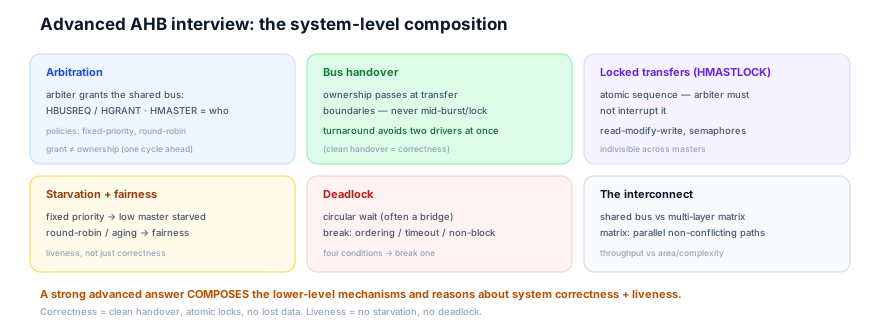
The advanced round is where the interview goes system-level — composing the mechanisms (transfers, wait states, bursts, responses) into multi-master behavior and reasoning about correctness and liveness. The questions group into six areas: arbitration (in a multi-master system the arbiter grants the shared bus with HBUSREQ/HGRANT, and HMASTER identifies who owns it; policies are fixed-priority and round-robin); bus handover (ownership passes only at transfer boundaries — never mid-burst or mid-locked-sequence — with a turnaround so two masters never drive at once); locked transfers (HMASTLOCK marks an atomic sequence the arbiter must not interrupt — for read-modify-write and semaphores); starvation and fairness (fixed priority can starve a low-priority master; round-robin or priority aging prevents it); deadlock (a circular wait — often at a bridge — broken by ordering, timeouts, or a non-blocking path); and the interconnect (a shared bus vs a multi-layer bus matrix that runs non-conflicting paths in parallel). The way to answer well at this level is to compose the lower-level mechanisms and reason about correctness AND liveness — separately. The single most valuable move is to separate correctness (clean handover, atomic locks, no lost data) from liveness (no starvation, no deadlock), because senior interviewers want to see you reason about both. This chapter gives model answers to the system-level questions you'll actually be asked.
1. What Is It?
Advanced AHB questions compose the mechanisms into multi-master, system-level behavior; answering them well means composing the lower-level mechanisms and reasoning about correctness and liveness separately. The areas:
- Arbitration — the arbiter grants the shared bus (
HBUSREQ/HGRANT);HMASTERidentifies who owns it; grant is one cycle ahead of ownership; policies: fixed-priority, round-robin. - Bus handover — ownership passes only at transfer boundaries (never mid-burst/mid-lock), with a turnaround so two masters never drive at once.
- Locked transfers + starvation —
HMASTLOCKmarks an atomic sequence; fixed priority can starve a low master, round-robin/aging prevents it. - Deadlock + interconnect — a circular wait (often a bridge) broken by ordering/timeout/non-blocking; a shared bus vs a multi-layer matrix (parallel paths).
So advanced AHB questions are the system-level check — interviewers use them to confirm you can reason about the whole bus, not just a single transfer. The signal they're looking for is whether you can compose the mechanisms and separate correctness from liveness — anyone can say "the arbiter decides who gets the bus"; a candidate who reasons at the system level says "the arbiter grants with HGRANT one cycle ahead of ownership, but ownership only transfers at a transfer boundary — never mid-burst — and HMASTER tracks the current owner; that handover discipline is what keeps the bus correct (no two masters driving, no lost data), while the policy — fixed-priority vs round-robin — is what determines liveness (whether a low-priority master can be starved)." The compose-and-separate is the differentiator: it shows you can reason about a multi-master system as a system, distinguishing will it behave correctly from will every master make progress. And the meta-signal: these are built from the lower mechanisms — handover is built of transfer boundaries and HREADY; deadlock involves wait and response interactions. So advanced AHB questions are the system-level composition, answered by composing the mechanisms and separating correctness from liveness. So they're the senior round.
2. Why Does It Exist?
The advanced round exists because, after the mechanisms, interviewers must probe system-level reasoning — whether you can compose the mechanisms into multi-master behavior and reason about correctness (will it behave right?) and liveness (will every master make progress?) — because that is the senior skill: reasoning about a bus as a system, not just a single transfer.
The compose the mechanisms is the root: a single transfer (beginner) and a single mechanism (intermediate) are not a multi-master system. Composing them — many masters sharing one bus, handing over ownership, contending — produces system-level behavior (arbitration, handover, deadlock). So the advanced round probes composition — can you reason about the whole? So it exists to test system-level reasoning. So composition comes after mechanisms. So the system follows the parts.
The correctness AND liveness is the senior distinction: a correct bus (no two drivers, atomic locks, no lost data) can still be broken if a master is starved or the system deadlocks — correctness and liveness are different properties. A senior engineer reasons about both: will it behave correctly AND will every master eventually make progress? So the advanced round tests the separation — do you distinguish correctness from liveness? So it exists to test the two-property reasoning. So separate them. So reason about both.
The the mechanisms are still the foundation is the meta-signal: every system-level behavior composes the lower mechanisms — handover is transfer boundaries + HREADY; deadlock involves waits and responses. So showing the composition signals you understand how the system emerges from the parts. So the advanced round builds on the mechanisms. So compose them. So the advanced round exists because: interviewers must probe system-level reasoning (composing the mechanisms — the root); the senior distinction is correctness AND liveness (two different properties — the skill); and the mechanisms are still the foundation the system composes (the meta-signal). So advanced AHB questions are the system-level check — passed by composing the mechanisms and separating correctness from liveness — demonstrating you can reason about the bus as a system. So this chapter prepares you for the system-level round. So compose the mechanisms, and reason about correctness and liveness.
3. Mental Model
Model answering an advanced question as an air-traffic controller being asked "how do you run a busy airport?" — not "what's a runway." A ramp agent says: "planes land and take off on the runway." A controller who reasons at the system level says: "I have one runway and many aircraft, so I sequence them — only one uses the runway at a time (that's correctness: no two aircraft on it at once, clean handoffs between approach and tower), and I order them by a policy. But a pure first-come policy can starve a small plane behind a stream of big arrivals, so I age the queue to guarantee everyone eventually lands (that's liveness). And I watch for gridlock — a plane stuck at a gate waiting for a tug while the tug waits for the gate to clear — a circular wait I break by imposing an order or a timeout." The interviewer instantly hears system-level reasoning — correctness AND liveness — not just runway facts.
A control tower where a candidate is asked "how do you run a busy airport?" — not "what's a runway" (a beginner question) but how the whole system works (an advanced one). A ramp agent who knows the parts gives the bare fact: "planes land and take off on the runway" ("the arbiter decides who gets the bus"). It's correct but not system-level — it names a part, doesn't reason about the system. A controller who reasons at the system level composes and separates: one runway, many aircraft → sequence them (one shared bus, many masters → arbitrate); only one on the runway at a time, clean handoffs approach-to-tower (correctness: one HMASTER, clean handover at boundaries, no two drivers); order by a policy but age the queue so everyone eventually lands (liveness: round-robin/aging so no master is starved); and watch for gridlock — the plane-tug circular wait — broken by ordering or a timeout (deadlock: the circular wait, broken by ordering/timeout). The interviewer instantly hears system-level reasoning — correctness AND liveness — not just runway facts. The controller composes the parts (runway, gates, tugs, queue) into a system and reasons about two properties: will it operate correctly (no collisions) AND will every aircraft eventually fly (no starvation, no gridlock). That compose-and-separate is the tell.
This captures advanced-question answering: "how do you run a busy airport?" = an advanced (system-level) AHB question; the ramp agent naming a part = a non-system-level answer; the controller composing runway + gates + queue = composing the mechanisms; only one on the runway, clean handoffs = correctness (one HMASTER, clean handover); aging the queue so everyone lands = liveness (no starvation); breaking the plane-tug gridlock = breaking a deadlock (circular wait); reasoning about both properties = separating correctness from liveness. Compose the mechanisms, reason about correctness AND liveness separately — and the interviewer hears a system-level engineer.
Take a bus handover and compose it from the mechanisms, the way a strong answer would:
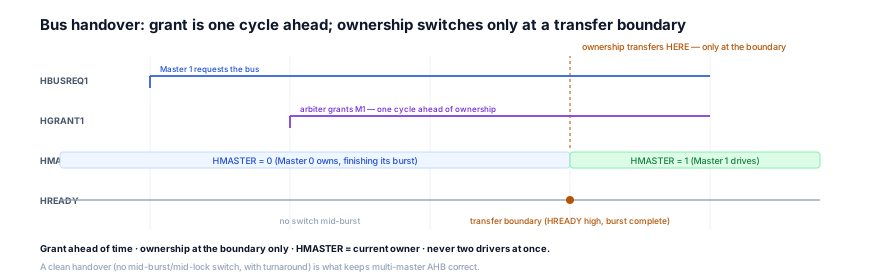
A bus handover: grant ahead, ownership at the boundary, never two drivers at once
5 cyclesThe model's lesson: compose the mechanisms, and reason about correctness AND liveness separately. In the figure, the handover isn't just "the arbiter switches" — it's grant one cycle ahead (composed from the address-phase-leads idea), ownership only at a boundary (HREADY high, burst complete — correctness), with the policy behind HGRANT determining liveness. That's the system, composed.
4. Real Hardware Perspective
The substance behind a strong advanced answer is the system-level detail from Modules 5–7 — so each question maps to a chapter, and the answer composes the mechanisms and separates the properties.
The arbitration and handover: compose it — a master requests with HBUSREQ; the arbiter (by policy) grants with HGRANT one cycle ahead; HMASTER tracks the owner; ownership transfers only at a transfer boundary (current transfer/burst/lock complete, HREADY high), with a turnaround so no two masters drive at once. So the answer composes the request → grant → boundary → handover flow (see Why Arbitration, HBUSREQ / HGRANT, HMASTER, Bus Ownership Handover). So it's the shared-bus discipline. So compose the handover.
The locked transfers and starvation: compose them — HMASTLOCK makes a sequence atomic: the arbiter holds the grant to the locking master until the locked sequence completes (for read-modify-write) — correctness (indivisibility). Starvation is a liveness failure: fixed priority can starve a low master; round-robin/aging prevents it. So the answer separates the atomicity (correctness) from the fairness (liveness) (see Locked Transfers (HLOCK), Fixed-Priority Arbitration, Round-Robin Arbitration, Starvation). So it's the two-property reasoning. So separate them.
The deadlock and the interconnect: compose them — deadlock is a circular wait (the four conditions), often at a bridge where two buses hold-and-wait on each other; broken by ordering, timeout, or a non-blocking path. The interconnect choice — shared bus (one transfer at a time) vs multi-layer matrix (parallel non-conflicting paths) — is a throughput vs area tradeoff. So the answer reasons about liveness (deadlock) and tradeoffs (interconnect) (see Bridge Deadlock, Shared Bus vs Interconnect, Bus Matrix Concept, Multiple Masters). So in practice, each advanced answer composes the mechanisms and separates correctness from liveness — the substance behind the composition. So in practice, know the system-level detail (Modules 5–7) and compose it. So that's the preparation.
5. System Architecture Perspective
At the interview level, the advanced round is the senior signal — passing it (composing the mechanisms, reasoning about correctness and liveness) is what distinguishes a senior engineer (reasons about the system) from a competent one (knows the mechanisms), and it mirrors the real job: designing and debugging a multi-master SoC bus where system-level correctness and liveness are what actually break.
The the senior signal: a competent engineer (intermediate round) knows the mechanisms; a senior engineer reasons about the system — will this multi-master design behave correctly, and will every master make progress? So the advanced round is the senior signal — passing it distinguishes the level. So at the interview level, the advanced round sets the level. So reason at the system level. So composition signals seniority.
The it mirrors the real job: in a real SoC, the single-transfer mechanics rarely break (they're well-understood); what breaks is the system — a starved master missing a deadline, a deadlock at a bridge, a handover bug corrupting data, an interconnect bottleneck. So the advanced round mirrors the real job — the system-level reasoning is what the role requires. So at the interview level, the advanced round tests the actual skill. So it's job-relevant. So reason about correctness and liveness. So at the interview level, the advanced round is the senior signal (passing it — composing the mechanisms, reasoning about correctness and liveness — distinguishes a senior engineer) and mirrors the real job (where system-level correctness and liveness are what actually break). So the advanced round is where you prove senior-level reasoning — making composing the mechanisms and separating correctness from liveness the keys to signaling seniority and demonstrating the real skill. So compose, separate, and reason about the system. So the advanced round is the senior bar.
6. Engineering Tradeoffs
Answering advanced questions embodies the compose-the-mechanisms, separate-correctness-from-liveness, system-level-reasoning approach.
- Compose vs name. Composing the answer from the lower mechanisms (handover = boundaries +
HREADY) signals system-level reasoning; naming a part is shallow. Compose it. - Correctness AND liveness vs one only. Reasoning about both (clean handover/atomic locks AND no starvation/deadlock) signals seniority; reasoning about one misses half. Separate and cover both.
- Tradeoff reasoning vs single answer. Discussing the tradeoff (fixed-priority vs round-robin; shared bus vs matrix — and when each fits) signals judgment; a single answer is junior. Reason about the tradeoff.
- Grant vs ownership precision. Being precise (grant one cycle ahead; ownership only at a boundary;
HMASTER= current owner) signals depth; conflating them is a trap. Be precise.
The throughline: advanced AHB questions compose the mechanisms into multi-master behavior — answer them by composing the lower-level mechanisms and reasoning about correctness AND liveness separately. The topics: arbitration (HBUSREQ/HGRANT/HMASTER, fixed-priority vs round-robin), bus handover (only at transfer boundaries, turnaround), locked transfers (HMASTLOCK, atomic), starvation/fairness (a liveness concern), deadlock (a circular wait, broken by ordering/timeout/non-blocking), and the interconnect (shared bus vs multi-layer matrix). The meta-signal: these compose the lower mechanisms — show the emergence. The common traps: confusing grant with ownership, thinking handover can happen mid-burst, conflating starvation with deadlock. The advanced round is the senior signal — passing it (composing, separating correctness from liveness) distinguishes a senior engineer and mirrors the real job.
7. Industry Example
A typical advanced round — the system-level questions and strong, composed answers.
After the mechanisms, the interviewer probes multi-master, system-level reasoning.
- "How does arbitration work in multi-master AHB?" Strong (composed): "Each master that wants the bus asserts
HBUSREQ. The arbiter, by its policy, decides who wins and assertsHGRANTto that master — one cycle ahead of ownership, like the address phase leads the data phase.HMASTERidentifies the current owner. Crucially, ownership only transfers at a transfer boundary — when the current transfer, or the whole burst or locked sequence, completes withHREADYhigh — never mid-burst. There's a turnaround so two masters never drive at once. The policy — fixed-priority or round-robin — is separate from this mechanism; it decides who gets granted, which determines fairness." - "Fixed-priority vs round-robin — when would you use each?" Strong (tradeoff + liveness): "Fixed-priority is simple and gives a guaranteed-fast path to the highest-priority master — good when one master is latency-critical, like a CPU or a real-time DMA. But it can starve a low-priority master: if a high-priority master keeps requesting, the low one is never granted — a liveness failure. Round-robin rotates fairly, guaranteeing every master eventual access — better for fairness, at the cost of the priority guarantee. Many systems use a hybrid: priority with aging, so a starved master's effective priority rises until it's served. The choice is a correctness-vs-liveness-vs-latency tradeoff."
- "What's a locked transfer for?" Strong: "
HMASTLOCKmarks a sequence as atomic — the arbiter must not grant the bus to another master until the locked sequence completes. It's for operations that must be indivisible, like a read-modify-write or a semaphore: you read a lock variable, modify it, and write it back, and no other master can sneak a transfer in between. Without it, two masters could both read the semaphore as free and both acquire it. The tradeoff: a long lock can worsen starvation, since it holds off everyone else — so locks should be short." - "Give me an example of a bus deadlock and how to break it." Strong (liveness): "A classic one is at a bridge between two buses. Master A on bus 1 holds bus 1 and needs to reach a slave on bus 2 through the bridge; meanwhile master B on bus 2 holds bus 2 and needs to reach bus 1. Each holds the bus it's on and waits for the other — a circular wait, the four deadlock conditions met. You break it by removing one condition: impose a global ordering on bus acquisition, add a timeout that forces a master to back off and retry, or make the bridge non-blocking with buffering so a transfer doesn't have to hold its source bus while waiting. The point is to break the circular wait."
- "Shared bus vs bus matrix?" Strong (tradeoff): "A shared bus carries one transfer at a time — simple, low area, but a bottleneck when multiple masters are busy. A multi-layer bus matrix gives each master its own path into the interconnect, so non-conflicting master-slave pairs transfer in parallel — much higher throughput, but more area and complexity, and you still need arbitration where paths do conflict, at a shared slave. The choice is throughput vs area: a matrix where bandwidth matters, a shared bus where simplicity and area dominate."
- The meta-signal. Across the answers, you composed the mechanisms and separated correctness from liveness — handover correctness vs starvation/deadlock liveness, with tradeoff reasoning. The interviewer sees senior-level system reasoning.
The example shows the advanced round and strong, composed answers: each composed from the mechanisms, separating correctness from liveness, reasoning about tradeoffs, avoiding the traps (grant ≠ ownership, no mid-burst handover, starvation ≠ deadlock). This signals seniority and mirrors the real job. This is how you show system-level reasoning.
8. Common Mistakes
9. Interview Insight
The advanced round is the senior signal — composing the mechanisms, separating correctness from liveness, and reasoning about tradeoffs are the signals.
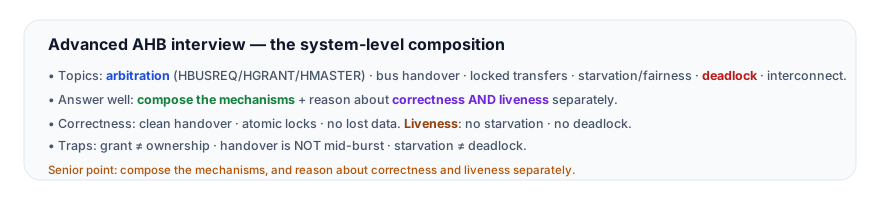
The way to carry the advanced round: compose each answer from the lower mechanisms, separate correctness from liveness, and reason about the tradeoffs. The interviewer is checking whether you can reason about the bus as a system — will this multi-master design behave correctly (clean handover, atomic locks, no lost data) AND will every master make progress (no starvation, no deadlock)? The most valuable move is to make the correctness/liveness distinction explicit — name which property each mechanism protects (handover → correctness; round-robin → liveness) — and to reason about the tradeoffs (fixed-priority vs round-robin; shared bus vs matrix; lock length vs fairness). Get the precision right (grant ≠ ownership; no mid-burst handover; starvation ≠ deadlock), and you'll pass the senior round and signal the system-level reasoning the role requires.
10. Practice Challenge
Practice the advanced round.
- Arbitration. Explain
HBUSREQ/HGRANT/HMASTERand the grant vs ownership distinction (grant one cycle ahead; ownership at the boundary). - Policy tradeoff. Compare fixed-priority and round-robin — the starvation risk and when each fits (and aging hybrids).
- Locked transfers. Explain
HMASTLOCK— the atomicity (correctness) and the fairness cost (liveness). - Deadlock vs starvation. Give a bridge deadlock (circular wait), how to break it, and how it differs from starvation.
- Interconnect. Compare a shared bus and a multi-layer matrix — the throughput vs area tradeoff and when each fits.
11. Key Takeaways
- Advanced AHB questions compose the mechanisms into multi-master behavior — arbitration, handover, locked transfers, starvation/fairness, deadlock, the interconnect.
- Answer by composing the lower-level mechanisms — handover = transfer boundaries +
HREADY; deadlock = wait/response interactions. Show the emergence from the parts. - Separate correctness from liveness — correctness: clean handover (no two drivers, no lost data), atomic locks; liveness: no starvation, no deadlock. Senior reasoning covers both.
- Be precise on the traps — grant ≠ ownership (grant one cycle ahead; ownership at a boundary); no mid-burst handover; starvation ≠ deadlock (policy problem vs circular wait).
- Reason about tradeoffs — fixed-priority vs round-robin (latency vs fairness, with aging hybrids); shared bus vs matrix (throughput vs area); lock length vs fairness.
- The advanced round is the senior signal — it mirrors the real job, where system-level correctness and liveness are what actually break. Compose and separate to signal seniority.
12. What Comes Next
You can now reason at the system level. The next chapters cover the specialized interview rounds:
- Waveform Interpretation (next) — reading AHB timing from a waveform (the skill that underlies many of these questions).
- Design Questions, Verification Questions, and the rest — RTL prompts, testbench strategy, and the tricky misconceptions.
To revisit the system-level topics these questions cover, see Why Arbitration, HBUSREQ / HGRANT, Bus Ownership Handover, Starvation, Bridge Deadlock, and Shared Bus vs Interconnect.