AMBA AHB · Module 19
Tricky Misconceptions
The myths candidates repeat about AHB timing — and how to correct them crisply. The root myth: 'address and data are in the same cycle.' The truth: AHB is pipelined, the address phase is one cycle ahead of the data phase — and almost every other myth traces back to not internalizing this. The others: the master does NOT drive HREADY (the addressed slave does, and it's shared); a burst is NOT repeated singles (one address phase + beats with a defined pattern); ERROR is NOT one cycle (two cycles, because the next transfer is already issued); a granted master does NOT own the bus immediately (grant is one cycle ahead, ownership at a boundary); HRDATA is NOT valid whenever you see it (only when HREADY is high, and it belongs to the address one cycle earlier). Correct a myth with the true rule + the WHY — which almost always returns to the pipeline. The #1 habit: anchor every answer on the pipeline.
This final chapter is the air-clearer — the myths candidates repeat about AHB timing, and how to correct them crisply. They matter because repeating a myth in an interview instantly signals a shaky foundation — and because recognizing and correcting one signals the opposite: real understanding. Here's the punchline: almost every AHB misconception traces back to one thing — not internalizing the pipeline (the address phase is one cycle ahead of the data phase). The root myth is "address and data are in the same cycle" — and from that one wrong instinct flow the others: "the master drives HREADY", "a burst is repeated singles", "ERROR is one cycle", "a granted master owns the bus immediately", "HRDATA is valid whenever you see it." The way to correct a myth is to state the true rule crisply and give the why — and the why almost always returns to the pipeline. The single most valuable habit is to anchor every answer on the pipeline: the address phase is one cycle ahead of the data phase. Internalize that, and the myths dissolve. This chapter lists the myths, corrects each, and shows why the pipeline is the cure.
1. What Is It?
Misconception questions test whether you repeat the myths or correct them; the cure is to anchor on the pipeline. The common myths and their corrections:
- The root (pipeline) myth — "address and data are in the same cycle." Truth: AHB is pipelined — the address phase is one cycle ahead of the data phase. Almost every other myth traces to this.
- HREADY + burst myths — "the master drives
HREADY" (no — the addressed slave does, and it's shared); "a burst is repeated singles" (no — one address phase + beats with a defined pattern). - Response + arbitration myths — "
ERRORis one cycle" (no — two cycles, because the next transfer is already issued); "granted = owns the bus now" (no — grant is one cycle ahead; ownership at a boundary). - Data-validity myth — "
HRDATAis valid whenever I see it" (no — only whenHREADYis high, and it belongs to the address one cycle earlier).
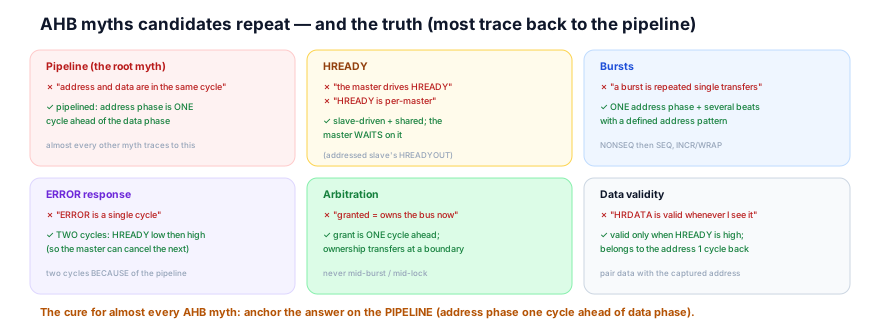
So misconception questions are the foundation check — interviewers use a myth (or a leading question) to see whether you repeat it or correct it. The signal they're looking for is whether you anchor on the pipeline — anyone can recite signal names; a candidate who understands catches the myth: "Actually, that's a common misconception — AHB is pipelined, so the address and data are not in the same cycle; the data comes one cycle after the address. That's why [the rest follows]." The catch-and-correct, anchored-on-the-pipeline is the differentiator: it shows you don't just know the facts — you understand the structure well enough to spot what's wrong. And the meta-signal: every correction returns to the pipeline — the one fact that, internalized, prevents the myths. So misconception questions are the foundation check, cured by the pipeline. So they test whether you truly understand.
2. Why Does It Exist?
Misconception questions exist because the myths are common (many candidates repeat them) — so they're a cheap, reliable filter (a myth instantly reveals a shaky foundation) — and because the corrections all share one root (the pipeline), correcting them well demonstrates you've internalized the one fact that matters most.
The the myths are common is the root: these myths are widespread — candidates repeat them constantly (the non-pipelined instinct is natural). So a myth is a common failure mode. So an interviewer can use one as a cheap filter. So misconception questions exist because the myths are common. So they're a reliable filter. So know the myths.
The a myth reveals the foundation is the test: repeating a myth reveals you don't understand the structure (you memorized facts without the model); correcting it reveals you do. So a myth is a high-signal probe — it separates understanding from memorization cheaply. So misconception questions exist because they reveal the foundation. So they're high-signal. So correct the myth.
The the corrections share one root is the meta-insight: almost every correction returns to the pipeline. So correcting the myths well demonstrates you've internalized the pipeline — the one fact the whole protocol builds on. So misconception questions exist because the root (the pipeline) is the thing to test. So the pipeline is the cure. So anchor on it. So misconception questions exist because: the myths are common (a widespread failure mode — the root); a myth reveals the foundation (a cheap, high-signal filter — the test); and the corrections share one root, the pipeline (correcting them demonstrates the key understanding — the meta-insight). So misconception questions are the foundation check — passed by catching and correcting the myth and anchoring on the pipeline — demonstrating you've internalized the structure. So this chapter prepares you to correct the myths. So anchor on the pipeline, and give the why.
3. Mental Model
Model correcting a myth as a physics tutor hearing a student say "heavier things fall faster." A weak response is to argue the specific case. A great tutor goes to the root: "That's a really common intuition — but actually, ignoring air, everything falls at the same rate. The misconception comes from confusing weight with air resistance. Once you separate those two, the feather-and-hammer-on-the-moon makes sense, and so does the coin-and-feather in a vacuum tube, and so does terminal velocity." One root correction — separating weight from air resistance — dissolves a whole family of related confusions. The tutor doesn't memorize a rebuttal per myth; they fix the underlying model, and the myths fall away together.
A physics classroom where a student states a myth: "heavier things fall faster" (an AHB myth — "address and data are in the same cycle"). A weak tutor argues the specific case ("well, in this one example…") — patching one myth without fixing the cause. A great tutor goes to the root: "common intuition — but actually, ignoring air, everything falls at the same rate. The misconception comes from confusing weight with air resistance" ("common misconception — but AHB is pipelined, the address phase is one cycle ahead of the data phase; the myth comes from the non-pipelined instinct"). And once you fix the root, a whole family of confusions dissolves: the feather-and-hammer on the moon, the coin-and-feather in a vacuum, terminal velocity (→ the two-cycle ERROR, the data-validity rule, grant ≠ ownership — all explained by the pipeline). The tutor doesn't memorize a rebuttal per myth — they fix the underlying model (the pipeline), and the myths fall away together. The root correction is more powerful than any per-myth patch, because it addresses the cause.
This captures correcting AHB myths: the student's "heavier falls faster" = the root AHB myth (address + data same cycle); the weak tutor arguing one case = patching one myth without the root; the great tutor's "confusing weight with air resistance" = "the non-pipelined instinct vs the pipeline"; the family of confusions dissolving = the derived myths (two-cycle ERROR, data validity, grant ≠ ownership) all resolved by the pipeline; fixing the underlying model = anchoring on the pipeline. Go to the root (the pipeline), state the true rule, give the why — and a whole family of myths dissolves at once.
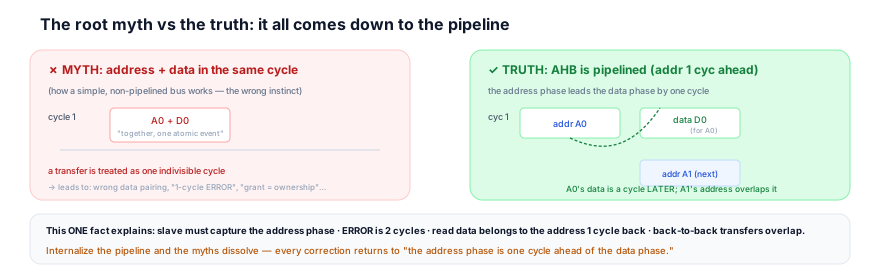
Here is the root myth and the pipeline truth side by side:
The root myth vs the truth: address and data are a cycle apart (pipelined)
4 cyclesThe model's lesson: go to the root (the pipeline), state the true rule, give the why — and a family of myths dissolves at once. In the figure, the data for A0 arrives one cycle after its address — while A1's address phase overlaps it. That one picture refutes the root myth and explains the derived ones.
4. Real Hardware Perspective
The substance behind each correction is the protocol structure from across the curriculum — so each myth maps to the chapter that refutes it, and the correction applies that structure.
The the pipeline and HREADY myths: correct them — AHB is pipelined (address phase ahead of data phase); HREADY is slave-driven and shared (the master waits). So the correction applies the pipeline and HREADY structure (see Pipelined Operation, What HREADY Means, HRDATA Muxing). So they're the root corrections. So anchor on the pipeline, and on slave-driven HREADY.
The the burst, response, and arbitration myths: correct them — a burst is one address phase + a pattern (not singles); ERROR is two cycles (because of the pipeline); grant is a cycle ahead of ownership (boundary handover); HRDATA is valid only when HREADY is high and pairs with the captured address. So the correction applies the burst, response, arbitration, and data-validity structure (see Single vs Burst Transfer, Two-Cycle ERROR Response, Bus Ownership Handover, AHB vs APB vs AXI). So in practice, correcting a myth is applying the true protocol structure — and almost every correction returns to the pipeline. So in practice, know the structure and anchor on the pipeline. So that's the preparation.
5. System Architecture Perspective
At the interview level, the misconception check is the cheapest, highest-signal probe — passing it (catching and correcting the myth, anchored on the pipeline) proves the depth the whole curriculum built, and it mirrors the real value of deep understanding: spotting the subtle error (in a review, a waveform, a spec) that a surface knower misses.
The the cheapest, highest-signal probe: a single myth (or a leading question) cheaply reveals the foundation — repeat it (shallow) or correct it (deep). So the misconception check is the highest-signal-per-question probe. So at the interview level, it's a fast filter. So don't repeat the myth. So it's high-signal.
The mirrors the value of deep understanding: in the real job, the value of deep understanding is spotting the subtle error — the wrong assumption in a design review, the misread in a waveform, the bug in a spec. So the misconception check mirrors that value — can you spot what's wrong? So at the interview level, correcting a myth signals the real value you'd add. So spot the error. So it's job-relevant. So at the interview level, the misconception check is the cheapest, highest-signal probe (catching the myth proves depth) and mirrors the value of deep understanding (spotting the subtle error). So the misconception check is where your depth shows — making catching and correcting the myth and anchoring on the pipeline the keys to proving the understanding the whole curriculum built. So catch the myth, correct it, anchor on the pipeline. So the misconception check is where depth shows.
6. Engineering Tradeoffs
Correcting a myth embodies the catch-it, state-the-true-rule, give-the-why-from-the-pipeline approach.
- Catch and correct vs repeat. Catching the myth (and correcting it) signals depth; repeating it signals a shaky foundation. Catch it.
- The why vs the bare correction. Giving the why (the pipeline) signals understanding; the bare correction could be memorized. Give the why.
- Root correction vs per-myth patch. Anchoring on the pipeline (the root) dissolves a family of myths; a per-myth patch is fragile. Go to the root.
- Gracious vs combative. Correcting graciously ("that's a common misconception, but actually…") reads well; combative correction reads poorly. Be gracious.
The throughline: misconception questions test whether you repeat a myth or correct it — and the root myth is "address and data are in the same cycle" (truth: AHB is pipelined, the address phase one cycle ahead of the data phase). The derived myths: master drives HREADY (no — slave-driven, shared), burst = repeated singles (no — one address phase + pattern), ERROR is one cycle (no — two, because of the pipeline), grant = ownership (no — grant ahead, ownership at a boundary), HRDATA always valid (no — only at HREADY-high, paired with the captured address). The correction technique: true rule + the why (which returns to the pipeline). The meta-signal: anchor every answer on the pipeline. The misconception check is the cheapest, highest-signal probe (proves depth) and mirrors the value of deep understanding (spotting the subtle error).
7. Industry Example
A typical misconception probe — the interviewer states a myth (or asks a leading question) and watches your response.
The interviewer says, casually, "so since the master puts the address and data out together each cycle…" — a planted myth.
- You catch it. "Actually, let me correct that gently — that's a common misconception. AHB is pipelined: the master puts out the address in the address phase, and the data comes one cycle later, in the data phase. They're not together." (Caught and corrected.)
- You give the why. "The reason is throughput — by overlapping the next transfer's address phase with the current transfer's data phase, the bus pipelines transfers and gets close to one per cycle. The address path and data path work on different transfers at the same time, a cycle apart." (The why, from the pipeline.)
- You connect the consequences. "This pipeline is also why a lot of things are the way they are — a slave has to capture the address phase to use it with the next cycle's data; the
ERRORresponse is two cycles so the master can cancel the already-issued next transfer; and on a waveform, read data belongs to the address one cycle earlier, not the live one." (Showing the root dissolves the family.) - The interviewer plants another. "And the
ERRORresponse is just a single cycle, right?" You catch it: "Two cycles, actually —HREADYlow then high — and again it's because of the pipeline: the next transfer is already in flight, so the two cycles give the master a chance to cancel it." - You stay gracious. Throughout, you correct without being combative — "common misconception", "let me clarify" — so it reads as helpful expertise, not one-upmanship.
- The meta-signal. You caught each planted myth, corrected it crisply, gave the why from the pipeline, and connected the consequences. The interviewer sees the depth — you understand the structure, not just the facts.
The example shows the misconception probe and a strong response: caught the myth, corrected crisply, gave the why (pipeline), connected the family, stayed gracious. This proves depth and mirrors the real value (spotting the subtle error). This is how you handle a planted myth.
8. Common Mistakes
9. Interview Insight
The misconception check is the cheapest, highest-signal probe — catching the myth, correcting it crisply, and giving the why from the pipeline are the signals.
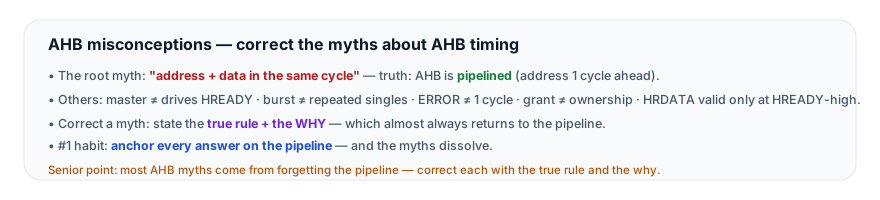
The way to carry a misconception probe: catch the myth, correct it crisply, and give the why from the pipeline. The interviewer is checking whether your foundation is deep (you spot and fix the error) or shallow (you repeat it). The most valuable habit is to anchor every answer on the pipeline — the address phase is one cycle ahead of the data phase — because internalizing that one fact is what prevents the myths in the first place (you can't believe "address and data are in the same cycle" if you've internalized the pipeline). Correct graciously (it reads as expertise), give the why (it proves understanding), and connect the consequences (it shows the root dissolves the family) — and you'll pass the highest-signal check and demonstrate the depth the whole curriculum built.
10. Practice Challenge
Practice correcting the myths.
- The root. Correct "address and data are in the same cycle" — the true rule (pipelined) and the why (throughput).
- HREADY. Correct "the master drives
HREADY" — slave-driven and shared; the master waits. - Two-cycle ERROR. Correct "
ERRORis one cycle" — two cycles, and why (the pipeline — to cancel the next transfer). - Grant vs ownership. Correct "a granted master owns the bus now" — grant one cycle ahead; ownership at a boundary.
- The root cure. Explain why almost every AHB myth traces back to the pipeline — and how anchoring on it dissolves the family.
11. Key Takeaways
- Misconception questions test whether you repeat a myth or correct it — a cheap, high-signal probe of your foundation.
- The root myth is "address and data are in the same cycle" — truth: AHB is pipelined, the address phase is one cycle ahead of the data phase. Almost every other myth traces back to this.
- Know the derived myths and their corrections — master drives
HREADY(slave-driven, shared), burst = repeated singles (one address phase + pattern),ERRORis one cycle (two, because of the pipeline), grant = ownership (grant ahead, ownership at a boundary),HRDATAalways valid (only atHREADY-high, paired with the captured address). - Correct with the true rule + the why — the why almost always returns to the pipeline; the bare correction could be memorized.
- Anchor every answer on the pipeline (the #1 habit) — internalizing that one fact is what prevents the myths; the root correction dissolves a family at once.
- Correct graciously — "common misconception, but actually…" reads as expertise. The misconception check mirrors the real value of deep understanding: spotting the subtle error.
12. What Comes Next
This completes the AHB Interview Mastery module — you can now handle the fundamentals, the mechanisms, the system-level questions, waveform reading, design and verification prompts, bridge and arbitration prompts, and the tricky misconceptions. The throughline across all of them is the pipeline — internalize it, and AHB makes sense.
To revisit the structure these corrections apply, see Pipelined Operation, What HREADY Means, Single vs Burst Transfer, Two-Cycle ERROR Response, and Bus Ownership Handover. And to put it all into practice, work back through the earlier interview chapters — Beginner, Intermediate, and Advanced — with the pipeline firmly in mind.