AMBA AHB · Module 19
Intermediate Interview Questions
The mechanism-level AHB interview questions that build on the fundamentals — wait states (the slave drives HREADY low to stretch the data phase while the master holds the address stable), bursts in depth (HBURST types, NONSEQ/SEQ beats, wrapping for cache-line fills), HTRANS (IDLE/BUSY/NONSEQ/SEQ), the pipeline effects (the slave captures address-phase control and uses it a cycle later), the two-cycle ERROR response (HREADY low then high so the pipelined master can cancel the next transfer), and HSIZE/alignment. Answer by tracing the mechanism through BOTH phases and connecting it to the pipeline. With model answers to the questions you'll actually be asked.
After the fundamentals, the interview moves to mechanisms — the questions that probe how AHB actually works once you're past "what is it." They group into six areas: wait states (the slave drives HREADY low to stretch the data phase while the master holds the address and control stable — how a fast bus serves slow slaves); bursts in depth (the HBURST types — SINGLE/INCR/WRAP4/INCR4/…; the first beat NONSEQ, the rest SEQ; wrapping bursts that wrap the address within an aligned region for cache-line fills); HTRANS (IDLE/BUSY/NONSEQ/SEQ — the transfer-type encoding); the pipeline effects (because the address phase is one cycle ahead, the slave must capture the address-phase control and use it a cycle later in the data phase); the two-cycle ERROR response (HREADY low then high so the pipelined master can cancel the already-issued next transfer); and HSIZE/alignment (the transfer size must be consistent with the address and burst). The way to answer well at this level is to trace the mechanism through BOTH phases — connect it back to the pipeline and explain the why. The single most valuable move is to trace the mechanism through the pipeline, because that shows you understand the pipeline, not just the signal names. This chapter gives model answers to the mechanism questions you'll actually be asked.
1. What Is It?
Intermediate AHB questions probe the mechanisms that build on the fundamentals; answering them well means tracing the mechanism through both phases and connecting it to the pipeline. The areas:
- Wait states — the slave drives
HREADYlow to stretch the data phase; the master holds the address/control stable and waits. How a fast bus serves slow slaves. - Bursts in depth —
HBURSTtypes; first beatNONSEQ, restSEQ; wrapping bursts wrap within an aligned region (cache-line fills). - HTRANS —
IDLE(no transfer),BUSY(pause mid-burst),NONSEQ(start),SEQ(continue) — decoded in the address phase, acted on a cycle later. - Pipeline effects, two-cycle ERROR, HSIZE — the slave captures address-phase control for the data phase;
ERRORis two cycles (low then high) so the master can cancel the next transfer; size must match the address/burst.
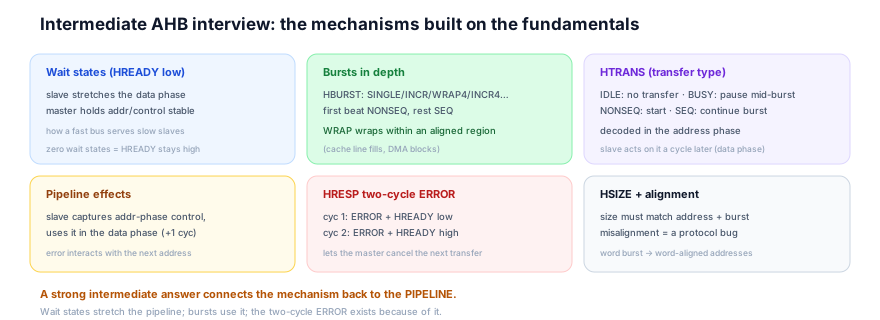
So intermediate AHB questions are the mechanism check — interviewers use them to confirm you understand how the protocol works (not just what it is). The signal they're looking for is whether you can trace a mechanism through the pipeline — anyone can say "a wait state is when the slave isn't ready"; a candidate who understands says "the slave drives HREADY low, which stretches the data phase of the current transfer; the master holds the address and control constant — because the pipeline means the next address is already being presented — and waits until HREADY goes high." The trace-through-both-phases is the differentiator: it shows you understand the pipelined nature, the capture discipline, and the master-slave interaction — not just the signal. And the meta-signal is the same as the beginner round, deepened: connect the mechanism back to the pipeline — wait states stretch it, bursts use it, the two-cycle ERROR exists because of it. So intermediate AHB questions are the mechanisms, answered by tracing through both phases. So they're the depth that builds on the fundamentals.
2. Why Does It Exist?
The intermediate round exists because, after the baseline, interviewers must probe how AHB works (the mechanisms) to distinguish a candidate who grasps the protocol's operation from one who only knows the terms — and the test is whether you can trace a mechanism through both phases and connect it to the pipeline, because that's what demonstrates real working knowledge.
The probe the mechanisms is the root: knowing what HREADY is (beginner) is different from knowing how a wait state works (the slave stretches the data phase, the master holds the address, the pipeline keeps the next address presented). So the intermediate round probes the mechanisms — how the protocol operates. So it exists to test working knowledge. So mechanisms come after fundamentals. So depth follows baseline.
The trace through both phases is the test: AHB is pipelined, so every mechanism spans the address phase and the data phase. A candidate who understands can trace a mechanism through both — what's presented in the address phase, what happens a cycle later in the data phase. So the intermediate round tests the trace — can you follow the mechanism through the pipeline? So it exists to test the two-phase trace. So tracing is the skill. So follow both phases.
The the pipeline is still the foundation is the deepened meta-signal: every intermediate mechanism connects to the pipeline — wait states stretch it, bursts use it, the two-cycle ERROR exists because of it. So connecting the mechanism to the pipeline signals you understand the foundation at the mechanism level. So the intermediate round deepens the pipeline signal. So the pipeline carries forward. So connect to the pipeline. So the intermediate round exists because: interviewers must probe the mechanisms (how AHB works — beyond the terms — the root); the test is tracing a mechanism through both phases (following it through the pipeline — the skill); and the pipeline is still the foundation every mechanism connects to (the deepened meta-signal). So intermediate AHB questions are the mechanism check — passed by tracing the mechanism through both phases and connecting it to the pipeline — demonstrating you understand how AHB works. So this chapter prepares you for the mechanisms. So trace through both phases, and connect to the pipeline.
3. Mental Model
Model answering an intermediate question as a mechanic being asked "how does the clutch work?" — not "what's a clutch." A parts-counter clerk says: "it's the pedal that lets you change gears." A mechanic who understands traces it: "you press the pedal, which moves the release bearing, which pushes the pressure plate's fingers, which lifts the clamp off the friction disc — so the engine spins free of the gearbox while you change gear (the input side) — then you release the pedal and the spring re-clamps the disc, re-coupling engine to gearbox (the output side). It works in two coordinated stages — disengage, then re-engage — and the timing between them is what makes a smooth shift." The interviewer instantly knows which one understands the mechanism vs knows the name. Tracing it through both stages is the tell.
A garage where a candidate is asked "how does the clutch work?" — not "what's a clutch" (a beginner question) but how it operates (an intermediate one). A parts-counter clerk who knows the name gives the bare function: "it's the pedal that lets you change gears" ("a wait state is when the slave isn't ready"). It's correct but shallow — it names the part, doesn't trace the mechanism. A mechanic who understands traces it through both stages: press the pedal → release bearing → pressure plate fingers → lifts the clamp off the disc → engine spins free (the input/disengage stage — the slave drives HREADY low → the data phase stretches → the current transfer holds); release the pedal → spring re-clamps → re-couples engine to gearbox (the output/re-engage stage — HREADY goes high → the data completes → the bus advances); and the timing between them is what makes the shift smooth (the master holds the address stable through the wait because the pipeline keeps the next address presented). The interviewer instantly knows: the clerk knows the name; the mechanic understands the mechanism. Tracing it through both stages — and explaining the coordination (the timing) — is the tell. And the meta-signal: a mechanic who keeps relating every mechanism back to the fundamental (engine-to-gearbox coupling) signals system understanding — like a candidate who connects every mechanism back to the pipeline.
This captures intermediate-question answering: "how does the clutch work?" = an intermediate (mechanism) AHB question; the clerk naming the part = a shallow, name-only answer; the mechanic tracing both stages = tracing the mechanism through both phases; the disengage stage = the address phase / the wait beginning; the re-engage stage = the data phase / the wait ending; the timing/coordination = the master-slave interaction across the pipeline; the interviewer knowing who understands = distinguishing mechanism-understanding from name-knowledge; relating every mechanism to the coupling = connecting every mechanism to the pipeline. Trace the mechanism through both phases, explain the coordination, connect it to the pipeline — and the interviewer knows you understand how AHB works.
Take a wait state and trace it through both phases, the way a strong answer would:
A wait state traced through both phases (slave holds HREADY low; master holds the address)
4 cyclesThe model's lesson: trace the mechanism through both phases, explain the coordination, and connect it to the pipeline. In the figure, the wait state isn't just "HREADY low" — it's the slave stretching the data phase while the master holds the address stable (the coordination), made necessary by the pipeline (the next address is already being presented). That's the mechanism, traced.
4. Real Hardware Perspective
The substance behind a strong intermediate answer is the mechanism detail from Modules 2–4 — so each question maps to a chapter, and the answer traces that mechanism through both phases.
The wait states: trace it — address phase: the master presents HADDR/control; data phase: the slave drives HREADY low to insert wait states, stretching the data phase; the master holds the address and control stable and waits; when the slave is ready, HREADY goes high and the data completes. So the answer traces the wait state through both phases and the master-slave coordination (see Slave Wait States, Master Behavior During Wait). So it's the pacing mechanism. So trace the hold.
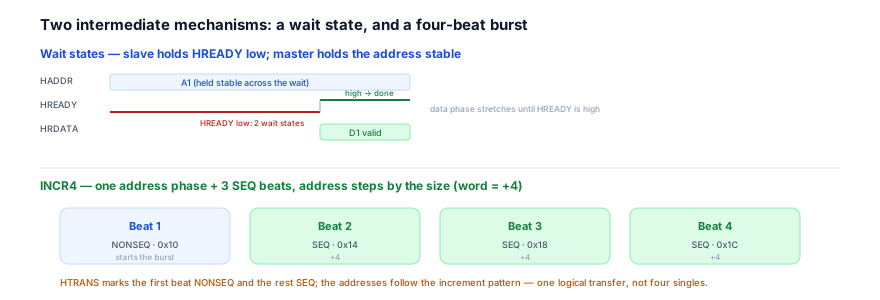
The bursts and HTRANS: trace a burst — first beat: HTRANS=NONSEQ, the master presents the start address and the HBURST type/length; subsequent beats: HTRANS=SEQ, the address follows the pattern (increment by the size, or wrap within the aligned region); BUSY lets the master pause mid-burst while staying committed. So the answer traces the burst through its beats and the HTRANS encoding (see HBURST, HTRANS, INCR Bursts, WRAP4 / INCR4, BUSY Transfer). So it's the structured transfer. So trace the beats.
The the two-cycle ERROR and HSIZE: trace the ERROR — cycle 1: the slave drives HRESP=ERROR with HREADY low (a warning — and because the bus is pipelined, the master has already issued the next address); cycle 2: HRESP=ERROR with HREADY high (completing the errored transfer), giving the master a cycle to cancel the next transfer; HSIZE must match the address/burst alignment. So the answer traces the two-cycle response and connects it to the pipeline (see HSIZE and ERROR Response). So in practice, each intermediate answer traces the mechanism through both phases and connects it to the pipeline — the substance behind the trace. So in practice, know the mechanisms (Modules 2–4) and trace them. So that's the preparation.
5. System Architecture Perspective
At the interview level, the intermediate round is where the depth lives — passing it (tracing mechanisms through the pipeline) is what signals you can work with AHB (not just describe it), and it sets up the advanced round (arbitration, the interconnect, deadlock), which composes these mechanisms into system-level behavior.
The where the depth lives: the intermediate round is where the interviewer learns whether you can actually work with AHB — debug a wait-state issue, understand a burst on a waveform, reason about an error. A strong showing signals working competence; a weak showing caps the assessment at "knows the terms." So at the interview level, the intermediate round is where the depth lives. So pass it. So mechanisms signal competence.
The it sets up the advanced round: the advanced round (arbitration, the interconnect, deadlock) composes the intermediate mechanisms — arbitration manages who drives transfers (built of address/data phases and HREADY); deadlock involves the two-cycle error and wait interactions. So passing the intermediate round (the mechanisms) sets up the advanced round (the composition). So at the interview level, the mechanisms are the building blocks of the advanced discussion. So it sets up the depth. So master the mechanisms first. So at the interview level, the intermediate round is where the depth lives (passing it — tracing mechanisms — signals working competence) and sets up the advanced round (which composes these mechanisms into system-level behavior). So the intermediate round is where you prove you can work with AHB — making tracing mechanisms through the pipeline the key to signaling competence and unlocking the advanced discussion. So trace the mechanisms, prove competence, and earn the system-level questions. So the intermediate round is the depth.
6. Engineering Tradeoffs
Answering intermediate questions embodies the trace-through-both-phases, connect-to-the-pipeline, mechanism-over-name approach.
- Trace through both phases vs name the signal. Tracing (address phase → data phase, the coordination) signals understanding; naming the signal is shallow. Trace it — the coordination across phases is the differentiator.
- Connect to the pipeline vs isolated fact. Connecting the mechanism to the pipeline (waits stretch it, bursts use it, ERROR is two cycles because of it) signals foundation; an isolated fact misses it. Connect it.
- The why vs the what. Why the mechanism works that way (e.g. why ERROR is two cycles) signals depth; the what alone is intermediate-shallow. Give the why.
- Concrete trace vs vague gesture. A concrete trace (specific addresses,
HTRANSvalues, cycle-by-cycle) is strong; a vague gesture is weak. Be concrete — walk the cycles.
The throughline: intermediate AHB questions probe the mechanisms — answer them by tracing the mechanism through both phases (address phase: what's presented; data phase: what happens a cycle later) and connecting it to the pipeline. The topics: wait states (slave drives HREADY low, stretches the data phase, master holds the address), bursts in depth (HBURST types, NONSEQ/SEQ, wrapping), HTRANS (IDLE/BUSY/NONSEQ/SEQ), the pipeline effects (capture address-phase control for the data phase), the two-cycle ERROR (low then high — because of the pipeline), and HSIZE/alignment. The meta-signal: the pipeline underlies all of these — connect each mechanism back to it. The common traps: forgetting the master holds the address during a wait, thinking a burst is repeated singles, missing why ERROR is two cycles. The intermediate round is where the depth lives — passing it (tracing mechanisms) signals you can work with AHB and sets up the advanced round.
7. Industry Example
A typical intermediate round — the mechanism questions and strong, traced answers.
After the fundamentals, the interviewer probes how the protocol works.
- "Walk me through a wait state." Strong (traced): "In the address phase, the master presents the address and control. In the data phase, the slave drives
HREADYlow — it's not ready, so it inserts wait states, stretching the data phase. The master holds the address and all control signals stable and waits — it can't advance the pipeline because the current transfer is still in its data phase. When the slave is ready, it drivesHREADYhigh, the data completes — for a read,HRDATAis valid that cycle — and the bus advances. So a slow slave can take as many cycles as it needs, and the master just waits." (Traced through both phases, with the hold.) - "Describe a four-beat incrementing burst." Strong: "It's an
INCR4. The first beat hasHTRANS=NONSEQat the start address — say0x10— withHBURST=INCR4andHSIZE=word. The next three beats haveHTRANS=SEQ, with addresses0x14,0x18,0x1C— each stepping up by 4, the word size. One address phase establishes the burst; the rest follow the increment pattern. It's one logical transfer, often a cache-line fill or DMA block, not four separate singles." - "What's the difference between INCR and WRAP?" Strong: "Both step the address by the size each beat, but
WRAPwraps within an aligned region the size of the burst. AWRAP4word burst starting at0x14goes0x14,0x18,0x1C, then wraps to0x10— staying within the aligned 16-byte region. This is for cache-line fills where you fetch the critical word first and wrap around to fill the rest of the line." - "Why is the ERROR response two cycles?" Strong (the key why): "Because the bus is pipelined. The slave signals
ERRORover two cycles — firstHRESP=ERRORwithHREADYlow, thenHRESP=ERRORwithHREADYhigh. By the time the slave signals the error, the master has already issued the next transfer's address phase — that's the pipeline. The two-cycle sequence gives the master a cycle to see the error coming and cancel that next transfer cleanly, instead of it completing erroneously." - "What does HTRANS BUSY mean?" Strong: "
BUSYlets the master pause mid-burst — it's committed to the burst but isn't ready with the next beat yet, maybe it's waiting on internal data. The address reflects the next beat, butBUSYtells the slave not to treat this as a real transfer — to wait for the master to resume withSEQ. It keeps the burst alive without forcing the master to produce a beat every cycle." - The meta-signal. Across the answers, you traced each mechanism through both phases and connected it to the pipeline — especially the two-cycle ERROR. The interviewer sees you can work with AHB and moves on to the advanced round.
The example shows the intermediate round and strong, traced answers: each traced through both phases, connected to the pipeline, avoiding the traps (the master holds the address, bursts are structured, ERROR is two cycles because of the pipeline). This signals working competence and earns the advanced round. This is how you show you can work with AHB.
8. Common Mistakes
9. Interview Insight
The intermediate round is where the depth lives — tracing the mechanism through both phases, connecting it to the pipeline, and getting the subtleties (the hold, the pattern, the two-cycle why) right are the signals.
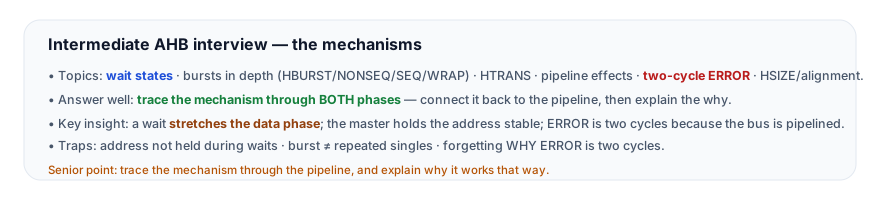
The way to carry the intermediate round: trace each mechanism through both phases, connect it to the pipeline, and get the subtleties right. The interviewer is checking whether you can work with AHB — follow a mechanism through the pipelined operation, not just name the signals. The most valuable move is to trace concretely — specific addresses, HTRANS values, cycle-by-cycle — and connect it to the pipeline (the foundation that makes the mechanism necessary). Get the subtleties right (the master holds the address during waits, bursts have a defined pattern, ERROR is two cycles because of the pipeline), and you'll pass the depth round and earn the advanced (arbitration, interconnect, deadlock) questions.
10. Practice Challenge
Practice the intermediate round.
- Trace a wait state. Walk a two-wait-state read cycle by cycle — what the slave drives, what the master holds.
- Burst patterns. Trace
INCR4andWRAP4word bursts from0x14— the addresses andHTRANSvalues. - The two-cycle why. Explain why ERROR is two cycles (the pipeline — to cancel the next transfer).
- HTRANS. Distinguish
BUSYfromIDLE— commitment to a burst vs no transfer. - The write pipeline. Explain when the slave samples
HWDATArelative to the address — and why it must register the address.
11. Key Takeaways
- Intermediate AHB questions probe the mechanisms — wait states, bursts in depth, HTRANS, the pipeline effects, the two-cycle ERROR, HSIZE/alignment.
- Answer by tracing the mechanism through both phases — address phase: what's presented; data phase: what happens a cycle later; then the coordination. Tracing is intermediate-depth; naming is beginner-depth.
- Connect every mechanism to the pipeline — wait states stretch it, bursts use it, the two-cycle ERROR exists because of it. The pipeline is still the foundation.
- Get the subtleties right — the master holds the address stable during a wait; a burst is one address phase + a pattern (not singles); ERROR is two cycles because of the pipeline;
WRAPwraps within an aligned region;BUSYpauses a burst (≠IDLE). - The intermediate round is where the depth lives — passing it (tracing mechanisms) signals you can work with AHB and sets up the advanced round.
- Substance behind the trace — each answer draws on the mechanism detail from Modules 2–4. Know it and trace it concretely (specific addresses,
HTRANSvalues, cycles).
12. What Comes Next
You can now trace the mechanisms. The next chapters cover the system-level and specialized rounds:
- Advanced Interview Questions (next) — arbitration, the interconnect, deadlock (composing these mechanisms into system-level behavior).
- Waveform Interpretation, Design Questions, Verification Questions, and the rest — reading timing, RTL prompts, and testbench strategy.
To revisit the mechanisms these questions cover, see Slave Wait States, Master Behavior During Wait, HBURST, HTRANS, WRAP4 / INCR4, and ERROR Response.