AMBA AHB · Module 19
Bridge Interview Questions
The bridge interview prompts — design or verify a bridge that connects AHB to a slower downstream protocol — answered with the AHB slave-design and verification skills you already have. The framing that unlocks them: a bridge is an AHB slave on its upstream side PLUS an FSM that runs a downstream transaction, stretching HREADY until the downstream completes. The pieces: the bridge as an AHB slave (capture the address phase), the bridge FSM (IDLE → SETUP → ACCESS → DONE), HREADY stretching (held low across the whole downstream transaction), the latency penalty (one AHB transfer = one downstream transaction — the bridge serializes), optional clock-domain crossing, and cross-side verification. The #1 move: hold HREADY low until the downstream is done. The downstream protocol's own details are a separate subject.
Bridge prompts ask you to design or verify a bridge — the block that connects AHB to a slower downstream protocol (a peripheral bus). They sound intimidating, but there's a framing that unlocks them: a bridge is an AHB slave on its upstream side plus an FSM that runs a downstream transaction, stretching HREADY until the downstream completes. So you answer them with the AHB slave-design and verification skills you already have — the downstream protocol's own details are a separate subject. The pieces: the bridge as an AHB slave (capture the address phase, like any slave); the bridge FSM (IDLE → SETUP → ACCESS → DONE — sequencing the downstream transaction, one per AHB transfer); HREADY stretching (hold HREADY low across the whole downstream transaction so the AHB master waits); the latency penalty (each access costs the downstream cycles — bursts and back-to-back traffic are slow through a bridge); optional clock-domain crossing (if the two sides differ in clock, synchronize the handshake safely); and cross-side verification (each AHB transfer maps to the correct downstream transaction). The single most valuable move is to hold HREADY low until the downstream is done — and to state that one AHB transfer = one downstream transaction, which is the source of the penalty. This chapter works the bridge prompts as an AHB slave + FSM problem.
1. What Is It?
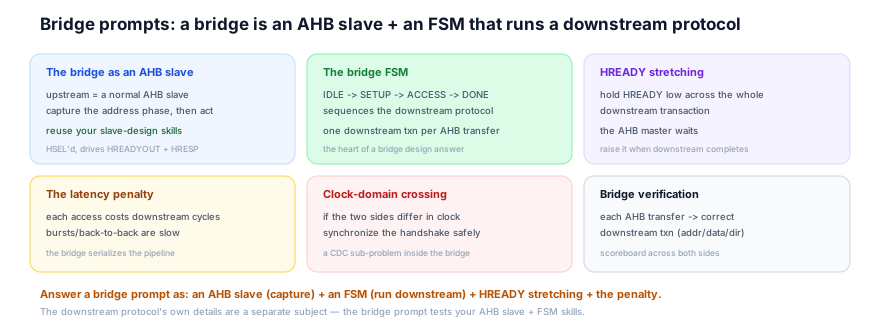
Bridge questions ask you to design or verify a bridge to a slower downstream protocol; answering them means framing the bridge as an AHB slave + an FSM and stretching HREADY. The pieces:
- The bridge as an AHB slave — the upstream side is a normal AHB slave:
HSEL'd, captures the address phase, drivesHREADYOUT/HRESP. Reuse your slave-design skills. - The bridge FSM (the heart) —
IDLE → SETUP → ACCESS → DONEsequences the downstream transaction; one downstream transaction per AHB transfer. - HREADY stretching — hold
HREADYlow across the whole downstream transaction (SETUP+ACCESS); raise it only inDONE. The AHB master waits. - Penalty + CDC + verification — each access costs downstream cycles (the latency penalty); optional CDC if the clocks differ; verify each AHB transfer → the correct downstream transaction.
So bridge questions are the translation test — interviewers use them to confirm you can connect AHB to another protocol, a common SoC task. The signal they're looking for is whether you frame the bridge correctly — anyone can say "a bridge connects two buses"; a candidate who can design one says: "the upstream side is just an AHB slave — it gets HSEL'd, captures the address phase. Then an FSM takes that captured transfer and runs it as a downstream transaction — SETUP, then ACCESS for however many cycles the downstream needs — and holds HREADY low the whole time so the AHB master waits. When the downstream completes, the FSM drives HREADY high for one cycle to finish the AHB transfer." The slave-plus-FSM, stretch-HREADY framing is the differentiator: it shows you can decompose the bridge into parts you already know (a slave + an FSM). And the meta-signal: one AHB transfer = one downstream transaction — the source of the latency penalty. So bridge questions are the translation test, framed as an AHB slave + FSM. So they reuse the skills you have.
2. Why Does It Exist?
Bridge questions exist because connecting AHB to a slower peripheral bus is a ubiquitous SoC task (almost every system has a high-speed AHB and a slow peripheral subsystem) — and the test is whether you can decompose the bridge into an AHB slave + an FSM and get the HREADY stretching right — because that decomposition is what makes the (seemingly hard) bridge a tractable design.
The connecting buses is ubiquitous is the root: real SoCs have a high-speed bus (AHB) for memory/fast peripherals and a slow, simple bus for the many slow peripherals — and a bridge connects them. So designing/verifying a bridge is a common task. So bridge questions test a real skill. So they exist to test bridging. So bridges are everywhere. So know how to build one.
The decompose into slave + FSM is the test: a bridge seems hard (it touches two protocols), but decomposes into parts you know — an AHB slave (upstream) + an FSM (running the downstream) + HREADY stretching (connecting them). So the test is whether you decompose it — not "memorize the bridge" but "build it from a slave + an FSM." So bridge questions test the decomposition. So they exist to test whether you see the structure. So decompose it. So see the parts.
The HREADY stretching is the crux is the key: the whole point of the bridge is to make the fast AHB master wait for the slow downstream — and that's done by holding HREADY low. So getting the HREADY stretching right is the crux of a correct bridge. So bridge questions test the HREADY handling. So they exist to test the crux. So stretch HREADY. So bridge questions exist because: connecting AHB to a slower bus is ubiquitous (the root); the test is decomposing the bridge into a slave + an FSM (seeing the structure — the skill); and the HREADY stretching is the crux (making the fast master wait — the key). So bridge questions are the translation test — passed by framing the bridge as an AHB slave + an FSM and stretching HREADY — demonstrating you can connect AHB to another protocol. So this chapter prepares you for bridge prompts. So decompose it, and stretch HREADY.
3. Mental Model
Model a bridge as a hotel concierge taking a request in English and fulfilling it through a local agency that only speaks the local language and works slowly. A guest asks the concierge (the AHB master asks the bridge) for theater tickets. The concierge takes the request (the upstream AHB slave captures the transfer), then turns to the phone and places the order with the local agency in its own language and at its own pace (the FSM runs the downstream transaction). Crucially, the concierge says to the guest "one moment, please" and makes them wait at the desk (holds HREADY low) for the entire time the agency takes — they do NOT tell the guest "done!" until the agency actually confirms. Only when the agency comes back (the downstream completes) does the concierge hand over the tickets and say "all set" (drive HREADY high, return the data). One guest request = one agency call — and the guest waits the agency's full time. That serialization is exactly why a busy concierge (a bridge under burst traffic) is a bottleneck.
A hotel lobby where a guest (the AHB master) asks the concierge (the bridge) for something — theater tickets (an AHB transfer). The concierge takes the request in the guest's language (the upstream AHB slave captures the transfer). Then the concierge turns to the phone and places the order with a local agency that only speaks the local language and works slowly (the FSM runs the downstream transaction in the downstream protocol, at the downstream pace). Crucially, the concierge says "one moment, please" and makes the guest wait at the desk (holds HREADY low) for the entire time the agency takes — they do not say "done!" until the agency actually confirms (the AHB transfer does not complete until the downstream completes). Only when the agency comes back (the downstream completes) does the concierge hand over the tickets and say "all set" (drive HREADY high, return the data). One guest request = one agency call — and the guest waits the agency's full time. And that serialization is exactly why a busy concierge (a bridge under burst traffic) is a bottleneck: each request must wait the full agency round-trip, one at a time.
This captures the bridge: the guest asking = the AHB master issuing a transfer; the concierge taking the request = the upstream AHB slave capturing the transfer; placing the order with the slow local agency = the FSM running the downstream transaction; "one moment, please" / making the guest wait = holding HREADY low across the whole downstream transaction; not saying "done" until the agency confirms = not completing the AHB transfer until the downstream completes; handing over the tickets and "all set" = driving HREADY high and returning the data in DONE; one request = one call, guest waits the full time = one AHB transfer = one downstream transaction = the latency penalty; the busy concierge as a bottleneck = the bridge serializing burst traffic. Take the request (slave), place the order (FSM), make them wait (HREADY low), hand over when done (HREADY high) — and you've designed the bridge.
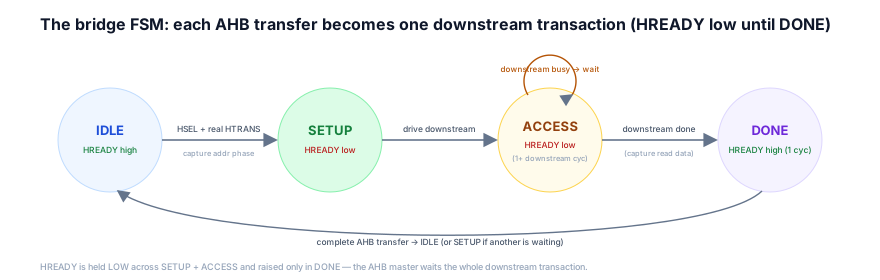
Here is the bridge FSM that captures it:
The bridge stretches HREADY across the whole downstream transaction
5 cyclesThe model's lesson: take the request (slave), run it downstream (FSM), make the master wait (HREADY low), complete when done (HREADY high). In the figure, HREADY is held low across SETUP+ACCESS (the whole downstream transaction) and raised only in DONE — that stretching is how the bridge makes the fast AHB master wait for the slow downstream.
4. Real Hardware Perspective
The substance behind a strong bridge answer is the bridge structure from the slave/verification modules — so each piece maps to a chapter, and the answer builds it as an AHB slave + FSM.
The the bridge FSM and HREADY stretching: build it — the upstream AHB slave captures the transfer; the FSM (IDLE → SETUP → ACCESS → DONE) runs the downstream transaction; HREADY is held low across SETUP+ACCESS and raised in DONE. So the answer builds the FSM and the stretching (see Bridge FSM RTL, Slave Wait States, Master Behavior During Wait). So it's the core design. So run the FSM, stretch HREADY.
The the penalty, CDC, and verification: reason about them — the penalty is one AHB transfer = one downstream transaction (the bridge serializes); CDC applies if the clocks differ (synchronize the handshake); verification checks each AHB transfer → the correct downstream transaction (a cross-side scoreboard). So the answer reasons about the penalty, the CDC, and the cross-side check (see Bridge Penalty, CDC Bridges, Bridge Verification, Bridge Deadlock). So in practice, a bridge is an AHB slave + an FSM that runs a downstream transaction, with HREADY stretched — and the penalty, CDC, and verification follow from that. So in practice, frame it as a slave + FSM and reason about the consequences. So that's the preparation.
5. System Architecture Perspective
At the interview level, the bridge round tests decomposition — passing it (framing the bridge as an AHB slave + an FSM, getting the HREADY stretching right) proves you can break a hard-seeming problem into parts you know, and it reflects the real SoC (where the bridge is the boundary between the high-speed and low-speed domains — and a known bottleneck).
The tests decomposition: the bridge seems hard (two protocols), but a strong candidate decomposes it into an AHB slave + an FSM — parts they know. So the bridge round tests decomposition — a senior skill (reduce the unfamiliar to the familiar). So at the interview level, the bridge round tests whether you decompose. So decompose it. So decomposition is the skill.
The reflects the real SoC: in a real SoC, the bridge is the boundary between the fast AHB domain and the slow peripheral domain — a critical integration point and a known bottleneck (the latency penalty). So the bridge round reflects a real architectural reality. So at the interview level, understanding the bridge (and its penalty) signals system awareness. So know the bridge's role. So it's architecturally real. So at the interview level, the bridge round tests decomposition (framing the bridge as a slave + an FSM — reducing the unfamiliar to the familiar) and reflects the real SoC (the bridge as the high/low-speed boundary and a known bottleneck). So the bridge round is where you show you can decompose a cross-protocol problem — making the slave + FSM framing and the HREADY stretching the keys to proving decomposition and signaling system awareness. So decompose, stretch HREADY, and know the penalty. So the bridge round tests decomposition.
6. Engineering Tradeoffs
Answering a bridge question embodies the slave-plus-FSM framing, the HREADY stretching, and the penalty awareness.
- Slave + FSM framing vs "it's complicated". Decomposing the bridge into an AHB slave + an FSM makes it tractable; treating it as a monolith overwhelms. Decompose it.
- Stretch HREADY vs complete early. Holding
HREADYlow until the downstream is done is correct; completing the AHB transfer early (before the downstream finishes) is the bridge bug. StretchHREADY. - One-transfer-one-transaction (penalty) awareness. Knowing the bridge serializes (one AHB transfer = one downstream transaction) signals performance awareness; ignoring the penalty misses the bottleneck. Know the penalty.
- Treat downstream as its own protocol. Respecting the downstream protocol (its handshake, its pace) is correct; treating it as AHB is wrong. Keep the protocols separate.
The throughline: bridge questions ask you to design/verify a bridge to a slower protocol — frame it as an AHB slave + an FSM (IDLE → SETUP → ACCESS → DONE) and stretch HREADY across the whole downstream transaction. The pieces: the slave capture, the FSM, the HREADY stretching, the latency penalty (one AHB transfer = one downstream transaction), optional CDC, and cross-side verification. The meta-signal: hold HREADY low until the downstream is done. The common traps: completing the AHB transfer early, forgetting to stretch HREADY, treating the downstream as AHB. The bridge round tests decomposition (slave + FSM) and reflects the real SoC (the high/low-speed boundary and its bottleneck).
7. Industry Example
A typical bridge round — the interviewer asks you to design a bridge.
The interviewer says "design a bridge from AHB to a slower peripheral bus."
- You frame it as a slave + FSM. "I'd decompose it. The upstream side is just an AHB slave — it gets
HSEL'd, captures the address-phase control. Then an FSM takes that captured transfer and runs it as a downstream transaction. So it's an AHB slave plus an FSM — parts I know." - You describe the FSM. "The FSM is
IDLE → SETUP → ACCESS → DONE. InIDLE,HREADYis high. When I'm selected, I capture the address, write flag, and data, and move toSETUP, pullingHREADYlow. InSETUP, I present the address and control to the downstream side and start its transaction. InACCESS, the downstream runs — one or more of its cycles — and I holdHREADYlow; for a read, I capture the returned data. When the downstream completes, I go toDONE, driveHREADYhigh for one cycle to complete the AHB transfer and return the read data, then back toIDLE." - You stress the HREADY stretching. "The key is that I hold
HREADYlow across the entire downstream transaction —SETUPandACCESS. The AHB master waits the whole time. I do not complete the AHB transfer until the downstream actually finishes — completing early would latch garbage on a read or clobber a write." (The #1 move.) - You note the penalty. "Each AHB transfer becomes one downstream transaction, and the downstream is slow. So the bridge serializes — a burst of AHB transfers becomes a sequence of slow downstream transactions, each fully waited. That's the latency penalty, and it's why bridges are bottlenecks. If writes can be posted, I could add a write buffer so the master doesn't wait on writes — within the protocol's rules."
- You mention CDC and verification. "If the two sides are on different clocks, the handshake between my FSM and the downstream crosses clock domains, so I'd add a proper CDC synchronizer. For verification, I'd put a scoreboard across both sides: every AHB transfer must produce the correct downstream transaction — right address, data, and direction — and the data must match."
- You keep the protocols separate. "I'm treating the downstream as its own protocol with its own handshake and pace — not as a second AHB. My FSM speaks the downstream protocol on its terms." (Avoiding the trap.)
- The meta-signal. You decomposed the bridge into a slave + FSM, stretched
HREADY, noted the penalty, and kept the protocols separate. The interviewer sees you can design a cross-protocol bridge.
The example shows the bridge round and a strong answer: framed as a slave + FSM, HREADY stretched, penalty noted, protocols kept separate, avoiding the traps (early completion, no stretch, treating downstream as AHB). This proves decomposition and reflects the real SoC. This is how you design a bridge.
8. Common Mistakes
9. Interview Insight
The bridge round tests decomposition — framing the bridge as an AHB slave + an FSM, stretching HREADY, and knowing the penalty are the signals.
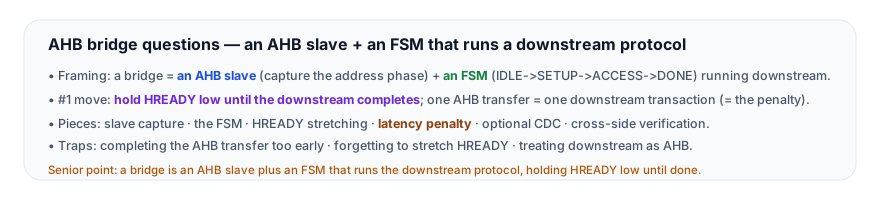
The way to carry the bridge round: frame the bridge as an AHB slave + an FSM, stretch HREADY across the whole downstream transaction, and know the latency penalty. The interviewer is checking whether you can decompose a cross-protocol problem into parts you know — and get the core mechanism (HREADY stretching) right. The most valuable move is to hold HREADY low until the downstream completes — never completing the AHB transfer early — and to state that one AHB transfer = one downstream transaction (the source of the penalty). Keep the two protocols separate (the downstream is not AHB), handle the CDC if the clocks differ, and verify across both sides — and you'll pass the bridge round and show you can connect AHB to another protocol. (The downstream protocol's own details are a separate subject — here, the prompt tests your AHB slave + FSM skills.)
10. Practice Challenge
Practice the bridge round.
- The framing. Decompose a bridge into an AHB slave + an FSM and explain how they connect (
HREADYstretching). - The FSM. Sketch the
IDLE → SETUP → ACCESS → DONEFSM and theHREADYvalue in each state. - The crux. Explain why the bridge must hold
HREADYlow until the downstream completes and what breaks if it completes early. - The penalty. Explain why a bridge is a bottleneck (one AHB transfer = one downstream transaction) and how a write buffer helps.
- Verification. Describe the cross-side scoreboard and what's different from verifying a single slave.
11. Key Takeaways
- Bridge questions ask you to design/verify a bridge to a slower downstream protocol — answered with the AHB slave-design and verification skills you already have.
- Frame it as an AHB slave + an FSM — the upstream side is a normal AHB slave (capture the address phase); an FSM (
IDLE → SETUP → ACCESS → DONE) runs the downstream transaction. - Stretch
HREADY(the #1 move) — holdHREADYlow across the whole downstream transaction; complete the AHB transfer only when the downstream finishes. Completing early corrupts data. - Know the latency penalty — one AHB transfer = one downstream transaction; the bridge serializes (a bottleneck). A write buffer (posted writes) hides write latency.
- Keep the protocols separate — the downstream is not AHB (its own handshake/pace); handle CDC if the clocks differ.
- Verify across both sides — a scoreboard spanning AHB and downstream: each AHB transfer → the correct downstream transaction. The bridge round tests decomposition.
12. What Comes Next
You can now frame bridge prompts. The next chapters cover the last specialized rounds:
- Arbitration Interview Questions (next) — the arbitration-policy and handover prompts.
- Tricky Misconceptions — the myths candidates repeat about AHB timing, and how to correct them.
To revisit the bridge structure these answers build, see Bridge FSM RTL, Bridge Penalty, CDC Bridges, Bridge Verification, and Bridge Deadlock.
Standards & specifications
- Governing standard
- Arm AMBA AHB Protocol Specification (IHI 0033)(opens Arm in a new tab)
Defines AHB transfers, the two-cycle response mechanism and arbitration. Bridge design and debug technique are engineering practice built on top of it.
This page also covers RTL structure, verification approach and debugging technique. Those are engineering practice built on the standard, not requirements the standard itself imposes.
Where this fits
Part of the AMBA AHB curriculum.