AMBA AHB · Module 13
The Bus Matrix Concept
The multi-layer AHB bus matrix — a crossbar connecting every master to every slave, with each master on its own layer and each slave having its own arbiter and decoder. Per-slave arbitration lets masters access different slaves concurrently and contend only on the same slave, turning multiple masters into parallel bandwidth.
This is the central chapter of Module 13: the bus matrix. Chapters 13.1–13.2 set up the two sides — multiple masters (the routing-and-arbitration problem) and multiple slaves (broadcast + decode + mux). The bus matrix combines them into a crossbar: it connects every master to every slave, with each master on its own layer (path into the matrix) and each slave having its own arbiter and decoder. The defining property follows from that structure: because arbitration is per slave (not one global arbiter for the whole bus), masters accessing different slaves proceed concurrently — and they contend only when targeting the same slave (resolved by that slave's arbiter). This is what turns multiple masters into parallel bandwidth — the matrix realizes the concurrency that a shared bus serializes (chapter 13.1). The cost is hardware that scales with masters × slaves. Crucially, each master still drives a simple single-master interface; the matrix handles all the routing and arbitration. This chapter explains the matrix structure, why per-slave arbitration unlocks concurrency, and the cost/bandwidth tradeoff.
1. What Is It?
A bus matrix (or multi-layer interconnect) is a crossbar connecting every master to every slave. Its structure:
- Each master on its own layer — every master has a dedicated path into the matrix (not a shared bus).
- Each slave has its own arbiter + decoder — at each slave port, an arbiter resolves which master accesses that slave, and a decoder/routing connects the chosen master.
- Per-slave arbitration — contention is resolved per slave, so accesses to different slaves don't compete.
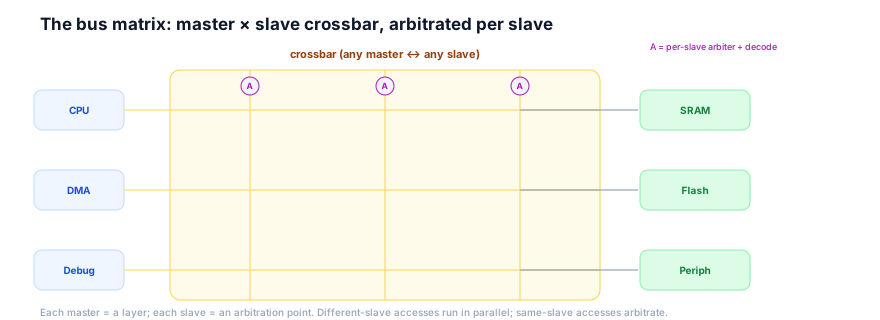
So the bus matrix is the cross-product of masters and slaves — a grid where each master's layer can connect to each slave's port. The key difference from a shared bus is where arbitration happens: a shared bus has one arbiter for the whole bus (so the whole bus serializes); the matrix has one arbiter per slave (so only that slave's accesses serialize). This localizes contention to individual slaves, leaving accesses to different slaves independent and concurrent. So the matrix is "many shared buses in parallel, one per slave" — or equivalently, a crossbar switch with per-slave arbitration. That structure is what gives it parallelism. So the bus matrix is the concurrent multi-master interconnect: every master to every slave, arbitrated per slave.
2. Why Does It Exist?
The bus matrix exists because a single shared bus serializes all masters (wasting their concurrency potential, chapter 13.1), and per-slave arbitration — the matrix's defining idea — removes that serialization for accesses to different slaves, realizing real parallelism and bandwidth.
The shared-bus serialization problem is the motivation (chapter 13.1): on a shared bus, one arbiter controls the whole bus, so only one master uses it at a time — even if masters want different slaves. So a CPU accessing flash and a DMA accessing a peripheral can't overlap; they serialize on the one bus. This wastes the concurrency that having multiple masters could provide. So the shared bus is a bottleneck — all multi-master traffic funnels through one bus. So there's a need to remove this single-bus bottleneck. So the matrix exists to solve the shared-bus serialization.
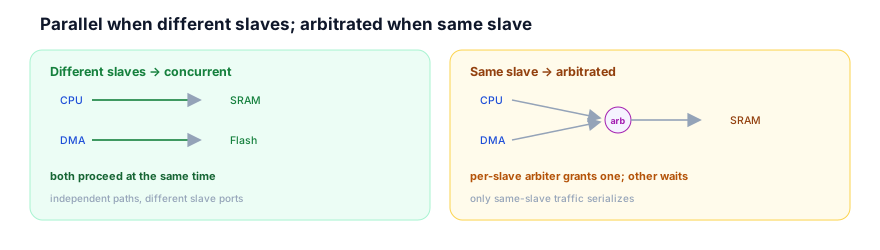
The per-slave-arbitration insight is the solution: the reason the shared bus serializes is that there's one arbitration point (the whole bus). What if there were one arbitration point per slave instead? Then contention is resolved at each slave — two masters compete only if they want the same slave. Accesses to different slaves go through different arbitration points (different slave ports) and don't compete — they proceed in parallel. So moving arbitration from the bus to each slave localizes contention and unlocks concurrency. This is the matrix's core idea: per-slave arbitration. So the matrix exists because per-slave arbitration removes the single-bus bottleneck — accesses to different slaves run concurrently. So the matrix is the realization of "arbitrate per slave, not per bus."
The reason this is worth the cost (more hardware) is bandwidth: by allowing concurrent access to different slaves, the matrix multiplies the effective bus bandwidth — up to N transfers in flight at once (N = number of slaves being accessed by different masters), versus one on a shared bus. For systems with genuine multi-master concurrency (CPU + DMA + more), this bandwidth is needed — the shared bus would be a bottleneck. So the matrix's extra hardware (a crossbar + per-slave arbiters, scaling as masters × slaves) buys the parallelism the system requires. So the matrix exists because: a shared bus serializes (the problem), per-slave arbitration removes the serialization for different-slave accesses (the insight), and the resulting parallel bandwidth justifies the masters × slaves hardware cost (the tradeoff). It's the structural answer to "how do we let multiple masters actually run in parallel?" — and it's why the rest of the module (parallel access, decoder+arbiter composition, routing, HREADY aggregation, performance) details its mechanics. (The matrix keeps each master's interface single-master-simple — chapter 12.5 — so masters and slaves don't change; only the interconnect does.)
3. Mental Model
Model the bus matrix as a building's elevator system upgraded from one elevator to a bank of elevators with a smart dispatcher per floor — with one elevator (a shared bus), everyone waits for the single car no matter which floor they want; with a bank of elevators where each destination floor has its own dispatching (per-slave arbitration), people going to different floors ride different cars simultaneously, and only people heading to the same floor at the same moment have to be sequenced.
A building starts with one elevator (a shared bus): no matter which floor (slave) people (masters) want, they all queue for the single car — only one person's trip happens at a time, even if they're going to different floors. It's a bottleneck. Now upgrade to a bank of elevators with smart per-floor dispatching (a bus matrix): the system can route different people to different cars heading to different floors simultaneously — someone going to floor 3 and someone going to floor 7 ride at the same time, in parallel, because their destinations are independent. The only time people are sequenced is when two of them want the same floor at the same moment — then a per-floor dispatcher (the per-slave arbiter) decides who goes first. So the upgrade's magic is per-destination dispatching: trips to different floors are concurrent; only same-floor trips are sequenced. The building moves far more people per minute (more bandwidth) — at the cost of more elevators and dispatchers (more hardware, scaling with people × floors served).
This captures the bus matrix: the one elevator = the shared bus (serializing); the bank of elevators = the matrix's per-master layers; per-floor dispatching = per-slave arbitration; different people to different floors simultaneously = masters accessing different slaves concurrently; same-floor sequencing = same-slave contention arbitrated per slave; more people per minute = higher bandwidth; more elevators/dispatchers = the masters × slaves hardware cost. Per-destination dispatching turns one serialized elevator into a concurrent bank — that's the matrix.
Watch concurrent access (different slaves) and contention (same slave):
Matrix: concurrent different-slave, arbitrated same-slave
4 cyclesThe model's lesson: per-destination dispatching — different floors ride concurrently, same floor is sequenced. In the waveform, the CPU and DMA run in parallel on different slaves (cycles 0–1) and serialize only when both hit SRAM (cycles 2–3).
4. Real Hardware Perspective
In hardware, a bus matrix is a crossbar of master-to-slave paths plus a per-slave arbiter+decoder at each slave port — and its size scales with masters × slaves, which drives practical structuring (sparse matrices, hierarchy).
The crossbar paths are the routing fabric: conceptually, each master's layer can connect to each slave port — an M × S crossbar. In each slave port, a multiplexer selects which master's address/control/write-data drives that slave (chosen by the slave's arbiter), and the slave's response routes back to the granted master's layer. So the matrix is a grid of muxes (master-select at each slave, slave-select at each master's return path). So in hardware, the matrix is a crossbar of muxes. So the path fabric scales with masters × slaves.
The per-slave arbiter + decoder is at each slave port: the arbiter resolves which master accesses that slave (when several want it), applying a policy (priority, round-robin — Module 10) locally to that slave. The decoder role (which master's transfer is for this slave) and the mux select are driven by the master-side decode (each master decodes its address to know which slave port to route to). So each slave port is a small arbitrated mux. Because arbitration is per slave, the matrix has S arbiters (one per slave) rather than one global one — this is the structural source of concurrency. So in hardware, per-slave arbiters localize contention. So the matrix replicates the single-master decode/mux building block (chapter 13.2) per master path, with per-slave arbitration added.
The scale and structuring is the practical concern: a full M × S crossbar (every master to every slave) grows quickly (M × S paths + S arbiters). Real matrices are often sparse — not every master needs to reach every slave (e.g. the debug port may only reach memory, not every peripheral), so unneeded paths are omitted, shrinking the crossbar. And hierarchy is used: groups of slaves behind a sub-interconnect (e.g. peripherals behind a bridge, chapter 11.7) appear as one matrix port, so the matrix sees fewer ports. So in hardware, the matrix is structured (sparse + hierarchical) to manage the masters × slaves cost. So a real bus matrix is a (often sparse, hierarchical) crossbar of muxes with a per-slave arbiter+decode at each slave port — replicating the slave-side building block per master and adding local arbitration, sized by masters × slaves and trimmed by sparsity/hierarchy. The detailed mechanics (parallel access, decoder+arbiter composition, routing, HREADY aggregation) are the next chapters.
5. System Architecture Perspective
At the system level, the bus matrix is the AHB-level answer for scalable multi-master bandwidth — it sits between the simple shared bus and the high-end AXI fabric on the interconnect ladder, and its per-slave-arbitration principle is foundational to all high-bandwidth interconnects.
The scalable bandwidth role: the matrix is how an AHB-based system gets more than one transfer's worth of bandwidth from multiple masters. By allowing N concurrent transfers (to N different slaves), it scales bandwidth with the number of slaves being accessed — a CPU + DMA + accelerator can each be hitting a different memory/peripheral simultaneously. So the matrix is the bandwidth-scaling interconnect for multi-master AHB. So at the system level, the matrix is chosen when a shared bus's single-transfer bandwidth is insufficient for the system's concurrent masters. This is the common case for any system with active DMA + CPU overlap or multiple cores.
The interconnect-ladder position (chapter 12.5/12.7): the matrix sits between the shared bus and AXI. A shared bus (one arbiter, serialized) is simplest/cheapest, for low concurrency. A bus matrix (per-slave arbitration, concurrent) is the mid-tier, for moderate multi-master concurrency — and crucially keeps each master/slave interface single-master-simple (the matrix absorbs the complexity). AXI is the high-end (separate channels, many outstanding transactions, out-of-order) for the highest concurrency. So the matrix is the natural step up from a shared bus when you need concurrency but not full AXI complexity. So at the system level, the matrix is the right-sized choice for moderate multi-master bandwidth — and many systems live here (an MCU/SoC with a CPU + DMA + a couple of masters). So the matrix occupies a key rung of the ladder.
The principle generalizes view: the matrix's core idea — per-resource (per-slave) arbitration to localize contention and enable concurrency — is foundational to all high-bandwidth interconnects, including AXI and NoCs (networks-on-chip). AXI's independent channels and per-slave (per-target) arbitration, a NoC's per-link routing — all are extensions of "don't funnel everything through one arbitration point; arbitrate per resource so independent traffic runs concurrently." So understanding the bus matrix is understanding the general principle of concurrent interconnects, not just AHB. So at the system level, the bus matrix is the scalable-bandwidth multi-master interconnect for AHB, the mid-rung between shared bus and AXI on the right-sizing ladder, and the embodiment of the per-resource-arbitration principle that underlies all high-bandwidth fabrics. It's the conceptual heart of the interconnect module — the rest details its mechanics, but the idea (per-slave arbitration → concurrency → bandwidth) is the key takeaway. So the matrix is where multi-master AHB becomes genuinely parallel.
6. Engineering Tradeoffs
The bus matrix embodies the per-slave-arbitration, concurrency-for-hardware design.
- Bus matrix vs shared bus. A matrix gives concurrent access to different slaves (parallel bandwidth) at the cost of masters × slaves hardware (crossbar + per-slave arbiters). A shared bus is cheap but serializes all masters. Choose the matrix when concurrency/bandwidth is needed.
- Full vs sparse crossbar. A full M × S crossbar connects every master to every slave (max flexibility) at max cost; a sparse matrix omits unneeded paths (e.g. debug → only memory), cutting cost. Real matrices are usually sparse.
- Flat matrix vs hierarchy. A flat matrix has all slaves as ports (large at scale); hierarchy groups slaves behind sub-interconnects (e.g. peripherals behind a bridge), reducing matrix ports. Use hierarchy to bound size.
- Per-slave arbitration policy. Each slave's arbiter has its own policy (priority, round-robin, QoS) — tunable per slave (a critical slave can prioritize a real-time master). This per-slave tuning is a matrix advantage over a single global policy.
The throughline: a bus matrix is a crossbar connecting every master (each on its own layer) to every slave (each with its own arbiter + decoder); per-slave arbitration localizes contention so masters accessing different slaves run concurrently and contend only on the same slave. This turns multiple masters into parallel bandwidth (up to N concurrent transfers) at the cost of masters × slaves hardware (trimmed by sparsity and hierarchy). The matrix keeps each master/slave interface single-master-simple, sits between the shared bus and AXI on the interconnect ladder, and embodies the per-resource-arbitration principle underlying all high-bandwidth fabrics.
7. Industry Example
Trace a bus matrix in a system with concurrent masters.
An SoC has a CPU, a DMA engine, and a crypto accelerator (three masters), accessing instruction-flash, two SRAM banks, and a peripheral block (slaves), via a bus matrix.
- Concurrent, different slaves. The CPU fetches from flash, the DMA moves data into SRAM bank 0, and the crypto accelerator reads SRAM bank 1 — all three simultaneously, because they're hitting different slaves on different matrix paths. Three transfers in flight at once: 3× the bandwidth of a shared bus.
- Per-slave arbitration. Each slave (flash, SRAM0, SRAM1, peripherals) has its own arbiter. So contention is local: if the CPU and DMA both wanted SRAM0, SRAM0's arbiter would resolve it — without affecting the crypto accelerator's access to SRAM1.
- A hot slave. Suppose all three masters need SRAM0 at once (a shared buffer). Then SRAM0's arbiter serializes them — the matrix gives no concurrency for that traffic (the hot slave is the bottleneck). The fix: bank the buffer across SRAM0 and SRAM1 so the masters hit different banks (turning same-slave contention into different-slave concurrency).
- Per-slave policy. SRAM0's arbiter might prioritize the CPU (latency-sensitive), while the peripheral block's arbiter uses round-robin (fairness). Per-slave policies let each slave's arbitration suit its access pattern — a matrix advantage.
- Simple interfaces. The CPU, DMA, and crypto accelerator each drive a single-master AHB-Lite-style interface into the matrix; none implements full multi-master logic. The matrix handles routing and arbitration. So the IP stays simple.
- Sparse + hierarchical. The debug port (a fourth master) might only reach the memories (not every peripheral) — a sparse matrix omits its peripheral paths. And the peripheral block is one matrix port (hierarchy), with its own sub-decode behind a bridge — keeping the matrix's port count down.
The example shows the matrix delivering parallel bandwidth (three concurrent transfers to different slaves), localizing contention per slave, supporting per-slave policies, keeping master/slave interfaces simple, and using sparsity/hierarchy to bound cost — while reminding that a hot slave (all masters on one slave) remains a bottleneck, fixable by banking. This is the bus matrix in real use.
8. Common Mistakes
9. Interview Insight
The bus matrix is a flagship interconnect interview topic — the crossbar structure, the per-slave-arbitration-enables-concurrency insight, and the hot-slave caveat are the signals.

The answer that lands gives the structure and the key insight: "A bus matrix is a crossbar that connects every master to every slave. Each master has its own layer — its own path into the matrix — and each slave has its own arbiter and decoder. The defining property is that arbitration is per slave, not one global arbiter for the whole bus. That's the key insight: because each slave arbitrates independently, masters accessing different slaves go through different arbitration points and proceed concurrently — they only contend when they target the same slave, which that slave's arbiter resolves. So a CPU accessing flash and a DMA accessing a peripheral run in parallel, where a shared bus would serialize them. This turns multiple masters into parallel bandwidth — up to N concurrent transfers for N slaves being accessed. The cost is hardware scaling with masters times slaves, usually trimmed by making the matrix sparse (omitting unneeded paths) and hierarchical (grouping slaves). Importantly, each master still drives a simple single-master interface; the matrix absorbs the routing and arbitration. The one caveat is that the concurrency only applies to different-slave accesses — if all masters hammer the same slave, that hot slave's arbiter serializes them and the matrix gives no parallelism for that traffic, which is why memory banking is used to spread contention." The crossbar structure, the per-slave-arbitration insight, and the hot-slave caveat are the senior signals.
10. Practice Challenge
Reason from the bus matrix.
- The structure. Describe a bus matrix: masters as layers, slaves with per-slave arbiters, the crossbar.
- Why concurrency. Explain why per-slave arbitration lets different-slave accesses run concurrently.
- Read the waveform. From Figure 2, explain the concurrent phase (different slaves) and the arbitrated phase (same slave).
- Hot slave. Explain when the matrix gives no concurrency and how banking fixes it.
- Cost. Explain how the matrix's hardware scales and how sparsity/hierarchy bound it.
11. Key Takeaways
- A bus matrix is a crossbar connecting every master (each on its own layer) to every slave (each with its own arbiter + decoder) — the cross-product of masters and slaves.
- Per-slave arbitration is the core idea — contention is resolved per slave, not by one global arbiter, so masters accessing different slaves run concurrently and contend only on the same slave.
- It turns multiple masters into parallel bandwidth — up to N concurrent transfers (N slaves accessed) vs one on a shared bus — realizing the concurrency a shared bus serializes.
- The cost scales with masters × slaves (crossbar paths + per-slave arbiters), trimmed by sparse matrices (omit unneeded paths) and hierarchy (group slaves behind sub-interconnects).
- A hot slave is still a bottleneck — if all masters target one slave, its arbiter serializes them (no matrix benefit); memory banking spreads contention into different-slave concurrency.
- Endpoints stay simple — each master/slave drives a single-master interface; the matrix absorbs routing/arbitration. The matrix sits between the shared bus and AXI on the interconnect ladder, embodying the per-resource-arbitration principle of all high-bandwidth fabrics.
12. What Comes Next
You now understand the bus matrix — the crossbar with per-slave arbitration that unlocks concurrency. The next chapters detail its mechanics:
- Parallel Slave Access (next) — how the matrix lets masters reach different slaves at once, in detail.
- Decoder + Arbiter Combination — how decoders and arbiters compose in the fabric.
- Interconnect Routing, HREADY Aggregation, Bus Matrix Performance — routing, response aggregation, and bandwidth.
To revisit the two sides this combines, see Multiple Masters and Multiple Slaves; for the single-master matrix context, see Typical Microcontroller Use.