AMBA AHB · Module 18
Bridge Deadlock
Finding and breaking a bridge deadlock — a circular wait where the bridge and the system get stuck waiting on each other, so nothing completes. A bridge holds its upstream side (wait states) while running the downstream transaction; deadlock arises when that holding closes a dependency cycle (master waits on the bridge -> bridge waits on the downstream -> downstream waits back on the master or a shared resource). The four classic conditions hold (mutual exclusion, hold-and-wait, no preemption, circular wait). It looks like a stuck HREADY but is a cycle, not a single stuck slave, so the stuck-HREADY method goes in circles. Diagnose by mapping what each party waits for and finding the cycle; break ONE edge — a timeout (abort with ERROR), an ordering rule, or buffering. A bus watchdog is the safety net.
This is the module's hardest debug: a bridge deadlock. A deadlock is a circular wait — the bridge and the rest of the system get stuck waiting on each other in a circle, so nothing completes. It looks like a stuck HREADY (18.1) — the bus is hung — but the cause is deeper: not a single stuck slave, but a dependency cycle. Recall (16.10) that a bridge holds its upstream side (wait states, HREADYOUT low) while it runs the downstream transaction. A deadlock arises when that holding forms a circular dependency that never resolves. The classic example: the upstream master is waiting for the bridge to complete its transfer; the bridge is waiting for the downstream peripheral to respond; but the downstream peripheral is waiting on something that depends on the upstream side — e.g. the same master needing to service the peripheral, or a shared resource the master holds. So the loop closes: master → bridge → downstream → master. Each party is correctly waiting, yet together they form a cycle with no progress. All four classic deadlock conditions hold: mutual exclusion (of the bus), hold-and-wait (the bridge holds upstream while waiting downstream), no preemption (transfers aren't preempted), and the circular wait itself. To find it, identify what each party is waiting for and look for the cycle. To break it, eliminate one edge: a timeout (abort with an error), ordering (so the dependency can't be circular), or buffering (so the bridge doesn't hold while waiting). (This is the debug methodology applied to a bridge-style FSM; the conceptual AHB-to-APB bridge is a separate subject.) This chapter builds the diagnosis.
1. What Is It?
A bridge deadlock is a circular wait through the bridge; debugging it means mapping the cycle and breaking one edge. Its parts:
- A circular wait — the bridge and the system wait on each other in a circle (master → bridge → downstream → master), so nothing completes.
- The bridge's hold-and-wait — the bridge holds its upstream side (wait states) while waiting on downstream; that holding closes the cycle.
- The four conditions — mutual exclusion, hold-and-wait, no preemption, circular wait — all hold in a deadlock.
- Diagnose + break — map what each party waits for, find the cycle; break one edge (timeout / ordering / buffering). A watchdog is the safety net.
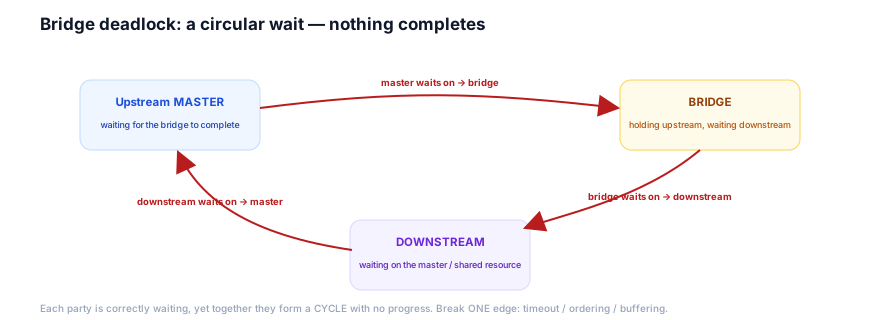
So a bridge deadlock is a systemic failure — not a bug in one component, but a cycle of mutual waiting that spans the master, the bridge, and the downstream. The key to debugging it is recognizing it as a deadlock (a circular wait), not a stuck slave. A stuck HREADY (18.1) is one slave that won't complete; a deadlock is multiple parties each correctly waiting but collectively stuck. The bridge's role is central: its hold-and-wait behavior (holding upstream while waiting downstream — necessary for rate-matching — 16.10) is exactly the condition that closes a dependency cycle if the downstream depends back on the upstream. So the diagnosis is graph-like: map the wait-for relationships (who waits on whom), and look for a cycle. The fix is to break the cycle — remove one edge (one wait-for dependency) via a timeout, an ordering rule, or buffering. So a bridge deadlock is the circular-wait failure debugged by mapping the cycle and breaking an edge. So it's the hardest, most systemic AHB debug.
2. Why Does It Exist?
Bridge deadlocks exist because the bridge's hold-and-wait behavior (necessary for rate-matching) creates a resource dependency that, combined with a downstream-depends-on-upstream path, closes a cycle — and the four classic deadlock conditions (mutual exclusion, hold-and-wait, no preemption, circular wait) all hold, so the system locks up.
The the bridge holds-and-waits is the root: a bridge must hold its upstream side (wait states) while it runs the downstream transaction (it can't complete the upstream transfer until downstream is done — 16.10). This is hold-and-wait: the bridge holds a resource (the upstream bus, via the held transfer) while waiting for another (the downstream completion). Hold-and-wait is one of the four deadlock conditions. So the bridge's necessary behavior introduces a deadlock precondition. So bridge deadlocks exist because the bridge holds-and-waits. So it's an inherent risk. So the bridge enables the precondition.
The a dependency cycle closes drives the deadlock: hold-and-wait alone isn't a deadlock — it becomes one when the waited-for resource (downstream) depends back on the held resource (upstream). If the downstream needs something from the upstream master (which is blocked waiting on the bridge), the loop closes: master → bridge → downstream → master. So the deadlock exists because a cycle forms (the downstream-depends-on-upstream path plus the bridge's hold-and-wait). So it's a circular dependency. So the cycle closes the loop.
The all four conditions hold is the formalization: a deadlock requires all four of mutual exclusion (the bus/resource is exclusive), hold-and-wait (a party holds while waiting), no preemption (held resources can't be forcibly taken), and circular wait (the cycle). In the bridge case, all four hold: the bus is exclusive, the bridge holds-and-waits, transfers aren't preempted, and the cycle exists. So the system deadlocks. So bridge deadlocks exist because: the bridge's hold-and-wait (necessary for rate-matching) is a deadlock precondition (the why); a downstream-depends-on-upstream path closes a cycle (the circular dependency); and all four deadlock conditions hold (the formal deadlock — the lock-up). So a bridge deadlock is the circular-wait failure that arises when the bridge's hold-and-wait meets a downstream-depends-on-upstream dependency — debugged by mapping the wait-for cycle and broken by removing one edge (one of the four conditions). So this chapter teaches the cycle-mapping diagnosis. So map the cycle and break a condition.
3. Mental Model
Model debugging a bridge deadlock as untangling a gridlocked intersection where each driver is blocked by the next, in a circle — nobody can move because everybody is waiting for the car ahead, and the car ahead is (eventually) waiting for them. To debug, you map who is blocked by whom and look for the circle. To fix, you break the circle at one point: a traffic cop forces one car to back out (a timeout — abort), a rule that says "always yield in this direction" prevents the circle forming (ordering), or a wider road / turn lane lets a car proceed without blocking (buffering). You don't fix every car — you break the cycle at one edge.
A four-way intersection (the system) in gridlock (deadlock). Each car (the master, the bridge, the downstream) has entered the intersection and is now blocked by the car ahead — and crucially, the blocking forms a circle: car A is blocked by car B, B by C, and C is blocked back by A. Nobody can move, because everybody is waiting for the car ahead, and the chain loops back. This is a deadlock: each car is correctly waiting (it can't move into an occupied space — mutual exclusion; it holds its spot while waiting — hold-and-wait; nobody will back out voluntarily — no preemption), yet together they form a circular wait. The naive reaction — "which car is broken?" — is wrong: no car is broken; the configuration is deadlocked. To debug, you map who is blocked by whom — A waits on B, B waits on C, C waits on A — and see the circle. To fix, you break the circle at one point — you don't need to fix every car. Three ways: a traffic cop (a timeout/watchdog) forces one car to back out (abort the held transfer with an error — removing hold-and-wait); a traffic rule ("always yield to the right" — ordering) prevents the circle from forming in the first place (you can't create a circular wait if everyone acquires in the same order); or a wider road with a turn lane (buffering) lets a car proceed without blocking the next (the bridge completes upstream into a buffer and drains downstream independently — removing hold-and-wait). Each fix removes one edge of the cycle. The cop is the safety net — even if you miss the cycle, the cop eventually clears it (a watchdog turning a permanent gridlock into a recoverable one).
This captures bridge-deadlock debug: the gridlocked intersection = the deadlocked system; each car blocked by the next in a circle = the circular wait (master → bridge → downstream → master); no car being broken = no single component being buggy (it's the configuration); mapping who is blocked by whom = mapping the wait-for graph; seeing the circle = finding the cycle; the traffic cop forcing one car out = a timeout/watchdog aborting the held transfer; the always-yield rule = an ordering rule preventing the cycle; the turn lane letting a car proceed = buffering removing hold-and-wait; breaking the circle at one point = removing one edge; the cop as safety net = the watchdog. Map who is blocked by whom, find the circle, and break it at one edge.
Watch a bridge deadlock on the waveform — the permanent stall and the cycle:
Bridge deadlock: a circular-wait permanent stall
4 cyclesThe model's lesson: map who is blocked by whom, find the circle, and break it at one edge. In the waveform, the permanent stall looks like a stuck HREADY — but tracing further reveals the bridge's downstream is also stuck, and the downstream waits back on the master: a cycle (master → bridge → downstream → master). It's a deadlock, not a single stuck slave — fixed by breaking one edge, not unsticking one component.
4. Real Hardware Perspective
In debug, you recognize the deadlock (a stall with no single stuck component), map the wait-for graph (who waits on whom across the master, bridge, and downstream), find the cycle, and break one edge (timeout / ordering / buffering) — with a watchdog as the safety net.
The recognize the deadlock (not a stuck slave): on the waveform, you start like a stuck HREADY (18.1) — trace the upstream HREADY to the bridge. But unlike a stuck slave, going further — to the bridge's downstream side — shows it's also stuck waiting (not its own logic stuck, but waiting on the downstream). And the downstream is waiting on the master. So there's no single stuck component — each is waiting on the next. This is the recognition: a deadlock (circular wait), not a stuck slave. So in debug, recognize the cycle, not a single stuck component. So that's the key recognition. So it's a deadlock, not a hang.
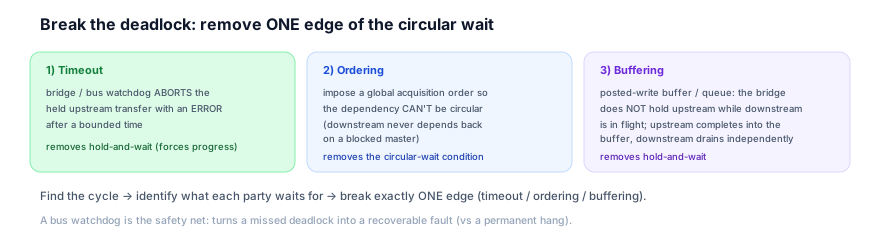
The map the wait-for graph and find the cycle: map the wait-for relationships — for each party (master, bridge, downstream, any shared resource), what is it waiting for? The master waits on the bridge (its transfer to complete); the bridge waits on the downstream (the peripheral's response); the downstream waits on... — here's the critical step — what does the downstream depend on? If it depends back on the master (the master must service it, or release a shared resource the master holds), the cycle closes. So you trace the dependency all the way around and find the cycle. So in debug, map the wait-for graph. So it's cycle-finding. So that localizes the deadlock.
The break one edge + watchdog: with the cycle mapped, break one edge (remove one of the four conditions — usually hold-and-wait or circular wait): (1) Timeout — the bridge (or a bus watchdog) aborts the held upstream transfer with an ERROR after a bounded time (removing hold-and-wait — the master is released); (2) Ordering — redesign so the downstream never depends back on a blocked master (a global acquisition order — removing the circular wait by construction); (3) Buffering — give the bridge a posted-write buffer/queue so it completes upstream immediately (into the buffer) and drains downstream independently (removing hold-and-wait — the bridge doesn't hold while waiting). And always add a bus watchdog as the safety net — even if a deadlock is missed in design, the watchdog detects the prolonged stall and triggers recovery (turning a permanent hang into a recoverable fault — 18.1). So in debug, a bridge deadlock is recognize (a stall with no single stuck component) → map the wait-for graph → find the cycle → break one edge (timeout/ordering/buffering) + watchdog. So in debug, map the cycle and break an edge. So that's the method.
5. System Architecture Perspective
At the system level, a bridge deadlock is a system-integration failure (it arises from the interaction of correctly-designed components, not a single bug) — making it hard to find (no single culprit) and a prevention-by-design problem (the four conditions, posted writes, ordering rules) — and it's why a bus watchdog is essential (the safety net for the un-found deadlock).
The system-integration failure: a bridge deadlock is an emergent property of the system's structure — it arises from the interaction of the master, bridge, and downstream (each correctly designed) forming a cycle. So it's a system-integration failure, not a component bug. So at the system level, it's emergent — no single component is wrong; the composition is. So it's hard to attribute. So integration creates it.
The hard to find, prevent by design: because there's no single culprit, a deadlock is hard to find by component-level debug (each component passes in isolation). So the primary defense is prevention by design: avoid the four conditions (especially hold-and-wait via posted writes/buffering, and circular wait via ordering rules) at design time, and verify with deadlock-detection (a formal check for cycles, or stress tests that create the dependency). So at the system level, deadlocks are prevented by design (not found after). So it's a design-time concern. So prevent, don't chase.
The the watchdog as essential safety net: because deadlocks are hard to find (some may escape to silicon), a bus watchdog is essential — it detects the prolonged stall (a HREADY low beyond a threshold — 18.1) and triggers recovery (an error/reset), turning a permanent system freeze into a recoverable fault. So the watchdog is the system-level safety net for the un-found deadlock. So at the system level, a bridge deadlock is a system-integration failure (emergent from correctly-designed components forming a cycle — no single culprit, hard to find), prevented by design (avoiding the four conditions — posted writes/buffering, ordering rules — at design time, verified by deadlock-detection), with a bus watchdog as the essential safety net (recovering the un-found deadlock — a permanent freeze → a recoverable fault). So a bridge deadlock is the hardest class of bug — emergent, systemic, no single culprit — making design-time prevention (break a condition) and a runtime watchdog (the safety net) the two-layer defense, and the cycle-mapping the diagnostic skill. So design out the cycle, and guard with a watchdog. So deadlock is the systemic frontier.
6. Engineering Tradeoffs
Debugging a bridge deadlock embodies the recognize-the-cycle, map-the-wait-for-graph, break-one-edge approach.
- Recognize a deadlock vs chase a stuck slave. Recognizing a circular wait (no single stuck component) directs you to map the cycle; chasing a single stuck slave (the stuck-HREADY method) fails (each component is correctly waiting). Recognize the cycle.
- Map the wait-for graph vs guess. Mapping what each party waits for (and finding the cycle) localizes the deadlock; guessing misses the circular structure. Map the graph.
- Break one edge vs fix every component. Breaking one edge (removing one condition) resolves the deadlock; fixing every component is futile (none is broken). Break one edge.
- Timeout vs ordering vs buffering. Timeout is simple (abort after a bound) but aborts a transfer; ordering prevents the cycle but constrains design; buffering removes hold-and-wait but adds a buffer. Choose by the design; always add a watchdog.
The throughline: a bridge deadlock is a circular wait — the master, bridge, and downstream wait on each other in a circle (master → bridge → downstream → master), so nothing completes. It looks like a stuck HREADY but is a dependency cycle, not a single stuck slave. The bridge's hold-and-wait (holding upstream while waiting downstream — necessary for rate-matching, 16.10) closes the cycle when the downstream depends back on the upstream. All four classic conditions hold (mutual exclusion, hold-and-wait, no preemption, circular wait). Diagnose by mapping what each party waits for and finding the cycle; break one edge — timeout (abort with ERROR — removes hold-and-wait), ordering (no circular dependency — removes circular wait), or buffering (don't hold while waiting — removes hold-and-wait). It's a system-integration failure (emergent, no single culprit), prevented by design, with a bus watchdog as the essential safety net.
7. Industry Example
Debug a bridge deadlock between a CPU, a bridge, and a peripheral that needs CPU service.
A system hangs intermittently. A CPU accesses a peripheral through a bridge; the hang involves the bridge.
- The symptom (looks like a stuck HREADY). The system freezes; the CPU's upstream
HREADYis stuck low. You start the stuck-HREADY method (18.1): decode the address → the bridge; the bridge'sHREADYOUTis low. - But it's not a stuck slave. Going further: the bridge's
HREADYOUTis low because it's waiting on the downstream peripheral (not its own logic stuck). You trace to the peripheral: it's waiting too — for the CPU to service an interrupt (the peripheral won't complete the access until the CPU handles a pending condition). But the CPU is blocked (held by the bridge on this very access) — so it can't service the interrupt. Cycle: CPU → bridge → peripheral → CPU. - Map the cycle. The wait-for graph: CPU waits on the bridge (its access to complete); bridge waits on the peripheral (the downstream response); peripheral waits on the CPU (to service the interrupt / release a condition). The cycle is the deadlock — each correctly waiting.
- Break one edge. Three options: (timeout) the bridge aborts the held access with an ERROR after a bound — the CPU is released, services the interrupt, and the peripheral progresses; (ordering) redesign so the peripheral doesn't require CPU service to complete a bus access (decouple them); (buffering) make the access a posted write — the bridge completes it immediately (into a buffer), releasing the CPU, and drains it to the peripheral independently. You choose the timeout (simplest) plus a posted-write path for writes.
- The watchdog. You also add a bus watchdog (18.1): if
HREADYstays low beyond a bound, it recovers — the safety net for any deadlock that escapes design.
The example shows the recognition and the method: the hang looked like a stuck HREADY, but tracing further revealed a cycle (CPU → bridge → peripheral → CPU) with no single stuck component; mapping the wait-for graph found it; breaking one edge (timeout / posted write) resolved it; and a watchdog guards the rest. This is how you debug the hardest bug — a deadlock. This is the cycle broken.
8. Common Mistakes
9. Interview Insight
Bridge deadlock is an expert debug interview topic — the it's-a-cycle-not-a-stuck-slave recognition, the wait-for-graph mapping, and the break-one-edge + watchdog discipline are the signals.
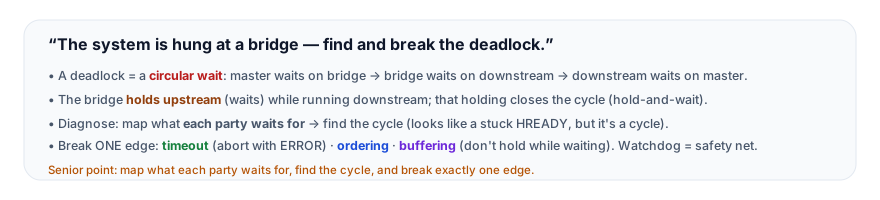
The answer that lands gives the cycle recognition and the break-one-edge fix: "A bridge deadlock is a circular wait — the master, the bridge, and the downstream get stuck waiting on each other in a circle, so nothing completes. It looks like a stuck HREADY — the bus is hung — but the cause is different: not a single stuck slave, but a dependency cycle. The bridge holds its upstream side with wait states while it runs the downstream transaction — that's necessary for rate-matching — and that hold-and-wait closes a cycle if the downstream depends back on the upstream. The classic case: the master is waiting for the bridge to complete; the bridge is waiting for the downstream peripheral; but the peripheral is waiting on the master — maybe it needs the master to service an interrupt, or release a shared resource the master holds. So master to bridge to downstream to master — a cycle where each party is correctly waiting but together they never progress. All four classic deadlock conditions hold: mutual exclusion, hold-and-wait, no preemption, and circular wait. The key debugging insight is recognizing it's a deadlock, not a stuck slave. If I use the stuck-HREADY method — decode the address, find the bridge, check why its HREADYOUT is stuck — I'd find it's not stuck because of its own logic; it's correctly waiting on the downstream. And the downstream is waiting on the master. There's no single broken component; if I keep chasing, I go in circles — literally following the deadlock cycle. So I recognize it's a deadlock and map the wait-for graph: what is each party waiting for, and is there a cycle. Then I break one edge — I don't fix every component, because none is broken. Three ways: a timeout, where the bridge or a watchdog aborts the held transfer with an error after a bound, removing hold-and-wait; ordering, redesigning so the downstream can't depend back on a blocked master, removing the circular wait; or buffering, a posted-write buffer so the bridge completes upstream immediately and drains downstream independently, removing hold-and-wait. One edge breaks the whole cycle. And I always have a bus watchdog as the safety net, because deadlocks are hard to find and some escape to silicon — the watchdog turns a permanent freeze into a recoverable fault." The cycle recognition, the wait-for-graph mapping, and the break-one-edge + watchdog discipline are the senior signals.
10. Practice Challenge
Build and reason from debugging a bridge deadlock.
- The circular wait. Describe a bridge deadlock as a circular wait (master → bridge → downstream → master) and how the bridge's hold-and-wait closes the cycle.
- Vs stuck HREADY. Explain why a deadlock is not a stuck slave and why the stuck-HREADY method fails (goes in circles).
- Read the waveform. From Figure 2, explain how the permanent stall is recognized as a cycle (not a single stuck component).
- Break one edge. Describe the three fixes (timeout / ordering / buffering) and which deadlock condition each removes.
- The watchdog. Explain why a bus watchdog is essential even after design fixes.
11. Key Takeaways
- A bridge deadlock is a circular wait — the master, bridge, and downstream wait on each other in a circle (master → bridge → downstream → master), so nothing completes. It's not a single stuck slave.
- The bridge's hold-and-wait closes the cycle — the bridge holds upstream (wait states) while waiting downstream (necessary for rate-matching — 16.10); the cycle closes when the downstream depends back on the upstream.
- All four conditions hold — mutual exclusion, hold-and-wait, no preemption, circular wait. Removing any one breaks the deadlock.
- The stuck-HREADY method fails — chasing a single stuck slave goes in circles (each party is correctly waiting). Recognize the cycle, map the wait-for graph, and find the cycle.
- Break one edge — timeout (abort with ERROR → removes hold-and-wait), ordering (no circular dependency → removes circular wait), or buffering (don't hold while waiting → removes hold-and-wait). Don't fix every component (none is broken).
- Always have a watchdog — deadlocks are emergent and hard to find (some escape to silicon); a bus watchdog is the essential safety net (permanent freeze → recoverable fault). It's a system-integration failure — prevent by design, guard at runtime.
12. What Comes Next
You now can debug the hardest AHB bug — a deadlock. The final chapter generalizes the debugging skills into a repeatable method:
- Waveform-Based Debug Methodology (next) — a repeatable method for debugging any AHB waveform, unifying all the failure modes of this module.
To revisit the contrast with a single stuck slave, see Stuck HREADY; for the bridge's hold-and-wait, see Bridge FSM (RTL); for the watchdog/assertion safety net, see AHB Assertions (SVA).