
AMBA AHB · Module 12
AHB-Lite Slave Design
How to build a correct AHB-Lite slave — qualify the select (HSEL AND a real HTRANS), register the address-phase controls into the data phase, drive read/write through the register file, and respond with HREADYOUT (low for wait states) and OKAY or the two-cycle ERROR. Plus the HREADYOUT-vs-HREADY relationship in a multi-slave system.
This chapter is the constructive payoff of Module 12: how to build a correct AHB-Lite slave. The slave is where the protocol's two-phase pipeline meets real logic, and there are a handful of rules that must be right. A correct AHB-Lite slave: qualifies its select (act only when HSEL is high AND HTRANS is a real transfer — NONSEQ/SEQ — never on IDLE/BUSY); registers the address-phase controls (the qualified select, HADDR, HWRITE, HSIZE) so it can act in the data phase (the pipeline demands this one-cycle offset); drives the response — HREADYOUT (held low to insert wait states) and HRESP (only OKAY or the two-cycle ERROR); and handles read/write correctly (capture HWDATA in the data phase for writes, mux the register onto HRDATA for reads). It must also understand the HREADYOUT-vs-HREADY relationship in a multi-slave system. This chapter walks the slave's structure, its FSM, and the subtle rules that separate a working slave from a buggy one.
1. What Is It?
An AHB-Lite slave is a bus endpoint that responds to transfers addressed to it. Building one correctly means getting these elements right:
- Qualify the select — respond only when HSEL is high and HTRANS is a real transfer (NONSEQ/SEQ), not IDLE/BUSY (chapter 11.2).
- Register address-phase → data-phase — latch the qualified select, HADDR, HWRITE, HSIZE at the clock edge ending the address phase, to act on them in the data phase.
- Drive the response — HREADYOUT (low for wait states, high to complete) and HRESP (OKAY, or the two-cycle ERROR).
- Handle data — for writes, capture HWDATA (data phase) into the register file; for reads, mux the addressed register onto HRDATA (data phase).
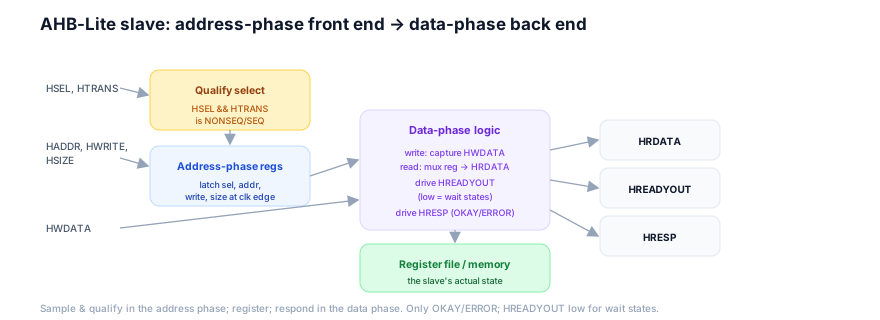
So an AHB-Lite slave is a two-phase machine matching the AHB pipeline: an address-phase front end that samples and qualifies the access and registers it, and a data-phase back end that acts (read/write) and responds (HREADYOUT/HRESP/HRDATA). The discipline is in the details: qualify with HTRANS (or suffer spurious accesses on IDLE/BUSY), register correctly (or misalign with the pipeline), drive a defined HREADYOUT/HRESP every cycle (or hang/confuse the master), and use the two-cycle ERROR (or break the master's follow-on cancellation). Get these right and you have a correct, simple AHB-Lite slave. So slave design is the constructive application of the protocol — the place where the pipeline, HSEL qualification, wait states, and responses all come together.
2. Why Does It Exist?
The AHB-Lite slave's structure exists because it must correctly participate in the two-phase pipeline — which forces the qualify-register-respond pattern — and because each rule prevents a specific failure (spurious accesses, pipeline misalignment, master hangs, broken error handling).
The two-phase pipeline forces the structure: AHB's transfer has an address phase (HADDR, HWRITE, HTRANS, HSEL valid) one cycle before the data phase (where the slave drives/accepts data and the response). So the slave is told about the transfer in the address phase but must act and respond in the data phase — a one-cycle offset. This forces a register: the slave must latch the address-phase information to use it in the next cycle (the data phase). So the qualify-then-register-then-respond structure is a direct consequence of the pipeline — the slave can't respond in the address phase (it doesn't have the data-phase context yet) nor act on stale address-phase signals in the data phase (HADDR has moved on to the next transfer). So the slave registers the address-phase controls to align its action/response to the data phase. So the structure exists to match the pipeline.
The qualification rule prevents spurious accesses (chapter 11.2): HSEL alone can be high during IDLE/BUSY (HADDR still decodes to the slave's region). If the slave acted on HSEL alone, it would perform spurious reads/writes on non-transfers — a read with side effects (popping a FIFO, clearing a flag), an acknowledged non-write. So the slave must qualify: act only when HSEL is high and HTRANS is NONSEQ/SEQ. So the qualification rule exists to prevent the spurious-access bug. So it's a correctness necessity, not optional.
The response rules prevent hangs and broken handshakes: the slave must drive a defined HREADYOUT and HRESP every data-phase cycle. If it left HREADYOUT undefined or never asserted it high, the master would hang (waiting for completion). If it signaled ERROR in one cycle (HRESP = ERROR with HREADYOUT already high) instead of the two-cycle sequence, the master couldn't cancel a pipelined follow-on transfer (chapter 12.4) — a protocol violation. So the response rules (defined HREADYOUT/HRESP, wait via HREADYOUT low, two-cycle ERROR) exist to keep the master correctly synchronized. So each rule prevents a specific failure. So the AHB-Lite slave's structure and rules exist because the slave must correctly participate in the pipeline (forcing qualify-register-respond) and because each rule averts a concrete bug: qualification (spurious accesses), registering (pipeline alignment), defined/two-cycle responses (master hangs and broken follow-on cancellation). The slave is simple (AHB-Lite removed SPLIT/RETRY, so no complex bus-release logic), but it must be correct in these specific ways. So slave design exists as the disciplined construction that makes a bus endpoint correctly pipeline-compliant.
3. Mental Model
Model the AHB-Lite slave as an order counter at a deli with a "take a number, prepare, then serve" flow — when a customer's number is both called and it's a real order (not someone just browsing), the clerk writes down the order details on a ticket (registers the address phase), then in the next step prepares and hands over the food (the data phase), keeping a "please wait" light on if it's not ready yet (HREADYOUT low), and only ever says "here you go" (OKAY) or "sorry, we're out of that" (ERROR).
A deli order counter (the slave) has a disciplined flow. First, the clerk acts on a customer only when their number is called and they actually have an order — not when someone's just browsing the menu (HSEL high but HTRANS = IDLE/BUSY — selected, but no real transfer). That's the qualification: called and a real order. When both hold, the clerk writes the order on a ticket — the items, whether it's pickup or delivery, the quantity (registering HADDR, HWRITE, HSIZE in the address phase) — because they'll prepare it in the next step, not instantly. Then, in the preparation step (the data phase), the clerk makes the order (reads/writes the register file) using the ticket (the registered info, not whatever the next customer is now saying). If it's not ready, they keep a "please wait" light on (HREADYOUT low) — the customer waits — and flip it off when done. And they only ever say "here you go" (OKAY) or, if they can't fulfill it, "sorry, we're out of that" (ERROR) — with a moment's warning before the final "sorry" so the customer behind can adjust (the two-cycle ERROR). Disciplined: qualify, ticket, prepare, serve.
This captures the slave: the deli counter = the slave; number called AND a real order = HSEL high AND real HTRANS (qualify); writing the ticket = registering address-phase controls; preparing in the next step = acting in the data phase; using the ticket not the next customer's words = using registered values (the pipeline offset); the "please wait" light = HREADYOUT low (wait states); "here you go" / "sorry, we're out" = OKAY / ERROR; the warning before "sorry" = the two-cycle ERROR. Qualify, ticket, prepare, serve — the disciplined slave flow.
Watch a read with one wait state — qualify, register, respond:
AHB-Lite slave: read with one wait state
4 cyclesThe model's lesson: qualify (called AND a real order), ticket (register), prepare (data phase), serve (OKAY/ERROR) with a "please wait" light (HREADYOUT). In the waveform, the slave registers the qualified address-phase access, inserts a wait state, then returns the data with OKAY.
4. Real Hardware Perspective
In hardware, the slave is the address-phase sample-and-register logic, the data-phase read/write and response logic, and — crucially in a multi-slave system — the HREADYOUT-vs-HREADY handling that keeps slaves synchronized.
The address-phase front end samples and qualifies: at the rising clock edge ending the address phase, the slave latches sel_q = HSEL && (HTRANS == NONSEQ || HTRANS == SEQ), along with the address (the relevant low bits / register index), HWRITE, and HSIZE, into registers. These registered values (sel_q, the address, write/size) are what the data-phase logic uses. So the front end is a set of flops capturing the qualified, address-phase context. So in hardware, the front end is a qualify-and-latch stage.
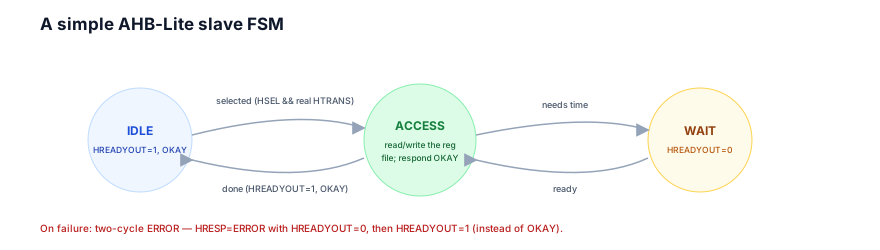
The data-phase back end acts and responds: using the registered context, for a write it captures HWDATA (which the master drives in the data phase) into the addressed register/memory location; for a read it muxes the addressed register onto HRDATA. It drives HREADYOUT — high if the access completes this cycle, low to insert wait states (if it needs more time, e.g. a slow memory) — and HRESP — OKAY normally, or the two-cycle ERROR on failure (HRESP = ERROR with HREADYOUT low, then high). A simple slave is often a small FSM (Figure 3): IDLE → ACCESS (→ WAIT if needed) → respond. So in hardware, the back end is the read/write datapath plus the HREADYOUT/HRESP drivers. So the slave is front-end flops + back-end response logic + register file.
The HREADYOUT vs HREADY relationship is the subtle multi-slave point: each slave drives its own HREADYOUT (its readiness). But the master needs a single HREADY (is the current transfer — to whichever slave — done?). So the interconnect combines the slaves' HREADYOUT signals — selecting the active slave's HREADYOUT (and accounting for the pipeline) — into the shared HREADY that goes to the master and back to all slaves. Why back to all slaves? Because a slave needs HREADY as an input to know when the previous transfer (possibly to another slave) has completed, so it knows when its own address-phase sample is valid (it should sample its address phase only when HREADY is high — i.e. the previous transfer finished). So a slave both drives HREADYOUT (its readiness) and observes HREADY (the system's readiness) — using HREADY to time its address-phase sampling. So in hardware, the slave drives HREADYOUT and observes HREADY, and the interconnect maps between them. So a correct slave must handle this: sample the address phase when HREADY is high, register, then drive HREADYOUT/HRESP/HRDATA in the data phase. Getting the HREADYOUT/HREADY timing right is the subtle part of multi-slave AHB-Lite slave design.
5. System Architecture Perspective
At the system level, the AHB-Lite slave's design discipline is what makes a library of interoperable, reusable slaves possible — and the simplicity (vs full AHB) is what makes correct slaves easy to build, which is a major reason AHB-Lite is attractive.
The interoperability through discipline point: AHB-Lite works as a system because every slave follows the same rules — qualify with HTRANS, register address-phase, drive defined HREADYOUT/HRESP, use the two-cycle ERROR. This shared discipline is the contract that lets any compliant master and any compliant slaves interoperate. A slave that violates the contract (responds on HSEL alone, drives undefined HREADYOUT, one-cycle ERROR) would break the system even if it "works" in isolation. So slave-design correctness is a system property — the slave must be a good protocol citizen. So at the system level, the design rules are the interoperability contract; following them is what makes a slave usable in any AHB-Lite system. This is why slave design is taught as a set of rules, not just "make it do reads and writes."
The simplicity enables a rich slave ecosystem: because AHB-Lite slaves are simple (no SPLIT/RETRY, no arbitration interaction — chapter 12.4), they're easy to design correctly and verify. A reusable slave (a memory controller, a peripheral) needs only the qualify-register-respond logic and OKAY/ERROR responses — a small, well-understood pattern. So there's a rich ecosystem of AHB-Lite slave IP (memories, peripherals, bridges) that's cheap to build and integrate. So at the system level, the slave's simplicity (a consequence of AHB-Lite's reductions) enables the many-slave systems that microcontrollers are — you can attach a dozen simple, correct slaves easily. So the slave simplicity is a system enabler, not just a per-slave nicety.
The verification leverage rounds it out: a simple, rule-following slave is verifiable — the rules (qualify, register, respond, two-cycle ERROR) map directly to checkable properties (assertions: "never act on HSEL without real HTRANS", "always drive defined HREADYOUT", "ERROR is always two cycles", "read data valid when HREADYOUT high on a read"). So slave verification is tractable and largely reusable across slaves (the protocol-compliance checks are common; only the slave-specific function differs). Protocol-checker IP (assertion-based VIP) encodes exactly these rules. So at the system level, the slave's rule-based design makes verification systematic and reusable — you verify protocol compliance once (via shared assertions) and the slave's specific function separately. So AHB-Lite slave design's system value is threefold: the design rules form the interoperability contract (any compliant slave works with any master), the simplicity enables a rich, cheap slave ecosystem (many-slave MCU systems), and the rule-based structure makes verification systematic and reusable. The disciplined-but-simple slave is the building block that makes AHB-Lite systems practical to assemble and verify — which, with the other AHB-Lite simplifications, is why it dominates single-master design. So slave design is where AHB-Lite's simplicity pays off most concretely: simple, correct, interoperable, verifiable endpoints.
6. Engineering Tradeoffs
AHB-Lite slave design embodies the disciplined-but-simple endpoint.
- Qualify (HSEL + HTRANS) vs HSEL-only. Qualifying prevents spurious accesses on IDLE/BUSY at the cost of a little logic (the HTRANS check). HSEL-only is simpler but buggy (spurious reads/writes). Always qualify.
- Register address-phase vs combinational response. Registering aligns the response to the data phase (pipeline-correct) at the cost of the registers. A combinational (address-phase) response would be a phase early — wrong. Always register.
- HREADYOUT wait states vs always-ready. Driving HREADYOUT low lets a slow slave take the time it needs (correct) at the cost of stalling the master. An always-ready slave is simpler but only works if it's genuinely single-cycle. Use wait states when needed.
- Two-cycle ERROR vs one-cycle. The two-cycle ERROR lets the master cancel a pipelined follow-on (protocol-correct) at the cost of the two-cycle sequence logic. A one-cycle ERROR is simpler but violates the protocol. Always use two-cycle.
The throughline: a correct AHB-Lite slave qualifies its select (HSEL AND real HTRANS — never IDLE/BUSY), registers the address-phase controls (select, address, write, size) to act in the data phase (matching the pipeline), and drives the response — HREADYOUT (low for wait states, high to complete) and HRESP (OKAY or the two-cycle ERROR) — handling reads (mux register → HRDATA) and writes (capture HWDATA) in the data phase. It observes HREADY (to time its address-phase sampling) while driving HREADYOUT (its readiness), with the interconnect mapping between them. Each rule prevents a specific bug; the slave is simple (no SPLIT/RETRY) but must be correct in these ways — the disciplined endpoint that makes AHB-Lite systems interoperable and verifiable.
7. Industry Example
Build a simple AHB-Lite register-block slave (a small peripheral).
A peripheral has a few registers: a control register, a status register, and a data register.
- Address-phase sampling. When HREADY is high (the previous transfer completed), the slave samples HSEL, HTRANS, HADDR (the register-index bits), HWRITE, and HSIZE. It computes
sel_q = HSEL && (HTRANS == NONSEQ || HTRANS == SEQ)and registerssel_q, the register index, and HWRITE. - Ignoring IDLE. Between accesses, the master drives HTRANS = IDLE while HADDR may still point into the peripheral's region (HSEL high). Because
sel_qrequires a real transfer, the slave does not act — no spurious read of the status register (which might be read-to-clear), no spurious write. Qualification prevents the bug. - A register read. For a read (registered
sel_q= 1, HWRITE = 0), in the data phase the slave muxes the addressed register (say the status register) onto HRDATA, drives HREADYOUT high and HRESP = OKAY. The master captures the data. (If the register access needed an extra cycle, the slave would hold HREADYOUT low for a wait state first.) - A register write. For a write (
sel_q= 1, HWRITE = 1), in the data phase the slave captures HWDATA (which the master drives in the data phase) into the addressed register (say the control register), drives HREADYOUT high, HRESP = OKAY. The write lands. - An illegal access. A write to the read-only status register: the slave detects the read-only violation and returns the two-cycle ERROR — HRESP = ERROR with HREADYOUT low, then HREADYOUT high. The master faults (chapter 11.5). The slave never silently drops the write.
- HREADY observation. Throughout, the slave watches the shared HREADY to know when each transfer completes (when to advance) — it samples its address phase only when HREADY is high, ensuring it aligns with the system pipeline even when a previous transfer (to another slave) inserted wait states.
The example shows the slave's discipline end-to-end: qualify (ignore IDLE), register the address phase, act in the data phase (read muxes a register, write captures HWDATA), respond with HREADYOUT/OKAY (or two-cycle ERROR for the illegal write), and observe HREADY for timing. This is the template for any AHB-Lite register-block or memory slave.
8. Common Mistakes
9. Interview Insight
AHB-Lite slave design is a hands-on interview topic — the four rules (qualify, register, respond, two-cycle ERROR) and the HREADYOUT/HREADY distinction are the signals.
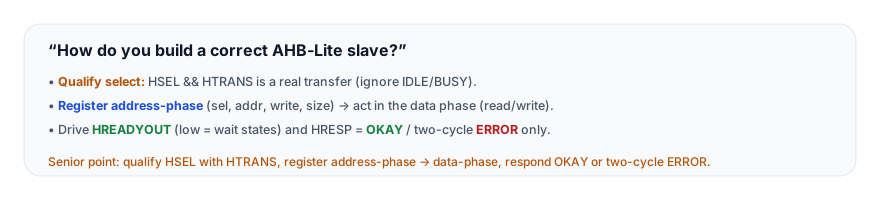
The answer that lands gives the rules and the pipeline reasoning: "A correct AHB-Lite slave follows four rules. First, qualify the select: act only when HSEL is high and HTRANS is a real transfer — NONSEQ or SEQ — not IDLE or BUSY, because HSEL can be high during IDLE and responding then would cause spurious reads or writes. Second, register the address-phase controls — the qualified select, the address, HWRITE, HSIZE — at the clock edge, because the AHB pipeline puts the data phase one cycle after the address phase, so the slave must latch the address-phase context to act on it in the data phase; using the live HADDR in the data phase would read the next transfer's address. Third, in the data phase, perform the access — for a write, capture HWDATA, which the master drives in the data phase, into the register; for a read, mux the addressed register onto HRDATA — and drive the response: HREADYOUT, holding it low to insert wait states if the slave needs more time, high to complete. Fourth, drive HRESP as only OKAY or the two-cycle ERROR — ERROR with HREADYOUT low, then high — never a one-cycle ERROR, so the master can cancel a pipelined follow-on. There's also the HREADYOUT-versus-HREADY point: the slave drives its own HREADYOUT, but observes the shared HREADY — which the interconnect builds from the active slave's HREADYOUT — to time when it samples its address phase." The four rules, the pipeline-forces-registering reasoning, and the HREADYOUT/HREADY distinction are the senior signals.
10. Practice Challenge
Build and reason from an AHB-Lite slave.
- The four rules. State the four rules a correct AHB-Lite slave must follow.
- Qualify. Explain why the slave qualifies HSEL with HTRANS and what bug it prevents.
- Read the waveform. From Figure 2, identify the address-phase sampling, the wait state, and the data-phase response.
- HREADYOUT vs HREADY. Explain the difference and why the slave needs both.
- Two-cycle ERROR. Explain how the slave signals an error and why it takes two cycles.
11. Key Takeaways
- A correct AHB-Lite slave follows four rules: qualify the select (HSEL AND real HTRANS), register the address-phase controls into the data phase, drive a defined HREADYOUT/HRESP every cycle, and use the two-cycle ERROR.
- Qualify with HTRANS — act only on NONSEQ/SEQ, never IDLE/BUSY — or suffer spurious reads/writes with side effects.
- Register address-phase → data-phase — the pipeline puts the data phase one cycle after the address phase, so latch the select/address/write/size; using live HADDR in the data phase is an off-by-one-phase bug.
- Respond in the data phase — capture HWDATA (writes) or mux the register onto HRDATA (reads); drive HREADYOUT (low = wait states, the only delay mechanism), and HRESP = OKAY or the two-cycle ERROR.
- HREADYOUT ≠ HREADY — the slave drives HREADYOUT (its readiness); it observes HREADY (system readiness, built by the interconnect from the active slave's HREADYOUT) to time its address-phase sampling.
- The rules are the interoperability contract — following them makes the slave work with any compliant master/system, simple to build, and systematically verifiable (the rules map to assertions).
12. What Comes Next
You can now build a correct AHB-Lite slave. The final chapter of Module 12 ties the module together:
- AHB-Lite vs Full AHB (next) — a precise tabulation of exactly what AHB-Lite keeps and drops, consolidating the module.
To revisit the pieces this slave design uses, see HSEL Generation (qualification), Simplified Responses (OKAY/ERROR), and Slave-Inserted Wait States (HREADY).
Continue learning
Related tutorials
- Related topic
HSEL Generation
How the AHB decoder produces each slave's HSEL — one comparator per region turns HADDR's upper bits into a one-hot select, valid in the address phase; the slave samples HSEL with HADDR and control, qualifies it with HTRANS, and responds in the data phase.
- Related topic
Simplified Responses
AHB-Lite's OKAY/ERROR-only response model — SPLIT and RETRY are removed because they exist only to release the bus to other masters; a slow slave instead inserts HREADY wait states. Delay is orthogonal to the response: HREADY handles timing, HRESP says only success or failure.
- Related topic
AHB-Lite Overview
The single-master subset of AHB — what it keeps (phases, pipelining, bursts, HREADY, HRESP) and drops (arbiter, request/grant, handover, SPLIT/RETRY), and why it, not full AHB, is what real designs build.
- Related topic
AHB-Lite Response Simplification
How AHB-Lite and AHB5 reduce the response set to just OKAY and ERROR — dropping the legacy RETRY and SPLIT — because a single-master bus has no other master to free, and why this simplification made AHB-Lite the dominant variant.
Standards & specifications
- Governing standard
- Arm AMBA AHB Protocol Specification (IHI 0033)(opens Arm in a new tab)
Defines AHB transfers, the two-cycle response mechanism and arbitration. Bridge design and debug technique are engineering practice built on top of it.
This page also covers RTL structure, verification approach and debugging technique. Those are engineering practice built on the standard, not requirements the standard itself imposes.
Where this fits
Part of the AMBA AHB curriculum.