top of page

System Verilog

As we know, HDLs provide ways to represent the digital circuits in the textual form. Verilog HDL is a HARDWARE DESCRIPTION LANGUAGE to model the digital circuits, the source code is written in a text file with the extension [*. v]. [Click here for Verilog]

​

System Verilog is of both types HARDWARE DESCRIPTION LANGUAGE (HDL) and HARDWARE VERIFICATION LANGUAGE (HVL). It is also called as enhancement of Verilog HDL. The source code is written in a text file with the extension [*. sv].


Any System Verilog source code is created with the combination of IDENTIFIERS and KEYWORDS which are also called as SYNTAX/SEMANTICS. All the lexical conventions of Verilog HDL are supported in System Verilog.

​

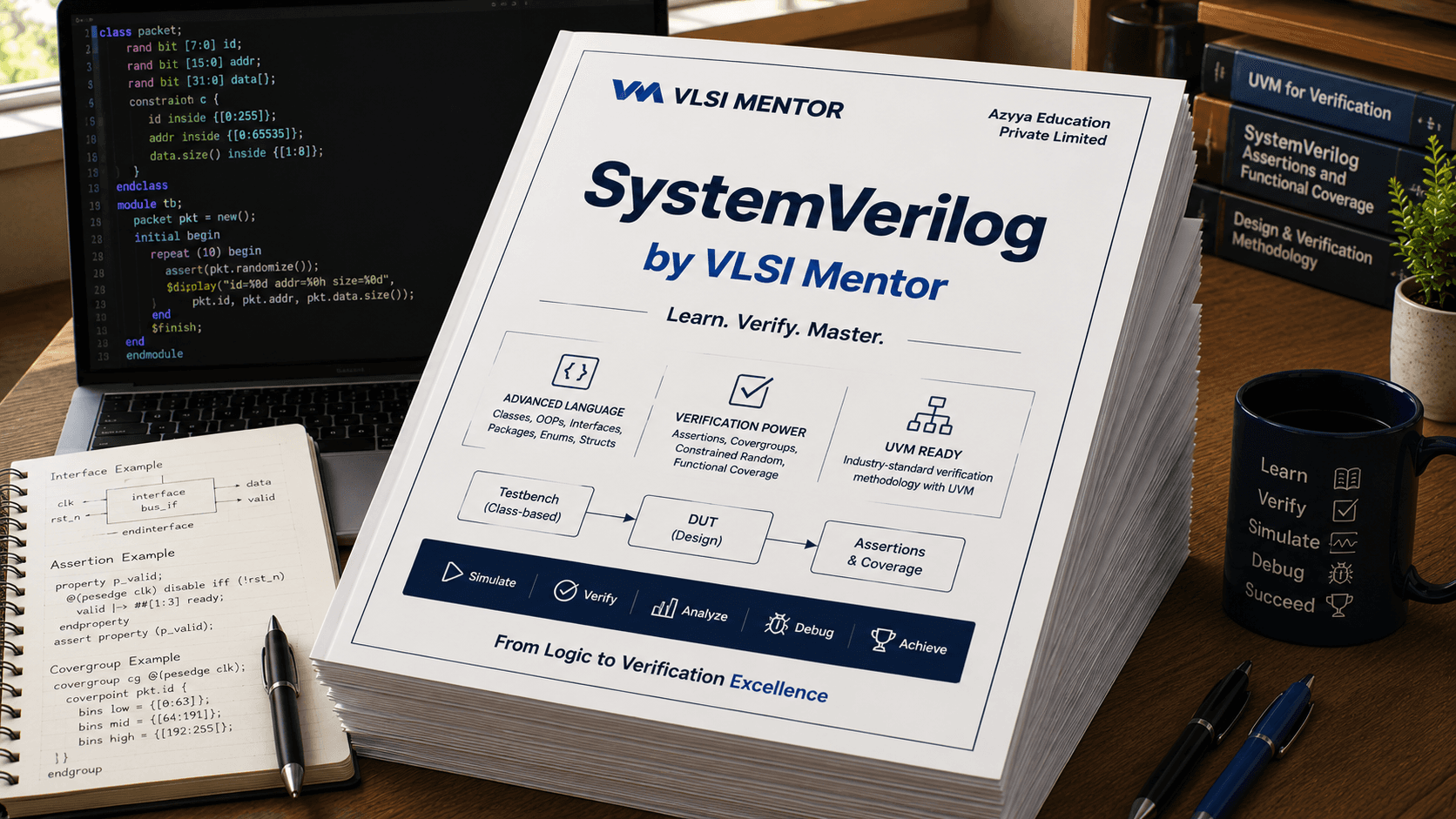
We can say that (Verilog + OOPs = System Verilog). But, its not the complete difference among both the languages. ​

sv_image.png

All the concepts in Verilog are enhanced in System Verilog, we have explained each and every concepts of System Verilog in relation with Verilog so that readers can easily imagine the connection between Verilog and System Verilog.

​

Below points describes the few more differences between Verilog and SV:

Verification Enhancements
Verilog to SystemVerilog testbench flow.png
  1. Objected Oriented Programming (OOPs): concepts are newly added in System Verilog for creating highly scalable and reusable testbench to verify high performance designs.

  2. Interface: is newly added for resolving connection related issues between complex designs and testbench.

  3. Randomization: is the key concept for generating random inputs. Constraints are also added for limitation of range in which generated input value lies.

  4. Coverage: is introduced for capturing the information of the design and testbench while running the simulations.

  5. Assertions: are added for verification of particular part of design directly without running simulations.

  6. Packages, Program Block, Inter Process Communication (IPC)- Mailbox and Semaphore: are newly added for making smooth verification process.

Designing Enhancements
Verilog to SystemVerilog design flow.png
  1. Port Mapping Rules: are added for better connections between design hierarchy.

  2. Behavioural Blocks: Three procedural blocks are newly added for resolving ambiguity errors as well as design blockage/deadlock issue.

    1. always_comb: models combinational circuits.​

    2. always_latch: models latch circuits.

    3. always_ff: models flip flop circuits.

  3. Task & Function: are enhanced for introducing better reusability and splitting the larger code into smaller parts.​

  4. Operator and Loop: are enhanced for reducing the complexity of boolean expression.

  5. Lexical Conventions: are enhanced for better control over the language.

SystemVerilog Course Index (Detailed)

​

1. Introduction to SystemVerilog

    1.1. What is SystemVerilog?

    1.2. Why SystemVerilog? Evolution from Verilog

    1.3. SystemVerilog vs Verilog: Key Differences

    1.4. Design vs Verification in SystemVerilog

    1.5. Compilation Units, Files, and Libraries

    1.6. Tool Flow: Simulation vs Synthesis

    1.7. SystemVerilog Standards Overview (IEEE 1800)

    1.8. Common Use Cases in Industry​

2. SystemVerilog Basics and Syntax

    2.1. Lexical Structure: Tokens, Identifiers, Keywords

    2.2. Comments and Compiler Directives

    2.3. Modules and Programs

    2.4. Ports, Nets, and Variables

    2.5. Data Types Overview: 2-state vs 4-state

    2.6. Operators: Arithmetic, Logical, Bitwise, Reduction

    2.7. Assignments: Blocking vs Non-blocking

    2.8. Procedural Blocks: initial, always

    2.9. always_comb, always_ff, always_latch

    2.10. Statements: if/else, case, loops

    2.11. Tasks and Functions Basics

    2.12. Packages and Importing

    2.13. Compilation and Simulation Basics

3. Data Types and Variables

    3.1. 2-state Types: bit, byte, int

    3.2. 4-state Types: logic, reg

    3.3. Signed vs Unsigned

    3.4. Integer Types: shortint, longint, integer

    3.5. Real Types: real, shortreal, realtime

    3.6. String Data Type

    3.7. Enum Types

    3.8. Structs: Packed and Unpacked

    3.9. Unions: Packed and Unpacked

    3.10. Type Casting: static and dynamic

    3.11. $cast usage

    3.12. Typedef

    3.13. User-defined Types and Aliases

4. Arrays and Memory Structures

    4.1. Packed Arrays

    4.2. Unpacked Arrays

    4.3. Multi-dimensional Arrays

    4.4. Dynamic Arrays

    4.5. Associative Arrays

    4.6. Queues

    4.7. Array Methods and Iterators

    4.8. Array Slicing and Streaming Operators

    4.9. Memory Modeling Techniques

    4.10. Common Pitfalls and Best Practices

5. Procedural Blocks and Timing

    5.1. Procedural Execution Model

    5.2. Event Scheduling Regions

    5.3. Delay Control: #delay

    5.4. Event Control: @, posedge/negedge

    5.5. Wait Statements

    5.6. Fork-Join Variants: join, join_any, join_none

    5.7. Disable Fork and Named Blocks

    5.8. Race Conditions and Avoidance

    5.9. Clocking and Reset Strategies

6. Tasks, Functions, and DPI

    6.1. Task vs Function Differences

    6.2. Automatic vs Static Tasks/Functions

    6.3. Pass by Value vs Reference

    6.4. Input/Output/Inout Arguments

    6.5. Default Arguments

    6.6. Recursive Functions

    6.7. Extern Declarations

    6.8. Import/Export DPI Basics

    6.9. Calling C Functions from SV

    6.10. Practical DPI Examples

7. Interfaces and Modports

    7.1. Interface Basics

    7.2. Interface Ports and Signals

    7.3. Modports

    7.4. Clocking Blocks

    7.5. Virtual Interfaces

    7.6. Connecting Interfaces to DUT

    7.7. Best Practices for Interface Usage

    7.8. Common Errors and Debugging

8. Object-Oriented Programming in SystemVerilog

    8.1. Classes and Objects

    8.2. Class Properties and Methods

    8.3. Constructors and Destructors

    8.4. Inheritance and Method Overriding

    8.5. Virtual Methods and Polymorphism

    8.6. Abstract Classes and Pure Virtual Methods

    8.7. Interface Classes

    8.8. Static Class Members

    8.9. This, Super Keywords

    8.10. Deep Copy vs Shallow Copy

    8.11. Cloning and Copy Methods

    8.12. Class Randomization

    8.13. Common OOP Interview Questions

9. Assertions (SVA)

    9.1. Immediate Assertions

    9.2. Concurrent Assertions

    9.3. Property and Sequence Basics

    9.4. Implication Operators (|->, |=>)

    9.5. Repetition Operators

    9.6. Disable iff

    9.7. Clocking Event and Sampling

    9.8. Assertions for Protocol Checking

    9.9. Cover Properties

    9.10. Assertions Debugging Techniques

    9.11. Best Practices and Common Pitfalls

10. Constrained Random Verification

    10.1. Random Variables and rand/randc

    10.2. Constraints Basics

    10.3. Constraint Blocks and Inline Constraints

    10.4. Constraint Inheritance

    10.5. Soft Constraints

    10.6. Static Constraints

    10.7. Constraint Modes and Disabling

    10.8. Randomize with()

    10.9. Distribution Constraints

    10.10. Solve Before

    10.11. Pre/Post Randomize Methods

    10.12. Constraint Debugging

    10.13. Coverage-driven Randomization

11. Functional Coverage

    11.1. Coverage Concepts and Goals

    11.2. Covergroups and Coverpoints

    11.3. Bins: Default, Illegal, Ignore

    11.4. Cross Coverage

    11.5. Coverage Options and Weights

    11.6. Sampling Events

    11.7. Coverage in Classes

    11.8. Merging Coverage

    11.9. Coverage Reports and Analysis

    11.10. Best Practices for Coverage Closure

12. Interprocess Communication and Synchronization

    12.1. Events

    12.2. Mailboxes

    12.3. Semaphores

    12.4. Processes and Threads

    12.5. Wait Fork

    12.6. Process Control and Kill

    12.7. Synchronization Patterns

    12.8. Common Use Cases in Testbenches

13. Testbench Architecture and Methodologies

    13.1. Basic Testbench Components

    13.2. Directed vs Random Testing

    13.3. Scoreboarding Concepts

    13.4. Reference Models

    13.5. Monitors and Drivers

    13.6. Transaction-Level Modeling (TLM) Basics

    13.7. Reusable Testbench Design

    13.8. Layered Testbench Approach

    13.9. Introduction to UVM

    13.10. Common Debugging Strategies

14. SystemVerilog for Synthesis

    14.1. Synthesizable Constructs

    14.2. always_ff/always_comb Guidelines

    14.3. Coding Style for Synthesis

    14.4. FSM Coding Techniques

    14.5. Resource Sharing and Optimization

    14.6. Synthesis Pitfalls

    14.7. Linting and Coding Rules

    14.8. Best Practices for RTL Designers

15. Advanced SystemVerilog Topics

    15.1. Streaming Operators

    15.2. Random Stability and Seed Control

    15.3. Parameterized Classes

    15.4. Generate Constructs

    15.5. Macros and Compiler Directives

    15.6. Packages and Namespaces

    15.7. SystemVerilog Interfaces in Complex Designs

    15.8. Performance Optimization in Simulation

    15.9. Common Real-world Debug Scenarios

© Copyright 2025 VLSI Mentor. All Rights Reserved.©

Connect with us

  • Instagram
  • Facebook
  • Twitter
  • LinkedIn
  • YouTube
bottom of page