
Makefile tutorials, labs & MCQs.
A deliberately short, two-part Makefile path for VLSI. Part I teaches GNU Make from zero with no semiconductor prerequisite: what Make solves, the target / prerequisite / recipe model, a first Makefile, file and .PHONY targets, dependencies and automatic rebuilding, the four assignment operators, command-line overrides, automatic variables, wildcards and functions, pattern rules, conditionals and includes, shell execution and error handling, and debugging with make -n and --debug. Part II applies it without repeating it: Makefiles in RTL and verification projects, filelists, includes and defines, compile / elaborate / run and waveform / log / clean targets, UVM test and seed selection, regression targets, test lists and pass/fail reports, VCS / Xcelium / Questa integration and simulator dispatch, hand-offs to Bash, Tcl and Python, synthesis and STA automation, and the organisation, parallelism and debugging a production Makefile needs.
Tutorials
Learn Makefile from beginner to advanced through structured tutorials.
Labs
Practice Makefile using progressively challenging hands-on labs.
MCQs
No MCQ papers for Makefile yet.
What Makefile is
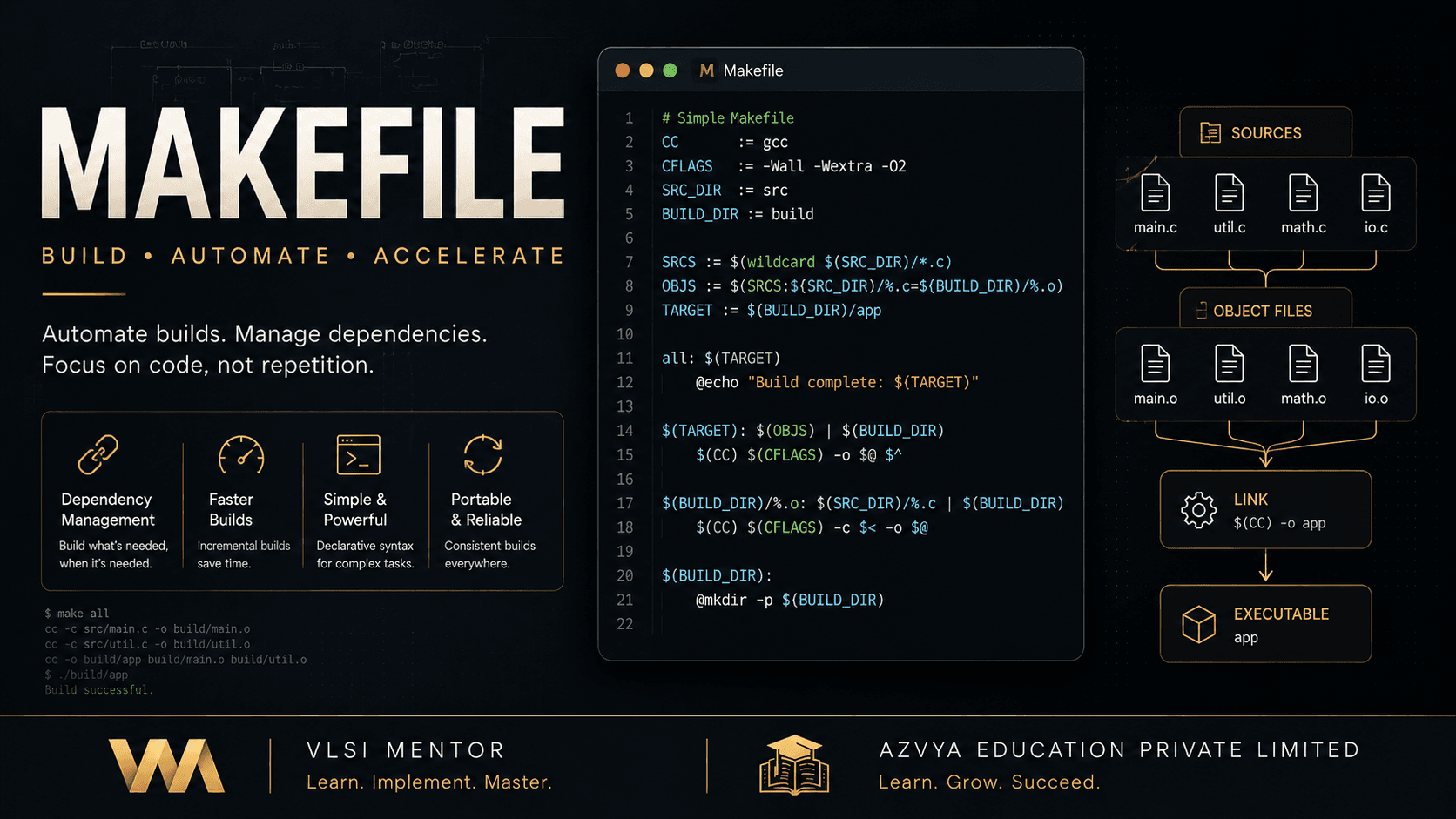
Make is a dependency engine with a build language attached. A Makefile is a set of rules, and each rule names three things: a target to produce, the prerequisites it is built from, and the recipe that produces it. From those rules Make assembles a dependency graph, compares each target against the inputs it was declared to depend on, and runs only the recipes whose work is actually out of date. That is the whole idea, and everything else — variables, pattern rules, parallel execution — is machinery for expressing the graph more compactly. In a chip project it is the layer that turns a sequence of tool invocations into something re-runnable: compile, elaborate, simulate, lint, collect a regression, regenerate an artifact. Make itself knows nothing about any of those tools. It knows files, timestamps and the graph you wrote down.
Why it exists
A shell script re-runs everything, every time; doing the same work by hand re-runs the wrong subset. Neither scales once a compile takes minutes and a regression takes hours. Make exists to answer one question precisely — given what changed, what is the least work that still produces a correct result — and to answer it the same way for every engineer on the team. That is also why it became the interface to EDA flows: a new engineer who can read a rule can run the flow, and a flow that lives in a Makefile is reviewable in the same way the RTL is.
The part engineers get wrong
A build that finished is not the same thing as a build whose graph was right. Make decides what to rebuild from the prerequisites you declared, so an under-declared prerequisite does not produce an error — it produces a stale artifact, silently, while make exits zero. A simulation that reuses yesterday's compiled library after you edited the RTL looks exactly like a passing run. Two consequences follow. Parallel execution with -j does not create this class of bug but it does expose it: an incomplete graph that happened to work in serial order becomes a race, and the failure moves around between runs. And a green build says nothing about the design — Make compared file timestamps, it did not read your HDL, resolve an include, or understand a timing constraint. Reproducibility comes from declaring the inputs honestly and pinning the environment around them, not from the tool.
Before you start
- Comfort running commands in a terminal and knowing where your files are
- Enough shell to read a command line — recipes are shell commands, and Part I explains the rest
- No semiconductor background for Part I; Part II assumes an RTL or verification flow you want to automate
What you will be able to do
- Read any rule as a target, its prerequisites and its recipe, and predict what Make will do with it
- Write a Makefile from an empty file and explain which rule re-ran and which was skipped
- Decide whether a target names a file or an action, and declare the action ones phony
- State prerequisites so that editing an input rebuilds exactly what depends on it, and no more
- Recognise the stale-output bug an under-declared prerequisite causes, and trace it back to the graph
- Control what a bare make builds, and explain the order in which Make walked the graph
- Get the mechanics right that stop beginners cold — the required tab, one shell per recipe line, continuations
- Choose between the assignment operators, and tell a Make variable from a shell variable by when it is expanded
- Factor repeated rules into pattern rules, and keep a growing Makefile readable
- Debug a Makefile by asking what it would do before letting it do it
- Drive an RTL compile, elaborate, run, waveform and clean cycle from one command
- Parameterise a test and a seed, expand a test list into a regression, and collect the results
- Dispatch the same flow across simulators without rewriting it, and call out to Bash, Tcl or Python where that is the better tool
- Judge when a build is genuinely reproducible and when it only appears to be
The learning path
- Make itself — rules and the dependency graphModules 1 and 2. What Make solves that a shell script does not, the target / prerequisite / recipe model, a first Makefile run end to end, and the syntax mechanics that stop beginners. Then the graph itself: real file targets against phony actions, timestamp-driven rebuilding, the stale-output bug a missing prerequisite causes, and the order Make walks the graph in
- Parameterising and reusing a MakefileModules 3 and 4, closing Part I. The four assignment operators and when each is right, environment and command-line overrides, automatic variables, wildcards and functions; then pattern rules that stop a Makefile growing one rule per file, conditionals and includes, how recipes interact with the shell, and debugging with a dry run and the debug output
- Automating a simulation and a regressionModules 5 and 6, where Part I is applied and never re-taught. Makefiles in RTL and verification projects, source filelists, includes and defines, compile / elaborate / run targets, waveform, log and clean targets; then UVM test selection, seed configuration, regression targets over a test list, and pass/fail collection
- Tool integration and production flowsModules 7 and 8. One Makefile across several simulators, simulator selection and configuration, the boundary where Bash, Tcl or Python is the better tool, and synthesis and STA automation; then structuring Makefiles for a large project, parallel execution that stays correct, a complete verification Makefile, and the debugging and review habits a team depends on
Core concepts
New to Makefile? Work through the curriculum in order — each lesson assumes the one before it, and the sequence is what turns the roadmap above into working knowledge.
Already working with it? Use the core-concept links above to jump straight to the topic you need; each one opens the lesson that covers it in most depth.
Where this leads
Standards: GNU Make Manual — The reference for the implementation this track teaches, and the place to confirm whether a feature is GNU-specific. Pattern rules, the four assignment operators, automatic variables beyond the POSIX set, conditionals, includes and most built-in functions are GNU extensions, not portable Make · IEEE Std 1003.1 (POSIX) — the make utility — Specifies the portable baseline: suffix rules, the basic macro syntax and the target / prerequisite / recipe model itself. Worth knowing when a Makefile has to run under a vendor make on a compute farm rather than under GNU Make