AMBA AHB · Module 17
AHB Scoreboards
Checking data integrity with a scoreboard — an independent reference model that predicts expected data and compares it against actual reads from the monitor. On a write it updates the model (expected[addr] = data); on a read it looks up the expected value and compares against the monitor's actual read data, flagging a data-integrity error (address, expected, actual) on a mismatch. The reference model must be independent of the DUT (else it shares its bugs) and honor access attributes (RO/W1C/RC). It catches wrong-data bugs that cycle-level assertions miss — assertions check timing, the scoreboard checks data; they're complementary.
Assertions (17.2) check protocol timing rules; the monitor (17.3) reconstructs transactions. But neither answers the data question: did a read return the value that was written? That's the scoreboard's job — checking data integrity. A scoreboard maintains an independent reference model — a golden model of what the design should contain — and compares its prediction against the actual data the monitor reconstructs. It subscribes to the monitor's transaction stream: on a write transaction, it updates the reference model (expected[addr] = data); on a read transaction, it looks up the expected value for that address and compares it against the actual read data — passing if they match, flagging a data-integrity error (address, expected, actual) if they differ. The reference model is deliberately simple and independent (an associative array from address to data — a "golden memory"), so a bug in the design that returns wrong data is caught by the mismatch. The subtleties: the model must honor access attributes (a read-only, write-1-to-clear, or read-to-clear register predicts differently than plain RW — 16.2) and apply transactions in order. Crucially, the scoreboard catches data-corruption bugs — like the wrong-mux-select (16.5) — that cycle-level assertions miss (they check timing, not data). Assertions and the scoreboard are complementary: assertions check protocol rules, the scoreboard checks data correctness. This chapter builds the scoreboard.
1. What Is It?
An AHB scoreboard is a data-integrity checker: an independent reference model that predicts on writes and compares on reads. Its parts:
- Reference model — an independent golden model of the design's data (an associative array
expected[addr] = data), honoring access attributes (RO/W1C/RC). - Predict on writes — on a write transaction, update the model (
expected[addr] = data). - Compare on reads — on a read transaction, look up
expected[addr]and compare against the monitor's actual read data. - Report mismatches — on a difference, flag a data-integrity error with the address, expected, and actual values.
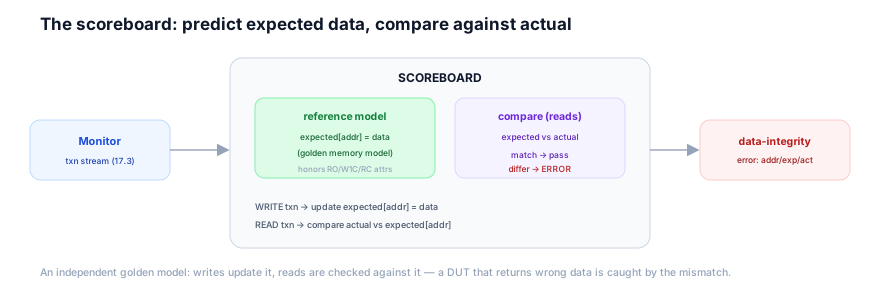
So an AHB scoreboard is the data-correctness checker — the complement to assertions' protocol-correctness checking. The core idea is an independent reference model: a separate, simple, trusted model of what the design should hold. By keeping it independent (a plain associative array, not derived from the DUT's logic), the scoreboard provides a golden prediction that's immune to the DUT's bugs — so when the DUT returns wrong data, the prediction is right and the comparison fails, catching the bug. The flow is simple: writes build the model (record what should be at each address), reads check against it (compare what the DUT actually returned to what's expected). The subtleties are in the prediction: the model must honor the same access attributes the slave does (a read-only register predicts the hardware value, not a written one; a W1C/RC register predicts the attribute-specific behavior), and apply transactions in the right order. An AHB scoreboard is the independent golden model that catches wrong-data bugs.
2. Why Does It Exist?
The scoreboard exists because data correctness is a distinct concern from protocol correctness — assertions check the rules of the bus (timing, sequencing) but not whether the data values are right; so a separate mechanism, an independent reference model, is needed to verify that reads return what was written.
The data correctness ≠ protocol correctness is the root: a design can perfectly obey the protocol (every assertion passes — stable address, two-cycle ERROR, correct HREADY) and still return wrong data — e.g. the wrong-mux-select bug (16.5) returns the wrong slave's data, but all the timing is correct. So assertions (which check timing/sequencing) can't catch it — the protocol is fine; the data is wrong. A separate check comparing the data values is therefore needed, orthogonally to the protocol.
The independent model catches DUT bugs drives the golden-model design: to check the DUT's data, you need a prediction of what's correct — and that prediction must be independent of the DUT (else a DUT bug would also corrupt the prediction, and the comparison would spuriously pass). So the scoreboard maintains an independent, simple reference model — a golden model whose correctness doesn't depend on the DUT's logic. When the DUT is wrong, the golden model is right, so the mismatch catches the bug. The model is independent precisely because the prediction has to be trustworthy when the DUT is not.
The end-to-end data verification is the value: the scoreboard provides end-to-end data verification — every write's data is tracked, every read's data is checked. So any data corruption anywhere (a wrong write, a wrong read, a dropped update) is caught by an eventual read mismatch. In summary, the scoreboard exists because: data correctness is distinct from protocol correctness (assertions check timing, not values — the why); checking data needs an independent prediction (a golden reference model, immune to DUT bugs — the independence); and it provides end-to-end data verification (every write tracked, every read checked — the coverage). The AHB scoreboard is the independent, end-to-end data-integrity checker that complements assertions, catching wrong-data bugs that correct-timing assertions cannot.
3. Mental Model
Model the scoreboard as an accountant keeping an independent ledger of a store's inventory, separate from the store's own records. Every time stock comes in (a write), the accountant records it in their own ledger. Every time the store claims what's on a shelf (a read returns data), the accountant checks the claim against their ledger — and if the store says "10 units" but the ledger says "12", the accountant flags the exact discrepancy (item, expected, claimed). Because the ledger is independent of the store's records, it catches the store's errors — if the accountant just trusted the store's count, they'd catch nothing.
A store (the design) with inventory (the data at each address). An accountant (the scoreboard) keeps an independent ledger (the reference model) — separate from the store's own records. The independence is the whole point: if the accountant just copied the store's own counts, they'd never catch the store's mistakes (a wrong count would be in both). By keeping their own ledger, the accountant has a trusted reference. Now the flow. Every time stock arrives (a write), the accountant records it in the ledger — "12 units of item A received" (expected[A] = 12). They track every delivery. Then, when the store claims what's on a shelf (a read returns data — the monitor reports the actual value), the accountant checks the claim against the ledger: the store says "shelf A has 10", the ledger says "should be 12" — mismatch! The accountant flags the exact discrepancy: "item A — ledger says 12, store claims 10" (the address, expected, actual). If they matched, fine — pass. The accountant must also know the rules: some items are "display only — count is fixed by the manufacturer" (a read-only register — predict the hardware value, not a "received" count); some are "consumed on inspection" (a read-to-clear — the count changes when read). So the accountant's ledger honors these rules when predicting. And they process deliveries and checks in the right order (a delivery before a sale vs after changes the expected count). So the accountant independently tracks what should be there and catches the store whenever its claim doesn't match.
This captures the scoreboard: the store = the design; the inventory = the data at each address; the accountant's independent ledger = the reference model (golden, separate from the DUT); the independence catching errors = the model being immune to DUT bugs; recording each delivery = updating expected[addr] on a write; checking the store's claim against the ledger = comparing actual read data to expected; flagging the exact discrepancy = reporting address/expected/actual; display-only and consumed-on-inspection items = read-only and read-to-clear attributes the model honors; processing in the right order = applying transactions in order. Keep an independent ledger, record every delivery, check every claim, and flag the exact discrepancy.
Watch the scoreboard catch a wrong-data read:
The scoreboard catches a wrong-data read
4 cyclesThe model's lesson: keep an independent ledger, record every delivery, check every claim, and flag the exact discrepancy. In the waveform, the scoreboard predicted expected[A] = D1 from the write, and when the buggy DUT returned D2 on the read of A, the mismatch was caught — with the exact address, expected, and actual.
4. Real Hardware Perspective
In a UVM testbench, the scoreboard is a uvm_scoreboard with an analysis export (subscribing to the monitor), a reference model (an associative array, possibly an attribute-aware model), and a write method that predicts on writes and compares on reads; ordering and attribute-awareness are the correctness-critical parts.
The analysis export subscription: the scoreboard has a uvm_analysis_imp (or export) that connects to the monitor's analysis port (17.3). Each broadcast transaction arrives at the scoreboard's write(txn) method. So in UVM, the scoreboard subscribes to the monitor. So it receives transactions. So that's the input.
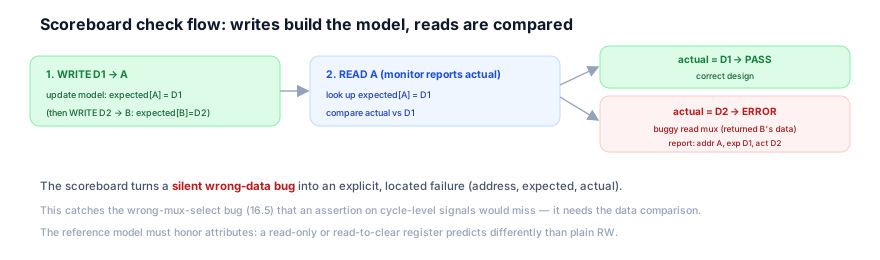
The predict-on-write, compare-on-read: the write(txn) method branches on the transaction: if txn.is_write, update the model — expected[txn.addr] = txn.data (or attribute-specific); if txn.is_read, look up exp = expected[txn.addr] and compare — if (txn.data !== exp) report data-integrity error(addr, exp, txn.data). So in UVM, the scoreboard's core is this predict/compare branch. So it's a method. So that's the logic.
The attribute-awareness and ordering: the reference model must honor the access attributes (16.2): a read-only register's expected value is the hardware-driven value (not a written one — so a write to it doesn't update the model; a read predicts the hardware value); a W1C register clears the written-1 bits in the model; a read-to-clear register's model clears on a read (so a subsequent read predicts the cleared value). And the scoreboard must process transactions in the order the monitor delivers them (and handle pipelining/out-of-order carefully if applicable). Getting the attribute prediction or the ordering wrong makes the scoreboard itself wrong (false errors or missed bugs). So in UVM, the scoreboard is a subscribing component with an attribute-aware reference model and a predict/compare write method — and its correctness (right prediction, right order) is as critical as the monitor's (both are load-bearing). So in UVM, build an attribute-aware, correctly-ordered reference model. So that's the implementation.
5. System Architecture Perspective
At the system level, the scoreboard is the data-correctness authority — the end-to-end guarantee that the design moves and stores data correctly — and it's the complement to assertions that, together, give complete verification: protocol (assertions) plus data (scoreboard).
The data-correctness authority: the scoreboard is the final word on data correctness — it tracks every write and checks every read, so it catches any data corruption (a wrong write address, a wrong read value, a dropped update, a wrong-mux). So at the system level, the scoreboard is the authority on "does the design handle data correctly?". So it's the data guarantee. So data integrity is its domain.
The complement to assertions: assertions check protocol (timing, sequencing, responses); the scoreboard checks data. These are orthogonal and complementary — a design could pass all assertions and fail the scoreboard (correct protocol, wrong data — the wrong-mux bug) or vice versa. So together, they cover both dimensions of correctness. So at the system level, the scoreboard + assertions form a complete checking pair. So it's the data half of the pair. So both are needed.
The golden model reusability: the reference model (the golden memory, attribute-aware) is reusable — the same model checks any AHB slave/memory (configured for its attributes). And it's part of the VIP (17.11) — a reusable data checker. So at the system level, the scoreboard is the data-correctness authority (end-to-end — every write tracked, every read checked), the complement to assertions (protocol + data = complete verification — orthogonal, both needed), and a reusable golden model (part of the AHB VIP, configured per slave). So the scoreboard is the data half of AHB verification — the independent authority that, with assertions, makes the verification complete: the bus obeys the protocol (assertions) and handles data correctly (scoreboard). So check protocol and data together — that's complete. So pair the scoreboard with assertions.
6. Engineering Tradeoffs
The AHB scoreboard embodies the independent-model, predict-compare, attribute-aware design.
- Independent model vs derived-from-DUT. An independent golden model catches DUT bugs (the prediction is trustworthy); a model derived from the DUT's logic would share its bugs (spurious passes). Keep the model independent.
- Simple associative array vs full functional model. A simple
expected[addr]array suffices for memory/RW registers; an attribute-aware (or fully functional) model is needed for RO/W1C/RC and side effects. Model only the behavior the slave has. - Compare on read vs compare continuously. Comparing on reads (when data is observable) is natural; you can't compare internal state directly (it's not visible). Compare reads against the predicted model.
- Scoreboard (data) vs assertions (protocol). Use both — they're complementary (orthogonal correctness dimensions). Relying on one alone leaves the other dimension unchecked.
The throughline: an AHB scoreboard checks data integrity via an independent reference model — a golden model of the design's data (expected[addr] = data) that predicts on writes and compares on reads against the monitor's actual read data, flagging a data-integrity error (address, expected, actual) on a mismatch. The model is independent (immune to DUT bugs), must honor access attributes (RO/W1C/RC predict differently — 16.2), and must apply transactions in order. It catches data-corruption bugs (the wrong-mux-select — 16.5) that cycle-level assertions miss (assertions check timing; the scoreboard checks values). It's the data-correctness authority and the complement to assertions — together they give complete verification (protocol + data). Its correctness (right prediction, right order) is load-bearing, like the monitor's.
7. Industry Example
Build a scoreboard for the register-bank slave (16.2), handling its mixed attributes.
You're verifying the 16.2 register bank — CTRL (RW), STATUS (RO), IRQ (W1C), RXDATA (RC). The scoreboard's reference model must honor each.
- Subscribe to the monitor. The scoreboard's analysis export connects to the monitor's port; each reconstructed transaction arrives at
write(txn). - CTRL (RW) — plain prediction. On a write to CTRL:
expected[CTRL] = txn.data. On a read of CTRL: comparetxn.dataagainstexpected[CTRL]. Straightforward. - STATUS (RO) — predict the hardware value. On a write to STATUS: do not update the model (the DUT ignores RO writes). On a read: predict the hardware-driven status (modeled from the testbench's knowledge of the DUT state) — not any written value. (If the model wrongly predicted a written value, it would false-error against the correctly-ignoring DUT.)
- IRQ (W1C) — clear on write-1. On a write to IRQ: for each bit,
if (txn.data[b]) expected[IRQ][b] = 0(write-1 clears); hardware sets bits in the model per the testbench's event model. On a read: compare against the model. - RXDATA (RC) — clear on read. On a read of RXDATA: compare
txn.dataagainstexpected[RXDATA], then update the modelexpected[RXDATA] = 0(read-to-clear) — so a subsequent read predicts the cleared value (or the next FIFO entry). (If the model didn't clear, the second read would false-error.) - Verifying the scoreboard. Run against a known-good register bank (all checks pass — confirming no false errors from mispredicted attributes), then against a buggy one (e.g. a STATUS that's wrongly writable, or an RXDATA that doesn't clear) — confirming the right check fires.
The example shows the scoreboard's attribute-aware reference model: each register predicted per its attribute (RW plain, RO hardware-value, W1C clear-on-1, RC clear-on-read), so the comparisons are correct — no false errors from mispredicting, and real data bugs caught. The independence (a separate golden model) and the attribute-awareness are what make it trustworthy. This is how you check a register bank's data. This is the data-correctness authority.
7b. The Scoreboard, Written Out
The description above is complete except for the part that makes an AHB scoreboard harder than a generic one: a transaction does not exist in a single cycle. The address and control arrive in the address phase, the data arrives in the data phase, and the response arrives with the data — possibly several cycles later if the subordinate inserted wait states. Anything the scoreboard does has to happen after all three have been collected.
class ahb_txn;
  rand bit [31:0] addr;
  rand bit [31:0] data;      // HWDATA for a write, HRDATA for a read
  rand bit        write;
  rand bit [2:0]  size;
  bit      [1:0]  resp;      // 2'b00 OKAY, 2'b01 ERROR
  int             id;        // monotonic, for ordering and diagnostics
  time            t_addr;    // when the address phase was accepted
  time            t_data;    // when the transfer completed

  function string convert2string();
    return $sformatf("#%0d %s addr=%h data=%h resp=%s (addr@%0t done@%0t)",
                     id, write ? "WR" : "RD", addr, data,
                     resp == 2'b01 ? "ERROR" : "OKAY", t_addr, t_data);
  endfunction
endclass
The monitor's job is to fill that object across the two phases. This is the
compact form; the full treatment, including HREADY qualification of both
halves, is in AHB monitors.
class ahb_monitor extends uvm_monitor;
  `uvm_component_utils(ahb_monitor)
  virtual ahb_if vif;
  uvm_analysis_port #(ahb_txn) ap;
  int next_id;

  function new(string name, uvm_component parent);
    super.new(name, parent); ap = new("ap", this);
  endfunction

  task run_phase(uvm_phase phase);
    ahb_txn pending = null;                 // the transfer awaiting its data phase
    forever begin
      @(posedge vif.HCLK);
      if (!vif.HRESETn) begin pending = null; continue; end

      // A cycle with HREADY low advances nothing: no data phase completes and
      // no address phase is accepted. Skipping it is not an optimisation, it
      // is the difference between one transaction and one per wait cycle.
      if (!vif.HREADY) continue;

      // 1. COMPLETE the outstanding data phase FIRST. Its data and response
      //    belong to the address phase captured on an earlier cycle.
      if (pending != null) begin
        pending.data   = pending.write ? vif.HWDATA : vif.HRDATA;
        pending.resp   = vif.HRESP;
        pending.t_data = $time;
        ap.write(pending);
        pending = null;
      end

      // 2. THEN capture the new address phase. Doing this first would let the
      //    new transfer's address overwrite the one the data phase belongs to.
      if (vif.HSEL && vif.HTRANS[1]) begin
        pending        = ahb_txn::type_id::create("txn");
        pending.addr   = vif.HADDR;
        pending.write  = vif.HWRITE;
        pending.size   = vif.HSIZE;
        pending.id     = next_id++;
        pending.t_addr = $time;
      end
    end
  endtask
endclass
The reference model
typedef enum { ATTR_RW, ATTR_RO, ATTR_W1C, ATTR_RC } attr_e;

class ahb_scoreboard extends uvm_scoreboard;
  `uvm_component_utils(ahb_scoreboard)
  uvm_analysis_imp #(ahb_txn, ahb_scoreboard) txn_imp;

  bit [31:0] expected [bit [31:0]];      // the golden model
  attr_e     attr     [bit [31:0]];      // per-address access attribute
  ahb_txn    last_writer [bit [31:0]];   // diagnostics: who set this value

  int unsigned n_checked, n_mismatch, n_skipped_error;

  function new(string name, uvm_component parent);
    super.new(name, parent); txn_imp = new("txn_imp", this);
  endfunction

  function attr_e attr_of(bit [31:0] a);
    return attr.exists(a) ? attr[a] : ATTR_RW;
  endfunction

  function void write(ahb_txn t);
    // ── An ERRORed transfer DID NOT HAPPEN. A write that was answered with
    //    HRESP=ERROR never reached the storage, so applying it to the model
    //    would make every later read of that address mismatch - burying the
    //    one real failure under a cascade of false ones. A read answered with
    //    ERROR returned no meaningful data, so there is nothing to compare.
    if (t.resp == 2'b01) begin
      n_skipped_error++;
      `uvm_info("SB", $sformatf("ERROR response, not modelled: %s",
                                t.convert2string()), UVM_HIGH)
      return;
    end

    if (t.write) predict(t);
    else         compare(t);
  endfunction

  function void predict(ahb_txn t);
    case (attr_of(t.addr))
      ATTR_RO : ;                                        // hardware owns it
      ATTR_W1C: expected[t.addr] &= ~t.data;             // write-one-to-clear
      default : expected[t.addr]  =  t.data;             // RW
    endcase
    last_writer[t.addr] = t;
  endfunction

  function void compare(ahb_txn t);
    bit [31:0] exp;

    if (!expected.exists(t.addr)) begin
      // Never written and not hardware-owned: the model has no prediction, so
      // reporting a mismatch here would be reporting our own ignorance.
      `uvm_info("SB", $sformatf("read of unwritten %h - no prediction", t.addr),
                UVM_MEDIUM)
      return;
    end

    exp = expected[t.addr];
    n_checked++;

    if (t.data !== exp) begin
      n_mismatch++;
      `uvm_error("SB_MISMATCH", $sformatf(
        "\n  addr      : %h\n  expected  : %h\n  actual    : %h\n"
        "  differing : %h\n  read txn  : %s\n  set by    : %s",
        t.addr, exp, t.data, t.data ^ exp, t.convert2string(),
        last_writer.exists(t.addr) ? last_writer[t.addr].convert2string()
                                   : "(never written - reset value?)"))
    end

    // Read-to-clear takes effect AFTER the value has been returned, so the
    // model must be updated only once the comparison has been made.
    if (attr_of(t.addr) == ATTR_RC) expected[t.addr] = '0;
  endfunction

  function void check_phase(uvm_phase phase);
    super.check_phase(phase);
    if (n_checked == 0)
      `uvm_error("SB", "scoreboard compared nothing - was any read issued?")
    `uvm_info("SB", $sformatf("checked=%0d mismatches=%0d error-skipped=%0d",
                              n_checked, n_mismatch, n_skipped_error), UVM_LOW)
  endfunction
endclass
Three decisions in that file are the ones that separate a scoreboard that debugs quickly from one that does not.
The mismatch message names the writer. last_writer costs one associative
array and turns "address 0x40 expected DEADBEEF got 0" from a starting point into
an answer: you immediately see which write set the expectation, when it completed,
and whether it was the write you thought it was. The XOR of expected against
actual is there for the same reason — a single differing bit points at a bit-lane
or strobe problem, and a completely different value points at a decode or mux
problem.
A read of a never-written address is not a mismatch. The model has no prediction, and reporting one would be reporting the scoreboard's own ignorance as a DUT bug. Seed the model with reset values if you want those reads checked.
check_phase fails a run that checked nothing. A scoreboard whose compare
count is zero verified nothing, and without this it reports success — which is
the same silent-pass failure mode as a vacuous assertion.
One decode fault produced two hundred scoreboard mismatches and hid itself
ERRORED-WRITE-MODELLEDA regression that had been clean began reporting scoreboard mismatches in bulk — around two hundred per run, across many addresses, all of them reads returning zero where the model expected real data. The volume suggested something catastrophic in the read path, but a directed test of any individual address passed, and the protocol assertions were entirely clean.
Bisecting the RTL pointed at a change to the address decoder, which was confusing, because most of the mismatching addresses decoded correctly.
function void write(ahb_txn t);
  // resp was collected by the monitor but never consulted
  if (t.write) predict(t);
  else         compare(t);
endfunctionSorting the mismatches by address and time made the shape obvious: every
mismatching address had been written exactly once by a transfer whose HRESP
was ERROR, and every subsequent read of it mismatched forever after.
The count told the rest. Two hundred mismatches, but only one address range was genuinely mis-decoded — the test simply read those addresses repeatedly. One real fault, one bad model update, and then a permanent disagreement between model and DUT that re-reported itself on every later read.
The clean assertion run was the confirming detail rather than a puzzle. The subordinate had answered with a correct, well-formed two-cycle ERROR; the protocol was obeyed exactly. Nothing about the timing was wrong, which is precisely the division of labour between assertions and a scoreboard.
The scoreboard modelled a write that never happened. A transfer answered with
HRESP = ERROR did not reach the storage — that is what an error response means
— so the DUT's memory still held its previous value while the model had been
updated to the written one. From that moment the two disagreed permanently, and
every read of that address reported a fresh mismatch.
The damage is not the single wrong entry, it is the loss of signal. The genuine failure was one decode fault, reported once by the ERROR response itself. What the team saw instead was two hundred mismatches spread across addresses, which reads like a read-path catastrophe and sends the investigation in the wrong direction. A scoreboard that mismodels an error converts one loud, precise failure into a large diffuse one.
The symmetric case matters too: a read that returns ERROR carries no
meaningful data, so comparing HRDATA against the model on that transfer is
comparing against a value the subordinate never claimed to be driving.
function void write(ahb_txn t);
  // An ERRORed transfer did not happen: do not predict from it, and do not
  // compare against it. Count them so the run reports how many were skipped.
  if (t.resp == 2'b01) begin
    n_skipped_error++;
    `uvm_info("SB", $sformatf("ERROR response, not modelled: %s",
                              t.convert2string()), UVM_HIGH)
    return;
  end
  if (t.write) predict(t);
  else         compare(t);
endfunction
Verifying the fix takes a directed test rather than a random one: issue a write
to an address the decoder faults, confirm the subordinate answers ERROR, then
read the address back and assert that the scoreboard reports no mismatch and
that the read returns the pre-write value. Against the old scoreboard that test
fails; against the new one it passes and the ERROR is reported exactly once, by
the response checker that owns it.
Counting the skips rather than silently discarding them is the part worth
keeping. n_skipped_error in check_phase means a run where the DUT errored
everything cannot masquerade as a run where everything passed — the scoreboard
reports that it modelled almost nothing, which is a different and more useful
statement than reporting no mismatches.
The general rule: a scoreboard models the effect of transfers that completed successfully, and an error response means the transfer had no effect. The same reasoning applies to any protocol with a failure response — see error response for the AHB rules and AHB assertions for the protocol-side checks that run alongside this data-side one.
8. Common Mistakes
9. Interview Insight
The AHB scoreboard is a core verification interview topic — the independent-reference-model idea, the predict/compare flow, and the attribute-awareness + assertions-complement framing are the signals.
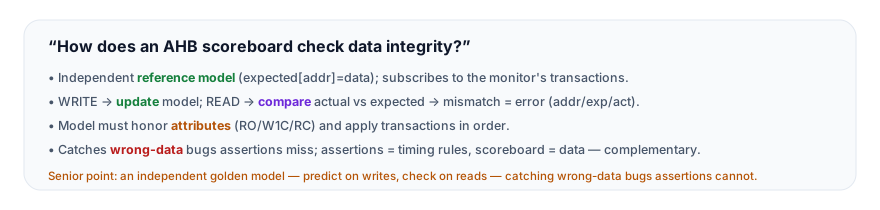
The answer that lands gives the independent model and the complement framing: "A scoreboard checks data integrity. It maintains an independent reference model — a golden model of what the design should contain, basically an associative array from address to expected data — and it subscribes to the monitor's transaction stream. On a write transaction, it updates the model: expected at that address equals the written data. On a read transaction, it looks up the expected value for that address and compares it against the actual read data the monitor reconstructed. If they match, pass; if they differ, it reports a data-integrity error giving the address, the expected value, and the actual value. The key word is independent: the model must not be derived from the DUT, because if it shared the DUT's logic it would share its bugs and spuriously pass. By keeping it a separate, simple golden model, when the DUT returns wrong data the prediction is right and the mismatch catches the bug. The subtlety is that the model has to honor access attributes — a read-only register predicts the hardware value not a written one, a write-one-to-clear register clears on a write of one, a read-to-clear register clears on read — otherwise you get false errors against a correct DUT. And transactions must be applied in order. The important framing is that the scoreboard is complementary to assertions. Assertions check the protocol — timing, sequencing, the two-cycle error. The scoreboard checks the data values. A design can pass every assertion and still return wrong data — like a wrong read mux that returns the wrong slave's data with perfect timing — which only the scoreboard catches. So you need both: assertions for protocol, scoreboard for data. And because the scoreboard's correctness is load-bearing, I'd verify it against a known-good DUT to confirm no false errors and a known-buggy one to confirm the check fires." The independent-model idea, the predict/compare flow, and the attribute-awareness + complement framing are the senior signals.
10. Practice Challenge
Build and reason from the AHB scoreboard.
- The structure. Describe the scoreboard: independent reference model, subscribe to the monitor, predict on writes, compare on reads.
- Independence. Explain why the reference model must be independent of the DUT, and the spurious-pass bug otherwise.
- Read the waveform. From Figure 2, explain how the scoreboard predicts
expected[A] = D1and catches the buggy read returningD2. - Attributes. Explain how the model must honor RO/W1C/RC attributes, and the false-error bug if it doesn't.
- Complement. Explain how the scoreboard (data) complements assertions (protocol), with a bug each catches that the other misses.
11. Key Takeaways
- A scoreboard checks data integrity via an independent reference model (
expected[addr] = data) that predicts on writes and compares on reads against the monitor's actual data — mismatch = data-integrity error (address, expected, actual). - The model must be independent of the DUT — a DUT-derived model shares its bugs (spurious passes). An independent golden model gives a trustworthy prediction.
- The model must honor access attributes (RO predicts the hardware value, W1C clears on write-1, RC clears on read — 16.2) and apply transactions in order — else false errors (or missed bugs).
- It catches wrong-DATA bugs assertions miss — e.g. the wrong-mux-select (16.5) with perfect timing; assertions check protocol, the scoreboard checks values.
- Scoreboard + assertions = complete — complementary, orthogonal dimensions (data + protocol); a design can pass one and fail the other. Use both.
- Its correctness is load-bearing — verify it against a known-good DUT (no false errors) and a known-buggy one (the right check fires). Compare on reads (state is observable there).
11b. Where This Is Specified
- Arm AMBA 5 AHB Protocol Specification (ARM IHI 0033). The address-phase/data-phase pipeline the monitor must reconstruct across; the rule that
HREADYqualifies both the completion of a data phase and the acceptance of an address phase; and the meaning ofHRESP = ERROR— that the transfer did not complete successfully, which is why the scoreboard must not model it. - Arm AMBA 5 AHB, response signalling. The two-cycle ERROR sequence, and the fact that read data accompanying an ERROR response is not required to be meaningful.
- IEEE 1800.2-2020 (UVM).
uvm_analysis_port/uvm_analysis_impfor the monitor-to-scoreboard path,uvm_scoreboard, and thecheck_phasein which end-of-test verification is reported. - IEEE 1800-2023 §7.8 — Associative arrays. The reference model and per-address attribute lookup, including
exists()for distinguishing "never written" from "written as zero".
12. What Comes Next
You now can check data integrity. The next chapters measure and generate — completing the verification loop:
- AHB Functional Coverage (next) — define coverage for transfers, bursts, sizes, responses, and corners (measuring what was exercised).
- Constrained-Random Traffic, and the targeted tests (wait/burst/error) — generate stressful, legal stimulus.
To revisit the transactions the scoreboard consumes, see AHB Monitors; for the attributes the model must mirror, see Register Bank Slave; for the protocol checks it complements, see AHB Assertions (SVA).