AMBA AHB · Module 17
AHB Assertions (SVA)
Writing the core AHB protocol assertions in SystemVerilog Assertions (SVA). An assertion has a clocking event, an antecedent that triggers it, an implication operator (overlapping for the same cycle, non-overlapping for the next), and a consequent that must hold; it fires at the exact cycle of a violation. The core set: address-phase stability while HREADY is low, HREADY liveness (no hang), the two-cycle ERROR sequence, HRESP legality, no-X on a real transfer, and burst sequencing. Bound to the DUT without changing RTL, assertions catch violations at the source, double as cover properties, and bridge to formal verification.
The previous chapter established the mindset — treat the spec as rules and hunt violations. This chapter writes the tool that encodes those rules: SystemVerilog Assertions (SVA). An assertion is a continuously-evaluated property that fires the instant a rule is broken — at the exact cycle and signal — which is exactly what the mindset demands. The anatomy is four parts: a clocking event (@(posedge HCLK) — when to evaluate), an antecedent (the trigger condition — e.g. !HREADY), an implication operator (|-> same cycle, or |=> next cycle), and a consequent (the property that must then hold — e.g. $stable(HADDR)). Read together: "at each clock edge, if the antecedent holds, then the consequent must hold — else fire." The chapter builds the core AHB assertion set — one per rule category from 17.1: address-phase stability (!HREADY |=> $stable(HADDR)), HREADY liveness (no hang), the two-cycle ERROR sequence, HRESP legality, no-X on a real transfer, and burst sequencing. Assertions are bound to the design without modifying the RTL, they catch violations at the source (not as downstream symptoms), and they double as cover properties (confirming scenarios were exercised). This chapter writes the rules as code.
1. What Is It?
AHB assertions are SVA properties that encode the protocol rules and fire at the exact cycle of a violation. Its parts:
- The anatomy — clocking event (
@(posedge HCLK)), antecedent (trigger), implication (|->same /|=>next cycle), consequent (must hold). - The core set — address-phase stability, HREADY liveness, two-cycle ERROR, HRESP legality, no-X-on-real-transfer, burst sequencing (one per 17.1 rule category).
- Bound, not embedded — assertions are bound to the DUT (or in a checker module), checking it without modifying the RTL.
- Fire at the source — a violation fires immediately, at the exact cycle and signal — and assertions double as cover properties (did the scenario occur?).
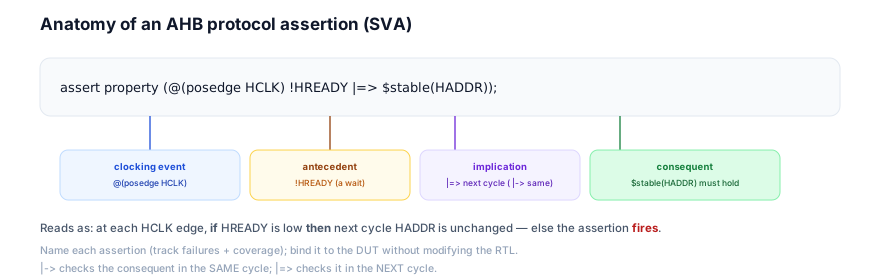
So AHB assertions are the executable form of the protocol rules. The mindset (17.1) said "for each rule, know what violates it and catch it at the exact cycle"; an SVA assertion is that catch — a property the tool evaluates every cycle, firing (an error with the cycle/signal) the moment it's violated. The anatomy maps directly to a rule: the antecedent is when the rule applies (!HREADY — during a wait), the consequent is what must hold ($stable(HADDR) — the address unchanged), and the implication sets the timing (|=> — checked next cycle, because the address should be stable into the next wait cycle). You write one assertion per rule, name it (so failures and coverage are tracked), and bind it to the design (checking it non-intrusively — no RTL change). The assertions then run continuously during any simulation, catching violations whenever they occur. So AHB assertions are the protocol rules, written as continuously-checked properties. So they're how you encode the mindset.
2. Why Does It Exist?
AHB assertions exist because the protocol-checker mindset needs an executable, continuous, precise mechanism — assertions evaluate every cycle (catching violations whenever they occur), fire at the source (pinpointing the exact cycle/signal), and bind non-intrusively (checking the design without changing it) — which directed testing can't provide.
The continuous evaluation is the root: a protocol rule must hold on every cycle, forever — so the check must be continuous. An assertion is evaluated every clock edge, automatically, throughout any simulation — so it catches a violation whenever it occurs, no matter what stimulus triggered it. A directed check (e.g. "after this transfer, verify X") only checks at specific points and misses violations elsewhere. So assertions exist to provide continuous checking — the rule is watched on every edge, for the whole run, regardless of which stimulus happens to be driving.
The fire at the source drives the precision: when an assertion fires, it reports the exact cycle and signal of the violation — at the moment the rule broke. So debugging is immediate: you know exactly what rule broke, when, and where. A downstream check (e.g. a scoreboard catching wrong data later) tells you something is wrong but not where it started. So assertions exist to localize bugs at the source — turning a silent violation into a failure with a cycle number and a signal name (17.1).
The non-intrusive binding is the practicality: assertions can be bound to the design (via bind) or live in a checker module — checking the DUT without modifying its RTL. So you can add protocol checks to any design (even third-party IP) without touching it, and reuse a checker across many designs. So assertions exist as a non-intrusive, reusable checking layer — the same checker module binds to third-party IP you cannot edit. So AHB assertions exist because: protocol rules must be checked continuously (every cycle, forever — assertions evaluate every edge — the why); violations must be localized (fire at the exact cycle/signal — source debugging — the precision); and checks should be non-intrusive (bound to the DUT without RTL changes, reusable — the practicality). So AHB assertions are the executable, continuous, precise, non-intrusive encoding of the protocol rules — the primary tool of the protocol-checker mindset, catching silent violations the instant they occur. §4 writes the full set.
3. Mental Model
Model an SVA assertion as a tripwire alarm wired to a specific rule, watching every moment. Unlike a guard who patrols and might miss a break-in between rounds (a directed check at specific points), a tripwire is always armed: the instant someone crosses the line it's watching (the rule's violation), it sounds immediately, and it tells you exactly which tripwire tripped and when (the cycle and signal). You install one tripwire per rule, label each, and wire them in without rebuilding the room (bind, no RTL change).
A secured building (the design) you want to protect against rule violations. One approach is a patrolling guard (a directed check) who walks a route and inspects things at specific points — but between rounds, a violation could happen and be missed (the guard wasn't there). The better approach is a network of tripwire alarms (assertions), each wired to a specific rule and always armed. A tripwire across the fire exit (the "address stable during waits" rule) sounds the instant someone crosses the line it watches (the exact violation — the address changing while HREADY is low). It's continuous — it doesn't patrol; it watches its line every moment — so it catches the violation whenever it happens, not just when a guard passes by. When it trips, it sounds immediately and identifies itself: "tripwire #7 — east fire exit — tripped at 2:14" (the named assertion, the exact cycle and signal). So you know precisely what rule broke, when, and where — not just "something's wrong somewhere" (which a downstream alarm — like noticing missing inventory later — would give). You install one tripwire per rule you care about (one assertion per protocol rule), label each (name them), and — crucially — you wire them in without rebuilding the room (you bind them to the design without modifying its structure). And the same tripwires can double as traffic counters — confirming someone did walk through the exit (a cover property — the scenario occurred).
This captures SVA assertions: the patrolling guard missing things between rounds = a directed check at specific points (misses violations elsewhere); the always-armed tripwire = the continuously-evaluated assertion; wired to a specific rule = the antecedent/consequent encoding one rule; sounding the instant the line is crossed = firing at the exact cycle of the violation; identifying which tripwire and when = the named assertion reporting the cycle/signal; one tripwire per rule, labeled = one named assertion per protocol rule; wiring in without rebuilding the room = binding to the DUT without RTL changes; doubling as a traffic counter = the assertion as a cover property. Install one always-armed, labeled tripwire per rule, wired in non-intrusively, sounding precisely on violation.
Watch an assertion fire on a two-cycle-ERROR violation (a buggy one-cycle error):
The two-cycle-ERROR assertion fires on a one-cycle error
4 cyclesThe model's lesson: install one always-armed, labeled tripwire per rule, wired in non-intrusively, sounding precisely on violation. In the waveform, the two-cycle-ERROR assertion arms when the first error cycle is seen and fires at cycle 2 when HRESP is wrongly dropped — catching the bug at the exact cycle.
4. The Assertions, Written Out
Everything above describes the assertions. This section is them — a complete, bindable checker module, because a page about writing SVA that never writes any leaves the reader exactly where they started.
// ─────────────────────────────────────────────────────────────────────────────
//  AHB protocol checker. Bind to a slave, a master, or the bus:
//     bind ahb_slave ahb_protocol_checker #(.AHB_LITE(1)) u_chk (.*);
//
//  One named assertion per rule category. Names matter: they are what appears
//  in the failure log and in the assertion-coverage report, so they are how a
//  regression tells you WHICH rule broke rather than merely that something did.
// ─────────────────────────────────────────────────────────────────────────────
module ahb_protocol_checker #(
  parameter bit AHB_LITE  = 1,     // 1 = AHB-Lite/AHB5 (OKAY,ERROR)
                                   // 0 = full AMBA-2 AHB (adds RETRY,SPLIT)
  parameter int MAX_WAITS = 16     // see the liveness note below - a POLICY bound
) (
  input logic        HCLK,
  input logic        HRESETn,
  input logic [31:0] HADDR,
  input logic [ 1:0] HTRANS,
  input logic        HWRITE,
  input logic [ 2:0] HSIZE,
  input logic [ 2:0] HBURST,
  input logic        HREADY,       // bus-level HREADY (slave -> master)
  input logic [ 1:0] HRESP         // 1 bit used when AHB_LITE
);

  localparam logic [1:0] IDLE = 2'b00, BUSY = 2'b01, NONSEQ = 2'b10, SEQ = 2'b11;
  localparam logic [1:0] OKAY = 2'b00, ERROR = 2'b01, RETRY = 2'b10, SPLIT = 2'b11;

  // A transfer is "real" only for NONSEQ/SEQ. IDLE and BUSY are placeholders and
  // carry no address meaning - which is why every rule below is gated on this.
  wire real_transfer = (HTRANS == NONSEQ) || (HTRANS == SEQ);

  // ── Rule 1: address-phase stability during wait states ──────────────────
  //  While the slave holds HREADY low, the master must not change the address
  //  phase of a REAL transfer.
  //
  //  The gating on real_transfer is not decoration. AHB explicitly permits the
  //  master to change HTRANS during a waited transfer in two cases - IDLE may
  //  become NONSEQ, and BUSY may become SEQ - so a blanket
  //  `!HREADY |=> $stable(HTRANS)` reports compliant masters as broken. This is
  //  the single most common way this assertion is written wrongly.
  a_addr_stable_during_wait:
  assert property (@(posedge HCLK) disable iff (!HRESETn)
      (!HREADY && real_transfer) |=> ($stable(HADDR)  && $stable(HWRITE) &&
                                      $stable(HSIZE)  && $stable(HBURST)))
    else $error("[%0t] address phase changed during a wait state (HADDR=%0h)", $time, HADDR);

  // ── Rule 2: the two-cycle error response ────────────────────────────────
  //  An AHB error is signalled over TWO cycles: HRESP=ERROR with HREADY low,
  //  then HRESP=ERROR with HREADY high. The first cycle gives the master time
  //  to cancel the follow-on transfer; a one-cycle error is missed entirely.
  a_two_cycle_error:
  assert property (@(posedge HCLK) disable iff (!HRESETn)
      (HRESP == ERROR && !HREADY) |=> (HRESP == ERROR && HREADY))
    else $error("[%0t] ERROR response was not held for the second cycle", $time);

  // On full AHB, RETRY and SPLIT use the same two-cycle handshake.
  if (!AHB_LITE) begin : g_full_ahb_two_cycle
    a_two_cycle_retry:
    assert property (@(posedge HCLK) disable iff (!HRESETn)
        (HRESP == RETRY && !HREADY) |=> (HRESP == RETRY && HREADY))
      else $error("[%0t] RETRY response was not held for the second cycle", $time);

    a_two_cycle_split:
    assert property (@(posedge HCLK) disable iff (!HRESETn)
        (HRESP == SPLIT && !HREADY) |=> (HRESP == SPLIT && HREADY))
      else $error("[%0t] SPLIT response was not held for the second cycle", $time);
  end

  // ── Rule 3: HRESP legality - dialect-dependent, hence the parameter ─────
  a_hresp_legal:
  assert property (@(posedge HCLK) disable iff (!HRESETn)
      AHB_LITE ? (HRESP inside {OKAY, ERROR})
               : (HRESP inside {OKAY, ERROR, RETRY, SPLIT}))
    else $error("[%0t] illegal HRESP encoding %0b for this AHB dialect", $time, HRESP);

  // ── Rule 4: no X on a real transfer ─────────────────────────────────────
  //  Scoped to real_transfer because HADDR is legitimately don't-care during
  //  IDLE - asserting !$isunknown(HADDR) unconditionally fires all through reset
  //  recovery and every idle cycle, which is how this check gets disabled and
  //  then never re-enabled.
  a_no_x_on_transfer:
  assert property (@(posedge HCLK) disable iff (!HRESETn)
      real_transfer |-> (!$isunknown(HADDR) && !$isunknown(HWRITE) &&
                         !$isunknown(HSIZE) && !$isunknown(HBURST)))
    else $error("[%0t] X/Z on address-phase signals during a real transfer", $time);

  // ── Rule 5: burst sequencing - SEQ may only continue an open burst ──────
  logic burst_open;
  always_ff @(posedge HCLK or negedge HRESETn)
    if (!HRESETn)            burst_open <= 1'b0;
    else if (HREADY) begin
      if (HTRANS == NONSEQ)  burst_open <= (HBURST != 3'b000);  // SINGLE opens nothing
      else if (HTRANS == IDLE) burst_open <= 1'b0;
    end

  a_seq_only_in_burst:
  assert property (@(posedge HCLK) disable iff (!HRESETn)
      (HREADY && HTRANS == SEQ) |-> burst_open)
    else $error("[%0t] SEQ transfer with no burst in progress", $time);

  // ── Rule 6: liveness - a POLICY bound, not a protocol rule ─────────────
  //  AHB does not define a hard maximum number of wait states. The spec
  //  RECOMMENDS slaves keep it small (16 is the usual figure) so masters are
  //  not starved, but a slave that waits longer is slow, not non-compliant.
  //  Keep this labelled: reporting it as "an AHB violation" will be corrected
  //  in review, and the number belongs to your integration budget.
  a_hready_liveness:
  assert property (@(posedge HCLK) disable iff (!HRESETn)
      (real_transfer && !HREADY) |-> ##[1:MAX_WAITS] HREADY)
    else $error("[%0t] HREADY low for more than %0d cycles - integration budget exceeded",
                $time, MAX_WAITS);

  // ── Covers. Every assertion above is an implication, so a quiet bus passes
  //    them all. These are what distinguish "the rules held" from "the rules
  //    were never exercised".
  c_waited_transfer: cover property (@(posedge HCLK) disable iff (!HRESETn)
      real_transfer && !HREADY);
  c_error_response:  cover property (@(posedge HCLK) disable iff (!HRESETn)
      (HRESP == ERROR && !HREADY) ##1 (HRESP == ERROR && HREADY));
  c_burst:           cover property (@(posedge HCLK) disable iff (!HRESETn)
      (HREADY && HTRANS == NONSEQ && HBURST != 3'b000) ##[1:$] (HREADY && HTRANS == SEQ));

endmodule
Proving the assertions can actually fire
An assertion that has never fired is not yet evidence of anything — it may be watching a condition your stimulus cannot create, or be mis-written so its antecedent is never true. This testbench drives one compliant sequence and two deliberate violations past the checker.
`timescale 1ns/1ps

module tb_ahb_checker;

  localparam logic [1:0] IDLE = 2'b00, NONSEQ = 2'b10, SEQ = 2'b11;
  localparam logic [1:0] OKAY = 2'b00, ERROR  = 2'b01;

  logic        HCLK = 0, HRESETn = 0;
  logic [31:0] HADDR  = '0;
  logic [ 1:0] HTRANS = IDLE;
  logic        HWRITE = 0;
  logic [ 2:0] HSIZE  = 3'b010, HBURST = 3'b000;
  logic        HREADY = 1;
  logic [ 1:0] HRESP  = OKAY;

  always #5 HCLK = ~HCLK;

  ahb_protocol_checker #(.AHB_LITE(1), .MAX_WAITS(16)) chk (.*);

  task automatic idle_cycle;
    @(negedge HCLK); HTRANS <= IDLE; HREADY <= 1'b1; HRESP <= OKAY;
    @(posedge HCLK);
  endtask

  initial begin
    repeat (2) @(posedge HCLK);
    HRESETn <= 1'b1;
    idle_cycle();

    // ── 1. COMPLIANT: a waited transfer whose address is held stable ──────
    @(negedge HCLK);
    HTRANS <= NONSEQ; HADDR <= 32'h0000_1000; HWRITE <= 1'b1; HREADY <= 1'b0;
    @(posedge HCLK);                       // wait state - address must hold
    @(negedge HCLK) HREADY <= 1'b1;        // address unchanged: no firing
    @(posedge HCLK);
    idle_cycle();

    // ── 2. VIOLATION: address changes during a wait state ────────────────
    //    a_addr_stable_during_wait must fire here.
    @(negedge HCLK);
    HTRANS <= NONSEQ; HADDR <= 32'h0000_2000; HREADY <= 1'b0;
    @(posedge HCLK);
    @(negedge HCLK) HADDR <= 32'h0000_3000; // ← illegal: moved mid-wait
    @(posedge HCLK);
    @(negedge HCLK) HREADY <= 1'b1;
    @(posedge HCLK);
    idle_cycle();

    // ── 3. VIOLATION: a one-cycle ERROR ──────────────────────────────────
    //    a_two_cycle_error must fire here.
    @(negedge HCLK);
    HTRANS <= NONSEQ; HADDR <= 32'h0000_4000; HREADY <= 1'b0; HRESP <= ERROR;
    @(posedge HCLK);                        // first error cycle: ERROR + !HREADY
    @(negedge HCLK) HRESP <= OKAY; HREADY <= 1'b1;   // ← dropped too early
    @(posedge HCLK);
    idle_cycle();

    repeat (2) @(posedge HCLK);
    $display("\n  Expect exactly TWO assertion failures above:");
    $display("    1. a_addr_stable_during_wait  (address moved mid-wait)");
    $display("    2. a_two_cycle_error          (ERROR held for one cycle only)");
    $display("  If either is missing, that assertion is not testing what it claims.");
    $finish;
  end

endmodule ** Error: [55] address phase changed during a wait state (HADDR=3000)
** Error: [95] ERROR response was not held for the second cycle
Expect exactly TWO assertion failures above:
1. a_addr_stable_during_wait (address moved mid-wait)
2. a_two_cycle_error (ERROR held for one cycle only)
If either is missing, that assertion is not testing what it claims.Why the compliant case matters as much as the violations. Sequence 1 is a waited transfer — exactly the condition a_addr_stable_during_wait watches — and it produced no failure. That is the half of the proof people skip: a checker that fires on violations and on compliant traffic is not a checker, it is noise, and it will be disabled by the first engineer whose clean run it fails.
5. Real Hardware Perspective
In SVA, the assertions are written as named properties (often in a checker/interface bound to the DUT), using the implication operators and sampled-value functions ($stable, $rose, $past, $isunknown); they're concurrent (clocked, continuous); and they compile into checking logic the simulator (or formal tool) evaluates.
The named properties and implication: each rule is a named property and an assert: property p_addr_stable; @(posedge HCLK) !HREADY |=> $stable(HADDR); endproperty then a_addr_stable: assert property (p_addr_stable);. The naming (a_addr_stable) makes failures and coverage traceable. The implication (|->/|=>) is the core operator. So in SVA, rules are named, asserted properties. So it's structured. So that's the form.
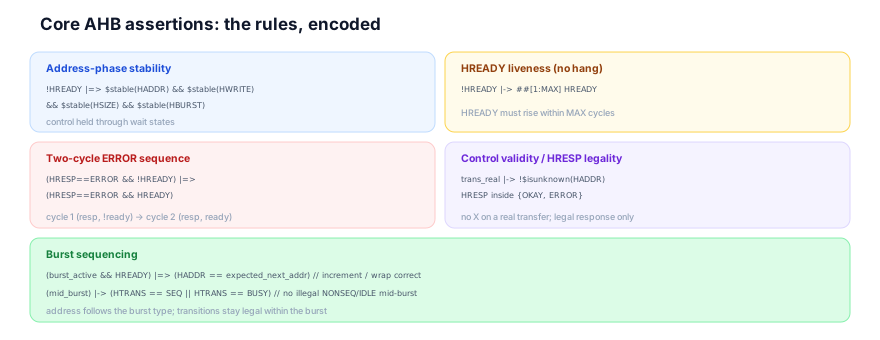
The sampled-value functions: AHB assertions lean on sampled-value functions: $stable(x) (x unchanged from last cycle — for stability rules), $past(x) (x's value N cycles ago — for comparing across cycles), $rose/$fell (edge detection — e.g. $rose(HREADY)), $isunknown(x) (x has X/Z — for no-X rules). These let the property reason about signal behavior over time. So in SVA, the sampled-value functions express the temporal rules. So they're the building blocks. So temporal rules use them.
The concurrent, bound, dual-use: AHB protocol assertions are concurrent (clocked, evaluated continuously — vs immediate assertions inside procedural code). They're typically in an interface or a checker module bound to the DUT (bind ahb_slave ahb_protocol_checker chk(.*);) — checking without modifying the RTL. And the same properties serve as cover properties (c_waited_transfer: cover property (...)) — confirming a scenario (a wait, an error, a burst) was exercised (feeding coverage — 17.5). So in SVA, AHB assertions are concurrent, named properties (using implication + sampled-value functions), bound to the DUT non-intrusively, dual-use (assert + cover). The skill is writing each rule correctly (right antecedent, consequent, and timing operator) and completely (the full rule set). So in SVA, write each rule as a precise, named, bound property. So that's the implementation.
6. System Architecture Perspective
At the system level, AHB assertions are a reusable protocol-compliance checker — a single, verified checker IP that, bound to any AHB interface, enforces the protocol everywhere; they're also the bridge to formal verification and a living, executable form of the spec.
The reusable checker IP: a complete set of AHB assertions, packaged as a checker module/interface, is a reusable protocol-compliance checker — bind it to any AHB master, slave, or interconnect, and it enforces the AHB protocol there. So one verified checker protects every AHB interface in the SoC (and across projects). So at the system level, the assertions are reusable checker IP — the protocol-compliance layer. So it's reusable. So one checker, many interfaces.
The formal verification bridge: SVA assertions are the input to formal verification (model checking — chapter beyond this module). A formal tool proves an assertion holds for all possible inputs (exhaustive) — or finds a counterexample. So the same assertions used in simulation (catching violations on exercised stimulus) can be formally proven (exhaustive — no stimulus needed). So at the system level, assertions bridge simulation and formal — a single property serving both. So it's the formal input. So assertions enable formal.
The executable spec: a complete assertion set is, in effect, an executable, machine-checkable form of the AHB protocol spec. The prose spec says "the address is stable during waits"; the assertion !HREADY |=> $stable(HADDR) is that rule, executable. So the assertion set documents and enforces the protocol simultaneously — a living spec. So at the system level, AHB assertions are a reusable protocol-compliance checker (one verified checker, bound to every AHB interface — the compliance layer), the bridge to formal verification (the same properties proven exhaustively, not just simulated), and an executable form of the spec (documenting and enforcing the protocol at once). So AHB assertions are how the protocol's rules become a reusable, formal-ready, self-documenting enforcement layer — the foundation of trustworthy AHB IP, bound everywhere and proven where it matters. So write the checker once, bind it everywhere, prove it where it counts.
7. Engineering Tradeoffs
AHB assertions embody the continuous, source-localized, non-intrusive checking design.
- Assertions (continuous) vs directed checks (sampled). Assertions check every cycle (catch violations whenever they occur); directed checks only at specific points (miss them). Use assertions for protocol rules.
- Bound checker vs embedded checks. A bound checker (or interface) checks the DUT without modifying it (reusable, non-intrusive); embedding checks in the RTL couples them. Bind a reusable checker.
|->(same cycle) vs|=>(next cycle). Use|->when the consequent must hold the same cycle as the antecedent;|=>when next cycle. Choosing wrong shifts the check by a cycle (false pass/fail). Match the operator to the rule's timing.- Assert + cover (dual-use) vs assert only. Using properties as both asserts (catch violations) and covers (confirm exercised) maximizes value; assert-only leaves you unsure the check ever ran. Add cover properties.
The throughline: AHB assertions encode each protocol rule (17.1) as an SVA property — a clocking event + antecedent (trigger) + implication (|-> same / |=> next cycle) + consequent (must hold) — that fires at the exact cycle of a violation. The core set: address-phase stability (!HREADY |=> $stable(HADDR)...), HREADY liveness (!HREADY |-> ##[1:MAX] HREADY), the two-cycle ERROR ((HRESP==ERROR && !HREADY) |=> (HRESP==ERROR && HREADY)), HRESP legality (HRESP inside {OKAY, ERROR}), no-X on a real transfer, and burst sequencing. They use sampled-value functions ($stable, $past, $rose, $isunknown), are bound to the DUT non-intrusively, double as cover properties, and bridge to formal. They're the executable, continuous, precise form of the protocol rules — a reusable compliance checker.
8. Industry Example
Write and bind the core assertion set for the simple slave (16.1), and watch each catch a Module-16 bug.
You're adding an AHB protocol checker to verify the 16.1 slave. You write the core assertions and bind them.
- Address-phase stability → catches the un-gated capture (16.7).
a_addr_stable: assert property (@(posedge HCLK) !HREADY |=> $stable(HADDR) && $stable(HWRITE));. If a waited transfer's address changes mid-wait (the bug), this fires at the exact cycle. (Paired withcover property (!HREADY)to confirm waits occurred.) - Two-cycle ERROR → catches the dropped HRESP (16.6).
a_err_2cycle: assert property (@(posedge HCLK) (HRESP==ERROR && !HREADY) |=> (HRESP==ERROR && HREADY));. If the slave dropsHRESPto OKAY in the second cycle (the bug), the consequent fails and it fires. - HREADY liveness → catches a stuck HREADYOUT (16.4).
a_hready_live: assert property (@(posedge HCLK) !HREADY |-> ##[1:MAX] HREADY);. IfHREADYnever rises (a hung slave), it fires afterMAXcycles. - HRESP legality + no-X.
a_hresp_legal: assert property (@(posedge HCLK) HRESP inside {OKAY, ERROR});anda_no_x: assert property (@(posedge HCLK) real_transfer |-> !$isunknown(HADDR));— catching an illegal response or an X on a real transfer. - Binding.
bind ahb_lite_slave ahb_protocol_checker u_chk (.HCLK, .HRESETn, .HADDR, .HWRITE, .HTRANS, .HREADY, .HRESP, ...);— the checker watches the slave without modifying its RTL. - Verifying the checker. You inject each bug (a buggy slave variant) and confirm the corresponding assertion fires — proving the checks are real (not vacuous).
The example shows the assertions operationalized: each core assertion encodes a rule and catches the specific Module-16 bug that violates it — at the exact cycle — bound non-intrusively, paired with covers (and tested against known violations). This is how you'd actually protocol-check the 16.1 slave. This is the mindset as code.
9. Common Mistakes
10. Debug Lab — The Assertion That Passed for Six Months
A protocol checker reports zero failures for six months, then a silicon bug arrives that it was written to catch
VACUOUS-ASSERTION-NEVER-FIREDAn AHB slave passes every regression. a_two_cycle_error — written specifically to catch a dropped HRESP — has never failed in six months. Silicon then returns a bug that is exactly a one-cycle error response: the master misses the error and completes a transfer that faulted.
The assertion existed, was bound, was enabled, and was green throughout.
Expected. Green means the rule held.
Actual. Green meant the rule was never tested. a_two_cycle_error is an implication whose antecedent is HRESP == ERROR && !HREADY. The regression's slave model never produced an error response at all, so the antecedent was false on every cycle of every run, the implication passed vacuously every time, and the consequent was evaluated exactly zero times.
The distinction that resolves this is not in the failure count — it is in the cover data, which is why §4 pairs every assertion with one:
- Check
c_error_response. If the cover count is zero, no error response ever occurred, and every error-related assertion in the run is vacuous. This single number separates "the design is correct" from "the scenario never ran." - Check the non-vacuous success count. Every simulator can report vacuous versus real successes per assertion; the default report usually blends them. An assertion whose successes are 100% vacuous is a finding even though nothing failed.
- Ask what generates the antecedent. Here: does the slave model have an error-injection mode, and does any test enable it? A protocol checker can only be as good as the stimulus that reaches its trigger.
Two independent gaps that look like one. The stimulus gap: no test ever asked the slave for an error response, so the error path of the design was unexercised. The methodology gap: the assertion result was read as evidence without checking whether it had been reached — a "0 failures" dashboard cannot distinguish a rule that held from a rule nobody tried.
Neither is an assertion-writing mistake. a_two_cycle_error is correct. It was simply never given the chance to be wrong.
Make the antecedent reachable, then make its absence a failure:
// 1. Stimulus: the slave model needs an error-injection mode, and negative
//    tests must enable it. An error path with no error test is untested logic.
if (inject_error && addr inside {[ERR_LO:ERR_HI]}) begin
  HRESP   <= ERROR;  HREADY <= 1'b0;   // first error cycle
  @(posedge HCLK);
  HRESP   <= ERROR;  HREADY <= 1'b1;   // second - the rule under test
end

// 2. Sign-off: an unhit cover on a spec-critical rule fails the run.
//    Zero failures AND every cover hit is the only green state.
c_error_response: cover property (@(posedge HCLK) disable iff (!HRESETn)
(HRESP == ERROR && !HREADY) ##1 (HRESP == ERROR && HREADY));Treat an unhit cover on a spec-critical assertion as a regression failure, not a report line. The pairing rule from §4 exists for this: the assertion catches the bug while the scenario runs, and the cover proves the scenario ran. Neither number means anything alone.
And write the negative test with the assertion. An assertion added without a test that makes it fire is an untested check — run the deliberate violation once, watch it fire, then fix the stimulus back. That is what the §4 testbench does, and it is the cheapest possible insurance against six green months.
11. Interview Insight
AHB assertions are a core verification interview topic — the anatomy (implication operators), the core rule set, and the vacuity/testing awareness are the signals.
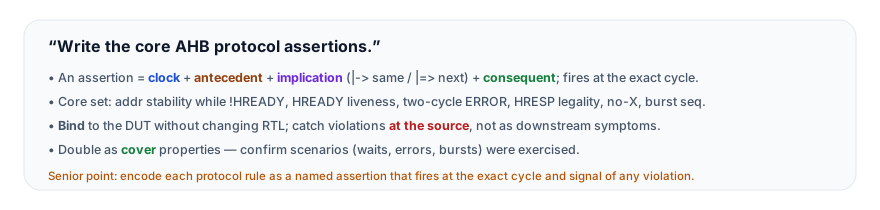
The answer that lands gives the anatomy and the core set: "An SVA assertion encodes a protocol rule as a property that's evaluated every clock edge and fires at the exact cycle of a violation. It has four parts: a clocking event saying when to evaluate, like at the posedge of HCLK; an antecedent, the trigger condition, like HREADY being low; an implication operator — the overlapping arrow checks the consequent in the same cycle, the non-overlapping double arrow checks it in the next cycle; and the consequent, what must hold, like the address being stable. So address-phase stability is: if HREADY is low this cycle, then next cycle the address is stable — using the non-overlapping operator. The core AHB assertion set, one per rule category, is: address-phase stability while HREADY is low; HREADY liveness, that it rises within some bound so the bus doesn't hang; the two-cycle ERROR sequence — if HRESP is ERROR with HREADY low, then next cycle HRESP is still ERROR with HREADY high; HRESP legality — it's inside the legal set OKAY or ERROR; no unknowns on a real transfer; and burst sequencing — the address increments or wraps correctly and HTRANS stays legal mid-burst. I'd write these using sampled-value functions like $stable, $past, and $isunknown, name each one so failures and coverage are tracked, and bind them to the DUT so they check it without modifying the RTL. Two things I'm careful about: getting the implication operator right, because an off-by-one shifts the check by a cycle, and vacuity — an assertion whose antecedent never holds passes without ever checking, so I pair each assert with a cover of the antecedent and I test the assertions by injecting known violations to confirm they fire. The same properties also double as cover properties to confirm scenarios like waits and errors were actually exercised." The anatomy, the core set, and the vacuity/testing awareness are the senior signals.
12. Practice Challenge
Build and reason from AHB assertions.
- The anatomy. Break down an assertion (clocking event, antecedent, implication, consequent) and read it in plain English.
- The core set. Write (in SVA-like form) the core AHB assertions: address stability, HREADY liveness, two-cycle ERROR, HRESP legality, burst sequencing.
- Read the waveform. From Figure 2, explain how the two-cycle-ERROR assertion arms and fires on a dropped
HRESP. - Operator and functions. Explain
|->vs|=>and the use of$stable/$past/$isunknown, with a rule that needs each. - Vacuity and testing. Explain vacuous assertions, why they're dangerous, and how covering antecedents + injecting bugs guards against them.
13. Key Takeaways
- An SVA assertion encodes a protocol rule as a property: clocking event + antecedent (trigger) + implication (
|->same /|=>next cycle) + consequent (must hold) — firing at the exact cycle of a violation. - The core AHB set: address-phase stability (
!HREADY |=> $stable(HADDR)...), HREADY liveness (!HREADY |-> ##[1:MAX] HREADY), two-cycle ERROR ((HRESP==ERROR && !HREADY) |=> (HRESP==ERROR && HREADY)), HRESP legality (inside {OKAY, ERROR}), no-X on a real transfer, burst sequencing. - Match the operator to the timing —
|->same cycle,|=>next; an off-by-one misses the violation. Use the right sampled-value function ($stable/$past/$rose/$isunknown). - Guard against vacuity — an assertion whose antecedent never holds passes without checking. Cover the antecedents and test assertions against injected known violations.
- Bind, non-intrusive, dual-use — bind the checker to the DUT without changing RTL; assertions double as cover properties; they bridge to formal (proven exhaustively).
- They catch violations at the source — the exact cycle/signal — turning silent protocol breaks into located failures; a complete set is a reusable compliance checker and an executable spec.
15. Where This Is Specified
The rules encoded in §4 are normative in the Arm AMBA AHB Protocol Specification — transfer types and the address phase, waited transfers and HREADY, the two-cycle response handshake, and the HRESP encodings. Arm publishes it on the AMBA AHB documentation page; AHB-Lite and full AHB are separate documents in that family, and which one applies decides §4's AHB_LITE parameter.
Three points reward reading the specification rather than a summary, because each one changes an assertion:
HRESPwidth and encodings differ by dialect. Full AMBA-2 AHB has two bits and four responses; AHB-Lite has the reduced set. AnHRESP inside {OKAY, ERROR}check is correct in one dialect and wrong in the other — see AHB-Lite vs full AHB and SPLIT responses.- The address-stability rule has documented exceptions. A master may change
HTRANSduring a waited transfer in specific cases, which is why §4's assertion is gated on a real transfer instead of stalling on any!HREADY. - There is no hard maximum wait-state count. The spec recommends slaves stay within a small bound; it does not make exceeding it a violation. That is why
a_hready_livenessis labelled an integration budget rather than a protocol rule.
The SVA itself is IEEE Std 1800 (SystemVerilog), clause 16 — see concurrent assertions for the sampling and implication semantics, and for the vacuity behaviour that §10's Debug Lab turns on.
Related lessons. The mindset these encode is the protocol-checker mindset; the signals are HTRANS, HREADY vs HREADYOUT, and HBURST. The failure modes they catch are bad HRESP, error responses, and wait-state bugs. The rest of the verification layer is AHB monitors, scoreboards, and coverage.
14. What Comes Next
You now can write the assertions that encode the protocol rules. The next chapters build the transaction-level verification components:
- AHB Monitors (next) — build a passive monitor that reconstructs transfers from the bus signals (the foundation for scoreboards and coverage).
- Scoreboards, Functional Coverage, and the rest — check data integrity and measure completeness.
To revisit the rules these assertions encode, see The Protocol-Checker Mindset; for the slave behaviors they check, see HRESP Generation and Address / Control Capture.