AMBA AHB · Module 17
Wait-State Testing
Stressing HREADY behavior across random wait patterns — the targeted testing that flushes out the subtle pipeline bugs that pass zero-wait tests. Cover the patterns (zero/single/multi/random/back-to-back) on reads, writes, and inside bursts; stress both sides (slave response waits via HREADYOUT low, and master request pacing via IDLE/BUSY and delays). The bugs caught — un-gated address capture, multiple write-commit during a wait, monitor mis-pairing, address-changing-during-a-stall, stuck HREADY — all pass zero-wait tests and only fail under waits. Use constrained-random wait counts and confirm via coverage that the wait buckets were hit.
The general methodology is in place (assertions, monitor, scoreboard, coverage, constrained-random); the next three chapters apply it to the hardest-to-test corners. First: wait states — the single richest source of subtle bugs in AHB. Recall from Module 16 that almost every subtle slave bug only manifests under wait states: the un-gated address capture (16.7) corrupts only waited transfers; the multiple write-commit (16.8) fires only during a wait; the monitor mis-pairing (17.3) happens only across a wait. These all pass zero-wait tests and only fail under waits. So wait-state testing deliberately varies HREADY behavior to flush them out. You cover the patterns — zero-wait, single-wait, multi-wait, random per-transfer, back-to-back stalled — on reads and writes and inside bursts. And you stress both sides: the slave inserts response waits (driving HREADYOUT low — a slow memory, a busy peripheral), and the master agent inserts request pacing (IDLE/BUSY cycles, delays). Testing only slave waits misses master-pacing bugs; testing only master pacing misses the slave's wait logic. You drive this with constrained-random wait counts (17.6) and confirm with coverage (17.5) that the wait buckets were hit. This chapter builds wait-state testing.
1. What Is It?
Wait-state testing is targeted verification that varies HREADY to exercise stall handling. Its parts:
- Wait patterns — zero-wait, single-wait, multi-wait, random per-transfer, back-to-back stalled — across reads, writes, and bursts.
- Both sides — slave response waits (
HREADYOUTlow) and master request pacing (IDLE/BUSY, delays). - Targets the subtle bugs — the pipeline bugs that only manifest under waits (un-gated capture, multi-commit, mis-pairing, address-in-stall, stuck HREADY).
- Random + coverage — constrained-random wait counts/pacing (17.6), with coverage (17.5) confirming the wait buckets were exercised.
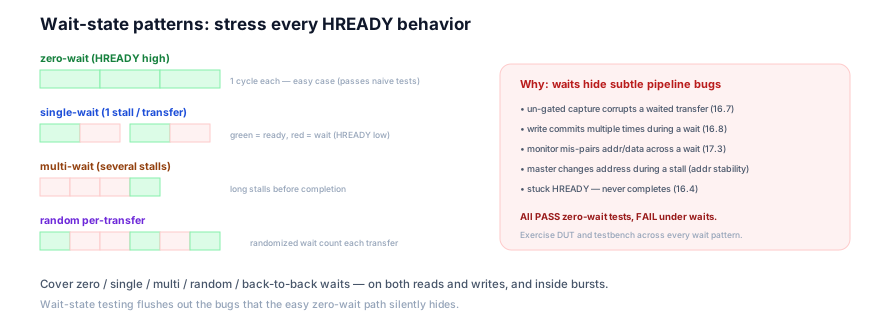
So wait-state testing is the deliberate stressing of the bus's flow-control mechanism — the place where AHB's pipelining meets real timing variation, and where the subtle bugs live. The insight (from Module 16's repeated warnings) is that the zero-wait path is deceptively easy — a slave that's only tested with back-to-back zero-wait transfers can be riddled with pipeline bugs that never show because the triggering condition (a wait) never occurs. Wait-state testing creates that condition systematically: it varies HREADY across every pattern (one wait, many waits, random, back-to-back), on every transfer type (read, write, burst beats), from both sides (slave response, master request). The result is that the pipeline-dependent bugs finally get triggered — and the checkers (assertions, scoreboard) catch them. So wait-state testing is the targeted exercise of stall handling. So it's how you find the bugs the easy path hides.
2. Why Does It Exist?
Wait-state testing exists because the zero-wait path is deceptively easy (most subtle bugs don't appear there), because wait states are the trigger for the pipeline-dependent bugs, and because both sides (slave and master) generate waits — so the only way to find these bugs is to deliberately and systematically exercise every wait pattern from both sides.
The zero-wait is deceptively easy is the root: a zero-wait transfer completes in one cycle — so the pipeline (address phase, data phase, the holding across waits) is never stretched. As a result, the bugs that depend on the stretch (the capture that needs HREADY-gating, the commit that needs the HREADYOUT term, the monitor that needs to hold across a wait) never get triggered — they pass. So a zero-wait test suite gives false confidence. So you can't rely on the easy path. So wait-state testing exists to go beyond zero-wait. So it's the un-easy path. So the easy path hides bugs.
The waits are the trigger drives the targeting: the Module-16/17 bugs share a trigger: a wait state (with the master pipelining the next transfer). The un-gated capture needs a wait (to let the next address overwrite); the multi-commit needs a wait (to commit repeatedly); the mis-pairing needs a wait (to misalign). So creating wait states is exactly what triggers these bugs. So wait-state testing exists to create the trigger — systematically. So it's the bug-trigger generator. So triggering needs the waits.
The both sides generate waits is the completeness: waits come from two sources — the slave (response stalls, HREADYOUT low) and the master (request pacing, IDLE/BUSY, delays). The slave-side waits stress the slave's wait logic and the master/monitor's holding; the master-side pacing stresses the slave/monitor's gap/BUSY handling. Each source triggers different bugs. So testing only one misses the other's bugs. So wait-state testing exists to stress both sides. So it's two-sided. So completeness needs both. So wait-state testing exists because: the zero-wait path is deceptively easy (most subtle bugs don't appear there — false confidence — the why); wait states are the trigger for the pipeline-dependent bugs (creating them systematically triggers the bugs — the targeting); and both sides (slave/master) generate waits (each triggering different bugs — the completeness). So wait-state testing is the dedicated, systematic, two-sided stressing of HREADY behavior that triggers and catches the pipeline-dependent bugs the zero-wait path hides — the highest-value targeted testing for AHB. So this chapter creates the triggers. So vary HREADY widely, from both sides.
3. Mental Model
Model wait-state testing as stress-testing a relay race's baton handoffs by deliberately varying the timing — not just clean, fast handoffs, but pauses, fumbles, and stutter-steps. A clean fast handoff (zero-wait) always works; the failures show up when a runner hesitates (a wait), double-pumps (back-to-back stalls), or the incoming runner is late (master pacing). To find the team's handoff bugs, you must deliberately introduce every kind of timing disruption — from both the incoming and outgoing runner — because the clean handoff never reveals them.
A relay race (the pipelined bus) where the baton (a transfer) is handed off between runners (phases/components). The clean, fast handoff (a zero-wait transfer) always works — the runners are practiced at the easy case, and it looks like the team has perfect handoffs. But real races have timing disruptions, and that's where handoff failures happen: a runner hesitates at the handoff (a single wait); a runner stumbles and pauses for several beats (a multi-wait); consecutive handoffs are all shaky (back-to-back stalls); the incoming runner arrives late or stutters (master request pacing — IDLE/BUSY). To find the team's handoff bugs — the dropped baton, the early release, the grab at the wrong moment — you can't just watch clean handoffs (they never fail). You must deliberately introduce every kind of timing disruption: have the outgoing runner hold the baton longer (slave response waits), have the incoming runner arrive late or hesitate (master pacing), vary the length of the pauses (single/multi/random), and do it repeatedly (back-to-back). And you must disrupt from both runners' sides — a bug might show only when the outgoing runner hesitates, or only when the incoming one is late. By systematically stressing the handoff timing from both sides, you trigger the failures the clean handoff hides — and the coach (the checkers) catches them.
This captures wait-state testing: the relay race = the pipelined bus; the baton handoff = a transfer; the clean fast handoff always working = zero-wait transfers passing; the runner hesitating/stumbling = single/multi waits; consecutive shaky handoffs = back-to-back stalls; the incoming runner late/stuttering = master request pacing (IDLE/BUSY); deliberately introducing every timing disruption = systematically varying HREADY; disrupting from both runners' sides = stressing both slave response waits and master pacing; the clean handoff never revealing the bugs = the zero-wait path hiding the bugs; the coach catching the failures = the checkers catching the triggered bugs. Deliberately disrupt the handoff timing, from both sides, in every way — because the clean handoff never reveals the bugs.
Watch a wait-state test trigger a bug the zero-wait path hid:
A wait-state test triggers a hidden bug
4 cyclesThe model's lesson: deliberately disrupt the handoff timing, from both sides, in every way — because the clean handoff never reveals the bugs. In the waveform, the zero-wait run passes (the bug never triggers), but inserting a wait triggers the un-gated-capture bug — and the scoreboard catches it.
4. Real Hardware Perspective
In the testbench, wait-state testing is implemented by a configurable slave responder (random HREADYOUT-low insertion), a master agent with random pacing (IDLE/BUSY, delays), constrained-random wait counts, and coverage on the wait buckets — driving the checkers (assertions/scoreboard) to catch the triggered bugs.
The configurable slave responder: when verifying a master (or in a system test), a slave responder (a testbench BFM) inserts random wait states — HREADYOUT low for a random number of cycles per transfer (constrained: rand int n_waits; constraint c { n_waits inside {[0:MAX]}; }). This stresses the master/monitor's holding across waits. When verifying a slave (the DUT), the slave's own HREADYOUT logic inserts waits (configured via the stimulus — e.g. a memory model with random latency). So in the testbench, one side drives the response waits. So it's a responder/config. So that generates slave-side waits.
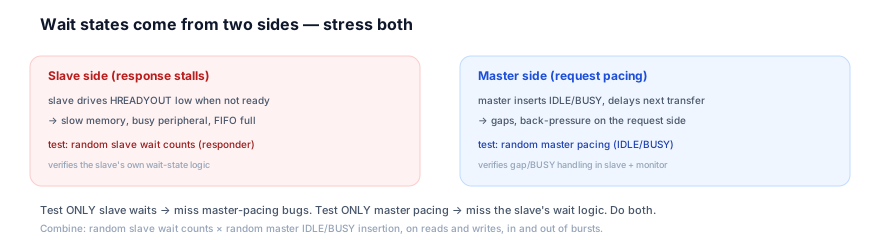
The master agent pacing: the master agent (driving the DUT slave) inserts random request pacing — IDLE cycles (no transfer), BUSY cycles (inside a burst — the master not ready to continue), and delays before the next transfer. This stresses the slave/monitor's handling of gaps and BUSY. (Crucially, the master must still obey address stability during its own held cycles — and the test checks that too.) So in the testbench, the other side drives the request pacing. So it's the master agent. So that generates master-side waits.
The constrained-random + coverage: the wait counts and pacing are constrained-random (17.6) — randomized widely (0/1/many waits, random IDLE/BUSY) for breadth. And coverage (17.5) confirms the wait buckets were hit — cp_wait (0/1/2+/many), and crosses (wait × direction, wait × burst). If the coverage shows the many-wait bucket unhit, you bias toward it. The checkers (assertions for address-stability/liveness, scoreboard for data) catch the triggered bugs. So in the testbench, wait-state testing is a two-sided (responder + master pacing) constrained-random generator, coverage-confirmed, checker-caught. The skill is exercising both sides across all patterns and confirming (via coverage) the waits happened. So in the testbench, stress both sides, randomly, confirmed by coverage. So that's the implementation.
5. System Architecture Perspective
At the system level, wait-state testing is the highest-ROI targeted testing for AHB — because waits are where the most (and subtlest) bugs hide — and it's a reusable capability (the responder/pacing agents) that every AHB verification needs; it's also the concrete payoff of the protocol-checker mindset (17.1).
The highest-ROI targeted testing: because the zero-wait path hides so many bugs and waits trigger them, wait-state testing has disproportionate bug-finding value — a small amount of wait-stress finds many subtle bugs. So at the system level, it's the highest-ROI targeted test (per the Module-16/17 bug catalog — most of those bugs are wait-triggered). So it's where the bugs are. So prioritize it.
The reusable capability: the slave responder (random waits) and the master agent (random pacing) are reusable testbench components — part of the VIP (17.11). Every AHB verification (any slave, master, interconnect) needs wait-state stress, so these components are built once and reused. So at the system level, wait-state testing is a reusable capability. So it's VIP infrastructure. So build it once.
The mindset payoff: wait-state testing is the concrete realization of the protocol-checker mindset (17.1) for the most important corner — it combines the adversarial stimulus (deliberately create waits — the hard scenario) with the continuous checks (assertions/scoreboard catch the triggered bugs) and coverage (confirm the waits happened). So at the system level, wait-state testing is the highest-ROI targeted test (waits hide the most/subtlest bugs — disproportionate value), a reusable capability (responder + pacing agents in the VIP), and the concrete payoff of the protocol-checker mindset (adversarial wait stimulus + continuous checks + coverage, for the most important corner). So wait-state testing is where AHB verification earns its keep — the targeted stress that finds the bugs the easy path hides, realizing the mindset on the protocol's richest bug-source. So stress the waits — it's where the bugs are. So invest in wait-state testing.
6. Engineering Tradeoffs
Wait-state testing embodies the deliberate-stress, two-sided, random-plus-coverage design.
- Wait-stress vs zero-wait-only. Wait-stress triggers the pipeline bugs (high bug yield); zero-wait-only hides them (false confidence). Always include wait-stress (it's the highest-ROI testing).
- Both sides vs one side. Stressing both slave response waits and master request pacing catches both classes of bug; one side misses the other's. Stress both.
- Random wait counts vs fixed. Random counts (0/1/many) exercise the variety (and find count-dependent bugs); fixed (always 1 wait) misses the others. Randomize, with coverage on the buckets.
- Coverage-confirmed vs assumed. Confirming (via coverage) the wait buckets were hit ensures the stress happened; assuming risks a wait-stress test that didn't actually wait (a vacuous test). Confirm with coverage.
The throughline: wait-state testing deliberately varies HREADY across every pattern (zero/single/multi/random/back-to-back) on reads, writes, and bursts, from both sides (slave response waits via HREADYOUT low; master request pacing via IDLE/BUSY and delays) — to flush out the pipeline-dependent bugs that pass zero-wait tests and only fail under waits. The bugs caught (the un-gated capture, the multi-commit write, the monitor mis-pairing, the address-in-stall, the stuck HREADY) are invisible on the easy path. It's driven by constrained-random wait counts/pacing (17.6) and confirmed by coverage (17.5) on the wait buckets. It's the highest-ROI targeted test (waits hide the most/subtlest bugs), a reusable VIP capability, and the concrete payoff of the protocol-checker mindset.
7. Industry Example
Run wait-state testing on the 16.x slaves and watch it flush out the wait-triggered bugs.
You're stress-testing the slaves' wait handling. You set up two-sided wait stress and confirm with coverage.
- Slave response waits. The memory slave (16.3) is configured with random read/write latency (0–8 cycles), so it drives
HREADYOUTlow for a random number of cycles per access. This stresses its own wait logic and the master/monitor's holding. - Master request pacing. The master agent inserts random IDLE cycles between transfers and random BUSY cycles inside bursts, and delays the next transfer randomly. This stresses the slave's gap/BUSY handling and the monitor's phantom-transfer avoidance (17.3).
- All patterns, both directions, in bursts. Constrained-random (17.6) drives the wait counts and pacing across zero/single/multi/random patterns, on reads and writes, and inside bursts (waits between beats).
- Bugs flushed out. The wait stress triggers the latent bugs: a buggy un-gated capture (16.7) is caught by the address-stability assertion + scoreboard (wrong-address access on a waited transfer); a buggy multi-commit write (16.8) is caught by the scoreboard (a side-effecting write firing per wait cycle); a stuck
HREADYOUT(16.4) is caught by the liveness assertion. None of these would have appeared in zero-wait tests. - Coverage confirmation. The wait-bucket coverage (
cp_wait= 0/1/2+/many) is checked: all buckets hit (confirming the waits actually happened), and the crosses (wait × direction, wait × burst) closed — so the wait-stress is proven real, not vacuous. - The avoided pitfall. Early on, an over-tight constraint accidentally capped waits at 0 — the coverage showed only the
0bucket hit, revealing the "wait test" wasn't waiting. Loosening the constraint enabled the real stress.
The example shows wait-state testing earning its keep: two-sided, all-pattern wait stress triggers the exact pipeline bugs Module 16 warned about (which zero-wait tests miss), the checkers catch them, and coverage confirms the waits happened (avoiding the vacuous-test trap). This is the highest-ROI targeted testing. This is where the bugs are.
8. Common Mistakes
9. Interview Insight
Wait-state testing is a high-signal verification interview topic — the waits-hide-bugs insight, the two-sided stress, and the confirm-via-coverage discipline are the signals.
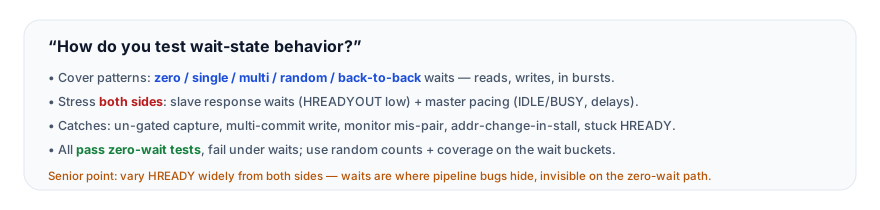
The answer that lands gives the waits-hide-bugs insight and the two-sided stress: "Wait-state testing deliberately varies HREADY behavior to flush out the pipeline bugs that pass zero-wait tests and only fail under waits. This is the highest-ROI targeted testing for AHB, because almost all the subtle slave bugs only manifest under wait states — the un-gated address capture that corrupts a waited transfer, the write that commits multiple times during a wait, the monitor that mis-pairs address and data across a wait, an address that changes during a stall, a stuck HREADY. All of these pass a zero-wait test, because the triggering condition — a wait — never occurs, so the zero-wait path gives false confidence. So I cover the wait patterns: zero, single, multi, random per-transfer, and back-to-back stalled, on reads and writes and inside bursts. And critically, I stress both sides. The slave inserts response waits by driving HREADYOUT low — a slow memory or busy peripheral — which stresses its own wait logic and the master and monitor's holding. The master agent inserts request pacing — IDLE and BUSY cycles, delayed transfers — which stresses the slave and monitor's gap and BUSY handling. Testing only slave waits misses master-pacing bugs, and only master pacing misses the slave's wait logic, so I do both. I drive the wait counts and pacing with constrained-random, and — this is important — I confirm via coverage that the wait buckets were actually hit. A common mistake is a wait-state test that, due to an over-tight constraint or a disabled responder, never actually drives HREADY low — it passes while testing nothing. The coverage on the wait buckets exposes that: if only the zero-wait bucket is hit, the test never waited. So I insert real, varied, two-sided waits and prove via coverage they happened." The waits-hide-bugs insight, the two-sided stress, and the confirm-via-coverage discipline are the senior signals.
10. Practice Challenge
Build and reason from wait-state testing.
- The patterns. List the wait patterns (zero/single/multi/random/back-to-back) and where to apply them (reads, writes, bursts).
- Both sides. Explain the slave response waits and the master request pacing, and why both are needed.
- Read the waveform. From Figure 2, explain how inserting a wait triggers the un-gated-capture bug that the zero-wait run hid.
- Vacuous tests. Explain what a vacuous wait-test is and how coverage on the wait buckets guards against it.
- The combination. Explain how stimulus (create the wait), checking (catch the bug), and coverage (confirm the wait) combine to find a wait-triggered bug.
11. Key Takeaways
- Wait-state testing deliberately varies
HREADYacross patterns (zero/single/multi/random/back-to-back) on reads, writes, and bursts — to flush out the pipeline bugs that pass zero-wait tests and only fail under waits. - It's the highest-ROI targeted testing — almost every subtle AHB slave bug (un-gated capture, multi-commit, mis-pairing, stuck HREADY) shares a trigger: a wait state with the master pipelining the next transfer.
- Stress both sides — slave response waits (
HREADYOUTlow — stress master/monitor holding) and master request pacing (IDLE/BUSY/delays — stress slave/monitor gap handling). Each triggers different bugs. - Randomize the wait counts/patterns — fixed single-wait misses count-dependent and back-to-back bugs. Use constrained-random (17.6).
- Confirm via coverage the waits happened — a vacuous wait-test (over-tight constraint, disabled responder) never waits and passes while testing nothing. The
cp_waitbuckets must be hit (the hollow-pass lesson from 17.5). - It combines stimulus + checks + coverage — create the wait (stimulus), catch the bug (assertions/scoreboard), confirm the wait happened (coverage) — the protocol-checker mindset on the richest bug-source.
12. What Comes Next
You now can stress the bus's flow control. The next chapters target the other rich corners:
- Burst Testing (next) — verify every burst type, length, and boundary (address increment/wrap, beat count, BUSY).
- Error-Response Testing, Bridge Verification, and the UVM AHB Agent — drive errors, verify the bridge, and assemble the VIP.
To revisit the wait mechanism this stresses, see Slave-Inserted Wait States and Common Wait-State Bugs; for the stimulus and confirmation, see Constrained-Random AHB Traffic and AHB Functional Coverage.