AMBA AHB · Module 16
Reusable AHB RTL Templates
Packaging the whole module into a small library of drop-in, parameterised AHB RTL building blocks — a HREADY-gated capture block, output blocks (HREADYOUT generation, HRDATA muxing, HRESP generation), leaf slaves (simple slave, register bank, memory slave), and a bridge skeleton control FSM. A new slave is assembled by instantiating and parameterising these verified blocks (WIDTH, DEPTH, ATTRS, WAITS, registered-read) rather than re-deriving the subtle pipeline and wait-state logic each time — fewer bugs, faster, consistent, often generated from a single register-map description.
This module built a slave piece by piece — capture (16.7), HREADYOUT (16.4), HRDATA muxing (16.5), HRESP (16.6), the write/read FSMs (16.8/16.9), and the bridge (16.10), across the simple/register/memory slaves (16.1–16.3). This final chapter does the engineering move that makes all of it pay off repeatedly: package the blocks into a small library of drop-in, parameterised RTL templates. The realization is that every slave you'll ever build is the same blocks, composed. At the base is a capture block (the HREADY-gated address/control register — 16.7). On it sit the output blocks — HREADYOUT generation (16.4), HRDATA muxing (16.5), HRESP generation (16.6). Combining these gives the leaf slaves — a simple register slave (16.1), a parameterised register bank (16.2), a memory slave (16.3). And a bridge skeleton (16.10) sequences the same blocks across cycles. The value: the subtle, correctness-critical logic — the HREADY-gated capture, the completion-gated commit, the two-cycle ERROR — is written and verified once, inside the templates; a new slave is assembled by instantiating and parameterising (WIDTH, DEPTH, ATTRS, WAITS, registered-read), not re-deriving the tricky logic. This chapter shows how to turn slave design from bespoke RTL into composition of trusted building blocks.
1. What Is It?
Reusable AHB RTL templates are a parameterised library of slave building blocks that compose into any slave by instantiation and configuration. Its parts:
- Capture block — the
HREADY-gated address/control register (16.7) producingsel_q,write_q,addr_q,size_q— the foundation every slave instantiates. - Output blocks —
HREADYOUTgeneration (16.4),HRDATAmuxing (16.5),HRESPgeneration (16.6) — the slave's standard outputs. - Leaf slaves — simple slave (16.1), register bank (16.2), memory slave (16.3) — built from capture + output blocks, parameterised.
- Bridge skeleton — a control FSM (16.10) sequencing the blocks across cycles for a multi-cycle downstream resource.
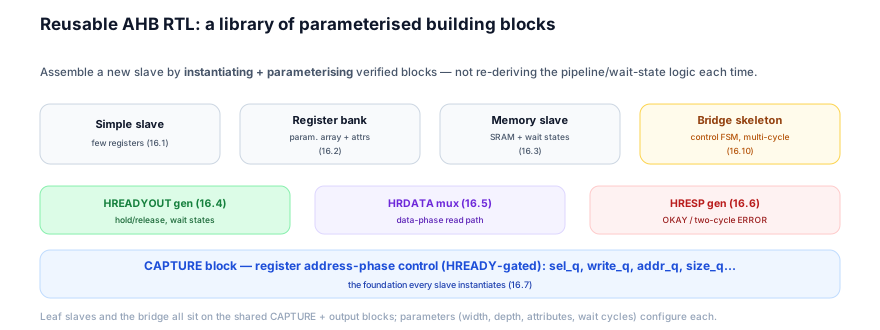
Reusable AHB RTL templates are the productization of the module — the recognition that slave design is composition, not re-derivation. Every slave shares the same skeleton: capture the address-phase control (the HREADY-gated register), act in the data phase (write commit / read production, gated to completion), pace with HREADYOUT, respond with HRESP. The differences between slaves are parameters — how many registers (a bank), how big the memory, which access attributes, how many wait states, whether the read is registered — not fundamentally different logic. So the engineering move is to write the skeleton once, parameterised, verify it thoroughly, and instantiate it for each slave. The subtle parts — the HREADY-gated capture (16.7), the completion-gated commit (16.8/16.9), the two-cycle ERROR (16.6), the data-phase-aligned mux (16.5) — the parts that are error-prone when hand-coded — live inside the verified templates, so they're never re-derived. The result is that slave design becomes configuration of trusted blocks.
2. Why Does It Exist?
Reusable templates exist because every slave shares the same error-prone skeleton, so re-deriving it per slave is wasteful and bug-prone — factoring it into verified, parameterised blocks gives fewer bugs, faster development, and SoC-wide consistency.
The every slave is the same skeleton is the root: across 16.1–16.10, every slave did the same things — capture the address-phase control (16.7), act in the data phase gated to completion (16.8/16.9), pace with HREADYOUT (16.4), return read data (16.5), respond with HRESP (16.6). The differences were parameters (register count, memory size, attributes, waits), not different logic. The differences are configuration; the skeleton is not. Re-writing the skeleton per slave duplicates the work and duplicates the risk with it.
The the subtle logic is error-prone drives the verify-once value: the slave skeleton has several subtle, correctness-critical points — the HREADY-gated capture (a free-running capture corrupts waited transfers — 16.7), the completion-gated commit (omitting HREADYOUT corrupts side-effecting writes/reads — 16.8/16.9), the two-cycle ERROR (a one-cycle error breaks the pipeline — 16.6), the data-phase-aligned mux (the wrong select returns wrong-slave data — 16.5). These are exactly the points hand-coded slaves get wrong, and the bugs hide in simple tests. Writing the skeleton once and verifying it thoroughly means those points are never re-derived, and therefore never re-bugged.
The consistency and productivity is the system benefit: with a template library, all the SoC's slaves are built the same way — consistent behavior (the same wait-state handling, error responses, capture timing), easier to review/verify (one block to trust), and faster to develop (instantiate, don't write). And the templates integrate with generation (chapter 11.4) — the register map generates the bank instances (and software headers), so HW/SW stay consistent. So reusable templates exist because: every slave shares the same skeleton (capture / act / pace / respond — the commonality, inviting factoring); the skeleton's subtle logic is error-prone (the HREADY-gate, completion-gate, two-cycle ERROR, data-phase mux — verify once to avoid re-bugging); and factoring gives consistency and productivity (one trusted block, instantiated SoC-wide, often generated). Together these turn slave design from bespoke, bug-prone re-derivation into composition of trusted, parameterised, verified blocks.
3. Mental Model
Model the template library as a professional kitchen's set of mother sauces and prepped components, versus cooking every dish from raw scratch. A great kitchen doesn't re-invent béchamel for every dish that needs it — it makes a perfect base once, and builds the lasagna, the gratin, and the croque-monsieur from it (plus a few prepped components). A new dish is assembled from trusted bases and components, tuned with parameters (more cheese, less salt), not cooked from raw ingredients re-deriving every technique each time. The tricky technique — the emulsion that can break — is mastered once, in the base.
A professional kitchen (the SoC design team) that must produce many dishes (slaves). The amateur approach is to cook every dish from raw scratch — re-deriving every technique (the tricky emulsion, the roux) each time, risking the same mistakes repeatedly (a broken sauce). The professional approach uses mother sauces and prepped components: a perfect base (the capture block — the HREADY-gated foundation) made once and trusted, plus a few prepped components (the output blocks — HREADYOUT, HRDATA, HRESP). A new dish (a new slave) is assembled from these trusted bases and components — the lasagna (a register bank), the gratin (a memory slave), the croque (a simple slave) — tuned with parameters (more cheese = more registers, less salt = fewer wait states), not cooked from raw, re-deriving every technique. The tricky technique — the emulsion that can break (the HREADY-gated capture, the completion-gated commit — the parts that break when done wrong) — is mastered once, in the base, and never re-attempted from scratch. And a complex dish (a bridge) is composed of the same bases and components, plated by a multi-step recipe (the control FSM). The menu (the register map) can even auto-generate the prep list (the instances). So the kitchen assembles dishes from trusted, tuned components — fewer broken sauces, faster service, consistent quality.
This captures the template library: the amateur cooking from raw scratch = hand-coding each slave, re-deriving the subtle logic; the mother sauce / perfect base = the HREADY-gated capture block; the prepped components = the HREADYOUT/HRDATA/HRESP output blocks; assembling dishes from bases = composing slaves from the blocks; tuning with parameters = parameterising (WIDTH/DEPTH/ATTRS/WAITS); mastering the tricky emulsion once in the base = verifying the error-prone logic once in the template; the multi-step recipe for a complex dish = the bridge skeleton FSM; the menu auto-generating the prep list = generating instances from the register map. Make the bases once, assemble and tune, master the tricky parts once.
Watch the same template produce different slaves by parameter:
Why the capture register is enabled by HREADY, not by every clock
6 cyclesThe model's lesson: make the bases once, assemble and tune, master the tricky parts once. Figure 2 shows why the base has to be a base. The HREADY gate is one line of RTL, it is invisible in any test that never inserts a wait state, and it is wrong in a large fraction of hand-written slaves. Put it in a block that every slave instantiates and it is decided once, for all of them.
4. Real Hardware Perspective
In hardware, the templates are parameterised modules (Verilog/SystemVerilog parameters, generate blocks) with the subtle logic inside; the leaf slaves instantiate the capture and output sub-modules; and a generator can emit instances from a register-map description.
The parameterised modules: each block is a parameterised module. The capture block: module ahb_capture #(parameter AW=32) (...) — instantiated with the address width. The register bank: module ahb_regbank #(parameter DW=32, N=8, ATTR=...) (...) — the data width, register count, and per-register attributes as parameters; a generate loop builds the N registers with their ATTR-specific logic. The memory slave: module ahb_mem #(parameter DW=32, DEPTH=4096, WAITS=0, REG_READ=0) (...). In hardware, then, the templates are parameterised modules: parameters and generate blocks configuring the structure.
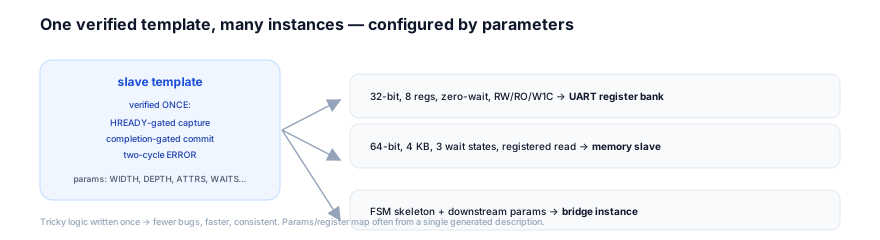
The leaf slaves instantiate the blocks: a leaf slave instantiates the shared sub-modules. The register bank instantiates the capture block (ahb_capture), drives a register array (the generated flops with attribute logic), instantiates the HRDATA mux (selecting by addr_q), the HREADYOUT generation (zero-wait or counter), and the HRESP generation (the error checks + two-cycle FSM). So the leaf slave's RTL is mostly instantiation and wiring; the subtle logic sits inside the sub-modules.
The generation from a register map: the parameters (and the register array's attributes/addresses) often come from a register-map description (SystemRDL/IP-XACT — chapter 11.4). A generator reads the map and emits the parameterised instance (the bank RTL with the right N, DW, per-register ATTR) and the software headers — consistent by construction. So in hardware, the templates integrate with generation — the map drives the instances. So in hardware, reusable AHB RTL is parameterised modules (the subtle logic inside, parameter/generate configuring), composed by leaf slaves (instantiation + wiring), and generated from a register map (consistent HW/SW). The parameterisation and the verified-once subtle logic are the essence. So in hardware, write parameterised, verify once, instantiate. So that's the reusable form.
5. System Architecture Perspective
At the system level, the template library is a design-discipline multiplier — it makes the SoC's many slaves consistent, correct, and fast to build, and it's the natural home for the module's hard-won correctness lessons; it's also where slave RTL meets the generation flow that keeps hardware and software in sync.
The consistency multiplier: an SoC has many slaves (dozens of peripherals, several memories, bridges). With a template library, they're all built from the same verified blocks — so they behave consistently (the same wait-state, error, capture semantics), are easier to verify (trust the block once), and are faster to develop. So at the system level, the library multiplies the design discipline across all slaves — one correct skeleton, many instances. So it's a consistency multiplier. So the SoC benefits at scale.
The correctness home: the module's hard-won lessons — the HREADY-gated capture, the completion-gated commit, the two-cycle ERROR, the data-phase-aligned mux — are exactly the subtle points that must be right. The template library is their home: encoded once, verified, reused. So instead of every slave designer re-learning (and re-bugging) these, the library embodies them. So at the system level, the library is where the module's correctness knowledge lives — institutionalized, not re-derived. So it's the correctness repository. So lessons are captured.
The generation integration: the library is where slave RTL meets the single-source generation flow (chapter 11.4). The register map (SystemRDL/IP-XACT) parameterises the templates and generates the instances and the software headers — so the hardware (template instances) and software (headers) stay consistent from one source. So at the system level, the library integrates with generation for HW/SW consistency. So at the system level, the template library is a design-discipline multiplier (consistent, correct, fast slaves across the whole SoC — one skeleton, many instances), the home for the module's correctness lessons (the subtle pipeline/wait-state/error logic, institutionalized once rather than re-derived), and the integration point with single-source generation (the register map parameterising and generating instances + headers for HW/SW consistency). So reusable templates are how the module's lessons scale from one correct slave to a whole correct SoC — the engineering discipline that turns knowledge into leverage. So institutionalize the blocks, and every slave inherits the correctness.
6. Engineering Tradeoffs
Reusable AHB RTL templates embody the compose-don't-rederive, parameterise, verify-once design.
- Reusable templates vs bespoke per-slave RTL. Templates give consistency, fewer bugs, and speed (verify once, instantiate); bespoke RTL re-derives the subtle logic each time (slower, bug-prone). Use templates for the common slave skeleton.
- Parameterised vs fixed. Parameterising (WIDTH/DEPTH/ATTRS/WAITS) makes one template serve many slaves at the cost of parameter/generate complexity; fixed modules are simpler but not reusable. Parameterise the dimensions that vary.
- Generated vs hand-instantiated. Generating instances (and headers) from a register map guarantees HW/SW consistency at the cost of the generator tooling; hand-instantiating risks mismatch. Generate for register-heavy slaves.
- General template vs specialized. A general template covers most slaves but may carry unused logic; a specialized one is leaner but less reusable. Balance generality against area for the common cases.
The throughline: reusable AHB RTL templates package the whole module into a parameterised library — a HREADY-gated capture block (16.7), the output blocks (HREADYOUT 16.4, HRDATA 16.5, HRESP 16.6), the leaf slaves (simple 16.1, register bank 16.2, memory 16.3), and a bridge skeleton control FSM (16.10). A new slave is assembled by instantiating and parameterising (WIDTH/DEPTH/ATTRS/WAITS/registered-read), not re-deriving the subtle, correctness-critical logic (the HREADY-gated capture, the completion-gated commit, the two-cycle ERROR, the data-phase-aligned mux — written and verified once, inside the templates). The benefits: fewer bugs (no re-derivation), faster development, SoC-wide consistency — and integration with generation (the register map parameterises/generates instances + headers for HW/SW consistency — chapter 11.4). It's the design-discipline multiplier that scales the module's correctness from one slave to a whole SoC.
6b. The Library, Written Out
Everything above argues that the skeleton should be factored and verified once. This is the factoring. Four modules: the capture block at the base, the response block, a parameterised register bank built on both, and the instantiations that turn them into an SoC's peripherals.
The capture block
// The base of the library. Note what is NOT in the port list: there is no
// capture-enable input. The gate is internal, so no instance can wire it wrong.
module ahb_capture #(
  parameter int AW = 32
) (
  input  logic            HCLK,
  input  logic            HRESETn,
  // AHB address phase
  input  logic            HSEL,
  input  logic [1:0]      HTRANS,
  input  logic [AW-1:0]   HADDR,
  input  logic            HWRITE,
  input  logic [2:0]      HSIZE,
  // GLOBAL HREADY from the interconnect - not this slave's HREADYOUT.
  // These differ whenever another slave is stalling the bus, and using the
  // wrong one here is the single most common capture bug.
  input  logic            HREADY,
  // Registered data-phase view
  output logic            sel_q,
  output logic            write_q,
  output logic [AW-1:0]   addr_q,
  output logic [2:0]      size_q
);
  // HTRANS[1] is set for NONSEQ (2'b10) and SEQ (2'b11) and clear for
  // IDLE (2'b00) and BUSY (2'b01). Testing the single bit is both cheaper
  // and harder to get wrong than enumerating the two active encodings.
  wire active = HSEL & HTRANS[1];

  always_ff @(posedge HCLK or negedge HRESETn) begin
    if (!HRESETn) begin
      sel_q   <= 1'b0;
      write_q <= 1'b0;
      addr_q  <= '0;
      size_q  <= '0;
    end else if (HREADY) begin      // <-- the invariant, owned here
      sel_q   <= active;
      write_q <= HWRITE;
      addr_q  <= HADDR;
      size_q  <= HSIZE;
    end
  end
endmodule
The response block
// AHB requires an ERROR response to span two cycles: HRESP=ERROR with
// HREADYOUT low, then HRESP=ERROR with HREADYOUT high. The first cycle gives
// the master an opportunity to cancel the next address phase. A one-cycle
// ERROR is accepted by many simple masters and breaks pipelined ones, which
// is why it survives block-level testing and fails at integration.
module ahb_hresp (
  input  logic       HCLK,
  input  logic       HRESETn,
  input  logic       dphase,      // a data phase is in progress
  input  logic       error_req,   // the slave has decided this transfer faults
  output logic [1:0] HRESP,
  output logic       resp_stall   // hold HREADYOUT low for the first ERROR cycle
);
  localparam logic [1:0] RSP_OKAY = 2'b00, RSP_ERROR = 2'b01;
  typedef enum logic [1:0] { OK, ERR1, ERR2 } state_e;
  state_e state, next;

  always_comb begin
    next = OK;
    unique case (state)
      OK:   next = (dphase && error_req) ? ERR1 : OK;
      ERR1: next = ERR2;
      ERR2: next = (dphase && error_req) ? ERR1 : OK;
    endcase
  end

  always_ff @(posedge HCLK or negedge HRESETn)
    if (!HRESETn) state <= OK; else state <= next;

  assign HRESP      = (state == OK) ? RSP_OKAY : RSP_ERROR;
  assign resp_stall = (state == ERR1);
endmodule
The register bank
module ahb_regbank #(
  parameter int AW   = 32,
  parameter int DW   = 32,
  parameter int N    = 8,                 // registers in the bank
  // Per-register access attribute, indexed the same way as the array.
  // 0 = RW, 1 = RO (hardware writes, software reads), 2 = W1C.
  parameter bit [1:0] ATTR [N] = '{default: 2'd0}
) (
  input  logic           HCLK,
  input  logic           HRESETn,
  input  logic           HSEL,
  input  logic [1:0]     HTRANS,
  input  logic [AW-1:0]  HADDR,
  input  logic           HWRITE,
  input  logic [2:0]     HSIZE,
  input  logic [DW-1:0]  HWDATA,
  input  logic           HREADY,
  output logic [DW-1:0]  HRDATA,
  output logic           HREADYOUT,
  output logic [1:0]     HRESP,
  // Hardware-side view of the bank
  input  logic [DW-1:0]  hw_set   [N],    // W1C event inputs / RO sources
  output logic [DW-1:0]  reg_out  [N]
);
  localparam int IDXW = (N > 1) ? $clog2(N) : 1;
  localparam int LSB  = $clog2(DW/8);      // word-aligned bank

  logic          sel_q, write_q;
  logic [AW-1:0] addr_q;
  logic [2:0]    size_q;

  ahb_capture #(.AW(AW)) u_cap (
    .HCLK, .HRESETn, .HSEL, .HTRANS, .HADDR, .HWRITE, .HSIZE, .HREADY,
    .sel_q, .write_q, .addr_q, .size_q
  );

  wire [IDXW-1:0] idx        = addr_q[LSB +: IDXW];
  wire            in_range   = (addr_q[LSB +: IDXW] < IDXW'(N));
  wire            dphase     = sel_q;
  // A write to a read-only register faults, as does an out-of-range address.
  wire            error_req  = dphase && ((!in_range) ||
                                          (write_q && ATTR[idx] == 2'd1));

  logic resp_stall;
  ahb_hresp u_rsp (.HCLK, .HRESETn, .dphase, .error_req, .HRESP, .resp_stall);

  // Zero-wait bank; the response block is the only source of back-pressure.
  assign HREADYOUT = ~resp_stall;

  // The commit condition. Every term matters:
  //   dphase      - there is a transfer to commit
  //   write_q     - it is a write
  //   HREADYOUT   - it is COMPLETING this cycle, not being stalled
  //   !error_req  - it is not the transfer we are about to ERROR
  // Dropping HREADYOUT here is the classic bug: the write commits once per
  // wait-state cycle instead of once per transfer, so a W1C register clears
  // bits that were never acknowledged.
  wire commit = dphase && write_q && HREADYOUT && !error_req;

  logic [DW-1:0] regs [N];

  for (genvar g = 0; g < N; g++) begin : g_reg
    always_ff @(posedge HCLK or negedge HRESETn) begin
      if (!HRESETn) begin
        regs[g] <= '0;
      end else begin
        unique case (ATTR[g])
          2'd1: regs[g] <= hw_set[g];                       // RO: hardware owns it
          2'd2: begin                                       // W1C
            // Set by hardware, cleared by a software write-one. Set wins on a
            // tie, or an event arriving in the same cycle as the clear is lost.
            logic [DW-1:0] clr;
            clr = (commit && idx == IDXW'(g)) ? HWDATA : '0;
            regs[g] <= (regs[g] & ~clr) | hw_set[g];
          end
          default: if (commit && idx == IDXW'(g)) regs[g] <= HWDATA;  // RW
        endcase
      end
    end
  end

  assign reg_out = regs;
  // Read data is combinational off the captured address, so it is already
  // aligned to the data phase. Out-of-range reads return zero alongside the
  // ERROR response rather than X, which keeps failures reproducible.
  assign HRDATA = (dphase && !write_q && in_range) ? regs[idx] : '0;
endmodule
Instantiating the SoC's peripherals
// A UART: control is RW, status is hardware-owned, the interrupt-pending
// register is write-one-to-clear.
localparam bit [1:0] UART_ATTR [4] = '{2'd0, 2'd1, 2'd2, 2'd0};
ahb_regbank #(.DW(32), .N(4), .ATTR(UART_ATTR)) u_uart ( ... );

// A timer: four RW configuration registers and one RO current-count.
localparam bit [1:0] TMR_ATTR [5] = '{2'd0, 2'd0, 2'd0, 2'd0, 2'd1};
ahb_regbank #(.DW(32), .N(5), .ATTR(TMR_ATTR)) u_timer ( ... );

// GPIO: all read-write.
ahb_regbank #(.DW(32), .N(8)) u_gpio ( ... );

// Three peripherals, three register maps, one piece of protocol logic. The
// HREADY gate, the completion-gated commit and the two-cycle ERROR were
// decided once, in ahb_capture and ahb_hresp, and none of these instances
// can reach past their parameters to change them.
Read the port lists rather than the bodies and the encapsulation argument from
Section 6 becomes checkable. ahb_capture has no capture-enable port.
ahb_hresp has no HRESP override. ahb_regbank exposes N, DW and ATTR
and nothing that reaches the commit condition. An instance can choose what the
bank contains; it cannot choose whether the bank obeys the protocol.
A peripheral that passed every block test cleared interrupts it never reported
LEAKY-TEMPLATEAn interrupt-status register in a UART peripheral intermittently lost bits. The driver read the pending register, saw two sources set, wrote back a one to clear those two, and a third interrupt that had arrived meanwhile was gone as well — so the device stopped servicing a source that was still asserting. It reproduced roughly once per thousand transactions, only on a busy bus, and never in the peripheral's own block-level regression, which was clean over millions of cycles.
// The team had a template, but its capture block exposed the enable:
module ahb_capture_leaky #(parameter int AW = 32) (
  ..., input logic cap_en, ...      // <-- the invariant, handed to the caller
);
  always_ff @(posedge HCLK or negedge HRESETn)
    if (!HRESETn) begin ... end
    else if (cap_en) begin sel_q <= active; addr_q <= HADDR; ... end
endmodule

// ...and the UART instantiated it like this:
ahb_capture_leaky #(.AW(32)) u_cap (
  .cap_en (1'b1),                   // "the address is always valid, right?"
  ...
);

// The W1C commit then had no completion term either:
wire commit = sel_q && write_q; // missing HREADYOUTTwo observations located it. First, the failure rate tracked bus contention, not UART traffic — a strong hint that the bug lived in transfer acceptance rather than in the peripheral's function. Second, a waveform of a failing transfer showed the write-one-to-clear data applied on three consecutive cycles for a single transfer that the interconnect had stalled for two wait states.
The block-level testbench never inserted a wait state, so HREADY was constant
high there. With cap_en tied to 1'b1 and HREADY never low, the leaky block
and the correct block are bit-identical. The bug was unobservable in the only
environment that tested it.
Both halves of the invariant had escaped the template. With cap_en hard-wired
high the capture register re-sampled the address phase on every cycle of a
stalled transfer, and with HREADYOUT missing from commit the write applied
once per cycle rather than once per accepted transfer. For an RW register that is
harmless — writing the same value three times is idempotent. For W1C it is not:
each application clears whatever bits HWDATA names, so a hardware event that
set a bit during the second or third cycle of the stall was cleared by the tail
of a write that had never acknowledged it.
This is precisely the leaky-encapsulation failure Section 6 describes. The template was real, it was verified, and it was correct — and it still shipped the bug, because the correctness-critical decision was made at the instantiation site by an engineer who had no reason to think they were making it.
// 1. Delete the port. The gate belongs to the block.
module ahb_capture #(parameter int AW = 32) (
  ..., input logic HREADY, ...      // no cap_en; internal gate only
);
  always_ff @(posedge HCLK or negedge HRESETn)
    if (!HRESETn) begin ... end
    else if (HREADY) begin sel_q <= active; addr_q <= HADDR; ... end
endmodule

// 2. Put the completion term back in the commit condition.
wire commit = dphase && write_q && HREADYOUT && !error_req;
Verification of the fix has two parts, and the second is the one that keeps it fixed. The direct check is a wait-state test: drive a W1C write, have the interconnect stall it for two cycles, raise a hardware event during the stall, and assert that the event survives. That test fails against the old RTL and passes against the new.
The durable part is that the port is gone, so the failure is now unreachable by construction rather than merely absent. A bound assertion makes the remaining assumption explicit:
// The captured address must not move while the bus is stalled.
a_capture_held: assert property (@(posedge HCLK) disable iff (!HRESETn)
  !HREADY |=> $stable(addr_q) && $stable(sel_q) && $stable(write_q))
  else $error("capture register moved during a wait state");
Bind that once, to the template, and every instance in the SoC inherits the check along with the block.
7. Industry Example
Build an SoC's slave set from a template library — the productivity and consistency in action.
An SoC has a dozen peripherals (UART, timers, GPIO, SPI), two memories (SRAM, ROM), and a peripheral bridge — all built from the template library.
- The peripherals (register banks). Each peripheral is a register bank instance: the UART is
ahb_regbank #(DW=32, N=8, ATTR={CTRL:RW, STATUS:RO, ...}); the timer isahb_regbank #(DW=32, N=6, ATTR=...); etc. The same verified register-bank template, parameterised per peripheral. The subtle logic (theHREADY-gated capture, the W1C/RC attribute logic, the qualified-select for read-to-clear, the two-cycle ERROR on illegal writes) is inside the template — each peripheral just sets parameters. - The memories. The SRAM is
ahb_mem #(DW=64, DEPTH=8K, WAITS=0)(fast, zero-wait); the ROM isahb_mem #(DW=32, DEPTH=4K, WAITS=2, REG_READ=1)(slower, registered read). The same memory template, parameterised — the wait-state generation and completion-gating are inside. - The bridge. The peripheral bridge is the bridge skeleton (the control FSM — 16.10) instantiated with the downstream parameters. The hold-the-upstream discipline is inside the skeleton.
- Generation from the register map. The peripherals' register banks are generated from a register-map description (SystemRDL): the generator emits the
ahb_regbankinstances (correctN,ATTR, addresses) and the software headers (matching addresses/fields) — HW and SW consistent by construction. - The payoff. All slaves behave consistently (same wait-state/error/capture semantics), the subtle logic was verified once (not re-derived a dozen times), development was fast (instantiate + parameterise), and HW/SW are consistent (generated). A bug found and fixed once in the template fixes all instances.
The example shows the template library's leverage: a dozen peripherals, two memories, and a bridge — all from a handful of verified, parameterised templates, instantiated and configured (and generated from the register map). The subtle correctness lives once, in the templates; the slaves are composition. This is slave design at SoC scale. This is the module's payoff.
8. Common Mistakes
9. Interview Insight
Reusable RTL is a senior design-judgment interview topic — the slave-is-composition insight, the verify-once-encapsulate value, and the parameterise-within-the-envelope discipline are the signals.
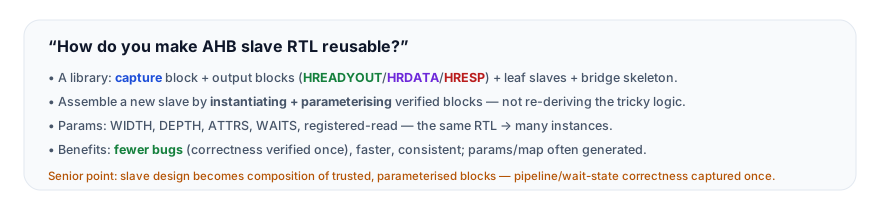
The answer that lands gives the composition insight and the verify-once value: "The realization across building a bunch of slaves is that they're all the same skeleton — capture the address-phase control, act in the data phase gated to completion, pace with HREADYOUT, respond with HRESP — and the differences between slaves are parameters, not different logic: how many registers, how big the memory, which attributes, how many wait states. So the engineering move is to factor that skeleton into a small library of parameterised, verified building blocks: a HREADY-gated capture block at the base, output blocks for HREADYOUT, HRDATA, and HRESP, leaf slaves for the simple slave, register bank, and memory, and a bridge skeleton control FSM. A new slave is assembled by instantiating and parameterising these blocks, not by re-deriving the logic. The value is that the subtle, correctness-critical parts — the HREADY-gated capture, the completion-gated commit, the two-cycle ERROR, the data-phase-aligned mux — the parts that hide bugs in simple tests — are written and verified once, inside the templates, and never re-derived. So you get fewer bugs, faster development, and consistency across all the SoC's slaves. The key discipline is that the templates must genuinely encapsulate the subtle logic — the instance can only set parameters and connect buses, it can't bypass the invariants — and the parameters configure within the correct envelope, they never disable a correctness invariant. And you verify across the parameter space, so every legal instance is trusted. Often the parameters and the register map come from a single description that generates the instances and the software headers, keeping hardware and software consistent. So slave design becomes composition of trusted blocks rather than bespoke RTL." The slave-is-composition insight, the verify-once-encapsulate value, and the parameterise-within-the-envelope discipline are the senior signals.
9b. Where This Is Specified
- Arm AMBA 5 AHB Protocol Specification (ARM IHI 0033). The address-phase/data-phase pipeline, the requirement that address-phase signals are held while
HREADYis low, the transfer-type encodings onHTRANS, and the two-cycle ERROR response sequence thatahb_hrespimplements. - Arm AMBA 3 AHB-Lite Protocol Specification (ARM IHI 0033A). The single-master subset most peripheral slaves are written against, including
HREADYOUTand the interconnect's combination of slave ready signals into the globalHREADY. - IEEE 1800-2023 (SystemVerilog) clause 27 — Generate constructs. The
for/genvarelaboration used by the register bank to buildNregisters with per-index attribute logic. - IEEE 1800-2023 §6.20 — Parameter declarations. Typed parameters and parameterised arrays such as the
ATTRattribute table.
10. Practice Challenge
Build and reason from reusable AHB RTL templates.
- The library. List the building blocks (capture block, output blocks, leaf slaves, bridge skeleton) and how they layer.
- Composition. Explain how a new slave is assembled by instantiating and parameterising the blocks, not re-deriving the logic.
- Read the figure. From Figure 2, explain how the same template logic produces different slaves by parameter (WIDTH/DEPTH/WAITS).
- Encapsulation. Explain why the templates must fully encapsulate the subtle logic, and the failure mode if it leaks.
- Generation. Explain how the templates integrate with register-map generation for HW/SW consistency.
11. Key Takeaways
- Every slave is the same skeleton — capture, act (gated to completion), pace (
HREADYOUT), respond (HRESP) — differing by parameters, not logic. So slave design is composition, not re-derivation. - The library: a
HREADY-gated capture block (16.7), output blocks (HREADYOUT16.4,HRDATA16.5,HRESP16.6), leaf slaves (simple 16.1, register bank 16.2, memory 16.3), and a bridge skeleton control FSM (16.10). - Assemble by instantiating + parameterising (WIDTH/DEPTH/ATTRS/WAITS/registered-read) — not re-deriving the subtle logic; the templates are parameterised modules (
parameter/generate). - The subtle logic is verified once, fully encapsulated — the
HREADY-gate, completion-gate, two-cycle ERROR, data-phase mux live inside the templates; the instance only sets parameters and connects buses (can't bypass the invariants). - Parameters configure within the correct envelope — never disabling an invariant; verify across the parameter space so every legal instance is trusted.
- Benefits: fewer bugs, faster, consistent — a bug fixed once fixes all instances; integrates with single-source generation (register map → instances + headers — chapter 11.4) for HW/SW consistency. The design-discipline multiplier that scales correctness from one slave to a whole SoC.
12. What Comes Next
This completes Module 16 — AHB Slave RTL Design: you can now build a correct AHB slave from the ground up — the capture, the outputs (HREADYOUT, HRDATA, HRESP), the write/read FSMs, the bridge control FSM, and the reusable template library that scales it across an SoC. The next module turns from building slaves to verifying them:
- Module 17 — AHB Verification (next) — the protocol-checker mindset, SVA assertions, scoreboards, coverage, and how to prove a slave (or interconnect) is correct.
To revisit the blocks this library packages, see A Simple AHB-Lite Slave, Register Bank Slave, Memory Slave, Address / Control Capture, and Bridge FSM (RTL).
Standards & specifications
- Governing standard
- Arm AMBA AHB Protocol Specification (IHI 0033)(opens Arm in a new tab)
Defines AHB transfers, the two-cycle response mechanism and arbitration. Bridge design and debug technique are engineering practice built on top of it.
This page also covers RTL structure, verification approach and debugging technique. Those are engineering practice built on the standard, not requirements the standard itself imposes.
Where this fits
Part of the AMBA AHB curriculum.