AMBA APB · Module 5
Why APB Uses Two Phases
Why APB splits every transfer into setup and access — the decode-and-settle window the setup cycle buys, separating select from enable, and the same-cycle race the two-phase model avoids.
Modules 2 and 4 taught you that an APB access has two phases and how the mechanics run. This deep-drill chapter answers a more fundamental question that those chapters take as given: why does the split exist at all, and what breaks if you collapse it into one cycle? APB's answer is a single design decision with enormous leverage — separating select (PSEL) from enable (PENABLE) hands the subordinate a guaranteed cycle to decode the address and prepare before the access is ever performed. The single idea to carry: the setup phase is deliberate free time — a decode-and-settle window where nothing is committed — and that window is the entire reason a slow, combinational subordinate can be correct without a single race.
1. What problem is being solved?
The problem is letting a simple subordinate decode an access and act on it correctly without ever having to do both on the same clock edge.
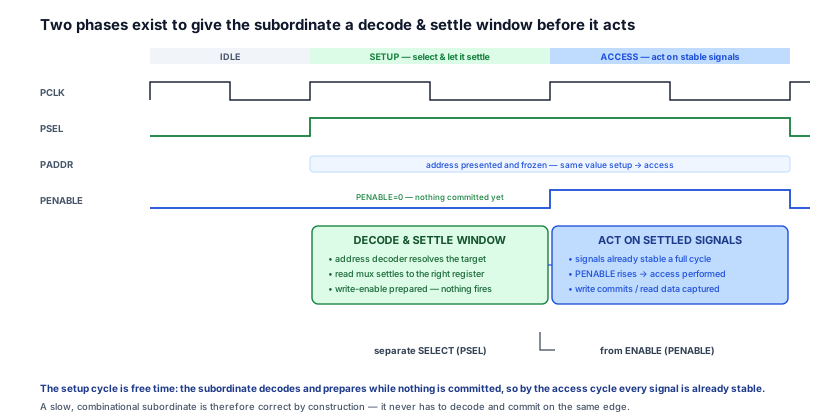
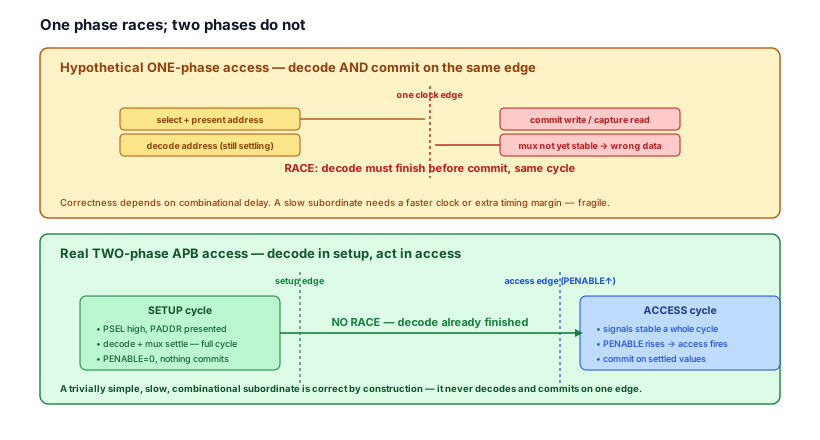
Every register access asks a peripheral to do two distinct jobs: first figure out which register is targeted (decode PADDR, settle the read mux, prepare the write-enable), then act on it (commit PWDATA, drive PRDATA). If both jobs had to happen on one edge, the subordinate's combinational decode would still be settling at the instant the commit fired — correctness would depend on logic depth and clock period. APB removes that pressure by spending an entire cycle up front:
- Setup selects and settles.
PSELrises andPADDR/PWRITE/PWDATAare presented, butPENABLEstays low. Nothing is committed. The subordinate's decode and read mux have the full cycle to stabilise. - Access acts on what already settled.
PENABLErises while the access-defining signals stay frozen. By now every signal has been stable for a whole cycle, so the access is performed on values that are guaranteed good.
The split buys a clean separation of "decide" from "do," and that separation is what makes the rest of APB trivially simple.
2. Why the previous model is not enough
Module 2 showed you the setup-phase timing and Module 4 showed you what happens during access — the mechanics of two phases you already accept as a fact. Those chapters answer "what does each phase do?" They do not answer the prior question this chapter drills: why is there a split to begin with, and what would go wrong with one phase? That gap matters because reasoning about the why is what lets you defend the protocol in an interview, design a correct subordinate, and recognise the failure mode the split prevents.
The mechanics view leaves three things unexamined, and each is where the real insight lives:
- The setup cycle looks like wasted latency until you see what it prevents. Treated as mechanics, the setup phase is just "the cycle before access." Its actual job is to give the subordinate a guaranteed decode-and-settle window — remove it and you have not saved a cycle, you have created a race.
- The
PSEL/PENABLEsplit looks like two redundant select signals. Knowing thatPSELselects andPENABLEenables does not explain why two signals. The reason is timing: select must lead enable by a cycle so decode can complete before commit. Collapse them and the reason vanishes. - The mechanics never show the counterfactual. You cannot appreciate why two phases are correct until you watch a one-phase access fail. This chapter builds the hypothetical one-phase bus, shows the same-edge decode-and-commit race, and proves the two-phase scheme removes it.
So the model to add is not another phase or signal — it is the rationale: the setup window as deliberate decode time, and the race it exists to kill.
3. Mental model
The model: setup is the subordinate's reading time; access is when it answers. APB never asks a question and demands the answer on the same beat — it shows the question, waits a full cycle while the peripheral reads it, then asks for the answer.
Think of a teacher reading a question aloud and only then saying "go." If the teacher said the question and "go" in the same breath, the fastest student might start before hearing it fully, and a slower student would answer late or wrong. By separating "here is the question" (setup: PSEL high, address presented) from "now answer" (access: PENABLE high), every student — even a slow one — has heard the whole question before the buzzer. The subordinate that decodes combinationally is the slow student APB protects: it gets its full cycle to settle, so it is always ready when the buzzer (PENABLE) sounds.
Three refinements make the model precise:
- Setup is committed-to-nothing. During setup
PENABLEis low, so no write lands and no read is sampled. The decode happening in setup is speculative — it costs nothing if it changes, and it is only acted on oncePENABLEconfirms. - The settle window is a full clock cycle of margin. The subordinate's address decoder, read mux, and write-enable logic are combinational; the setup cycle gives them an entire period to propagate before anything depends on them. That is timing margin handed over for free.
- Access is a commit on pre-settled signals. Because the access-defining signals were stable through all of setup, the access cycle never decodes and commits at once — it only commits. The hard combinational work already finished.
4. Real SoC / hardware context
In a real SoC, APB sits at the bottom of the bus hierarchy behind an AHB-to-APB or AXI-to-APB bridge, fanning out to slow peripherals: timers, GPIO, UARTs, interrupt controllers, clock-and-reset blocks. These subordinates are intentionally cheap — often nothing more than a combinational address decoder feeding a bank of registers. The two-phase split is precisely what lets them stay that cheap.
Here is why the rationale is load-bearing in silicon. The subordinate's address decode and read-data multiplexer are wide combinational cones on a low-speed bus shared by many peripherals; the path from PADDR through the decoder, into the selected register's read mux, and back onto PRDATA can be long. The setup cycle exists so that whole cone has a full clock period to settle before PENABLE causes the manager to sample. Without it, the bridge would have to either run the APB domain slow enough that decode-and-commit fit in one cycle, or add pipeline registers inside every trivial peripheral — both of which defeat APB's purpose as the simple, low-cost bus.
The split also covers two historical realities of shared low-speed buses. First, peripheral wake-up: a clock-gated or recently-woken peripheral may need a cycle of lead time before its logic is live; the setup cycle gives it that lead. Second, address-mux settling: on a bus where the address is muxed from several managers, the address line itself needs time to settle to a clean value, and the setup cycle absorbs that settling before the access commits. In both cases the lesson is the same — the setup phase is margin, deliberately spent so the access phase can be a clean, race-free commit.
5. Engineering tradeoff table
The two-phase split spends one cycle of latency to buy correctness and simplicity. Each row is a deliberate consequence of that choice.
| Two-phase decision | What it gives up | What it buys | Why it is correct for APB |
|---|---|---|---|
| Setup cycle before access | One cycle of access latency | A full-cycle decode-and-settle window | Peripherals are slow; latency is cheap, races are not |
PSEL leads PENABLE by a cycle | A single combined select/enable signal | Decode completes before commit | Select-then-enable removes the same-edge race |
| Nothing commits in setup | Earliest-possible commit | Speculative decode with no cost if it moves | The commit is confirmed only by PENABLE |
| Subordinate may be purely combinational | Built-in pipelining inside peripherals | Trivially simple, correct slow subordinates | APB's job is to be the cheap, low-speed bus |
| Two phases, not a pipeline | Throughput of overlapped accesses | Dead-simple, race-free sequencing | Sparse register traffic does not need throughput |
The throughline: APB deliberately spends a cycle of latency it does not miss to eliminate a race it cannot tolerate. On a sparse, low-speed register bus, one extra cycle per access is invisible, but a decode-and-commit race would force either a slower clock or pipelined peripherals everywhere. Two phases trade the cheap resource (latency) for the expensive one (simplicity and certainty).
6. Common RTL / waveform mistakes
7. Interview framing
This is a deceptively deep APB question because the shallow answer — "there's a setup phase and an access phase" — is the mechanics, not the rationale. Interviewers who ask "why does APB use two phases?" or "why split PSEL and PENABLE?" are checking whether you understand the protocol as a set of deliberate tradeoffs or just as a waveform you memorised.
Answer in three moves. First, the purpose: the setup phase gives the subordinate a guaranteed cycle to decode PADDR and settle its read mux and write-enable, with nothing committed, so the access phase only ever commits on already-stable signals. Second, the failure it prevents: in a hypothetical one-phase access, select, decode, and commit land on the same edge — a race whose correctness depends on combinational delay, which would force a slower clock or pipelined peripherals. Third, the payoff: separating select (PSEL) from enable (PENABLE) lets a trivially simple, slow, combinational subordinate be correct by construction, which is exactly APB's job as the cheap low-speed bus. The depth signal that lands: "APB spends a cycle of latency it doesn't miss to buy correctness it can't compromise on." An interviewer hears that and knows you reason about protocols, not just recite them.
8. Q&A
9. Practice
- State the purpose. In one sentence each, say what the setup phase is for and what the access phase is for, using the words "decode," "settle," and "commit."
- Build the counterfactual. Sketch a one-phase access where select, decode, and commit share an edge, and mark exactly where the race is and what the subordinate could get wrong.
- Defend the split. A reviewer claims removing the setup cycle would make APB 50% faster on single accesses. Explain why this is wrong and what it would actually cost.
- Connect to wait states. Explain how the same "settle first, commit later" rationale that justifies two phases also justifies wait states, in terms of the frozen access-defining signals.
- Justify the simplicity. Explain why the two-phase split lets a peripheral be a bare combinational decoder with no internal pipeline, and where the sequencing cost is paid instead.
10. Key takeaways
- Two phases exist to separate "decide" from "do." Setup decodes the address and settles the subordinate's logic; access commits on signals that are already stable — never both on one edge.
- The setup cycle is deliberate margin, not wasted latency. It is a full-cycle decode-and-settle window with nothing committed, spent on purpose to remove a race.
- Splitting
PSELfromPENABLEis the mechanism. Select must lead enable by a cycle so decode finishes before commit; a single combined signal would reintroduce the same-edge race. - A one-phase access races; two phases do not. Collapsing the split makes correctness depend on combinational delay, forcing a slower clock or pipelined peripherals — exactly what APB avoids.
- The split makes a trivially simple subordinate correct by construction. A purely combinational decoder is safe because it always gets its full settle cycle, regardless of logic depth or process corner.
- APB trades cheap latency for expensive certainty. One invisible cycle per access on a sparse low-speed bus buys race-free sequencing and centralises all complexity in the bridge.