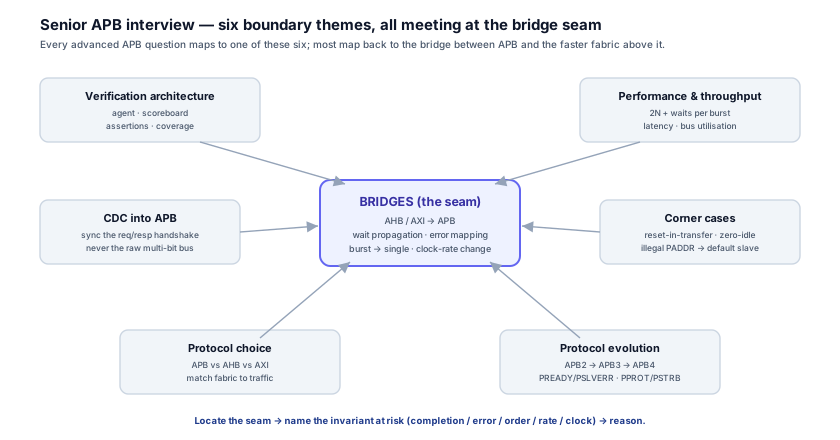
At the senior level the APB interview stops testing the protocol and starts testing your system judgment: how a bridge maps one fabric's wait/error semantics onto APB's, where a clock-domain crossing actually lives, how you prove an APB subsystem is correct, and when you would choose APB at all. Modules 1–16 gave you the two-phase contract, PREADY extension, PSLVERR, and the bridge mechanics. This chapter is the capstone interview bank that takes those facts and pushes them up a level — to the bridge boundary, the verification plan, the throughput budget, and the architecture decision. The single idea to carry through every question: APB is the terminal fabric in an AMBA hierarchy, so almost every senior question is really "what happens at the seam between APB and the faster bus above it" — wait states flowing up, errors mapping across, clocks changing, and a single-outstanding peripheral fabric absorbing bursts it was never built to pipeline. Hold that and each question below resolves to reasoning about a boundary, not reciting a signal.
1. What this chapter covers
This chapter covers the senior-level APB topics an interviewer uses to separate an integrator from a peripheral author: AHB-to-APB and AXI-to-APB bridge behaviour (wait-state propagation, error mapping, clock-rate change, burst-to-single sequencing); the verification architecture for an APB subsystem (agent, scoreboard, assertions, coverage); performance and latency analysis under bridging; clock-domain crossing into the APB domain; the hard corner cases (reset mid-transfer, back-to-back zero-idle, illegal PADDR); the APB vs AHB vs AXI tradeoff and when APB is the right choice; and protocol-version evolution across APB2/APB3/APB4 with PPROT and PSTRB.
Every one of these is a boundary question. A junior candidate describes APB in isolation; a senior candidate describes what APB does when wired beneath an AHB or AXI master through a bridge, running in a different clock domain, under a verification plan that has to prove the seam is correct. The chapter's job is to make you fluent at that seam.
2. Why this matters now
You have the pieces — but the pieces alone do not pass a senior screen, because the senior screen is about composition, not recall.
By this point in the curriculum you can state the two-phase contract, explain PREADY wait insertion, describe PSLVERR, and walk a bridge FSM. Each is necessary. None of them, alone, answers "an AXI write burst hits your AXI-to-APB bridge — walk me through what the peripheral sees and what BRESP the master eventually gets." That question requires you to hold four facts at once: AXI bursts are multi-beat and APB is single-transfer, so the bridge serialises; each APB beat can wait or error; the bridge must accumulate per-beat PSLVERR into a single BRESP; and the two sides may be in different clock domains so the bridge is also a CDC. The interview tests whether you can compose those, not whether you can recite any one.
That composition is exactly what the next stage of your career is — RTL integration, IP bring-up, SoC bus architecture. The model to add here is the boundary-reasoning discipline: for any senior APB question, locate the seam (which two fabrics, which clocks, which direction the wait/error flows), and reason from the seam outward. The rest of this chapter drills that discipline question by question.
3. Mental model
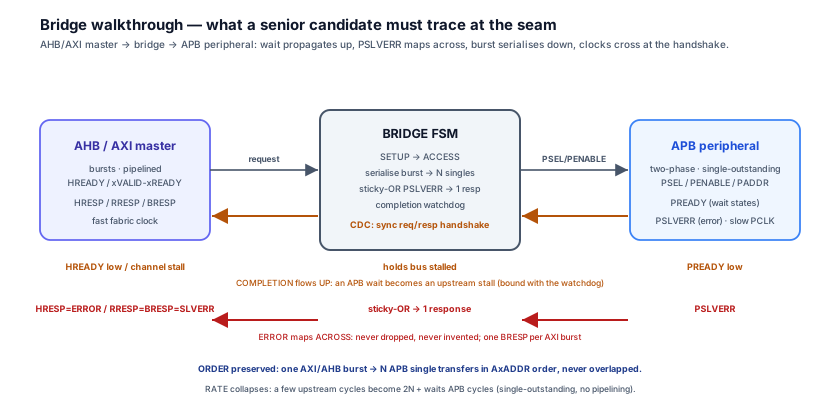
The model: a bridge is a translator that must preserve three invariants across the seam — completion, error, and order — while changing rate. Every senior bridge question is asking which invariant is at risk.
Picture the seam as a customs checkpoint between two countries with different rules. The upstream side (AHB or AXI) speaks in bursts, pipelined addresses, and rich responses; the downstream side (APB) speaks in single two-phase transfers with one PREADY and one PSLVERR. The bridge stands at the checkpoint and must guarantee three things survive the crossing:
- Completion must propagate, never be lost. An APB beat that holds
PREADYlow must turn into a held upstream wait —HREADYlow on AHB, a stalledxVALID/xREADYhandshake on AXI. A bridge that completes upstream before the APB beat finishes commits a transfer the peripheral has not accepted. Liveness flows up. - Error must map, never be dropped or invented. A
PSLVERRon any beat must surface as the upstream error encoding —HRESP = ERRORon AHB,RRESP/BRESP = SLVERRon AXI — and for a multi-beat burst the bridge must decide the accumulation rule (typically sticky: any beat's error makes the whole burst's response an error). - Order must hold. APB is single-outstanding by construction, so the bridge naturally serialises, but it must issue the APB singles in the burst's address order and not reorder or overlap them.
Three refinements sharpen the model:
- Rate change is mandatory, not incidental. The upstream fabric is usually faster and wider; the bridge is where throughput collapses from "burst per few cycles" to "one two-phase transfer plus wait states per beat." Every throughput and latency question lives here.
- The clock seam may coincide with the protocol seam. If APB runs slower than the upstream fabric (the usual case), the bridge is also a CDC —
PSEL/PENABLE/PADDRare launched in the APB domain, but the request/response handshake crosses clocks and needs synchronisers. - Single-outstanding is a feature at this seam. Because APB cannot pipeline, the bridge never has to track multiple in-flight peripheral transfers — which simplifies the FSM but caps throughput. That tradeoff is the heart of APB vs AHB vs AXI.
4. Real SoC / hardware context
These are not exam abstractions — they are the exact decisions made in real peripheral subsystems. In an Arm Cortex-class subsystem, the CPU and DMA sit on a fast main fabric (AHB5 or an AXI/ACE interconnect), and the slow control registers — UART, timers, GPIO, watchdog, the power/clock control block — hang off an APB peripheral bus reached through an AHB-to-APB or AXI-to-APB bridge such as Arm's PL301/NIC-style infrastructure. The bridge is where the CPU's pipelined, possibly-bursting access turns into the patient single-transfer poke a register block expects, and where the peripheral's clock — often a slower, gateable, lower-power clock — meets the fast fabric clock.
In a PCIe-class SoC, the same pattern appears: high-bandwidth datapath traffic rides AXI, while the configuration and status registers of dozens of IP blocks are reached over APB through bridges, precisely because you do not want a register poke consuming AXI pipeline resources. The senior questions below are the questions a lead asks during IP bring-up: when the bridge stalls because a peripheral holds PREADY low forever, where does the hang surface and how do you bound it? When you change the APB clock ratio for power, what breaks in the bridge CDC? When firmware reads an illegal PADDR, who returns the error and how? Each maps to a boundary in real RTL, and the model answer reveals whether you have integrated a bus or only authored a peripheral.
5. Strong-versus-weak answer table
This is the senior-judgment table: each row is a high-frequency advanced question, the weak answer that names a fact and stops, and the strong answer that reasons from the seam and reveals system judgment.
| Senior question | Weak answer (names a fact) | Strong answer (reasons from the seam) |
|---|---|---|
| How does an AHB-to-APB bridge handle wait states? | "It uses PREADY." | The bridge holds HREADY low to the AHB master for as long as the APB beat holds PREADY low — liveness flows up. The bridge's FSM cannot complete the AHB data phase until PSEL && PENABLE && PREADY; until then the AHB master is stalled, so an unbounded PREADY low becomes an unbounded HREADY low and a bus hang, which is why a watchdog/timeout belongs in the bridge. |
| How does an AXI write burst become APB transfers? | "It splits into singles." | The bridge serialises the burst into N single APB writes in AWADDR+beat order, asserting one two-phase transfer per beat and waiting on each PREADY. It accumulates PSLVERR across beats sticky and returns a single BRESP (SLVERR if any beat errored) only after the final beat's BVALID-equivalent completion. Order and the single-response-per-burst rule are the invariants. |
Where does PSLVERR go on the upstream side? | "It becomes an error." | PSLVERR maps to HRESP = ERROR on AHB (two-cycle ERROR response per the AHB-Lite spec) or to RRESP/BRESP = SLVERR on AXI. The bridge must not invent an error when PSLVERR is low, nor drop one when high; for bursts the mapping is sticky-OR across beats into one upstream response. |
| Is the APB-to-faster-bus boundary a CDC? | "Only if clocks differ." | Usually yes — the APB clock is typically slower and gateable for power, so the bridge's request/response handshake crosses clock domains and needs synchronisers (2-flop or req/ack). The APB bus signals themselves are launched in the APB domain; what crosses is the handshake, never the raw multi-bit PADDR/PWDATA unsynchronised. |
| What caps APB throughput in a bridged system? | "It's slow." | Two structural facts: every APB transfer is minimum two cycles (setup + access) even at zero wait, and APB is single-outstanding so there is no pipelining to hide latency. A burst that took a few cycles on AXI becomes 2N + waits APB cycles, and the bridge cannot overlap them — that is the throughput and utilisation ceiling. |
| When would you choose APB over AHB/AXI? | "For simple peripherals." | When the access is low-bandwidth control/status (registers, not data), latency-tolerant, and you want minimal gate count and verification surface. APB's single-outstanding two-phase simplicity is the reason to use it for a register block; you would never put a high-bandwidth datapath on it. The decision is bandwidth and pipelining need, not "simple." |
| What changed from APB2 to APB3 to APB4? | "They added signals." | APB3 (IHI 0024C) added PREADY (wait states) and PSLVERR (error response) — turning a fixed-latency, never-failing bus into one that can stall and report errors. APB4 added PPROT (protection/privilege/secure attributes) and PSTRB (write byte strobes), aligning APB with the security and partial-write semantics the rest of AMBA already had. |
The throughline: every weak answer states a property of APB in isolation; every strong answer reasons about what crosses the seam — completion up, error across, order preserved, rate collapsed, clocks synchronised. Naming the invariant at risk is the senior tell.
6. Red-flag answers an interviewer is listening for
7. How to frame your answer in the room
This is the chapter where how you answer matters as much as what you answer, because senior interviews probe judgment, and judgment is visible in framing.
The frame that lands every advanced APB question is "locate the seam, name the invariant, then reason." When handed any bridge or boundary question, open by stating the seam explicitly — "this is an AXI-write-to-APB-write question, so I'm at the seam between a multi-beat, single-response, possibly-faster-clock fabric and a single-transfer, per-beat-response, slower fabric" — then name which invariant the question stresses (completion, error, order, rate, or clock), then walk the mechanism. For example: "An AXI write burst into the bridge: I serialise to N APB singles in address order (order), hold each beat until PREADY so the AXI write channel stalls correctly (completion up), sticky-OR PSLVERR across beats into one BRESP (error across), and because the APB clock is slower I cross the request/response handshake through synchronisers (clock)." That single structured answer demonstrates you have integrated a bus.
The strongest move is to volunteer the system consequence the question implies — "and the reason a register block sits on APB at all is to keep these slow, latency-tolerant pokes off the AXI pipeline, so the throughput collapse at the bridge is a deliberate tradeoff, not a defect." Closing with the tradeoff, citing the spec version that introduced the feature you relied on, and offering the verification property that would prove your claim, is what separates a strong senior answer from a merely correct one.
8. Q&A
9. Practice
- Trace the wait. For an AHB read where the APB peripheral inserts three wait states, draw the cycle-by-cycle relationship between
PENABLE/PREADYon the APB side andHREADYon the AHB side, and state the invariant being preserved. - Map the burst. Given a 4-beat AXI write burst where beats 2 and 4 assert
PSLVERR, write out the sequence of APB singles, the sticky accumulator state after each beat, and the finalBRESP— and say why it is one response, not four. - Place the CDC. For an APB clock at one-third the AXI clock, list exactly which bridge signals cross clock domains, which you synchronise and how (2-flop vs req/ack), and which you must not run through bit-wise synchronisers, with the reason.
- Bound the hang. Write the bounded-completion SVA property for an APB subordinate, describe the bridge watchdog that converts a timeout into a clean upstream error, and explain where a hung slave's symptom appears in an AHB-bridged CPU subsystem.
- Defend the choice. A reviewer proposes putting a high-rate streaming peripheral on APB "to keep it simple." In three sentences, refute it using APB's single-outstanding two-phase structure, and state the traffic profile that would justify APB.
10. Key takeaways
- Every senior APB question is a seam question. APB is the terminal, single-outstanding, two-phase fabric at the bottom of the hierarchy, so the interesting behaviour is at the bridge boundary: which upstream fabric, which clock, and which invariant — completion, error, or order — is at risk.
- Completion flows up, error maps across, order is preserved, rate collapses. A bridge holds the upstream bus stalled until the APB beat completes; it maps
PSLVERRtoHRESP/RRESP/BRESP(sticky-OR across a burst into one response); it serialises bursts to in-order singles; and it is where burst throughput collapses to2N + waits. - The protocol seam is often a clock seam too. Synchronise the request/response handshake (2-flop or req/ack), never the multi-bit
PADDR/PWDATAbit-wise — gate the data on the synchronised control. - Corner cases live at the seam: a hung
PREADYbecomes a non-local system hang (bound it with a bridge watchdog); a reset mid-transfer must leave both sides consistent; an illegalPADDRneeds a default slave to returnPREADY+PSLVERRrather than hang. - Choosing APB is a bandwidth/concurrency decision, not a "simplicity" one. Control and status registers belong on APB; datapath endpoints that burst or stream belong on AXI. APB3 added
PREADY/PSLVERR; APB4 addedPPROT/PSTRB— and a bridge must faithfully carry all four or it corrupts partial writes, drops errors, or breaks the security model.