AMBA APB · Module 15
APB Assertions
Encoding the APB protocol-rules catalogue as SystemVerilog Assertions — property structure (clock, disable iff, antecedent |-> / |=> consequent, $stable), one property per rule for phase, select, stability, ready and error, and binding the checker non-intrusively to the bus with bind. The always-on protocol monitor that fails the instant a rule breaks.
The rules catalogue told you what legal APB is; assertions make a tool check it, continuously, on every edge. The single idea to carry: an APB assertion is a 1:1 encoding of one catalogue rule into a concurrent SVA property — clocked on pclk, disabled during reset, gated by an antecedent and obligated by a consequent — bind-ed non-intrusively to the bus so it fails the instant the rule breaks. You are not re-deriving the rules (they were enumerated in 15.1); you are turning each one into a property that an always-on simulation or formal engine evaluates. Get the property structure right — the clocking event, the disable iff, the antecedent/consequent split, $stable, and the bind — and the catalogue becomes a live protocol monitor. Get it subtly wrong — a vacuous antecedent, a missing reset disable — and the assertion reports green while the rule goes unchecked.
1. Problem statement
The problem is rendering each catalogue rule as a concurrent SystemVerilog Assertion (SVA) property that an engine evaluates on every clock, so a protocol violation fails an assertion the moment it occurs — and doing so non-intrusively, so the checker attaches to any APB bus without editing the DUT.
A rule in prose — "the address is held stable from SETUP through completion" — cannot fail a simulation. It has to become an executable proposition with three things made precise: when it is sampled (which clock edge), when it applies (the gating condition, or antecedent), and what must then hold (the obligation, or consequent). SVA is the language that expresses exactly this, and the encoding has hard requirements:
- It must be a temporal proposition, not a combinational
if. Protocol rules span cycles — "ifPSELis high and the transfer isn't completing this cycle, then next cyclePADDRis unchanged." That "next cycle" is temporal; it needs a clocking event and an implication operator, not a procedural conditional. - It must be disabled during reset. While
PRESETnis low the bus is not running a protocol; a property that keeps evaluating in reset fires spurious failures (or, worse, gets waived and masks a real one). Every property carriesdisable iff (!presetn). - It must be non-intrusive and reusable. The checker cannot live inside the DUT — it has to attach from outside, to the interface signals, so the same checker works on any APB slave and ships nothing into silicon. That is what
bindis for.
So the job is to take a complete catalogue and produce a complete, syntactically correct, idiomatic set of SVA properties — one per rule — bound to the bus as an always-on monitor.
2. Why previous knowledge is insufficient
Chapter 15.1 gave you the rulebook: phase, select, stability, ready, error and reset rules, each atomic and numbered. But a rule list is a document — it does not run. What you are missing is the language and structure that turns a written rule into something an engine checks:
- A rule statement is not a property. "
PENABLEis low in SETUP and high in ACCESS" is English. The property is@(posedge pclk) disable iff(!presetn) (psel && !penable) |=> penable— and writing it forces decisions the prose hides: which edge samples, whether the obligation is same-cycle (|->) or next-cycle (|=>), and what arms the check. The catalogue does not teach SVA; this chapter does. - Assertions are not the procedural monitor. Chapter 15.3 (the monitor) reconstructs transactions in procedural code — a class sampling the bus, building transaction objects, comparing in a scoreboard. SVA is declarative: you state the obligation and the engine proves or refutes it every cycle, with no sampling loop to write. The two are complementary — assertions are the dense, always-on rule checks; the monitor is the transaction reconstructor. Confusing them is a classic gap.
- Reachability is not coverage. This chapter uses
coverto confirm an assertion's antecedent actually fires (reachability — did the scenario happen at all). The functional coverage model — bins for every wait-count, every error case, every back-to-back pattern — is Chapter 15.5.cover propertyhere answers "did this property ever arm?"; the coverage model answers "did we exercise the whole space?"
So the model to add is SVA structure: clocking, reset-disable, antecedent/consequent, sequences, $stable/$isunknown, and bind — the machinery that makes the catalogue executable.
3. Mental model
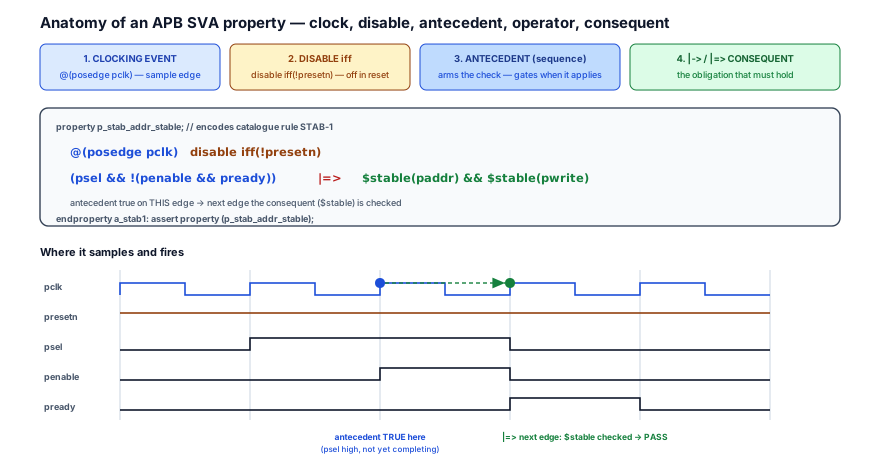
The model: an SVA property is a contract with a trigger and a clause. The antecedent is the trigger ("if this situation arises on the bus"); the consequent is the clause that then becomes legally binding ("then this must hold"). The clocking event says when the contract is read (which edge samples the signals); disable iff(!presetn) says the contract is void during reset. The engine re-reads the contract on every clock and the instant the trigger fires but the clause is broken, the assertion fails — pointing at the exact cycle and signal.
Four refinements make it precise and interview-ready:
|->is same-cycle;|=>is next-cycle.antecedent |-> consequentmeans the consequent must hold in the same cycle the antecedent matched.antecedent |=> consequentmeans it must hold one cycle later — exactly|-> ##1 consequent. Stability rules use|=>("if held this cycle, next cycle the value is unchanged"); a same-cycle combinational rule like "PENABLEhigh ⇒PSELhigh" uses|->. Choosing wrong shifts the check by a cycle and either fires falsely or misses the violation.$stable/$past/$isunknownare the sampled-value functions.$stable(sig)is true whensighas the same sampled value as the previous clock — the natural encoding of every stability rule.$isunknown(sig)is true if any bit is X/Z — the encoding of "never-X" rules (e.g.PSLVERRmust not be unknown at completion).$past(sig, n)reaches backncycles. These operate on sampled values (preponed to the clock edge), which is why glitches between edges don't trip them.- The antecedent must actually fire, or the pass is vacuous. If the antecedent is never true on the trace, the implication is trivially satisfied every cycle — the property reports PASS while never once testing the consequent. A vacuous pass is an unasked question. The defence is
cover propertyon the antecedent: if it never covers, the assertion never armed. bindattaches the checker from outside. You write the properties in a separate module (orchecker), thenbindit to the APB interface or DUT instance. The checker sees the bus signals as if it were inside, but the DUT source is untouched and the checker ships nothing into the netlist. One checker, bound to every APB slave.
4. Real SoC implementation
In a real environment the properties live in a dedicated checker module — one property per catalogue rule, each commented with its rule ID — and a bind statement attaches it to the APB interface so it monitors every transfer without touching the DUT. A representative checker:
// apb_protocol_checker.sv — concurrent SVA encoding of the APB rules catalogue.
// Non-intrusive: bound to the APB interface, ships nothing into the netlist.
// One property per catalogue rule; each assert/cover names the rule ID it owns.
module apb_protocol_checker #(
  parameter int ADDR_W   = 32,
  parameter int DATA_W   = 32,
  // Worst-case wait cycles this subordinate is permitted, from its datasheet.
  // Used to make the completion rule falsifiable in simulation.
  parameter int MAX_WAIT = 16
) (
  input logic              pclk,
  input logic              presetn,
  input logic              psel,      // single-slave view; one-hot handled at the fabric
  input logic              penable,
  input logic              pwrite,
  input logic [ADDR_W-1:0] paddr,
  input logic [DATA_W-1:0] pwdata,
  input logic [DATA_W-1:0] prdata,
  input logic [DATA_W/8-1:0] pstrb,
  input logic              pready,
  input logic              pslverr
);

  // A transfer is "active and not yet completing" when PSEL is high and we are
  // not on the completing edge (PENABLE & PREADY). Reused by the stability rules.
  let in_held_transfer = psel && !(penable && pready);

  // ---- PHASE rules -------------------------------------------------------
  // PHASE-2: PENABLE is LOW during SETUP - the first cycle of every transfer.
  //
  // Getting the antecedent right matters more than it looks. Writing
  //     ($rose(psel) && !penable) |-> !penable
  // is a TAUTOLOGY: !penable appears in both halves, so the property can never
  // fail no matter what the design does. It arms happily, its cover HITs, and
  // it still checks nothing - a failure mode distinct from vacuity and just as
  // silent. See the Debug Lab in beat 7b.
  //
  // The first cycle of a transfer is one where PSEL is high and the previous
  // cycle was either unselected or a completing ACCESS. Both cases start a
  // new SETUP, which covers back-to-back transfers where PSEL never drops.
  property p_setup_penable_low;
    @(posedge pclk) disable iff (!presetn)
      (psel && (!$past(psel) || $past(penable && pready))) |-> !penable;
  endproperty
  a_setup_penable_low: assert property (p_setup_penable_low);   // PHASE-2 (SETUP)

  // PHASE-1 + PHASE-2: SETUP is followed by ACCESS next cycle, i.e. once PSEL
  //          is high with PENABLE low, the NEXT cycle PENABLE must be high
  //          (assuming PSEL stays asserted). Next-cycle obligation → |=>.
  property p_setup_to_access;
    @(posedge pclk) disable iff (!presetn)
      (psel && !penable) |=> (penable);
  endproperty
  a_setup_to_access: assert property (p_setup_to_access);   // PHASE-1/2

  // ---- SELECT rules ------------------------------------------------------
  // SEL-1: PENABLE is never high unless PSEL is high (combinational → |->).
  property p_enable_implies_sel;
    @(posedge pclk) disable iff (!presetn)
      penable |-> psel;
  endproperty
  a_enable_implies_sel: assert property (p_enable_implies_sel);  // SEL-1
  // (SEL-2 one-hot PSEL is checked at the fabric level over the PSEL vector:
  //  assert ($onehot0(psel_vec)); — bound where all PSELx are visible.)

  // ---- STABILITY rules ---------------------------------------------------
  // STAB-1/2: address, control and write data are held stable across a transfer
  //           that has not yet completed. Next-cycle → |=> with $stable.
  property p_request_stable;
    @(posedge pclk) disable iff (!presetn)
      in_held_transfer |=> ($stable(paddr) && $stable(pwrite) &&
                            $stable(pwdata) && $stable(pstrb));
  endproperty
  a_request_stable: assert property (p_request_stable);     // STAB-1/2

  // ---- READY rules -------------------------------------------------------
  // RDY-1: PREADY is only meaningful (sampled) in ACCESS; outside ACCESS it
  //        must not falsely signal completion. Encoded as: completion edge
  //        (PSEL & PENABLE & PREADY) only occurs when PENABLE is high.
  // RDY-2: bounded completion - once in ACCESS, PREADY must rise within
  //        MAX_WAIT cycles, taken from the subordinate's worst-case wait spec.
  //
  // The bound is not a convenience. Written as
  //     (psel && penable) |-> ##[0:$] pready
  // the property is UNBOUNDED liveness, and a simulator cannot falsify it: an
  // attempt that never completes simply stays pending until the run ends, so
  // the assertion reports no failure however long the subordinate stalls. A
  // stuck PREADY - the exact bug this rule exists for - passes.
  //
  // True liveness needs formal. In simulation, assert the engineering
  // requirement instead, which is a real number the datasheet gives you.
  property p_bounded_completion;
    @(posedge pclk) disable iff (!presetn)
      (psel && penable && !pready) |-> ##[1:MAX_WAIT] pready;
  endproperty
  a_bounded_completion: assert property (p_bounded_completion)   // RDY-2
    else $error("PREADY did not rise within %0d cycles of ACCESS", MAX_WAIT);

  // ---- ERROR rules -------------------------------------------------------
  // ERR-1: PSLVERR is only VALID at completion (PSEL & PENABLE & PREADY), and
  //        at that edge it must be a known 0/1, never X.
  //
  // Note the strength of the first property below. AMBA *recommends* that
  // PSLVERR is driven low when it is not being sampled; it does not require
  // it. So this asserts a house rule rather than a protocol rule, and it will
  // flag a compliant subordinate that leaves PSLVERR as a don't-care outside
  // the completing cycle. Keep it where the project mandates the tie-low, and
  // downgrade it to a warning when qualifying third-party IP.
  property p_pslverr_only_at_completion;
    @(posedge pclk) disable iff (!presetn)
      pslverr |-> (psel && penable && pready);
  endproperty
  a_pslverr_only_at_completion: assert property (p_pslverr_only_at_completion); // ERR-1

  property p_pslverr_known_at_completion;
    @(posedge pclk) disable iff (!presetn)
      (psel && penable && pready) |-> !$isunknown(pslverr);
  endproperty
  a_pslverr_known: assert property (p_pslverr_known_at_completion);  // ERR-1 (never-X)

  // ---- COVER: prove the antecedents actually fire (anti-vacuity) ----------
  c_held_transfer: cover property (@(posedge pclk) in_held_transfer);
  c_wait_state:    cover property (@(posedge pclk) (psel && penable && !pready));
  c_error_resp:    cover property (@(posedge pclk) (psel && penable && pready && pslverr));

endmodule

// ---- BIND: attach the checker to the DUT's APB interface, non-intrusively --
// The checker is instantiated against apb_if without editing the slave RTL.
bind apb_slave apb_protocol_checker #(.ADDR_W(32), .DATA_W(32), .MAX_WAIT(16)) u_apb_chk (
  .pclk    (pclk),    .presetn (presetn),
  .psel    (psel),    .penable (penable), .pwrite (pwrite),
  .paddr   (paddr),   .pwdata  (pwdata),  .prdata (prdata),
  .pstrb   (pstrb),   .pready  (pready),  .pslverr(pslverr)
);
Two facts make this the right shape. First, each property names its catalogue rule ID, so the assertion set is an auditable derivation from 15.1 — a sign-off review walks rule IDs and confirms each has a property (and that each property non-vacuously fires via its cover). Second, bind keeps the checker non-intrusive and reusable: the same apb_protocol_checker binds to every APB slave in the SoC, lives only in the verification compile, and ships nothing into the netlist — which is precisely why assertions and the procedural monitor can both watch the same bus without interfering.
5. Engineering tradeoffs
Writing the SVA is a sequence of structural choices — operator, gating, where each construct fits.
| Construct | Use it for | Don't use it for | Why |
|---|---|---|---|
assert | Checking DUT behaviour — every catalogue rule | Constraining stimulus | An assert fails the test when the property is violated; it is the rule checker |
assume | Constraining inputs, mainly in formal | Checking the DUT | In formal, assume tells the engine the manager only drives legal APB — it bounds the input space so the proof is about a legal environment, not a check |
cover | Proving a scenario is reachable (antecedent fired) | Measuring functional coverage | cover property confirms the property armed non-vacuously; the coverage model measures the space |
The second axis is how each rule category maps to property style:
| Rule category | Operator / function | Why |
|---|---|---|
| Phase (SETUP→ACCESS) | ` | =>` (next-cycle) |
Phase / Select (combinational, e.g. PENABLE ⇒ PSEL) | ` | ->` (same-cycle) |
Stability (PADDR/PWDATA/PWRITE/PSTRB held) | ` | =>+$stable(...)` |
| Ready (bounded completion) | ` | -> ##[0:$]or##[1:N]` |
Error / never-X (PSLVERR known at completion) | ` | ->+!$isunknown(...)` |
The throughline: assert checks, assume constrains inputs (in formal), cover proves reachability — three different jobs, not three strengths of the same thing. And the operator follows the rule's timing: same-cycle relationships are |->, "next cycle / held" rules are |=>, completion is bounded liveness. Pick the operator from the rule, not from habit.
6. Common RTL mistakes
7. Debugging scenario
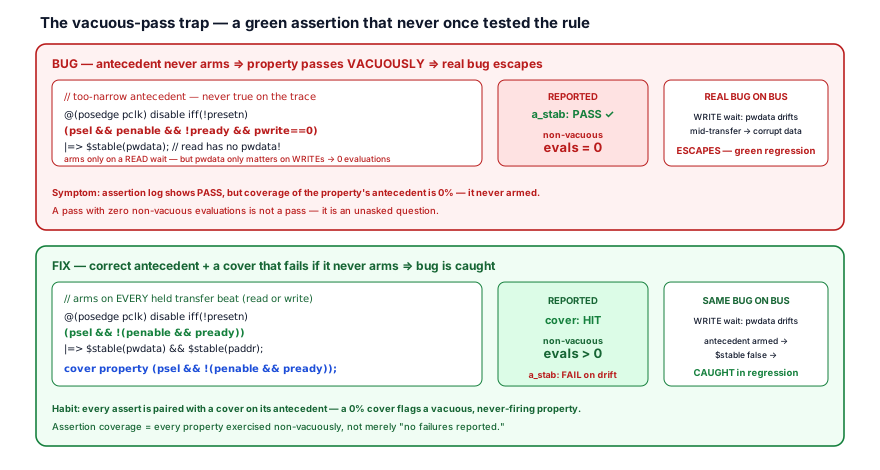
The signature SVA failure is not a noisy false fail — it is a silent vacuous pass: an assertion that reports green on every run because its antecedent never once armed, so a real protocol bug it was meant to catch sailed straight through.
- Observed symptom: a slave passes its full assertion suite, every property reports PASS, sign-off says "assertions clean." In integration the slave intermittently corrupts write data under back-to-back traffic with wait states — the exact failure the stability assertion was written to catch. The assertion that should have screamed never fired.
- Waveform clue: on the failing trace,
PWDATAchanges during a wait state (manager holding the transfer withPREADYlow). Yet the assertion log showsa_stab: PASS. Pulling the assertion's coverage reveals the tell: the property's antecedent has 0% coverage — it never evaluated non-vacuously, not once, across the entire regression. - Root cause: the stability property's antecedent was written too narrowly — it gated on
(psel && penable && !pready && pwrite==0), i.e. it only armed on a read wait, while write data only matters on writes. The condition was never true on a write transfer, so the property was vacuously satisfied every cycle and the$stable(pwdata)consequent was never checked. The assertion existed, compiled, and "passed" — but it was an empty contract whose trigger could never fire. - Correct RTL (corrected SVA): widen the antecedent to arm on every held transfer beat, and pair it with a cover so a non-firing antecedent is visible:
// FIX: arm on any held transfer (read or write), and prove the antecedent fires.
property p_request_stable;
  @(posedge pclk) disable iff (!presetn)
    (psel && !(penable && pready)) |=> ($stable(pwdata) && $stable(paddr) &&
                                        $stable(pwrite) && $stable(pstrb));
endproperty
a_request_stable: assert property (p_request_stable);
c_held_transfer: cover property (@(posedge pclk) (psel && !(penable && pready)));- Verification assertion: beyond fixing this property, add a sign-off gate: every
assertmust have a pairedcoveron its antecedent, and the regression report must show every suchcoverHIT. An assertion whose antecedent cover is 0% is treated as a failure of the suite, not a pass — vacuity is a coverage hole, not a clean result. - Debug habit: when a "fully verified" slave fails on a rule its assertion supposedly checks, do not assume the assertion is wrong — check whether it ever fired. Read the non-vacuous evaluation count and the antecedent cover. A PASS with zero non-vacuous evaluations means the property never tested anything; the bug is a too-narrow or mistyped antecedent, and the fix is to make the trigger reachable and prove it with
cover.
7b. Two ways an assertion passes without checking anything
Beat 7 covers vacuity: an antecedent that never arms. There are two further failure modes with the same symptom — a green report from a property that tests nothing — and both were present in earlier revisions of the checker above.
A tautology arms and still cannot fail. The original PHASE-2 property read:
// ✗ !penable appears on BOTH sides. This can never fail.
($rose(psel) && !penable) |-> !penable;
Its antecedent fires on every transfer, so an antecedent cover HITs and the standard vacuity check reports it healthy. It is nonetheless an empty contract: the consequent restates part of the antecedent, so the property is true by construction regardless of the design. Vacuity coverage cannot see this, because the property is not vacuous — it is trivially satisfiable.
Unbounded liveness cannot be falsified in simulation. The original completion property read:
// ✗ Unbounded. A simulator can never report this as failing.
(psel && penable) |-> ##[0:$] pready;
##[0:$] says "eventually". If PREADY never rises, the attempt simply remains
pending until the run ends — there is no cycle at which the tool can declare it
failed, because a later cycle might still satisfy it. A permanently stuck
PREADY, which is exactly the bug this rule exists to catch, produces no failure.
Only a formal engine can discharge true liveness; in simulation you assert the
bounded engineering requirement instead.
A protocol checker reported clean while the subordinate held PREADY low forever
UNFALSIFIABLE-ASSERTIONAn APB subordinate locked up under a specific register-access sequence: PREADY
went low and never returned, so the manager stalled and the whole peripheral bus
froze. Every test that hit the sequence timed out at the simulation time limit.
The protocol checker bound to that interface reported no failures. Not a late failure, not a warning — a completely clean assertion report on runs that had demonstrably hung on an APB violation. The team initially assumed the checker was not bound, then confirmed from the elaboration log that it was.
// Comment claims bounded; code is unbounded.
// RDY-2: bounded completion — PREADY must rise within N cycles.
property p_bounded_completion;
  @(posedge pclk) disable iff (!presetn)
    (psel && penable) |-> ##[0:$] pready;
endproperty
a_bounded_completion: assert property (p_bounded_completion);The assertion report distinguished the two counts that matter:
  a_bounded_completion   attempts: 4127   failures: 0   incomplete: 1
  c_wait_state           hits: 3891
One incomplete attempt, and zero failures. The incomplete attempt is the hang: an evaluation that started when the transfer entered ACCESS and never reached a verdict, because the sequence it was waiting for never occurred and the run ended first.
That is the whole diagnosis. Most report formats print incomplete attempts in a separate column that nobody reads, and no CI gate keys on it — the pass/fail decision reads the failure count, which was correctly zero. The property had not been violated. It had simply never finished deciding.
##[0:$] expresses unbounded eventuality, and unbounded eventuality is not
falsifiable by a finite simulation. At any cycle where PREADY is still low, the
property is not yet violated — a later cycle could still satisfy it. So no cycle
exists at which the tool may declare failure, and the attempt stays pending until
end of test, where it is reported as incomplete rather than failed.
The comment above the property said "within N cycles", which is what the author intended and what the reviewer read. Nobody compared the sentence with the operator. The gap between them is the entire bug: the rule was specified correctly, documented correctly, and implemented as something strictly weaker than a check.
This is a third category alongside vacuity and tautology, and it is worth naming separately. A vacuous property never arms. A tautological property arms and cannot fail. An unbounded-liveness property arms, could in principle fail, and the simulator is structurally unable to say so.
// Bound it with the subordinate's worst-case wait specification.
parameter int MAX_WAIT = 16;

property p_bounded_completion;
  @(posedge pclk) disable iff (!presetn)
    (psel && penable && !pready) |-> ##[1:MAX_WAIT] pready;
endproperty
a_bounded_completion: assert property (p_bounded_completion)
  else $error("PREADY did not rise within %0d cycles of ACCESS", MAX_WAIT);
Now the hang fails on cycle MAX_WAIT + 1, naming the interface and the bound,
while the simulation is still running and the waveform still has the context.
Three habits follow, and together they close the whole family.
Gate the regression on incomplete attempts, not only failures. An incomplete attempt is an assertion that did not reach a verdict, which is not a pass. Most tools can report the count; treating a non-zero count as a suite failure would have caught this on the first hanging run.
Review every unbounded operator. ##[0:$], s_eventually and until
without a bound belong in formal properties. In a simulation checker they should
be justified in a comment or replaced with a bound.
Check the consequent against the antecedent for shared terms. A term appearing on both sides — as in the PHASE-2 tautology above — makes the property unfalsifiable in a way no coverage metric reports.
The unifying question to ask of any assertion is not "did it pass" but "what input would make this fail?" If you cannot construct one, the property is not a check. See PREADY stuck low for the design-side failure this rule guards, and concurrent assertions for the sequence operators involved.
7c. Qualifying the checker
A protocol checker is itself a design, and the way you verify a checker is to feed it known-bad traffic and confirm it objects. This harness drives one deliberate violation per rule and fails if the corresponding assertion stays silent.
module apb_checker_qual_tb;
  logic pclk = 0, presetn = 0;
  logic psel = 0, penable = 0, pwrite = 0, pready = 1, pslverr = 0;
  logic [31:0] paddr = '0, pwdata = '0, prdata = '0;
  logic [3:0]  pstrb = '1;

  apb_protocol_checker #(.ADDR_W(32), .DATA_W(32), .MAX_WAIT(4)) chk (.*);

  always #5 pclk = ~pclk;

  // Count failures per rule by hooking the assertion action blocks through a
  // shared counter. In a real flow this comes from the tool's assertion API;
  // here an explicit counter keeps the example self-contained.
  int unsigned fired [string];
  int unsigned expected_fires;

  task automatic expect_fire (input string rule);
    expected_fires++;
    if (!fired.exists(rule) || fired[rule] == 0)
      $fatal(1, "QUALIFICATION FAILED: %s did not fire on its own violation",
             rule);
    else
      $display("PASS %-24s fired on injected violation", rule);
  endtask

  initial begin
    repeat (2) @(negedge pclk); presetn = 1;

    // ---- Violation 1: PENABLE high during SETUP (PHASE-2) ---------------
    @(negedge pclk) psel = 1; penable = 1;      // illegal: SETUP with PENABLE
    @(negedge pclk) psel = 0; penable = 0;
    repeat (2) @(negedge pclk);
    expect_fire("a_setup_penable_low");

    // ---- Violation 2: PADDR changes mid-transfer (STAB-1) ---------------
    @(negedge pclk) psel = 1; penable = 0; paddr = 32'h100; pready = 0;
    @(negedge pclk) penable = 1;
    @(negedge pclk) paddr = 32'h200;            // illegal: address moved
    @(negedge pclk) pready = 1;
    @(negedge pclk) psel = 0; penable = 0; pready = 1;
    repeat (2) @(negedge pclk);
    expect_fire("a_request_stable");

    // ---- Violation 3: PREADY held low past MAX_WAIT (RDY-2) -------------
    // Against the OLD unbounded property this injection produced no failure
    // at all - which is precisely why the qualification harness exists.
    @(negedge pclk) psel = 1; penable = 0; paddr = 32'h300; pready = 0;
    @(negedge pclk) penable = 1;
    repeat (8) @(negedge pclk);                 // 8 > MAX_WAIT of 4
    @(negedge pclk) pready = 1;
    @(negedge pclk) psel = 0; penable = 0;
    repeat (2) @(negedge pclk);
    expect_fire("a_bounded_completion");

    // ---- Violation 4: PENABLE without PSEL (SEL-1) ----------------------
    @(negedge pclk) psel = 0; penable = 1;      // illegal
    @(negedge pclk) penable = 0;
    repeat (2) @(negedge pclk);
    expect_fire("a_enable_implies_sel");

    $display("Checker qualification passed: %0d rules proven falsifiable.",
             expected_fires);
    $finish;
  end
endmodule
Violation 3 is the point of the whole harness. Run it against the unbounded
version of the completion property and the injected stall produces no failure,
so expect_fire reports the checker itself as broken. That is the only
mechanical way to distinguish a rule that holds from a rule that cannot fail —
and it costs one directed stimulus per property.
8. Verification perspective
Assertions are not "set and forget" — their own completeness is a verification deliverable, measured by non-vacuity and coverage of antecedents, and the choice between simulation and formal changes what they buy you.
- Vacuity is the first thing you verify about your assertions. A passing assertion proves nothing unless it armed. So every
assertis paired with acover propertyon its antecedent, and sign-off requires every such cover to be HIT — a 0% antecedent cover means the property never tested its rule. This is assertion coverage: not "did any assertion fail" but "was every property exercised non-vacuously." It is the single highest-value check on the assertion suite, because a vacuous property is indistinguishable from a passing one in the failure log. - Formal and simulation use the same properties differently. In simulation, properties are checked against the stimulus you happen to drive — they fail only on traces you generate, and vacuity is a real risk (an antecedent you never stimulated). In formal, the engine explores all legal input traces: you
assumethe manager drives legal APB (constraining inputs), and the tool proves eachassertholds for every reachable state or returns a counterexample. Formal turns "passed on my tests" into "cannot be violated" — invaluable for the dense, local APB rules (stability, phase, select) that are fully provable, while bounded-liveness ready rules may need a depth bound. bindreuse makes the checker an SoC-wide asset. Because the properties are written against interface signals and attached bybind, oneapb_protocol_checkerbinds to every APB slave in the design — and, in formal, to the same RTL under a different harness. The checker is authored once, audited once against the catalogue, and reused everywhere, which is what keeps the assertion set consistent across dozens of peripherals instead of drifting per-block. It also coexists cleanly with the procedural monitor and feeds the same sign-off as the coverage model: assertions prove the rules, the monitor reconstructs transactions, coverage confirms the space was exercised.
The point: verify the assertions by non-vacuity and antecedent coverage, exploit formal to turn passes into proofs, and use bind to make one audited checker watch every APB bus — because an assertion that never fires is worse than none, since it reads as green.
9. Interview discussion
"Walk me through how you'd write an APB protocol checker in SVA" is a critical verification question, and the answer that signals real experience moves from structure to non-vacuity to bind.
Lead with the structure: every concurrent property has a clocking event (@(posedge pclk)), a disable iff(!presetn) so it is void in reset, an antecedent that arms the check, and a consequent obligated by |-> (same cycle) or |=> (next cycle). Then show you can map the catalogue: a same-cycle relationship like "PENABLE ⇒ PSEL" is penable |-> psel; a stability rule is (psel && !(penable && pready)) |=> $stable(paddr); "PSLVERR only at completion" is pslverr |-> (psel && penable && pready); the never-X rule uses !$isunknown(...). The depth flourishes are three: assert vs assume vs cover — assert checks the DUT, assume constrains inputs in formal, cover proves reachability, three different jobs not three strengths; vacuity — a green assertion means nothing unless its antecedent fired, so you pair every assert with a cover on its antecedent and treat a 0% antecedent cover as a suite failure; and bind — the checker is a separate module bound to the interface so it is non-intrusive, ships nothing into the netlist, and the one audited checker reuses across every APB slave. Closing with "in formal I assume legal manager stimulus and the tool proves the stability and phase properties for all reachable states — turning 'passed my tests' into 'cannot be violated'" demonstrates you understand assertions as both a simulation monitor and a formal contract.
10. Practice
- Encode three rules. Write SVA properties for: "
PENABLEis high in ACCESS one cycle after SETUP," "PADDRis stable across a held transfer," and "PSLVERRis only asserted at completion." State the operator (|->vs|=>) for each and why. - Spot the vacuity. Given
(psel && penable && !pready && pwrite==0) |=> $stable(pwdata), explain why it can pass vacuously on every write transfer, and rewrite the antecedent so it arms on every held beat. Add thecoveryou'd pair with it. - Assert vs assume vs cover. For each of these, say which construct fits and why: (a) the DUT must never assert
PSLVERRoutside completion; (b) in a formal run, the manager only ever drives legal APB; (c) confirm the wait-state-with-error scenario was reached. - Reset discipline. Show what goes wrong if a stability property omits
disable iff(!presetn), and how a waived reset-time failure can later mask a real bug. - Bind it. Write a
bindstatement attaching anapb_protocol_checkerto anapb_slaveinstance, and explain in one sentence whybindkeeps the checker non-intrusive and reusable.
11. Q&A
Vacuity. The antecedent never arms, so the consequent is never evaluated. The standard defence is a cover property on every antecedent, with sign-off requiring each to be HIT.
Tautology. The antecedent arms, but the consequent restates part of it, so the property is true by construction. ($rose(psel) && !penable) |-> !penable is the example from this page's own checker: the antecedent cover HITs, vacuity analysis reports it healthy, and the property still cannot fail for any design. Coverage cannot detect this, because the property is not vacuous — it is trivially satisfiable.
Unbounded liveness. ##[0:$], s_eventually and unbounded until express "eventually", which a finite simulation cannot falsify. At every cycle where the consequent has not yet occurred the property is not yet violated, so no cycle exists at which the tool may declare failure; the attempt stays pending and is reported as incomplete at end of test, not as a failure.
The three need different defences — antecedent coverage, review of shared terms between antecedent and consequent, and a regression gate on incomplete attempts — which is why it is worth naming them separately. The single question that catches all three: what input would make this property fail? If you cannot construct one, it is not a check.
Because "eventually" is not checkable by simulation, and the bounded form is both checkable and closer to the engineering requirement anyway.
An unbounded property produces no failure when the subordinate hangs — the very case it exists to catch. What you get instead is one incomplete attempt in a column most report formats print and most CI gates ignore. The pass/fail decision reads the failure count, which is correctly zero, so a run that hung on a protocol violation reports clean.
The bounded form fails on a specific cycle, names the interface, and does so while the simulation is still running and the waveform still has context. And the bound is not arbitrary: a subordinate's datasheet states a worst-case wait, so MAX_WAIT is a real number with a real meaning rather than a tuning parameter. A design that exceeds it has violated its own specification even if it would eventually have completed.
Keep the unbounded form for formal, where an engine can prove liveness over all reachable states. The two are complementary: formal proves the property cannot be violated, simulation proves the implementation meets its stated latency bound.
By injecting each violation and confirming the corresponding assertion fires. A checker is a design, and an unexercised checker is unverified regardless of how carefully it was written.
The harness is one directed stimulus per rule: drive PENABLE high during SETUP and confirm the phase assertion fires; change PADDR mid-transfer and confirm the stability assertion fires; hold PREADY low past the bound and confirm the completion assertion fires. Each check asserts that the rule did fire — the harness fails when the checker stays silent, which is the opposite polarity from a normal test and is what makes it a qualification rather than a regression.
This is the only mechanical way to distinguish a rule that holds from a rule that cannot fail. Antecedent coverage proves a property armed; it says nothing about whether the consequent could ever be false. Running the harness against the unbounded completion property produces no failure on an injected stall, and the harness reports the checker itself as broken — which is exactly the diagnosis needed.
It is also cheap and permanent. The stimulus is a few tens of lines, it runs in microseconds, and it protects the checker against future edits that quietly weaken a property.
11b. Where This Is Specified
- Arm AMBA APB Protocol Specification (ARM IHI 0024). The IDLE → SETUP → ACCESS model;
PSELasserted withPENABLElow for exactly one SETUP cycle;PENABLEasserted throughout ACCESS; the transfer completing only whenPSEL && PENABLE && PREADY; address, direction and write data held stable for the duration of a transfer; andPSLVERRbeing valid only on the completing cycle — with driving it low elsewhere stated as a recommendation rather than a requirement. - IEEE 1800-2023 §16 — Assertions. Concurrent property syntax, the overlapping (
|->) and non-overlapping (|=>) implication operators,$past,$stable,$isunknown, andcover property. - IEEE 1800-2023 §16.9.2 — Cycle delay ranges. The
##[m:n]bounded range and the##[m:$]unbounded form whose eventuality a simulator cannot falsify. - IEEE 1800-2023 §16.12.2 — Property evaluation. Attempts that neither succeed nor fail before end of simulation, reported as incomplete.
- IEEE 1800-2023 §23.11 —
bind. Attaching the checker to the subordinate without editing its RTL.
12. Key takeaways
- An APB assertion is a 1:1 encoding of one catalogue rule into a concurrent SVA property — clocking event,
disable iff(!presetn), antecedent, and|->/|=>consequent — and the full suite is a complete, auditable derivation from the rules catalogue. |->is same-cycle,|=>is next-cycle (|=>≡|-> ##1); pick the operator from the rule's timing — combinational relationships use|->, "held / next-cycle" stability and phase rules use|=>, and bounded completion is liveness (##[1:N]).$stableencodes stability rules,$isunknownencodes never-X rules, both on sampled values at the clock edge — which is why glitches between edges don't trip them.assertchecks,assumeconstrains inputs (in formal),coverproves reachability — three different jobs, not three strengths of one construct.- A green assertion means nothing unless it fired non-vacuously — pair every
assertwith acoveron its antecedent and treat a 0% antecedent cover as a suite failure; vacuity is the dominant silent-escape mode. bindmakes the checker non-intrusive and reusable — one auditedapb_protocol_checker, written against the interface, binds to every APB slave and ships nothing into the netlist, and in formal the same properties turn "passed my tests" into "cannot be violated."
Standards & specifications
- Governing standard
- Arm AMBA APB Protocol Specification (IHI 0024)(opens Arm in a new tab)
Defines the APB setup/access phases and the PREADY and PSLVERR signalling. Peripheral register layout and verification approach are outside its scope.
This page also covers RTL structure, verification approach and debugging technique. Those are engineering practice built on the standard, not requirements the standard itself imposes.
Where this fits
Part of the AMBA APB curriculum.