The foundation tier is not testing whether you have memorised the APB pin list — it is testing whether you can draw a single transfer from a blank whiteboard and defend every cycle of it. This chapter is the opening round of an APB interview: the questions a screener asks in the first ten minutes to decide whether you actually understand the bus or have only skimmed the spec. The scope is deliberately narrow and deep — why APB exists and where it sits in AMBA, the two-phase SETUP→ACCESS model, what each signal is and who drives it, a single read versus a single write, and why APB is deliberately unpipelined and low-power. The single idea to carry through every answer: APB is a two-phase, single-outstanding, low-bandwidth peripheral bus, and completion is always PSEL & PENABLE & PREADY — every foundation question is a different angle on that one sentence. Model answers below do not just state facts; they show you the framing an interviewer is listening for.
1. What this tier covers (and who it's for)
This tier covers the foundation layer of APB knowledge — the set of facts and one diagram a candidate must hold so firmly that they can produce them under pressure, on a whiteboard, with no notes. Concretely: APB's role as the low-bandwidth peripheral bus in the AMBA family; the manager and subordinate roles and the single-manager bus topology; the mandatory two-phase SETUP→ACCESS sequence; every signal — PSEL, PENABLE, PWRITE, PADDR, PWDATA, PRDATA, PREADY, PSLVERR, plus PCLK and the active-low PRESETn — including who drives each one; a single read transfer versus a single write transfer; and why APB is unpipelined and power-efficient.
It is for two audiences. Students and new graduates facing their first verification or RTL screen, where APB is the canonical "do you know a real bus protocol" question because it is small enough to fully master. And working engineers rotating into an SoC integration or peripheral-IP role who need the foundation crisp before the intermediate timing traps come up. If you can already answer everything here instantly, this tier is a warm-up; if any answer makes you pause, this is exactly the gap a screener will find.
2. Why the foundation tier matters — what a screen is really testing
A screening round is short and the interviewer is filtering, not teaching. The foundation questions are cheap to ask and brutally diagnostic: they separate candidates who have built or debugged an APB peripheral from those who can recite a datasheet. The bus is simple enough that there is nowhere to hide — if you misname a signal's direction or get the phase count wrong, it shows immediately.
What the screen is really testing is whether your mental model is structural or just a list of bullet points. A list-of-facts candidate says "APB has PSEL, PENABLE, PADDR..." and stalls when asked why there are two phases. A structural candidate answers every question by reaching for the same small model — two phases, single-manager, completion is a three-signal conjunction — and derives the specific answer from it. That derivation is the signal the interviewer wants: it proves you understand the contract, so you will write RTL that honours it and verification that checks it. The foundation tier matters because everything harder in APB — wait states, error handling, protocol checkers — is built on these facts, and an interviewer will not move you to the next tier until the base is solid.
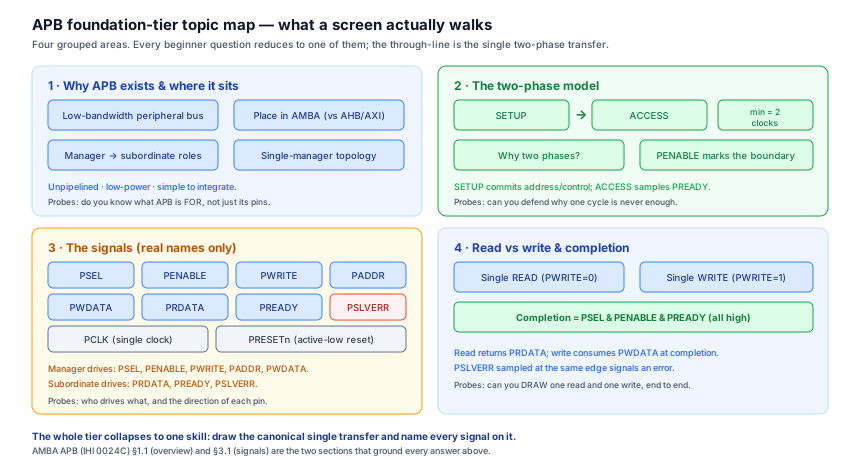
3. Mental model — the through-line concepts probed
The model: hold four facts and every foundation question answers itself. They are the through-line the entire tier is testing.
- APB is the low-bandwidth peripheral bus of AMBA, deliberately simple. It exists so that slow, register-mapped peripherals — timers, UARTs, GPIO, control registers — connect to the system without the cost and complexity of a high-performance interconnect. "Simple, low-power, unpipelined" is not a limitation to apologise for; it is the design intent.
- Every transfer is two phases: SETUP then ACCESS. In SETUP the manager presents address and control and asserts
PSEL; at the boundary it assertsPENABLEto enter ACCESS, where the data actually moves. The minimum transfer is therefore two clocks, never one. This is why understanding why there are two phases is the most-probed concept in the tier. - There is one manager and one or more subordinates, and the manager drives the transaction. The manager drives
PSEL,PENABLE,PWRITE,PADDR, and (for writes)PWDATA; the addressed subordinate drivesPRDATA,PREADY, andPSLVERR. Knowing the direction of each signal is half the tier. - Completion is always the conjunction
PSEL & PENABLE & PREADY. Nothing commits until all three are high on the samePCLKedge. A read presentsPRDATAthere; a write consumesPWDATAthere;PSLVERRis sampled there.
Two refinements sharpen the model. First, PENABLE is the marker that distinguishes the two phases — low in SETUP, high in ACCESS — so half the timing questions are really "where is PENABLE." Second, APB carries exactly one outstanding transfer at a time: there is no pipelining, no burst, no second access in flight, which is precisely why APB is not pipelined and why it stays low-power and easy to integrate.
4. Real SoC / hardware context
On a real chip, APB is the bus hanging off the bottom of the interconnect where the slow stuff lives. A typical SoC runs a high-throughput fabric (AXI or AHB) for the CPU, DMA, and memory, and bridges down to an APB segment for the configuration and control registers of dozens of peripherals — the timer, the watchdog, the UART, the GPIO controller, the PLL/clock-control block, the power-management registers. None of these need bandwidth; they need a cheap, predictable, low-power way to be poked by firmware. That is exactly APB's job, and the AMBA APB spec (IHI 0024C §1.1) describes it precisely as the low-bandwidth, low-power peripheral interface.
The two-phase structure is structural in the RTL, not a timing nicety. A peripheral's APB interface is an FSM with (at minimum) SETUP and ACCESS states; PENABLE is driven directly from that state register, so it is low in SETUP and high in ACCESS by construction. When firmware writes a control register, the bridge runs one APB write: SETUP presents the register address on PADDR and the value on PWDATA with PWRITE high, and at completion the peripheral latches the value into the register. When firmware reads status, the bridge runs one APB read with PWRITE low, and the peripheral muxes the addressed register onto PRDATA at completion. Because APB is single-outstanding, the CPU's register access is a simple, blocking two-cycle operation — which is exactly why it is used for control paths where simplicity and determinism matter more than throughput. This is the low-speed peripheral philosophy that an interviewer wants you to articulate, not just the pin list.
5. Weak answer vs strong answer
The fastest way to calibrate is to see the same question answered two ways. The weak column is technically not always wrong — it is thin, list-shaped, and reveals no model. The strong column reaches for the structural anchor and explains the why. Interviewers grade the difference.
| Question | Weak answer | Strong answer | What the difference signals |
|---|---|---|---|
| "What is APB?" | "It's a bus with PSEL, PENABLE, PADDR, and so on." | "It's AMBA's low-bandwidth, low-power peripheral bus for register-mapped slow peripherals — two-phase, single-manager, unpipelined by design." | Strong names the purpose and place in AMBA, not just pins. |
| "Why two phases?" | "Because the spec says SETUP then ACCESS." | "SETUP commits a stable address and control for one cycle so the subordinate can decode; ACCESS then moves data and samples PREADY. The separation gives a clean, glitch-free decode and a defined sampling edge." | Strong explains the engineering reason, not the rule. |
| "When is a transfer complete?" | "When PREADY goes high." | "When PSEL & PENABLE & PREADY are all high on the same edge — PREADY alone is meaningless outside the access phase." | Strong gives the full conjunction, catching the subset trap. |
| "How long is a transfer?" | "One cycle." | "At least two cycles — one SETUP, one ACCESS — even with zero wait states; the two-phase structure is mandatory." | Strong knows "single-cycle" means zero wait, not one clock. |
| "Who drives PRDATA?" | "The bus." | "The addressed subordinate drives PRDATA (and PREADY and PSLVERR); the manager drives everything else." | Strong knows signal direction, the core of the tier. |
| "Why is APB unpipelined?" | "It just is." | "Because it targets low-bandwidth peripherals where simplicity and low power beat throughput — single-outstanding means no pipeline logic, no power, no area." | Strong frames it as a deliberate tradeoff, not a flaw. |
The throughline: every weak answer is a surface restatement, and every strong answer derives from the anchor sentence and names a reason. You do not need more facts than the weak column has — you need to attach each fact to the model.
6. Common mistakes / red flags interviewers listen for
7. Interview framing — how to structure a foundation answer
The framing that consistently lands at this tier is anchor → answer → reason, in three short beats. First restate the relevant slice of the anchor sentence ("APB is two-phase and completion is the three-signal conjunction"), then give the specific answer, then attach the engineering reason. This ordering proves you are deriving from a model, not retrieving a memorised line — exactly the signal a screener is filtering for.
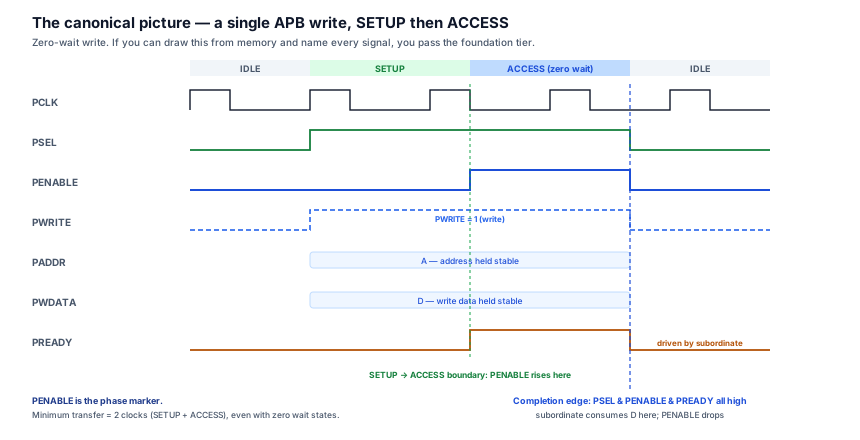
Two moves elevate a foundation answer further. First, volunteer the diagram. When asked almost anything — "explain a write," "what does PENABLE do," "when does data commit" — say "let me draw it" and sketch the canonical single transfer (Figure 2). Pointing at the completion edge as you say "here, PSEL & PENABLE & PREADY are all high, and the subordinate latches PWDATA" is worth more than three paragraphs. Second, always name who drives the signal you are discussing. Saying "the subordinate drives PREADY to extend the transfer" in passing shows you hold the manager/subordinate split as a reflex. Keep answers to two or three sentences — the foundation tier rewards crisp, correct, structural answers over long ones; depth comes from the reason, not the word count.
8. Q&A
9. Practice — a five-prompt mock drill
- Draw it cold. On a blank sheet, draw the canonical single APB write over five cycles:
PCLK,PSEL,PENABLE,PWRITE,PADDR,PWDATA,PREADY. Mark the SETUP→ACCESS boundary and the completion edge. Compare against Figure 2. - Name the driver. For each of
PSEL,PENABLE,PWRITE,PADDR,PWDATA,PRDATA,PREADY,PSLVERR, say "manager" or "subordinate" out loud, instantly, without pausing. - Anchor → answer → reason. Given the prompt "when is a transfer complete?", answer in the three-beat structure: restate the anchor slice, give the conjunction, then the reason
PREADYalone is insufficient. - Read vs write in one sentence. State the single difference between a read and a write transfer, naming who drives the data in each and on which edge it is valid.
- Defend the tradeoff. A reviewer says "APB is too simple to be a real bus." In two sentences, reframe APB's simplicity and lack of pipelining as the deliberate design intent for a low-bandwidth peripheral bus.
10. Key takeaways
- The foundation tier tests whether your model is structural, not a list. Derive every answer from one anchor sentence: APB is a two-phase, single-outstanding, low-bandwidth peripheral bus, and completion is
PSEL & PENABLE & PREADY. - Two phases, two-clock minimum. Every transfer is SETUP then ACCESS; the minimum is two clocks even with zero wait states. "Single-cycle" means zero wait states, never one clock.
- Direction is half the tier. The manager drives
PSEL/PENABLE/PWRITE/PADDR/PWDATA; the subordinate drivesPRDATA/PREADY/PSLVERR. Name the driver of every signal you discuss. - Completion is the three-signal conjunction.
PREADYalone is meaningless outside the access phase; the transfer commits only whenPSEL & PENABLE & PREADYare all high on onePCLKedge. - Unpipelined is a feature. APB is single-outstanding by design, trading throughput for low power, small area, and easy integration — the right trade for control-register peripherals.
- When in doubt, draw it. The single annotated transfer (Figure 2) answers most foundation questions faster than any paragraph; point at the completion edge and name the signals.