UVM
uvm_tlm_fifo
FIFO architecture, producer-consumer decoupling, uvm_tlm_analysis_fifo, sizing, complete patterns.
UVM Fundamentals · Module 14
Why Buffering Is Needed
TLM 1.0 put() is blocking: the producer waits until the consumer is ready. Analysis write() is non-blocking but cannot guarantee the consumer has processed the transaction. Neither handles a mismatch in production rate between producer and consumer.
| Scenario | Problem Without FIFO | FIFO Solution |
|---|---|---|
| Monitor fires fast, scoreboard checks slowly | With put(): monitor stalls waiting for scoreboard. With write(): scoreboard may miss items if it hasn't finished the previous one. | Monitor puts into FIFO instantly. Scoreboard pulls when ready. Buffer absorbs the burst. |
| Multiple producers, one consumer | Each producer blocks waiting for the consumer — they cannot produce in parallel. | Each producer puts into its own FIFO. Consumer pulls from each in round-robin. |
| Decoupling analysis from processing | Analysis write() is synchronous — heavy scoreboard logic runs inline during write(), delaying the monitor. | write() puts into FIFO (instant). Scoreboard task pulls and processes asynchronously. |
uvm_tlm_fifo Architecture — Built-In Ports
uvm_tlm_fifo #(T) is a uvm_component with built-in TLM ports on both sides. You do not implement any methods — you just connect your components to the FIFO's existing ports.
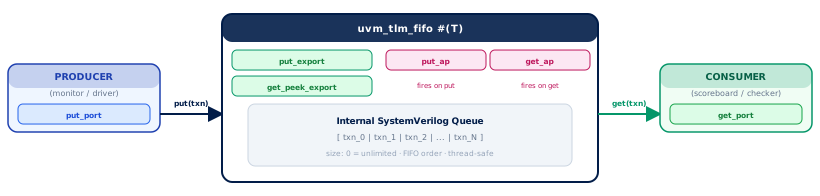
Figure 1 — uvm_tlm_fifo internal structure. The producer connects its put_port to put_export. The consumer connects its get_port to get_peek_export. put_ap and get_ap broadcast notifications on each operation.
| Port / Export | Type | Connected By | Purpose |
|---|---|---|---|
put_export | uvm_put_export | Producer's put_port | Receives put() calls and adds to internal queue |
get_peek_export | uvm_get_peek_export | Consumer's get_port | Returns items from queue on get() / peek() calls |
put_ap | uvm_analysis_port | Optional — subscribe for notifications | Broadcasts write(txn) every time an item enters the FIFO |
get_ap | uvm_analysis_port | Optional — subscribe for notifications | Broadcasts write(txn) every time an item leaves the FIFO |
The Producer-Consumer Pattern — Full Working Example
// ── Transaction type ──────────────────────────────────────────────────
class my_txn extends uvm_sequence_item;
    `uvm_object_utils(my_txn)
    rand bit [7:0] data;
    rand bit       parity;
    function new(string name = "my_txn"); super.new(name); endfunction
endclass

// ── Producer ──────────────────────────────────────────────────────────
class my_producer extends uvm_component;
    `uvm_component_utils(my_producer)
    uvm_blocking_put_port #(my_txn) put_port;

    function new(string name, uvm_component parent);
        super.new(name, parent);
    endfunction

    function void build_phase(uvm_phase phase);
        super.build_phase(phase);
        put_port = new("put_port", this);
    endfunction

    task run_phase(uvm_phase phase);
        phase.raise_objection(this);
        repeat (5) begin
            my_txn t = my_txn::type_id::create("t");
            void'(t.randomize());
            `uvm_info("PROD", $sformatf("Putting data=0x%0h", t.data), UVM_LOW)
            put_port.put(t);   // blocks if FIFO is full
            #10;
        end
        phase.drop_objection(this);
    endtask
endclass

// ── Consumer ──────────────────────────────────────────────────────────
class my_consumer extends uvm_component;
    `uvm_component_utils(my_consumer)
    uvm_blocking_get_port #(my_txn) get_port;

    function new(string name, uvm_component parent);
        super.new(name, parent);
    endfunction

    function void build_phase(uvm_phase phase);
        super.build_phase(phase);
        get_port = new("get_port", this);
    endfunction

    task run_phase(uvm_phase phase);
        my_txn t;
        forever begin
            get_port.get(t);   // blocks until FIFO has an item
            #30;               // consumer is 3× slower — FIFO absorbs the difference
            `uvm_info("CONS", $sformatf("Got data=0x%0h", t.data), UVM_LOW)
        end
    endtask
endclass

// ── Environment: instantiate FIFO and connect ─────────────────────────
class my_env extends uvm_env;
    `uvm_component_utils(my_env)
    my_producer                   prod;
    my_consumer                   cons;
    uvm_tlm_fifo #(my_txn)        fifo;

    function new(string name, uvm_component parent);
        super.new(name, parent);
    endfunction

    function void build_phase(uvm_phase phase);
        super.build_phase(phase);
        prod = my_producer::type_id::create("prod", this);
        cons = my_consumer::type_id::create("cons", this);
        // FIFO: size=4 means max 4 items; size=0 means unlimited
        fifo = new("fifo", this, 4);
    endfunction

    function void connect_phase(uvm_phase phase);
        super.connect_phase(phase);
        prod.put_port.connect(fifo.put_export);
        cons.get_port.connect(fifo.get_peek_export);
    endfunction
endclass
uvm_tlm_analysis_fifo — Bridging Analysis and TLM Pull
The uvm_tlm_analysis_fifo is a specialised FIFO that has an analysis imp on its input side and a TLM get_peek_export on its output side. (An imp implements the interface rather than merely forwarding it — see TLM ports and exports for the distinction between a port, an export and an imp.) It bridges the fire-and-forget analysis world with the pull-based consumer world.
This is the canonical pattern for connecting a monitor (which uses an analysis port) to a scoreboard that prefers to process transactions one at a time using get(). The port/export/imp roles it relies on are covered in TLM ports and exports.
// ── uvm_tlm_analysis_fifo: has analysis_export (input) + get port (output)
//
//   monitor.analysis_port  ──→  analysis_fifo.analysis_export
//                                (buffers transactions)
//                               analysis_fifo.get_peek_export  ←── scoreboard.get_port

class my_env extends uvm_env;
    `uvm_component_utils(my_env)

    apb_monitor                          mon;
    my_scoreboard                        scb;
    uvm_tlm_analysis_fifo #(apb_txn)    ap_fifo;

    function void build_phase(uvm_phase phase);
        super.build_phase(phase);
        mon     = apb_monitor::type_id::create("mon", this);
        scb     = my_scoreboard::type_id::create("scb", this);
        // uvm_tlm_analysis_fifo is ALWAYS unbounded. Its constructor passes 0
        // to uvm_tlm_fifo::new regardless of any size you supply, so
        //     new("ap_fifo", this, 8)
        // does not give you an 8-deep FIFO - it gives you an unbounded one.
        // That is deliberate: write() is a void function and cannot block, so
        // a bounded analysis FIFO could only cope with fullness by dropping.
        ap_fifo = new("ap_fifo", this);
    endfunction

    function void connect_phase(uvm_phase phase);
        super.connect_phase(phase);
        // Monitor's analysis_port writes into the FIFO via its analysis_export
        mon.analysis_port.connect(ap_fifo.analysis_export);
        // Scoreboard pulls from the FIFO at its own pace
        scb.get_port.connect(ap_fifo.get_peek_export);
    endfunction
endclass

// ── Scoreboard now uses get_port instead of analysis_imp ──────────────
class my_scoreboard extends uvm_scoreboard;
    `uvm_component_utils(my_scoreboard)
    uvm_blocking_get_port #(apb_txn) get_port;

    function void build_phase(uvm_phase phase);
        super.build_phase(phase);
        get_port = new("get_port", this);
    endfunction

    task run_phase(uvm_phase phase);
        apb_txn txn;
        forever begin
            get_port.get(txn);        // blocking — waits if FIFO is empty
            check_transaction(txn);   // can take as long as needed
        end
    endtask
    task check_transaction(apb_txn txn); /* ... */ endtask
endclassFIFO Sizing and the Control API
// ── Construction with size ────────────────────────────────────────────
// new(name, parent, size)
//   size = 0  : UNLIMITED — never blocks the producer on put()
//   size = N  : bounded — put() blocks when N items are already buffered

uvm_tlm_fifo #(my_txn) fifo_unlimited = new("fifo", this, 0);   // default: unlimited
uvm_tlm_fifo #(my_txn) fifo_bounded   = new("fifo", this, 8);   // max 8 items

// ── Query methods (call anywhere after build) ─────────────────────────
int  sz  = fifo.size();       // configured capacity (0 = unlimited)
int  used = fifo.used();      // current number of items in the FIFO
bit  emp = fifo.is_empty();   // 1 if no items
bit  ful = fifo.is_full();    // 1 if at capacity (always 0 for unlimited)

// ── flush() — drain all items ─────────────────────────────────────────
fifo.flush();   // removes all items — useful in reset sequences

// ── Monitoring FIFO depth during simulation ───────────────────────────
function void check_phase(uvm_phase phase);
    if (!ap_fifo.is_empty()) begin
        `uvm_error("SCB", $sformatf(
            "FIFO has %0d unprocessed transactions at end of simulation",
            ap_fifo.used()))
    end
endfunction

// ── peek() — read without consuming ───────────────────────────────────
uvm_blocking_peek_port #(my_txn) peek_port;
// peek_port.connect(fifo.get_peek_export);
// peek_port.peek(txn); → txn is populated but item stays in FIFO
// Useful for look-ahead logic without consuming the item
Ready-to-Run Simulator Example
Copy the code below into a single file tlm_fifo_demo.sv and run it with the commands shown. It demonstrates a 3× speed mismatch between producer and consumer, buffered by a 4-deep FIFO.
Ready to Run — Questa / VCS / Xcelium
// tlm_fifo_demo.sv — complete ready-to-run UVM TLM FIFO demonstration
// Compile and simulate:
//   Questa : vlog -sv tlm_fifo_demo.sv && vsim -c tlm_fifo_demo_top -do "run -all; quit"
//   VCS    : vcs -sverilog -ntb_opts uvm tlm_fifo_demo.sv && ./simv
//   Xcelium: xrun -sv -uvm tlm_fifo_demo.sv

`include "uvm_macros.svh"
import uvm_pkg::*;

// ═══════════════════════════════════════════════════════════════════════
//  TRANSACTION
// ═══════════════════════════════════════════════════════════════════════
class pkt extends uvm_sequence_item;
    `uvm_object_utils(pkt)
    rand bit [7:0] data;
    rand bit [3:0] id;
    function new(string name = "pkt"); super.new(name); endfunction
    function string convert2string();
        return $sformatf("id=%0d data=0x%0h", id, data);
    endfunction
endclass

// ═══════════════════════════════════════════════════════════════════════
//  PRODUCER — generates 8 packets every 10ns
// ═══════════════════════════════════════════════════════════════════════
class fast_producer extends uvm_component;
    `uvm_component_utils(fast_producer)
    uvm_blocking_put_port #(pkt) put_port;
    int num_pkts = 8;

    function new(string name, uvm_component parent);
        super.new(name, parent);
    endfunction

    function void build_phase(uvm_phase phase);
        super.build_phase(phase);
        put_port = new("put_port", this);
    endfunction

    task run_phase(uvm_phase phase);
        pkt p;
        phase.raise_objection(this);
        for (int i = 0; i < num_pkts; i++) begin
            p    = pkt::type_id::create($sformatf("p%0d", i));
            p.id   = i;
            p.data = $urandom_range(0, 255);
            `uvm_info("PROD", $sformatf("PUT  @ %0t → %s", $time, p.convert2string()), UVM_LOW)
            put_port.put(p);   // will block if FIFO is full (size=4)
            #10;
        end
        phase.drop_objection(this);
    endtask
endclass

// ═══════════════════════════════════════════════════════════════════════
//  CONSUMER — processes one packet every 30ns (3× slower)
// ═══════════════════════════════════════════════════════════════════════
class slow_consumer extends uvm_component;
    `uvm_component_utils(slow_consumer)
    uvm_blocking_get_port #(pkt) get_port;
    int processed = 0;

    function new(string name, uvm_component parent);
        super.new(name, parent);
    endfunction

    function void build_phase(uvm_phase phase);
        super.build_phase(phase);
        get_port = new("get_port", this);
    endfunction

    task run_phase(uvm_phase phase);
        pkt p;
        forever begin
            get_port.get(p);   // blocks until FIFO has something
            #30;               // simulate slow processing
            processed++;
            `uvm_info("CONS", $sformatf("GOT  @ %0t → %s  [total=%0d]",
                                    $time, p.convert2string(), processed), UVM_LOW)
        end
    endtask
endclass

// ═══════════════════════════════════════════════════════════════════════
//  ENVIRONMENT
// ═══════════════════════════════════════════════════════════════════════
class demo_env extends uvm_env;
    `uvm_component_utils(demo_env)
    fast_producer              prod;
    slow_consumer              cons;
    uvm_tlm_fifo #(pkt)        fifo;

    function new(string name, uvm_component parent);
        super.new(name, parent);
    endfunction

    function void build_phase(uvm_phase phase);
        super.build_phase(phase);
        prod = fast_producer::type_id::create("prod", this);
        cons = slow_consumer::type_id::create("cons", this);
        fifo = new("fifo", this, 4);   // capacity = 4 packets
    endfunction

    function void connect_phase(uvm_phase phase);
        super.connect_phase(phase);
        prod.put_port.connect(fifo.put_export);
        cons.get_port.connect(fifo.get_peek_export);
    endfunction

    function void check_phase(uvm_phase phase);
        if (fifo.used() != 0)
            `uvm_error("ENV", $sformatf("FIFO not empty at end: %0d items remain", fifo.used()))
        else
            `uvm_info("ENV", "All packets processed — FIFO empty ✓", UVM_LOW)
    endfunction
endclass

// ═══════════════════════════════════════════════════════════════════════
//  TEST
// ═══════════════════════════════════════════════════════════════════════
class fifo_demo_test extends uvm_test;
    `uvm_component_utils(fifo_demo_test)
    demo_env env;

    function new(string name, uvm_component parent);
        super.new(name, parent);
    endfunction

    function void build_phase(uvm_phase phase);
        super.build_phase(phase);
        env = demo_env::type_id::create("env", this);
    endfunction

    function void end_of_elaboration_phase(uvm_phase phase);
        `uvm_info("TEST", "Producer: 10ns/pkt   Consumer: 30ns/pkt   FIFO size: 4", UVM_LOW)
    endfunction
endclass

// ═══════════════════════════════════════════════════════════════════════
//  TOP MODULE
// ═══════════════════════════════════════════════════════════════════════
module tlm_fifo_demo_top;
    initial run_test("fifo_demo_test");
endmodule

// ═══════════════════════════════════════════════════════════════════════
//  EXPECTED OUTPUT (abridged):
//
//  UVM_INFO TEST: Producer: 10ns/pkt   Consumer: 30ns/pkt   FIFO size: 4
//  UVM_INFO PROD: PUT  @ 0 → id=0 data=0xA2
//  UVM_INFO PROD: PUT  @ 10 → id=1 data=0x3F
//  UVM_INFO PROD: PUT  @ 20 → id=2 data=0xC8
//  UVM_INFO PROD: PUT  @ 30 → id=3 data=0x15    ← FIFO fills; producer now stalls
//  UVM_INFO CONS: GOT  @ 30 → id=0 data=0xA2  [total=1]
//  UVM_INFO PROD: PUT  @ 30 → id=4 data=0xE1   ← producer unblocked
//  UVM_INFO CONS: GOT  @ 60 → id=1 data=0x3F  [total=2]
//  ... (consumer drains FIFO after producer finishes)
//  UVM_INFO ENV:  All packets processed — FIFO empty ✓
// ═══════════════════════════════════════════════════════════════════════
Common Patterns and Pitfalls
Pattern: Dual-FIFO Scoreboard (Request + Response)
The pattern below reads naturally and deadlocks against a pipelined DUT if the FIFOs are bounded — the mechanism is dissected in the Debug Lab further down. Compare it with the scoreboard's role and the sequence item it transports.
// ── Scoreboard receives separately from two monitors ──────────────────
class dual_fifo_scoreboard extends uvm_scoreboard;
    `uvm_component_utils(dual_fifo_scoreboard)

    uvm_blocking_get_port #(apb_req_txn) req_get_port;
    uvm_blocking_get_port #(apb_rsp_txn) rsp_get_port;

    function void build_phase(uvm_phase phase);
        super.build_phase(phase);
        req_get_port = new("req_get_port", this);
        rsp_get_port = new("rsp_get_port", this);
    endfunction

    task run_phase(uvm_phase phase);
        apb_req_txn req;
        apb_rsp_txn rsp;
        forever begin
            req_get_port.get(req);   // get from req FIFO
            rsp_get_port.get(rsp);   // get matching response
            compare(req, rsp);
        end
    endtask
    task compare(apb_req_txn req, apb_rsp_txn rsp); /* ... */ endtask
endclass

// ── Environment wiring ────────────────────────────────────────────────
uvm_tlm_analysis_fifo #(apb_req_txn) req_fifo;
uvm_tlm_analysis_fifo #(apb_rsp_txn) rsp_fifo;
// connect_phase:
req_mon.ap.connect(req_fifo.analysis_export);
rsp_mon.ap.connect(rsp_fifo.analysis_export);
scb.req_get_port.connect(req_fifo.get_peek_export);
scb.rsp_get_port.connect(rsp_fifo.get_peek_export);
Pattern: FIFO with Depth Monitoring
// FIFO's put_ap fires on every put() — use it to monitor FIFO depth
class fifo_monitor extends uvm_component;
    `uvm_component_utils(fifo_monitor)
    uvm_analysis_imp #(my_txn, fifo_monitor) put_imp;
    int depth = 0;
    int max_depth = 0;

    function void build_phase(uvm_phase phase);
        super.build_phase(phase);
        put_imp = new("put_imp", this);
    endfunction

    function void write(my_txn t);
        depth++;
        if (depth > max_depth) max_depth = depth;
        `uvm_info("FIFO_MON", $sformatf("depth=%0d max=%0d", depth, max_depth), UVM_HIGH)
    endfunction
endclass

// Connect: fifo.put_ap.connect(fifo_mon.put_imp);
// fifo.get_ap.connect(fifo_mon.get_imp); // separate imp for get side

// ── Common Pitfalls ───────────────────────────────────────────────────
//
// PITFALL 1: Using flush() during run_phase while consumer is waiting
//   → Consumer's get() may hang indefinitely after flush()
//   Fix: Only flush() when you know the consumer is not blocked in get()
//
// PITFALL 2: Bounded FIFO + fast producer causes deadlock
//   → Producer's put() blocks waiting for consumer to get()
//   → If consumer never runs (wrong phasing), simulation hangs
//   Fix: Use size=0 (unlimited) unless you specifically need backpressure
//
// PITFALL 3: Forgetting to check is_empty() in check_phase
//   → Missed transactions left in FIFO — silent failure
//   Fix: Always check fifo.is_empty() in check_phase and error if not
The Blocking Contract — and How It Deadlocks
Every method on a uvm_tlm_fifo falls into one of three categories, and knowing
which is which is most of what prevents a hung simulation.
The consequence worth stating plainly: put() on a bounded FIFO is a blocking
call whose duration is controlled by the consumer. If the consumer stops
consuming, the producer stops producing, and if the producer is a monitor, the
environment stops observing the DUT. A monitor that is blocked in put() is not
merely slow — it is not sampling the bus at all.
A scoreboard stopped checking halfway through the test and nothing reported an error
TLM-BLOCKING-DEADLOCKA request/response scoreboard verified the first few hundred transactions of
every test correctly and then silently stopped. The test still ran to completion,
UVM_ERROR was zero, and the run was reported as passing — but a coverage review
showed the scoreboard's compare count flat-lining partway through, while the DUT
kept transacting for the rest of the test.
On longer tests the simulation instead hung at end of test, with an objection
that never dropped and a run_phase that never returned.
// Env: bounded FIFOs, chosen "to catch runaway memory growth".
req_fifo = new("req_fifo", this, 8);
rsp_fifo = new("rsp_fifo", this, 8);

// Scoreboard: strict alternation, one request then one response.
task run_phase(uvm_phase phase);
  apb_req_txn req; apb_rsp_txn rsp;
  forever begin
    req_get_port.get(req);   // blocks until a request is available
    rsp_get_port.get(rsp);   // blocks until a response is available
    compare(req, rsp);
  end
endtaskTwo observations located it without needing a waveform.
Polling the FIFO depths from a background process showed req_fifo.used()
climbing to 8 and staying there, while rsp_fifo.used() sat at 0. A FIFO pinned
at its capacity means the producer side is suspended in put().
Confirming that took one line: the request monitor's transaction count stopped
incrementing at exactly the point the scoreboard's compare count stopped. The
monitor had not crashed and had not finished — it was suspended inside
analysis_port-driven put() on a full FIFO, so it was no longer sampling the
interface. The DUT carried on unobserved.
The scoreboard's strict alternation assumed request and response arrive in lockstep. The DUT is pipelined and can have many requests outstanding before the first response returns.
The sequence is deterministic once you see it. The scoreboard gets request 1 and
then blocks in get(rsp) waiting for response 1. Meanwhile requests 2 through 9
arrive and fill the 8-deep request FIFO. Request 10's put() suspends the
monitor. If the DUT's response depends on anything the monitor's continued
operation affects — or simply if the response monitor shares a process with the
request monitor — nothing ever completes, and the two sides wait on each other
forever.
The bound made it a deadlock rather than a leak. With an unbounded FIFO the requests would have accumulated and the scoreboard would have drained them once responses started arriving; the design would have been memory-hungry but functionally correct. Choosing a bound to "catch runaway growth" converted a performance concern into a correctness failure, and did so in a way that reports success.
Two changes, and both matter.
Unbound the observation path. A FIFO on a monitor's output exists to decouple observation from checking, and bounding it re-couples them:
req_fifo = new("req_fifo", this, 0);   // 0 = unbounded
rsp_fifo = new("rsp_fifo", this, 0);
Stop serialising the two streams. Even unbounded, strict alternation mis-pairs whenever responses are reordered. Consume each stream in its own process and match explicitly:
task run_phase(uvm_phase phase);
  fork
    forever begin apb_req_txn r; req_get_port.get(r); outstanding[r.id] = r; end
    forever begin
      apb_rsp_txn s; rsp_get_port.get(s);
      if (!outstanding.exists(s.id))
        `uvm_error("SCB", $sformatf("response for unknown id %0d", s.id))
      else begin compare(outstanding[s.id], s); outstanding.delete(s.id); end
    end
  join
endtask
Verifying the fix needs a test that creates outstanding depth greater than the old bound — which is exactly the test the original environment never ran. And the durable guard is the one that would have turned this silent pass into a loud failure in the first place:
function void check_phase(uvm_phase phase);
  super.check_phase(phase);
  if (!req_fifo.is_empty())
    `uvm_error("SCB", $sformatf("%0d requests never checked", req_fifo.used()))
  if (outstanding.size() != 0)
    `uvm_error("SCB", $sformatf("%0d requests never got a response",
                                outstanding.size()))
endfunction
An end-of-test drain check is cheap and it converts the entire class of "scoreboard quietly stopped" failures into errors. A scoreboard that finishes with items still queued did not verify them, and only the scoreboard knows that — see analysis ports for the broadcast side of this path and why scoreboards exist for what is lost when one stops checking.
Interview Questions
Decoupling in time. An analysis port is fire-and-forget: write() is a void function that runs to completion immediately in the caller's process, so every subscriber must handle the transaction the instant it is broadcast. That is fine for a coverage collector, which just samples, and awkward for a scoreboard that wants to process items one at a time at its own pace.
A uvm_tlm_fifo inserts a buffer. The producer deposits items with put() and the consumer withdraws them with get() whenever it is ready, so a slow consumer no longer forces the producer to wait — up to the FIFO's capacity. That is what makes the pull-based scoreboard style possible: a forever loop that calls get() and blocks naturally when there is nothing to do, instead of a write() callback that must return immediately.
The uvm_tlm_analysis_fifo is the adapter between the two worlds: an analysis imp on the input side so a monitor's analysis port can connect to it directly, and a get_peek_export on the output side so a scoreboard can pull from it.
Two directions block, and each blocks on the opposite fullness condition.
On the input side, put() suspends while the FIFO is full and resumes when a consumer removes an item. On the output side, get() and peek() suspend while the FIFO is empty and resume when a producer adds one. Those are the only two suspending behaviours, and between them they account for essentially every TLM-related hang.
Every blocking call has a non-blocking counterpart that returns a status instead of suspending: try_put(), try_get(), try_peek(), each returning 0 when the operation could not be performed. Use them when the caller has something else useful to do, and handle the 0 — a discarded try_put() return is a silently dropped transaction.
Note that an unbounded FIFO (size 0) can never be full, so put() on one never blocks. That is why unbounded is the right default for an observation path.
Because its input is an analysis write(), which is a void function. It cannot suspend and it cannot report failure, so there is no correct behaviour available to it when the FIFO is full — it could only drop the transaction silently. Making the FIFO unbounded removes the situation entirely.
The implementation enforces this rather than trusting the caller: the constructor passes 0 to uvm_tlm_fifo::new regardless of the size argument it received. So new("ap_fifo", this, 8) compiles, runs, and gives you an unbounded FIFO — the 8 is accepted and discarded. Anyone who passes a size expecting back-pressure gets none, and anyone who passes a size expecting to catch runaway growth gets no protection either.
The practical consequence is that memory growth on an analysis FIFO is a real risk and must be handled by making sure something drains it, not by bounding it. A check_phase that errors when the FIFO is non-empty at end of test is the standard guard, because a FIFO that is still full at the end is a FIFO whose contents were never checked.
get() removes the item from the FIFO; peek() returns a copy of the item at the head and leaves it in place. Both block while the FIFO is empty, and both are served by the same get_peek_export.
peek() earns its keep whenever the decision to consume depends on the item's contents. A scoreboard that must route transactions to different comparison paths by type or ID can peek, decide, and only then get — without the awkwardness of having already removed an item it turns out it cannot handle yet. The same applies to look-ahead logic that needs to know what is coming without committing to processing it.
The failure mode to watch for is a peek() in a forever loop with no matching get() on some path. Because peek leaves the item in place, the loop spins on the same transaction indefinitely, which presents as a simulation that makes no progress while consuming full CPU — quite different from the suspended-process hang that a missing put() consumer produces, and worth being able to tell apart.
A blocking get()/put() pair on a bounded FIFO, with nothing that notices the stall.
The usual shape is a scoreboard that serialises two streams — get a request, then get its response — against a pipelined DUT that has many requests outstanding. The scoreboard blocks waiting for the first response while further requests accumulate; the request FIFO reaches its bound; and the monitor's put() suspends. From that moment the monitor is no longer sampling the interface at all, so the DUT transacts unobserved and the scoreboard compares nothing further.
Nothing errors because nothing is designed to. No transaction was corrupted, no check failed, and no objection was raised — the checking simply stopped, and a checker that stops checking produces no output by definition.
Diagnosis is quick once suspected: poll used() on the FIFOs. One pinned at capacity while the other sits at zero identifies both the stalled direction and the stream that never arrived. The fixes are to unbound observation-path FIFOs and to consume each stream in its own process, matching by ID rather than by arrival order. The guard that turns the silence into a failure is a check_phase that errors when a FIFO is non-empty or when the outstanding-request table is not empty at end of test.
Bounding is right when the FIFO models something that is genuinely bounded in the design, and wrong when it is protecting an observation path.
The good case is a FIFO standing in for real hardware storage — a model of a DUT queue, or a stimulus path where you want the producer throttled so that back-pressure is exercised. There the bound is the point: put() blocking is the modelled behaviour, and a producer that stalls is the design's intent rather than an accident.
The bad case is a FIFO between a monitor and a scoreboard. Bounding it re-couples the two things the FIFO was inserted to decouple, and it does so in the worst direction — the monitor is the side that gets suspended, so the consequence of the scoreboard falling behind is that the environment stops observing the DUT. The instinct behind it is usually reasonable ("catch runaway memory growth"), and the result is that a performance concern has been converted into a correctness failure that reports success.
The right way to catch runaway growth on an unbounded FIFO is to watch it rather than to cap it: sample used() periodically and error past a threshold, and check that the FIFO is empty in check_phase. Both report the problem instead of causing a different one.
Where This Is Specified
- IEEE 1800.2-2020 (UVM) —
uvm_tlm_fifo. Theput_exportandget_peek_export, the blockingput/get/peekand non-blockingtry_put/try_get/try_peekinterfaces, thesize/used/is_empty/is_full/flushcontrol API, and the convention that a size of 0 means unbounded. - IEEE 1800.2-2020 —
uvm_tlm_analysis_fifo. The analysis imp on the input side, theget_peek_exporton the output, and its construction as an unboundeduvm_tlm_fifoirrespective of the size argument. - IEEE 1800.2-2020 — TLM 1 port/export/imp model. Which side supplies the implementation, and why an analysis
write()is a void function that neither blocks nor reports failure. - Accellera UVM User Guide — scoreboard connectivity. The monitor-to-analysis-FIFO-to-scoreboard pattern and end-of-test drain checking.
Quick Reference
| Task | Call / Declaration |
|---|---|
| Create unlimited FIFO | uvm_tlm_fifo #(T) fifo = new("fifo", this, 0) |
| Create bounded FIFO (N items) | uvm_tlm_fifo #(T) fifo = new("fifo", this, N) |
| Connect producer | prod.put_port.connect(fifo.put_export) |
| Connect consumer | cons.get_port.connect(fifo.get_peek_export) |
| Analysis FIFO (monitor → scoreboard) | uvm_tlm_analysis_fifo #(T) → mon.ap.connect(af.analysis_export) → scb.get_port.connect(af.get_peek_export) |
| Get item count | fifo.used() |
| Check empty / full | fifo.is_empty() / fifo.is_full() |
| Flush all items | fifo.flush() |
| Monitor put/get events | fifo.put_ap.connect(mon_imp) / fifo.get_ap.connect(mon_imp) |
## ── Questa / ModelSim ────────────────────────────────────────────────
vlog -sv -timescale 1ns/1ps tlm_fifo_demo.sv
vsim -c tlm_fifo_demo_top -do "run -all; quit -f"

## With verbosity control:
vsim -c tlm_fifo_demo_top +UVM_VERBOSITY=UVM_LOW -do "run -all; quit -f"

## ── VCS ───────────────────────────────────────────────────────────────
vcs -sverilog -ntb_opts uvm -timescale=1ns/1ps tlm_fifo_demo.sv -o simv
./simv +UVM_TESTNAME=fifo_demo_test +UVM_VERBOSITY=UVM_LOW

## ── Xcelium ───────────────────────────────────────────────────────────
xrun -sv -uvm -timescale 1ns/1ps tlm_fifo_demo.sv \
     -input "run; exit" \
     +UVM_TESTNAME=fifo_demo_test +UVM_VERBOSITY=UVM_LOW

## ── Expected key output lines: ───────────────────────────────────────
## UVM_INFO PROD: PUT  @ 0 → id=0 data=0x??
## UVM_INFO PROD: PUT  @ 10 → id=1 data=0x??
## UVM_INFO PROD: PUT  @ 20 → id=2 data=0x??
## UVM_INFO PROD: PUT  @ 30 → id=3 data=0x??   ← FIFO full (4 items)
## UVM_INFO CONS: GOT  @ 30 → id=0 ...          ← consumer unblocks producer
## ... (all 8 packets processed)
## UVM_INFO ENV:  All packets processed — FIFO empty ✓
## UVM_INFO @ 0: UVM_ERROR :   0   UVM_FATAL :   0
§9 — Code Examples
Example 1 — Beginner: Backpressure — Bounded FIFO Slowing the Producer
The most important FIFO behaviour to understand first: when the FIFO is full, the producer's put() blocks. This is backpressure — the consumer controls how fast the producer runs. The simulation timeline shows this clearly.
// ── Transaction ────────────────────────────────────────────────────────
class data_pkt extends uvm_sequence_item;
    `uvm_object_utils(data_pkt)
    int id;
    function new(string n="data_pkt"); super.new(n); endfunction
endclass

// ── Producer: puts a packet every 10ns ────────────────────────────────
task run_phase(uvm_phase phase);
    data_pkt p;
    phase.raise_objection(this);
    for (int i = 0; i < 6; i++) begin
        p    = data_pkt::type_id::create($sformatf("p%0d",i));
        p.id = i;
        `uvm_info("PROD", $sformatf("Attempting put(%0d) @ %0t", i, $time), UVM_LOW)
        put_port.put(p);   // BLOCKS if FIFO has 2 items (size=2)
        `uvm_info("PROD", $sformatf("put(%0d) returned @ %0t", i, $time), UVM_LOW)
        #10;
    end
    phase.drop_objection(this);
endtask

// ── Consumer: gets one packet every 40ns (4× slower) ─────────────────
task run_phase(uvm_phase phase);
    data_pkt p;
    forever begin
        get_port.get(p);  // waits for item
        #40;              // slow processing
        `uvm_info("CONS", $sformatf("Processed(%0d) @ %0t", p.id, $time), UVM_LOW)
    end
endtask

// ── FIFO: size=2 — forces backpressure ───────────────────────────────
uvm_tlm_fifo#(data_pkt) fifo = new("fifo", this, 2);  // max 2 items

// Simulation timeline (FIFO size=2, producer 10ns, consumer 40ns):
// @  0: put(0) → FIFO=[0]     — FIFO has 1 item, put returns immediately
// @  0: put(1) → FIFO=[0,1]   — FIFO has 2 items (FULL), put returns
// @ 10: put(2) → FIFO=[0,1,?] — FIFO FULL! put() BLOCKS here
// @ 40: Cons gets(0) → FIFO=[1] — put(2) unblocked! FIFO=[1,2]
// @ 50: put(3) returns immediately (FIFO had space)
// Consumer controls producer throughput — backpressure in action
Example 2 — Intermediate: Analysis FIFO Decoupling Monitor from Scoreboard
The canonical production pattern. Monitor uses analysis_port (fire-and-forget). Scoreboard uses get_port (pull-when-ready). The analysis FIFO bridges them.
// ── Monitor: uses standard analysis_port — unchanged ──────────────────
class apb_monitor extends uvm_monitor;
    uvm_analysis_port#(apb_txn) ap;

    function void build_phase(uvm_phase phase);
        super.build_phase(phase);
        ap = new("ap", this);
    endfunction

    task run_phase(uvm_phase phase);
        apb_txn txn;
        forever begin
            @(posedge vif.clk iff vif.psel);
            txn      = apb_txn::type_id::create("txn");
            txn.addr = vif.paddr;
            txn.data = vif.pwdata;
            ap.write(txn);   // non-blocking — into the FIFO instantly
        end
    endtask
    virtual apb_if vif;
endclass

// ── Scoreboard: uses get_port — can take as long as needed per item ────
class apb_scoreboard extends uvm_scoreboard;
    uvm_blocking_get_port#(apb_txn) get_port;

    function void build_phase(uvm_phase phase);
        super.build_phase(phase);
        get_port = new("get_port", this);
    endfunction

    task run_phase(uvm_phase phase);
        apb_txn txn;
        forever begin
            get_port.get(txn);       // waits if FIFO is empty
            do_reference_model(txn);  // can be slow — doesn't affect monitor
            compare_and_report(txn);
        end
    endtask

    task do_reference_model(apb_txn txn); #5; endtask  // expensive
    task compare_and_report(apb_txn txn); /* ... */ endtask
endclass

// ── Env: the FIFO is the glue ──────────────────────────────────────────
class apb_env extends uvm_env;
    apb_monitor                         mon;
    apb_scoreboard                      scb;
    uvm_tlm_analysis_fifo#(apb_txn)   af;  // the bridge

    function void build_phase(uvm_phase phase);
        super.build_phase(phase);
        mon = apb_monitor::type_id::create("mon", this);
        scb = apb_scoreboard::type_id::create("scb", this);
        af  = new("af", this);   // size=0: unlimited — monitor never stalls
    endfunction

    function void connect_phase(uvm_phase phase);
        super.connect_phase(phase);
        mon.ap.connect(af.analysis_export);     // analysis → FIFO input
        scb.get_port.connect(af.get_peek_export); // FIFO output → scoreboard
    endfunction

    function void check_phase(uvm_phase phase);
        if (af.used() != 0)
            `uvm_error("ENV", $sformatf(
                "Analysis FIFO has %0d unprocessed items at test end", af.used()))
    endfunction
endclass
Example 3 — Verification: peek() Before get() for Order-Sensitive Checking
peek() reads the next item without removing it. Useful when you need to inspect the next transaction before deciding whether to consume it — for example, in an out-of-order protocol where you need to scan for a specific ID.
// ── Scoreboard with peek() for look-ahead ─────────────────────────────
class reorder_scoreboard extends uvm_scoreboard;
    `uvm_component_utils(reorder_scoreboard)

    uvm_blocking_get_port#(axi_txn)  get_port;
    uvm_blocking_peek_port#(axi_txn) peek_port;

    function void build_phase(uvm_phase phase);
        super.build_phase(phase);
        get_port  = new("get_port",  this);
        peek_port = new("peek_port", this);
    endfunction

    // connect_phase:
    //   get_port.connect(fifo.get_peek_export)
    //   peek_port.connect(fifo.get_peek_export)  ← same export serves both

    task run_phase(uvm_phase phase);
        axi_txn  head;
        axi_txn  next;
        int      expected_id = 0;
        forever begin
            // Look at the next item WITHOUT consuming it
            peek_port.peek(head);

            if (head.txn_id == expected_id) begin
                // It's what we want — consume and process it
                get_port.get(next);
                process(next);
                expected_id++;
            end else begin
                // Not what we want yet — wait for the DUT to send the right one
                `uvm_info("SCB", $sformatf(
                    "Waiting: head=%0d, want=%0d", head.txn_id, expected_id),
                    UVM_HIGH)
                #10;   // wait and check again
            end
        end
    endtask
    task process(axi_txn t); /* ... */ endtask
endclass

// Note: get_peek_export handles both get() and peek() from the same FIFO.
// peek() reads the head without advancing the FIFO pointer.
// A subsequent get() then removes that same item.
// Never call peek() and get() on the same item from different threads — race.
Example 4 — Tricky: flush() Mid-Test Reset Sequence
When a DUT reset fires during a test, the FIFO may hold stale transactions that should be discarded. flush() clears the FIFO — but if the consumer is blocking inside get(), it will hang forever after the flush.
// ── Reset handler in the env or test ─────────────────────────────────
task handle_reset();
    `uvm_info("ENV", "Reset detected — flushing FIFO", UVM_LOW)

    // PROBLEM: if scoreboard is blocking inside get_port.get()
    // and FIFO becomes empty after flush(), scoreboard hangs forever

    // ✓ Safe pattern: signal the scoreboard to stop before flushing
    scb.handle_reset();    // scoreboard exits its get() loop via a flag
    @(posedge vif.clk);    // wait one clock for scoreboard to unblock
    af.flush();            // now safe to flush

    `uvm_info("ENV", $sformatf("FIFO flushed: %0d items discarded",
        af.used()), UVM_LOW)    // used() = 0 after flush
endtask

// ── Scoreboard with reset-aware get() loop ────────────────────────────
class reset_aware_scoreboard extends uvm_scoreboard;
    bit in_reset = 0;

    function void handle_reset();
        in_reset = 1;   // signal to exit get() loop
    endfunction

    task run_phase(uvm_phase phase);
        apb_txn txn;
        forever begin
            if (in_reset) begin
                in_reset = 0;
                `uvm_info("SCB", "Reset acknowledged — restarting", UVM_LOW)
                continue;
            end
            // Non-blocking try_get() allows the loop to check in_reset
            if (!get_port.try_get(txn)) begin
                #1;   // poll — not ideal but avoids blocking
                continue;
            end
            process(txn);
        end
    endtask
    task process(apb_txn t); /* ... */ endtask
endclass

// Alternative: use try_get() instead of get() across all scoreboard loops
// to avoid permanent blocking when the FIFO goes unexpectedly empty.
§10 — Bugs & Debugging
Bug 1 — Not Checking FIFO Empty in check_phase — Silent Transaction Loss
// ❌ WRONG — no check for unprocessed items ───────────────────────────
class bad_env extends uvm_env;
    uvm_tlm_analysis_fifo#(apb_txn) af;
    // check_phase: nothing here → FIFO may have items at simulation end
endclass
// Test ends: UVM_ERROR = 0 → CI reports PASS
// But af.used() = 3 → 3 unverified transactions silently lost

// ✓ CORRECT — always check FIFO in check_phase ────────────────────────
class good_env extends uvm_env;
    uvm_tlm_analysis_fifo#(apb_txn) af;

    function void check_phase(uvm_phase phase);
        if (af.used() != 0) begin
            `uvm_error("ENV", $sformatf(
                "%0d unprocessed transactions in analysis FIFO at test end."
                " Scoreboard may be too slow or dropped its loop early.",
                af.used()))
        end else
            `uvm_info("ENV", "Analysis FIFO drained — all transactions verified", UVM_NONE)
    endfunction
endclass

// Also add a timeout guard in the scoreboard's run_phase:
// Use a fork-join_any with a time limit to detect stuck consumers.
Bug 2 — Bounded FIFO Causing Simulation Hang (Deadlock)
// ❌ DEADLOCK — bounded FIFO, consumer starts late ─────────────────────
// env.build_phase:
uvm_tlm_fifo#(my_txn) fifo = new("fifo", this, 4);  // size=4

// Producer runs immediately in run_phase at T=0
// Puts items 0,1,2,3 → FIFO FULL at T=0
// Producer blocks on put(item_4)
//
// Consumer triggered by DUT interrupt — which never fires because
// the DUT is also waiting for the producer to drive more transactions.
// DEADLOCK: producer waits for consumer, consumer waits for DUT,
// DUT waits for producer. Simulation hangs.

// ✓ FIX — size=0 for analysis FIFOs and most verification uses ────────
uvm_tlm_analysis_fifo#(my_txn) af = new("af", this);
// size=0 (default): unlimited depth → producer NEVER blocks
// Memory usage grows if consumer is perpetually slower, but deadlock impossible
// Use bounded size ONLY when you intentionally want backpressure testing

// Diagnosis: if simulation hangs, enable +UVM_OBJECTION_TRACE and look for
// which component is still holding an objection.
// Then grep the log for the last PROD PUT line — the stuck producer.
// Check the FIFO depth with a periodic monitoring task.
Bug 3 — Consumer get() Loop Has No Drain — Test Ends Early
// ✓ Scoreboard raises its own objection and drops it only when FIFO is empty
class draining_scoreboard extends uvm_scoreboard;
    uvm_blocking_get_port#(apb_txn) get_port;
    uvm_tlm_analysis_fifo#(apb_txn)* af;  // handle to the env's FIFO

    task run_phase(uvm_phase phase);
        apb_txn txn;
        phase.raise_objection(this);  // SCB holds objection
        forever begin
            get_port.get(txn);   // blocks if FIFO empty
            process(txn);
            // When producer drops its objection, the FIFO will drain.
            // Once FIFO is empty AND no more items expected, drop ours.
            if (af.is_empty() && producer_done()) break;
        end
        phase.drop_objection(this);  // only drop when truly done
    endtask

    function bit producer_done();
        // Check if the test's objection count has dropped to zero
        return (uvm_root::get().get_objection_count(UVM_PHASE_OBJECTION) == 1);
        // 1 = only our own objection remains
    endfunction
    task process(apb_txn t); /* ... */ endtask
endclass
§11 — Ready-to-Run: Analysis FIFO Bridge Demo
A complete, self-contained demo showing uvm_tlm_analysis_fifo bridging a fast producer (analysis write) to a slow consumer (blocking get). The check_phase verifies the FIFO is drained. Run this and observe the timing difference.
Ready to Run — Questa / VCS / Xcelium
// analysis_fifo_demo.sv
// Compile: vlog -sv analysis_fifo_demo.sv
// Run:     vsim -c work.tb_af_top +UVM_TESTNAME=af_demo_test -do "run -all; quit"

`include "uvm_macros.svh"
import uvm_pkg::*;

class af_txn extends uvm_sequence_item;
    `uvm_object_utils(af_txn)
    int id;
    int data;
    function new(string n="af_txn"); super.new(n); endfunction
endclass

// ── Fast publisher: writes via analysis_port every 5ns ────────────────
class fast_pub extends uvm_component;
    `uvm_component_utils(fast_pub)
    uvm_analysis_port#(af_txn) ap;

    function new(string n, uvm_component p); super.new(n,p); endfunction

    function void build_phase(uvm_phase phase);
        super.build_phase(phase);
        ap = new("ap", this);
    endfunction

    task run_phase(uvm_phase phase);
        af_txn t;
        phase.raise_objection(this);
        for (int i=0; i<6; i++) begin
            t      = af_txn::type_id::create($sformatf("t%0d",i));
            t.id   = i;
            t.data = (i+1) * 16;
            `uvm_info("PUB", $sformatf("write(%0d) @ %0t", i, $time), UVM_LOW)
            ap.write(t);   // non-blocking — into FIFO instantly
            #5;
        end
        phase.drop_objection(this);  // publisher done — 6 items in FIFO
    endtask
endclass

// ── Slow subscriber: pulls from FIFO every 20ns ────────────────────────
class slow_sub extends uvm_component;
    `uvm_component_utils(slow_sub)
    uvm_blocking_get_port#(af_txn) get_port;
    int total = 0;

    function new(string n, uvm_component p); super.new(n,p); endfunction

    function void build_phase(uvm_phase phase);
        super.build_phase(phase);
        get_port = new("get_port", this);
    endfunction

    task run_phase(uvm_phase phase);
        af_txn t;
        phase.raise_objection(this);  // SUB holds objection until done
        repeat (6) begin
            get_port.get(t);  // blocks if FIFO empty
            #20;              // slow processing — 4× slower than publisher
            total++;
            `uvm_info("SUB", $sformatf(
                "got(%0d) data=%0d @ %0t [%0d/6]",
                t.id, t.data, $time, total), UVM_LOW)
        end
        phase.drop_objection(this);  // drop only after all 6 processed
    endtask
endclass

// ── Environment ────────────────────────────────────────────────────────
class af_env extends uvm_env;
    `uvm_component_utils(af_env)
    fast_pub                          pub;
    slow_sub                          sub;
    uvm_tlm_analysis_fifo#(af_txn)   af;

    function new(string n, uvm_component p); super.new(n,p); endfunction

    function void build_phase(uvm_phase phase);
        super.build_phase(phase);
        pub = fast_pub::type_id::create("pub", this);
        sub = slow_sub::type_id::create("sub", this);
        af  = new("af", this);   // unlimited depth
    endfunction

    function void connect_phase(uvm_phase phase);
        super.connect_phase(phase);
        pub.ap.connect(af.analysis_export);
        sub.get_port.connect(af.get_peek_export);
    endfunction

    function void check_phase(uvm_phase phase);
        if (af.used() != 0)
            `uvm_error("ENV", $sformatf("FIFO not drained: %0d items remain", af.used()))
        else
            `uvm_info("ENV", "FIFO fully drained. All items processed.", UVM_NONE)
    endfunction
endclass

class af_demo_test extends uvm_test;
    `uvm_component_utils(af_demo_test)
    af_env env;
    function new(string n, uvm_component p); super.new(n,p); endfunction
    function void build_phase(uvm_phase phase);
        env = af_env::type_id::create("env", this);
    endfunction
endclass

module tb_af_top;
    initial run_test();
endmodule

// Expected output:
// UVM_INFO PUB: write(0) @ 0     ← publisher fires all 6 by T=25
// UVM_INFO PUB: write(1) @ 5
// UVM_INFO PUB: write(2) @ 10
// UVM_INFO PUB: write(3) @ 15
// UVM_INFO PUB: write(4) @ 20
// UVM_INFO PUB: write(5) @ 25
// UVM_INFO SUB: got(0) data=16 @ 20  [1/6]  ← subscriber starts draining
// UVM_INFO SUB: got(1) data=32 @ 40  [2/6]
// UVM_INFO SUB: got(2) data=48 @ 60  [3/6]
// UVM_INFO SUB: got(3) data=64 @ 80  [4/6]
// UVM_INFO SUB: got(4) data=80 @ 100 [5/6]
// UVM_INFO SUB: got(5) data=96 @ 120 [6/6]
// UVM_INFO ENV: FIFO fully drained. All items processed.
//
// Note: publisher finishes at T=25, subscriber finishes at T=120.
// The FIFO absorbed the burst and let subscriber work at its own pace.
§12 — Interview Questions
Beginner Level
Intermediate Level
Senior / Architect Level
§13 — Best Practices
| Rule | Practice | Why It Matters |
|---|---|---|
| BP-1 | Always check fifo.used() == 0 in check_phase | Tests silently PASS with unprocessed transactions in the FIFO if this check is absent |
| BP-2 | Use size=0 (unlimited) for analysis FIFOs connected to monitors | Monitors must never stall; unlimited depth prevents deadlock; use bounded size only for deliberate backpressure testing |
| BP-3 | Let the scoreboard hold its own objection until the FIFO is drained | Prevents test ending before all transactions are verified — the producer's objection drop should not terminate the scoreboard's drain |
| BP-4 | Call flush() only when the consumer is not blocking in get() | flush() after get() leaves the consumer blocking forever on an empty FIFO — simulation hangs until timeout |
| BP-5 | Use uvm_tlm_analysis_fifo to decouple monitor write() from scoreboard processing | Scoreboard task-based processing can take time freely; monitor is never slowed by scoreboard workload |
| BP-6 | Connect both get_port and peek_port to the same get_peek_export | The export handles both — no need for two separate FIFOs; peek() does not consume the item |
| BP-7 | Name FIFOs descriptively: req_fifo, rsp_fifo, ap_fifo | When an env has multiple FIFOs, generic names like "fifo" cause confusion in debug logs and check_phase error messages |
| BP-8 | Subscribe to fifo.put_ap and fifo.get_ap for FIFO depth tracking in coverage or protocol checkers | These built-in analysis ports fire on every put and get — a FIFO depth monitor can track max depth as a coverage metric without modifying the FIFO or its connected components |
§14 — Summary
| Aspect | uvm_tlm_fifo | uvm_tlm_analysis_fifo |
|---|---|---|
| Input side | put_export — accepts blocking put() calls | analysis_export — accepts analysis write() calls |
| Output side | get_peek_export — serves get() and peek() | get_peek_export — same |
| Producer interface | TLM 1.0 put_port (blocking, can stall) | Analysis port (non-blocking, never stalls) |
| Backpressure | Yes — bounded FIFO blocks put() when full | No — analysis write() is non-blocking regardless of depth |
| Canonical use | Producer-consumer with rate control; pipeline stages | Monitor (write) → scoreboard/checker (get); bridge pattern |
| Size=0 | Unlimited depth — put() never blocks | Unlimited depth — default for analysis FIFOs |
| Monitoring | put_ap, get_ap for event notifications | Same — put_ap fires on write(), get_ap on get() |