AMBA AHB · Module 20
Case Study: Microcontroller Bus Fabric
A capstone case study assembling a full microcontroller AHB bus fabric from all the pieces. Three tiers: the masters (CPU, DMA, debug access port — all AHB masters); the AHB-Lite interconnect (the address decoder routing each transfer by address, the arbiter granting the shared bus to one master at a time); and the slaves, split into fast AHB slaves (flash/boot ROM, SRAM, accessed directly at full speed) and slow peripherals (UART, timer, GPIO on an APB bus behind an AHB-to-APB bridge so they don't burden the fast bus). The address map is the contract the decoder implements: non-volatile boot memory at the reset vector, fast RAM for runtime, slow peripherals isolated behind the bridge, a default slave catching unmapped accesses. A real MCU bus is just these pieces composed.
This capstone case study assembles the whole fabric — bringing together every piece from the earlier case studies into a complete microcontroller bus. A real MCU bus turns out to be just these pieces composed. There are three tiers: the masters (the CPU, a DMA engine, and the debug access port — all AHB masters); the AHB-Lite interconnect (the address decoder routing each transfer to the right slave by address, and the arbiter granting the shared bus to one master at a time); and the slaves, split into fast AHB slaves (flash/boot ROM and SRAM, accessed directly at full speed) and slow peripherals (UART, timer, GPIO on an APB bus behind an AHB-to-APB bridge so they don't burden the fast bus). The address map is the contract the decoder implements: non-volatile boot memory at the reset vector, fast RAM for runtime, slow peripherals isolated behind the bridge, and a default slave catching unmapped accesses. This chapter shows how all the concepts you've learned — pipelining, decode, arbitration, wait states, bridges — compose into the real MCU bus.
1. What Is It?
This capstone assembles the full MCU fabric — all the pieces composed. The three tiers:
- Masters — the CPU, a DMA engine, and the debug access port — all full AHB masters, sharing the bus via arbitration.
- AHB-Lite interconnect — the address decoder (
HADDR→HSEL, routing each transfer) and the arbiter (granting one master at a time). - Fast AHB slaves — flash/boot ROM (non-volatile, boot) and SRAM (fast, zero-wait), accessed directly.
- Slow peripherals + the address map — UART/timer/GPIO on APB behind a bridge; the address map (the decoder's contract) organizes it all, with a default slave for gaps.
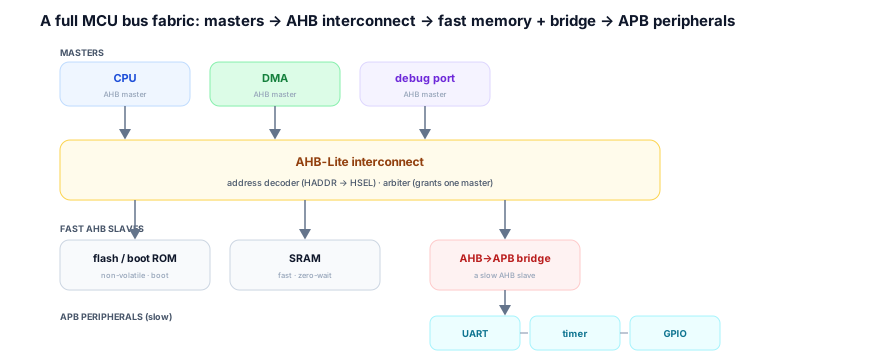
So this capstone shows that the whole MCU bus is nothing more than the pieces you've learned, composed: masters that arbitrate, an interconnect that decodes and arbitrates, fast memory on AHB, and slow peripherals on APB behind a bridge — all organized by the address map. The value of this chapter is integration: each earlier case study showed one path (CPU→SRAM, CPU→peripheral, DMA, debug, boot); here they all coexist in one system, and you see how the pieces fit. There's no new concept — just the assembly of everything into the real thing. So this case study is the complete picture. So a real MCU bus is the pieces composed.
2. Why Does It Exist?
This capstone exists because seeing the whole system is different from seeing the parts (integration is its own understanding) — and because it shows the pieces composing (every concept you learned fits into one coherent structure) — and it grounds the architecture (the three-tier, fast/slow, address-map-organized structure is how real MCUs are built).
The the whole is different from the parts is the root: knowing each piece (a master, a decoder, a bridge) is not the same as knowing how they compose into a system. Integration — seeing the pieces work together — is its own understanding. So this capstone exists to provide the integrated view. So the whole matters. So see it assembled.
The the pieces compose is the demonstration: every concept from the curriculum fits into this structure — pipelining (in every transfer), decode (routing), arbitration (sharing), wait states (slow slaves), bridges (peripherals). So this capstone demonstrates the composition — nothing is left over, everything fits. So it exists to show it all fits. So it's the synthesis. So everything composes.
The it grounds the architecture is the realism: the three-tier (masters / interconnect / slaves), fast/slow (AHB / APB), address-map-organized structure is literally how real MCUs are built. So this capstone grounds the abstract concepts in real architecture. So it exists to connect to reality. So it's the real thing. So this capstone exists because: the whole is different from the parts (integration is its own understanding — the root); the pieces compose (every concept fits — the demonstration); and it grounds the architecture (the real MCU structure — the realism). So the MCU-bus-fabric capstone is the integrated view — showing the pieces composing into the real MCU bus. So this chapter assembles everything. So see the whole, see it all fit, see the real architecture.
3. Mental Model
Model the MCU fabric as a city you've now seen built one street at a time, viewed from above. You've walked individual routes: a delivery from the warehouse (CPU→SRAM), a trip to a slow outlying village down a narrow road (CPU→peripheral via bridge), a courier's run (DMA), an inspector's visit (debug), the founding fetch (boot). Now you see the whole city map at once: the highways (the AHB bus) connecting the downtown core (CPU, memory) at full speed; the central traffic control (the interconnect — signs that route you by address, signals that take turns at the junction); and the narrow road with a tollbooth (the bridge) out to the slow village (the APB peripherals). The city plan (the address map) says what's where: the founding monument and archives downtown (boot ROM), the warehouses (RAM), the village (peripherals), and a "road closed" sign for nowhere (the default slave). It's not a new city — it's all the streets you walked, now seen as one coherent map.
A city you've seen built one street at a time, now viewed from above. You've walked individual routes: a warehouse delivery (CPU→SRAM, the fast direct path), a trip to a slow outlying village down a narrow road (CPU→peripheral via the bridge), a courier's run (the DMA), an inspector's visit (debug), the founding fetch (boot). Now you see the whole city map at once: the highways (the AHB bus) connecting the downtown core (the CPU and memory) at full speed; the central traffic control (the interconnect — signs that route you by address = the decoder; signals that take turns at the junction = the arbiter); and the narrow road with a tollbooth (the bridge) out to the slow village (the APB peripherals). The city plan (the address map) says what's where: the founding monument and archives downtown (boot ROM at the reset vector), the warehouses (RAM), the village (peripherals), and a "road closed" sign for nowhere (the default slave for unmapped addresses). It's not a new city — it's all the streets you walked, now seen as one coherent map.
This captures the fabric: the individual routes you walked = the earlier case studies (each one path); the whole city map from above = the integrated fabric view; the highways = the AHB bus; the downtown core at full speed = the CPU and fast memory; the traffic-control signs routing by address = the decoder; the signals taking turns = the arbiter; the tollbooth on the narrow road to the village = the bridge to the slow APB peripherals; the city plan = the address map; the monument/warehouses/village/road-closed sign = boot ROM / RAM / peripherals / default slave. See the whole map (the fabric) and recognize it's just the streets you already walked (the pieces), composed into one coherent city (the real MCU bus).
Here is the fabric's address map — the decoder's contract that ties it together:
The fabric: arbitration (who drives) + decode (where it goes), working together
6 cyclesThe model's lesson: see the whole map (the fabric) and recognize it's just the streets you already walked (the pieces), composed into one coherent city. In the figure, the interconnect's two jobs are both visible: the arbiter shares the bus among the masters (CPU → DMA → debug), and the decoder routes each transfer by address (memory direct, peripheral via the bridge). Every concept working together.
4. Real Hardware Perspective
The substance is all the structure you've learned, composed — so each tier maps to the relevant chapters, assembled into the fabric.
The masters and the interconnect: in hardware — the masters (CPU, DMA, debug) arbitrate for the bus; the interconnect decodes (routes by address) and arbitrates (grants one master). So the fabric composes the master and interconnect structure (see Master/Slave/Decoder/Arbiter, Address Decoding, Why Arbitration, Multiple Masters). So it's the top two tiers. So masters arbitrate, the interconnect decodes and grants.
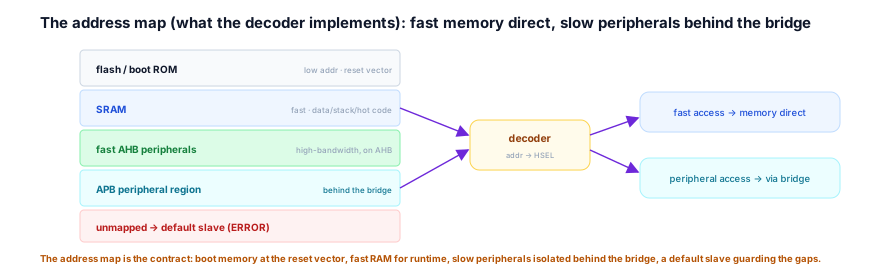
The the slaves and the address map: in hardware — the fast slaves (flash/ROM, SRAM) are on AHB (direct); the slow peripherals are on APB behind a bridge; the address map (the decoder's contract) organizes it, with a default slave for gaps. So the fabric composes the slave, bridge, and map structure (see CPU to SRAM, Boot ROM Access, CPU to Peripheral via Bridge, Bridge FSM RTL, Default Slave). So in practice, the MCU fabric is all the structure composed — masters, interconnect, fast/slow slaves, bridge, map. So in practice, know the pieces and see them assembled. So that's the whole fabric.
5. System Architecture Perspective
At the system level, the fabric reveals the organizing principles of a real bus — separation by speed (fast AHB vs slow APB, via the bridge), sharing via arbitration (multiple masters), and routing via the address map (the decoder's contract) — which together make a coherent, scalable system.
The separation by speed: the fabric separates fast (AHB — CPU, memory, DMA) from slow (APB — peripherals, via the bridge). This keeps the fast bus fast (slow peripherals don't stall it) while still connecting the slow peripherals. So at the system level, speed separation is a core organizing principle. So separate fast/slow. So the bridge isolates.
The sharing and routing: the arbiter shares the bus among masters (CPU, DMA, debug — each gets the bus when granted); the decoder routes each transfer by address (the map says where). Together, they make the bus a shared, routed resource — multiple masters reaching multiple slaves coherently. So at the system level, sharing (arbitration) and routing (decode) are the other organizing principles. So share and route. So the interconnect coordinates. So at the system level, the fabric reveals the organizing principles — separation by speed (the bridge isolating slow peripherals), sharing via arbitration (multiple masters), and routing via the address map (the decoder) — which together make a coherent, scalable system. So the fabric is where the architecture's principles show — making speed separation, arbitration, and address-map routing the keys to a real MCU bus. So separate by speed, share by arbitration, route by the map. So the fabric is the coherent whole.
6. Engineering Tradeoffs
Assembling the fabric surfaces the system-level design choices.
- Fast AHB vs slow APB (the bridge). Fast, high-bandwidth slaves (memory, DMA targets) go on AHB (direct); slow, low-bandwidth peripherals go on APB behind a bridge (off the fast bus). Separate by speed.
- Shared bus vs bus matrix. A single shared AHB bus is simple (this chapter); a multi-layer matrix lets non-conflicting masters run in parallel (higher throughput, more area) — for higher-bandwidth systems.
- Address-map design. The map (the decoder's contract) must place boot ROM at the reset vector, give fast RAM a region, isolate peripherals behind the bridge, and guard gaps with a default slave. Design it coherently.
- Number of masters. More masters (CPU, DMA, debug, more DMAs) = more contention → more arbitration complexity (policy, fairness). Add masters deliberately.
The throughline: the MCU bus fabric is all the pieces composed — masters (CPU/DMA/debug, all AHB masters) → AHB-Lite interconnect (decoder routes by address, arbiter grants one master) → fast AHB slaves (flash/ROM, SRAM) + slow peripherals (UART/timer/GPIO on APB behind a bridge). The address map is the contract (boot ROM at the reset vector, fast RAM, peripherals behind the bridge, default slave for gaps). The organizing principles: separation by speed (the bridge), sharing via arbitration, and routing via the address map — together a coherent system.
7. Industry Example
A concrete picture — a typical microcontroller's bus, top to bottom.
A microcontroller integrates a CPU, a DMA, debug, on-chip memory, and a set of peripherals into one AHB-Lite fabric.
- The masters. The CPU (running the application), a DMA engine (moving data for a communication peripheral), and the debug access port (for development) all sit as AHB masters on the bus. The arbiter grants the bus among them — typically the CPU and DMA contend most, with the debug port occasional.
- The interconnect. The AHB-Lite interconnect decodes every transfer's address to select the target slave, and arbitrates among the three masters, handing over at transfer boundaries.
- Fast memory on AHB. Flash (non-volatile, holding the program; the boot ROM at the reset vector) and SRAM (fast, for data/stack/hot code) are AHB slaves, accessed directly at full speed. The CPU fetches code from flash (or remapped RAM) and accesses data in SRAM with zero wait states.
- Peripherals on APB behind the bridge. The UART, timers, GPIO, SPI, I2C, and ADC sit on an APB bus behind the AHB-to-APB bridge. When the CPU configures a UART or reads a timer, the access goes through the bridge (with its wait-state penalty) — but since these are infrequent control accesses, that's fine, and the slow peripherals don't burden the fast bus.
- The address map. The decoder implements the map: flash at the low addresses (reset vector), SRAM next, then the peripheral regions decoded to the bridge, with a default slave returning ERROR for unmapped addresses (so a stray pointer faults cleanly instead of hanging the bus).
- It all works together. A single program run exercises the whole fabric: the CPU boots from flash, runs from SRAM, the DMA moves a buffer to the UART (through the bridge), the debugger watches a variable non-intrusively — all the paths from the earlier case studies, coexisting in one system, coordinated by the interconnect.
The example shows the complete fabric: three tiers (masters, interconnect, slaves), fast/slow separation (AHB memory vs APB peripherals via the bridge), arbitration (sharing among masters), and the address map (routing). It's every concept composed into the real MCU bus. This is the whole picture.
8. Common Mistakes
9. Interview Insight
The fabric is the integration check — describing it (the three tiers, fast/slow separation, arbitration, the address map) shows you can assemble the pieces into a real system.
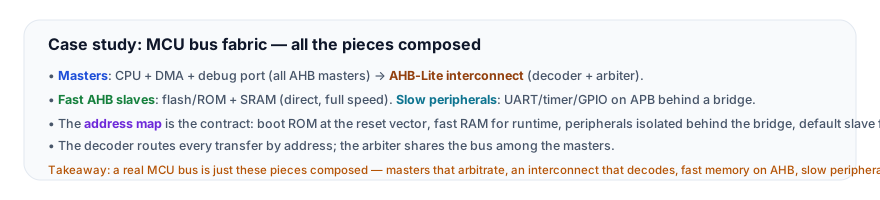
If asked to describe a microcontroller's bus fabric, assemble it in three tiers: the masters (CPU, DMA, debug — all AHB masters, sharing via the arbiter); the AHB-Lite interconnect (the decoder routing each transfer by address, the arbiter granting one master); and the slaves (fast flash/ROM and SRAM on AHB directly; slow peripherals on APB behind a bridge). Stress the organizing principles — separation by speed (the bridge isolating slow peripherals), sharing via arbitration, and routing via the address map (boot ROM at the reset vector, fast RAM, peripherals behind the bridge, default slave for gaps). And note that it's all the pieces composed — no new concept, just the assembly. That shows you can integrate the protocol into a real system architecture — the capstone understanding.
10. Practice Challenge
Practice assembling the fabric.
- The three tiers. Describe the masters, the interconnect, and the slaves — and what each does.
- Fast/slow separation. Explain why fast memory is on AHB and slow peripherals are on APB behind a bridge.
- The interconnect's two jobs. Explain decode (route by address) and arbitrate (grant one master) — both in the interconnect.
- The address map. Lay out a map (boot ROM at the reset vector, SRAM, peripherals behind the bridge, default slave) and explain the contract.
- The default slave. Explain what happens to an unmapped access and why the default slave is needed.
11. Key Takeaways
- The MCU bus fabric is all the pieces composed — masters (CPU/DMA/debug) → AHB-Lite interconnect (decoder + arbiter) → fast AHB slaves (flash/ROM, SRAM) + slow peripherals (APB behind a bridge).
- Three tiers — masters (arbitrate for the bus), interconnect (decode by address + arbitrate among masters), slaves (split by speed).
- Separation by speed — fast memory on AHB (direct, full speed); slow peripherals on APB behind a bridge (so they don't burden the fast bus). This is why AMBA has both AHB and APB.
- The address map is the contract — boot ROM at the reset vector, fast RAM, peripherals behind the bridge, a default slave (ERROR) guarding unmapped gaps (so a stray access doesn't hang the bus).
- Organizing principles — separate by speed (the bridge), share via arbitration (multiple masters), route via the address map (the decoder). Together: a coherent, scalable system.
- No new concept — the fabric is the pieces you learned, composed into the real MCU bus. This is the integration (capstone) understanding.
12. What Comes Next
You can now assemble the whole fabric. The last case study refines one corner of it:
- Low-Power Peripheral Access (next) — gated, low-power access through the bridge (clock gating, power domains).
To revisit the pieces this fabric composes, see Master/Slave/Decoder/Arbiter, Address Decoding, Why Arbitration, CPU to SRAM, CPU to Peripheral via Bridge, and Shared Bus vs Interconnect.