AMBA AHB · Module 3
HCLK & HRESETn
The two global AHB signals — HCLK, the single synchronous bus clock every signal is sampled against, and HRESETn, the active-low reset asserted asynchronously and deasserted synchronously.
This opens Module 3 — the AHB Signal Deep Dive. In Module 2 you learned what each signal does in a transfer; now we go bit by bit through the signals themselves, with their exact behaviour and encodings. We start with the two global signals that every other signal is defined relative to: HCLK, the bus clock, and HRESETn, the reset. They are the simplest signals in AHB and the foundation for all the rest — every timing rule you meet later ("sampled on the rising edge," "valid this cycle") is stated against HCLK, and every component's defined starting state is established by HRESETn. Get these two exactly right and the rest of the signal module has a firm footing.
1. What Is It?
AHB has two global signals — shared by every manager, subordinate, and piece of interconnect on the bus:
- HCLK — the bus clock. It is the single timing reference for the entire bus: every AHB signal is driven and sampled relative to the rising edge of HCLK. This is what makes AHB a fully synchronous protocol.
- HRESETn — the reset, active-low (the trailing "n" denotes active-low). When HRESETn is low, the bus is in reset; when high, it operates normally. It is the only asynchronous signal in AHB, with a specific assertion/deassertion discipline.
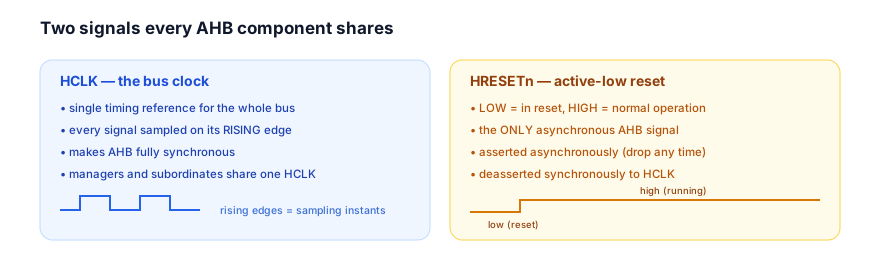
These two signals are "global" in the precise sense that they are not part of any one transfer — they are the shared environment in which all transfers happen. Every other AHB signal (HADDR, HTRANS, HREADY, and the rest) is defined by reference to HCLK's edges and assumes HRESETn has established a known starting state. They are the stage on which the rest of the protocol performs.
2. Why Does It Exist?
The two global signals exist to provide the two things every digital bus needs before it can do anything: a common sense of time and a defined starting state.
HCLK exists to give the bus one shared clock. A bus is a conversation among separate blocks, and for them to agree on when a signal is valid, they must share a timing reference. A synchronous design — everyone sampling on the same clock edge — is the simplest, most robust way to achieve that agreement. It means a manager can drive a signal knowing exactly when the subordinate will sample it (the next rising edge), and the subordinate can drive a response knowing when the manager will capture it. Without a shared clock, every signal would need its own handshaking to establish validity; with HCLK, validity is simply "stable at the rising edge." HCLK exists so the whole bus marches to one beat, which is what makes the rest of the protocol's timing rules simple and unambiguous.
HRESETn exists to put the bus into a known state. When a chip powers up, or when software forces a reset, every flip-flop's contents are undefined until something sets them. A bus full of undefined control signals would be chaos — a manager might appear to be issuing a garbage transfer, a subordinate might think it is selected. HRESETn exists to drive every component into a defined, safe initial state: managers issue no real transfers (they drive IDLE), subordinates are quiescent, and nothing transfers. From that clean baseline, normal operation can begin deterministically.
The specific choices — active-low, asynchronous assertion, synchronous deassertion — each have a reason we will see in the hardware section, but the existence of the two signals comes down to this: a bus needs a clock to agree on time and a reset to agree on a starting point. HCLK and HRESETn are those two necessities.
3. Mental Model
Model the two globals as the metronome and the conductor's "from the top."
HCLK is the metronome: a steady beat that every player (manager, subordinate, interconnect) follows. Nobody plays a note "whenever" — every note lands on a beat, so the ensemble stays together. Because everyone watches the same metronome, a note played by one player is heard by the others at a predictable moment (the next beat). That shared beat is what turns a collection of independent blocks into a coordinated bus.
HRESETn is the conductor calling "from the top": it forces everyone back to a known starting position before the piece begins. While the call is active (HRESETn low), nobody is playing the piece — they are all just holding their defined starting posture. When the conductor releases the call on a beat (synchronous deassertion), everyone begins together, cleanly, on the same beat.
Now watch the two in action as the bus comes out of reset:
Bus coming out of reset
5 cyclesThe model's lesson: HCLK never stops beating; HRESETn decides whether the players are performing the piece or holding the starting posture. During reset, the metronome runs but everyone holds position; after the clean "from the top" release, the performance — real transfers — begins on the beat.
4. Real Hardware Perspective
In hardware, HCLK and HRESETn map to the most fundamental nets in any synchronous design, and their specific disciplines have concrete reasons.
HCLK is distributed to the clock input of essentially every flip-flop in the AHB logic. Because the whole bus is synchronous to it, HCLK is a high-fanout, timing-critical net — clock distribution (skew, jitter) is a real physical-design concern, but at the protocol level the rule is simply: signals are launched from one rising edge and captured at the next. Every setup/hold constraint on every AHB signal is referenced to HCLK. The single-clock assumption is what lets the protocol state timing as "stable at the rising edge" without per-signal handshakes.
HRESETn is active-low for a classic hardware reason: an undriven or disconnected reset line tends to float toward its inactive-looking state, and making the asserted (reset) state the low/zero state means many failure modes (a floating net, a not-yet-driven output) default toward being in reset — a safe posture — rather than toward running with garbage. Active-low reset is the conventional safe default across digital design, and AHB follows it.
The assertion/deassertion discipline is the subtle part. HRESETn may be asserted asynchronously — you can force the bus into reset at any instant, even before the clock is stable or running, which is exactly what you want for power-up and emergency reset. But it must be deasserted synchronously — released on a rising HCLK edge — so that every flip-flop leaves reset on the same cycle. If reset were released asynchronously, different flops could exit reset at slightly different times (due to routing delay), some catching an extra clock edge and others not, producing a partial reset state and potential metastability. Synchronous deassertion guarantees a clean, simultaneous, glitch-free start. This "async assert, sync deassert" pattern is a standard reset-synchronizer technique, and AHB's HRESETn follows it.
5. System Architecture Perspective
At the system level, HCLK and HRESETn define the bus's clock domain and reset domain — and those domains are where AHB connects to the larger chip's clocking and reset architecture.
The HCLK domain is the region of the chip that runs synchronously on the AHB clock. Recall from Module 1 that different parts of an SoC often run at different clock rates — the AHB backbone fast, the APB peripherals slower. The boundary between those domains is exactly where HCLK stops being the reference and a clock-domain crossing (handled in a bridge) takes over. So HCLK is not just "the clock" — it defines the extent of the AHB synchronous island, and the bridges to other domains (APB, or a faster AXI fabric) are where signals safely cross between HCLK and another clock. The architecture of a chip is, in part, a map of which clock each region uses, and HCLK names the AHB region's.
The HRESETn domain similarly defines what resets together. Everything on the AHB that shares HRESETn comes out of reset as a unit, in the clean synchronous way described. Larger chips often have multiple reset domains — a power-on reset, software resets for subsystems, an always-on domain that does not reset with the rest — and HRESETn is the AHB subsystem's entry into that scheme. The system's reset architecture decides when HRESETn is asserted and released, and the AHB protocol's only requirement is the async-assert/sync-deassert discipline so that the bus comes up cleanly whenever the system chooses to release it.
So these two "simple" signals are the AHB subsystem's connection points to two of the most important system-wide structures: the clock tree and the reset network. When you integrate an AHB subsystem into a chip, wiring HCLK and HRESETn correctly — right clock domain, right reset domain, proper synchronization at the boundaries — is foundational, and getting it wrong produces the most fundamental kind of failure (a bus that never starts cleanly or never agrees on time).
6. Engineering Tradeoffs
The global signals carry a few real design decisions, even though they are the simplest signals in the protocol.
- Single synchronous clock: simplicity vs frequency/power flexibility. One HCLK for the whole bus makes timing trivially well-defined and the protocol simple, but it means the entire AHB region runs at one frequency. If part of the region could run slower to save power, a single clock domain cannot express that without additional clock management. The trade is protocol simplicity versus per-region frequency flexibility — and AHB chooses simplicity, pushing frequency differences to bridges and separate domains.
- Active-low reset: safe default vs polarity convention. Active-low gives the safe "floats toward reset" default, at the minor cost of the polarity being the opposite of intuitive "1 = active." The convention is universal enough that the safety benefit clearly wins, but mixing active-low and active-high resets in one system is a real integration hazard.
- Async assert / sync deassert: robustness vs a little synchronizer logic. This discipline gives instant reset capability and clean simultaneous release, which is exactly what you want — but it requires a reset synchronizer (a couple of flops) to implement the synchronous deassertion correctly. The tiny logic cost buys robustness against partial-reset and metastability, an easy trade to make and a dangerous one to skip.
- Global fanout: coordination vs physical-design burden. Making HCLK and HRESETn global means every component is coordinated, but both become high-fanout nets that the physical design must distribute with controlled skew (clock tree) and adequate timing (reset). The protocol benefit (everyone coordinated) comes with a back-end cost (careful distribution), which is routine but non-trivial on large designs.
The through-line: the global signals trade flexibility for simplicity and robustness. One clock and one reset domain make the protocol clean and the bus dependable, at the cost of per-region flexibility (handled elsewhere, via bridges and separate domains) and some physical-design care. For a bus whose whole identity is "cheap, simple, dependable," these are exactly the right trades.
7. Industry Example
Trace HCLK and HRESETn through a real microcontroller power-up.
A sensor MCU powers on. Here is the sequence in terms of the two global signals:
- Power-on, clock not yet stable. As soon as power is valid, the chip's reset controller drives HRESETn low — asserted asynchronously, because the HCLK clock source (an oscillator/PLL) may not be running or stable yet. The AHB is forced into reset regardless of clock state: the processor-side manager is held driving IDLE, subordinates are quiescent, no transfers happen. This is exactly why async assertion matters — you can force the safe state before you even have a reliable clock.
- Clock stabilizes. The oscillator/PLL locks and HCLK begins toggling cleanly. Now there is a reliable timing reference, but the bus is still held in reset (HRESETn still low), so nothing is happening yet beyond the metronome ticking.
- Synchronous release. The reset controller releases HRESETn synchronously to HCLK — it goes high coincident with a rising edge, through a reset synchronizer. Every flip-flop in the AHB leaves reset on the same cycle. The bus is now in its clean, defined idle state, fully coordinated.
- First transfer. On a subsequent cycle, the processor (now out of reset) issues its first real transfer — a NONSEQ fetch of the boot vector from flash, with a valid HADDR. From here, everything in the rest of Module 3 applies: address phase, data phase, HREADY, and so on, all referenced to HCLK.
The whole boot of the bus is governed by these two signals: HRESETn forced the safe state before the clock was even trustworthy, HCLK provided the shared beat once stable, and the synchronous release brought everything up together so the very first transfer happens on solid ground. Every AHB subsystem in every chip comes alive exactly this way, which is why these "trivial" signals are foundational rather than incidental.
8. Common Mistakes
9. Interview Insight
HCLK and HRESETn are deceptively simple interview material — the depth is entirely in the reset discipline.
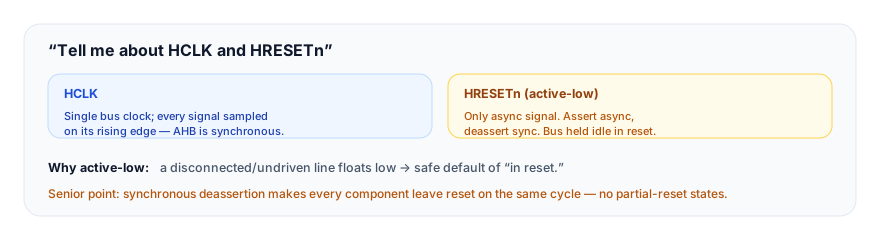
The answer that lands states the basics crisply and then volunteers the reset discipline: "HCLK is the single bus clock — AHB is fully synchronous, every signal sampled on its rising edge. HRESETn is the active-low reset, the only asynchronous AHB signal: it's asserted asynchronously so you can force reset even without a stable clock, but deasserted synchronously to HCLK so every component leaves reset on the same cycle, avoiding partial-reset and metastability. During reset the bus is held idle." The async-assert/sync-deassert detail, and why, is what distinguishes a real hardware engineer here.
10. Practice Challenge
Reason from the synchronous-clock and reset-discipline rules.
- State the basics. In one sentence each, define HCLK and HRESETn, including HRESETn's polarity.
- Explain the discipline. Write out "async assert, sync deassert" and justify each half in terms of what it protects against.
- Read the waveform. In Figure 2, identify the cycle reset is released and the first cycle a real transfer can begin, and explain the gap.
- Justify active-low. Explain why active-low reset is the safe default in terms of a floating or undriven net.
- Diagnose the hang. A subsystem intermittently hangs after reset. Name the most likely cause and the fix, and explain why the failure is intermittent.
11. Key Takeaways
- HCLK is the single synchronous bus clock — every AHB signal is driven and sampled relative to its rising edge, which is what makes AHB synchronous and lets timing be stated simply.
- HRESETn is the active-low reset — low means in reset, high means normal; active-low gives the safe "floats toward reset" default.
- HRESETn is the only asynchronous AHB signal, with the discipline "async assert, sync deassert" — force reset any time (even without a stable clock), but release it on a clock edge so all logic leaves reset together.
- Synchronous deassertion prevents partial-reset and metastability — asynchronous release is a classic source of intermittent post-reset hangs.
- During reset the bus is held in a defined idle state — manager driving IDLE, subordinates quiescent, nothing transferring — so operation begins deterministically.
- HCLK and HRESETn define the AHB clock and reset domains, the subsystem's connection points to the chip's clock tree and reset network; every other Module 3 signal is defined relative to them.
12. What Comes Next
With the global signals established, the rest of Module 3 walks the transfer signals one by one, each defined relative to HCLK. Next up are the first address-phase signals at full bit-level detail:
- 3.2 — HADDR & HWRITE (coming next) — the address bus (width, byte addressing, alignment) and the read/write direction control, in detail.
- 3.3 — HTRANS (coming soon) — the transfer-type encoding (IDLE/BUSY/NONSEQ/SEQ).
To revisit how these globals fit the transfer mechanics, see The Address / Control Phase and The Data Phase. For the architecture they underpin, see AHB Bus Architecture. For the broader protocol map, see the AMBA family overview.