AMBA AHB · Module 2
AHB-Lite Overview
The single-master subset of AHB — what it keeps (phases, pipelining, bursts, HREADY, HRESP) and drops (arbiter, request/grant, handover, SPLIT/RETRY), and why it, not full AHB, is what real designs build.
This chapter closes Module 2 with the version of AHB you are most likely to actually meet in real silicon: AHB-Lite. Full AHB, as we have described it, supports multiple managers — and that support brings an arbiter, bus request/grant, master-to-master handover, and a set of responses to manage it all. AHB-Lite makes one simplifying assumption — a single manager — and in doing so deletes that entire layer of machinery while keeping all the transfer mechanics you have just learned. By the end you will understand exactly what AHB-Lite keeps and drops, why the single-master assumption is so powerful, and why modern multi-master systems are built from AHB-Lite plus a bus matrix rather than from full AHB.
1. What Is It?
AHB-Lite is the single-master subset of the AHB protocol. It assumes exactly one manager on the bus, and from that assumption it removes everything in full AHB that exists only to coordinate multiple managers.
Everything you learned about the transfer is unchanged in AHB-Lite:
- The address phase and data phase, exactly as in chapters 2.3–2.4.
- Pipelining — the phases of consecutive transfers overlap, as in 2.5.
- Single and burst transfers, as in 2.6.
- HREADY wait states and HRESP (OKAY/ERROR) completion.
- The decoder, multiplexor, and subordinate select — one manager still reaches many subordinates by address.
What AHB-Lite removes is the multi-master coordination layer: the arbiter, the bus request/grant handshake, master-to-master bus handover, and the legacy SPLIT/RETRY responses that existed to manage contention.
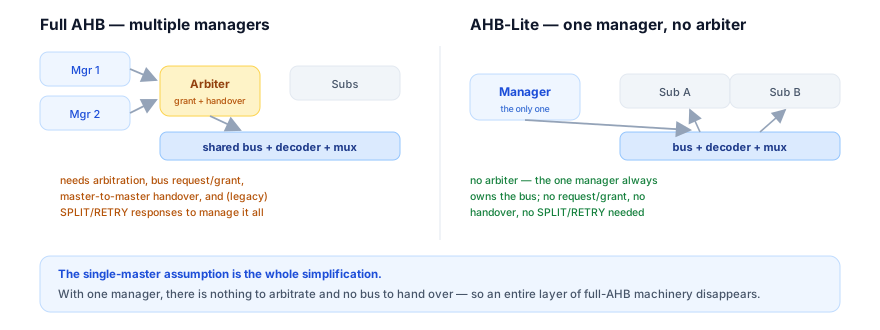
The essence is simple: AHB-Lite is AHB with the multi-master parts removed because there is only one master to begin with. The transfer engine — how a beat is described, moved, gated, and completed — is identical. Only the question "whose turn is it to drive the bus?" disappears, because the answer is always "the one manager."
2. Why Does It Exist?
AHB-Lite exists because the multi-master machinery in full AHB is complex, and most subsystems do not need it — so a single-master subset is both simpler to build and a better match for how real systems are actually structured.
Two pressures created it:
- Full AHB's multi-master coordination is genuinely complicated. Arbitration policy, the request/grant handshake, cleanly handing the bus from one master to another without glitches, and especially the legacy SPLIT and RETRY responses (mechanisms by which a slow subordinate could tell the arbiter to let other masters run while it worked) added significant design and verification burden. SPLIT in particular is notoriously fiddly to implement and verify correctly. For a bus whose virtue is simplicity, this was a lot of complexity to carry.
- Most subsystems have one master anyway, or arbitrate outside the protocol. A great many AHB subsystems are driven by a single processor or a single DMA channel. For those, the entire multi-master apparatus is dead weight — paid for in gates and verification but never used. And even multi-master systems, it turned out, are better served by handling arbitration in the interconnect (a bus matrix) rather than inside the bus protocol.
So AHB-Lite exists to strip full AHB down to the part everyone actually uses: a single manager doing transfers. By assuming one master, it deletes the arbiter, the request/grant signals, the handover, and SPLIT/RETRY in one stroke. The result is a protocol that is dramatically easier to design and verify, with no loss for the common single-master case — and, as we will see, a perfect building block for multi-master systems assembled a different way.
3. Mental Model
Model the difference as a shared meeting room with a booking system versus a private office.
Full AHB is a shared meeting room. Because many people want it, you need a booking system (the arbiter), a way to request and be granted a slot (request/grant), a clean handover when one meeting ends and the next begins (bus handover), and a procedure for "I need to step out, let someone else use the room meanwhile" (SPLIT/RETRY). All that overhead exists because the room is shared.
AHB-Lite is a private office. There is exactly one occupant, so there is no booking system, no request/grant, no handover, no stepping-out protocol — the occupant simply uses the office whenever they like. Everything you do in the office (the actual work — the transfers) is identical to what you would do in the shared room. Only the contention management vanishes, because there is no contention.
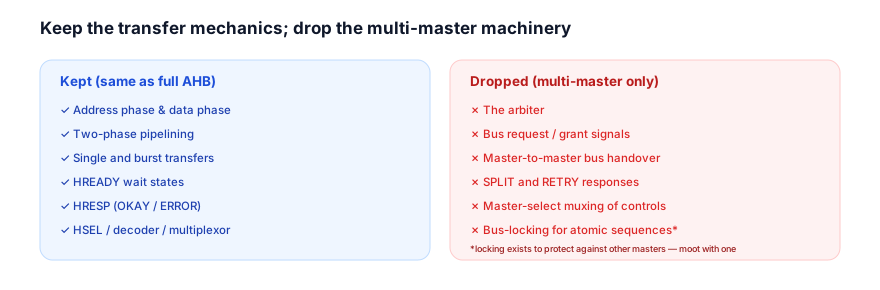
The model's lesson: the overhead full AHB carries is all about sharing, and AHB-Lite removes it by not sharing. When you see an AHB-Lite manager, picture the private office — the transfers are full-strength, but the contention machinery is simply absent because there is nothing to contend with.
4. Real Hardware Perspective
In hardware, AHB-Lite is materially smaller and simpler than full AHB, and the savings come from specific deleted blocks and signals.
There is no arbiter — a whole sequential block, with its policy logic, disappears. There are no bus request/grant signals between managers and an arbiter, removing wires and the handshake logic around them. There is no master-multiplexing of the address and control onto the shared bus, because a single manager drives them directly — full AHB needs to mux several managers' control signals onto the bus, and that mux and its select logic are gone. And the SPLIT/RETRY response handling — both in the subordinates that could issue them and the arbiter that had to act on them — is removed, which is a significant verification simplification because those responses interact subtly with the pipeline.
What remains is lean: the single manager drives address/control and write data; the decoder still turns the address into a subordinate select; the multiplexor still routes the selected subordinate's read data and HREADY back; subordinates still respond with HREADY and HRESP (OKAY/ERROR only — no SPLIT/RETRY). The transfer timing — address phase, data phase, pipelining, bursts, wait states — is bit-for-bit the same as full AHB, because none of that depends on having multiple masters.
A subtle but important hardware point: because there is one master, the manager always effectively owns the bus, so there is no "am I granted?" gating on its transfers — it issues whenever it has work. This removes a source of latency and complexity present in full AHB, where even a sole active master had to interact with the grant mechanism. AHB-Lite's single master just drives. The protocol is smaller, faster to close timing on, and far easier to verify — which is why it became the default.
5. System Architecture Perspective
At the system level, AHB-Lite's most important property is that it is the building block from which modern multi-master systems are actually constructed — by combining AHB-Lite managers with a bus matrix, rather than by using full AHB's in-protocol arbitration.
This is the key architectural insight, and it surprises people: even systems with several masters usually do not use full AHB. Instead, each master is a simple AHB-Lite manager, and a multi-layer bus matrix (the interconnect-thinking topology from chapter 1.6) handles the multi-master routing and arbitration outside the bus protocol, at the subordinates.
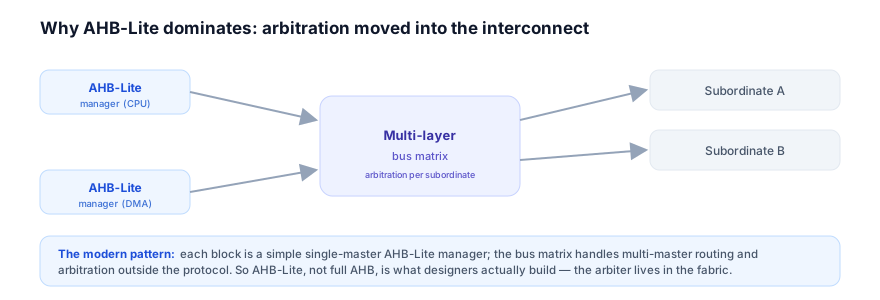
The reason this pattern won is compelling: it moves arbitration from the protocol into the interconnect. Each master stays simple (single-master AHB-Lite), and the matrix concentrates the multi-master complexity in one well-defined place where it can be designed and verified as a unit. This is far cleaner than full AHB's approach of spreading arbitration awareness across every master and subordinate via request/grant and SPLIT/RETRY. It also composes with the concurrency story from Module 1: the bus matrix can give disjoint master-subordinate pairs parallel paths, which full AHB's single shared bus could not.
So at the system level, AHB-Lite is not merely "AHB for simple chips" — it is the standard manager interface of the whole AHB ecosystem, with multi-master capability delivered by the surrounding fabric. When you see AHB in a modern SoC, it is almost certainly AHB-Lite managers on a bus matrix. Full AHB's in-protocol multi-master mechanism is largely a historical design that the Lite-plus-matrix pattern superseded. This is why this chapter matters out of proportion to its "subset" framing: AHB-Lite is the AHB people actually build.
6. Engineering Tradeoffs
The tradeoffs around AHB-Lite are mostly one-directional — it is simpler with little downside — but understanding where the multi-master capability went is the real content.
- Simplicity vs in-protocol multi-master support. AHB-Lite drops the arbiter and SPLIT/RETRY, hugely simplifying design and verification, at the "cost" of not supporting multiple masters within the protocol. But this is rarely a real cost, because multi-master support is provided by the bus matrix instead. The trade is "protocol handles arbitration" (full AHB, complex) versus "interconnect handles arbitration" (AHB-Lite + matrix, cleaner) — and the industry chose the latter.
- Per-master simplicity vs interconnect complexity. AHB-Lite pushes complexity out of each master and into the bus matrix. This is a good trade: many simple, reusable, easy-to-verify masters, with the multi-master complexity concentrated in one fabric block designed once. The alternative — every master carrying arbitration awareness — spreads complexity everywhere.
- No SPLIT/RETRY vs subordinate stalling. Without SPLIT/RETRY, a slow subordinate in an AHB-Lite system stalls its master with wait states (HREADY low) rather than releasing the bus for others. In a single-master subsystem this is fine (there are no others). In a matrix-based multi-master system, other masters on other layers are unaffected anyway, so SPLIT/RETRY's benefit is largely recovered by the matrix's parallelism — without its complexity.
- Ubiquity vs legacy compatibility. Choosing AHB-Lite means the common, well-supported, well-understood path, with abundant IP and verification components. The only reason to use full AHB's multi-master mode would be a legacy requirement; for new design, AHB-Lite (plus matrix where needed) is the default.
The through-line: AHB-Lite trades in-protocol multi-master support for simplicity, and the industry recovered multi-master capability more cleanly via the bus matrix. It is less a "reduced" protocol than a better-factored one — keep the transfer engine simple and standard, handle contention in the interconnect. That factoring is why AHB-Lite is the dominant form.
7. Industry Example
Look at two real chips and see AHB-Lite in both its forms.
A single-master microcontroller. A small sensor MCU has one processor as its only bus master, on-chip flash and SRAM, and peripherals behind an APB bridge. This is the textbook AHB-Lite case: one manager, so no arbiter, no request/grant, no SPLIT/RETRY — just the processor driving address/data phases, pipelining its instruction fetches, bursting cache-line or block accesses, and waiting on HREADY when a slow subordinate needs time. The entire multi-master layer of full AHB would be pure waste here, and AHB-Lite simply does not include it. This is AHB-Lite as the lean single-master backbone, and it is the shape of an enormous number of MCUs.
A multi-master application subsystem. A larger chip has a processor and a couple of DMA engines that all need the AHB subsystem. Crucially, the designers do not reach for full AHB's arbiter. Instead, each of the processor and DMA engines is an AHB-Lite manager, and a multi-layer bus matrix connects them to the memories and peripherals, handling arbitration per subordinate. When the processor and a DMA target different memories, the matrix lets them proceed in parallel; when they target the same one, the matrix arbitrates at that subordinate. Each master stayed simple (AHB-Lite), and all the multi-master complexity lives in one verified fabric block. This is the dominant modern pattern, and it shows AHB-Lite as the standard manager interface even in multi-master designs.
The verification payoff, concretely. In both chips, the absence of SPLIT/RETRY and in-protocol arbitration means the bus verification is dramatically simpler — no need to verify the intricate interactions of arbitration, handover, and split transactions with the pipeline. The single-master managers are individually simple to verify, and the matrix is verified as a focused unit. Teams ship faster and with fewer bus bugs precisely because AHB-Lite removed the hardest-to-verify parts of full AHB. That practical benefit — not just gate count — is why AHB-Lite became the default across the industry.
8. Common Mistakes
9. Interview Insight
AHB-Lite is a favourite interview topic because the right answer reveals whether you know how AHB systems are actually built, not just what the full spec contains.
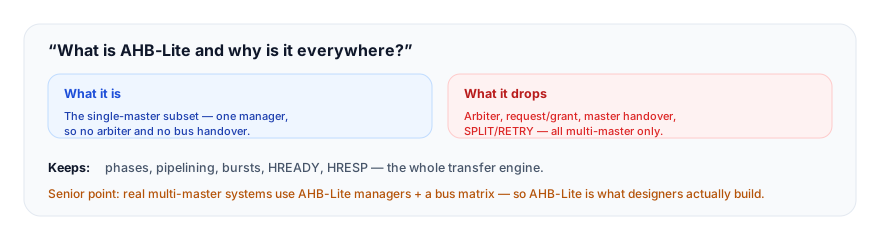
The answer that lands names the assumption, the kept/dropped split, and the modern pattern: "AHB-Lite is the single-master subset of AHB. It keeps the whole transfer engine — address and data phases, pipelining, bursts, HREADY wait states, HRESP — and drops everything that only exists for multiple masters: the arbiter, bus request/grant, master handover, and SPLIT/RETRY. And the key point is that modern multi-master systems are built from AHB-Lite managers plus a multi-layer bus matrix, with arbitration in the interconnect — so AHB-Lite, not full AHB, is what designers actually use." That last sentence is the senior differentiator.
10. Practice Challenge
Reason from the single-master assumption and the Lite-plus-matrix pattern.
- Keep or drop. For each of: address phase, arbiter, bursts, SPLIT/RETRY, HREADY, request/grant — state whether AHB-Lite keeps or drops it, and why.
- Explain the assumption. In two sentences, explain how the single-master assumption alone justifies dropping the arbiter and SPLIT/RETRY.
- Build multi-master. Sketch (in words) how you would connect a processor and two DMA engines to memories using AHB-Lite, and say where arbitration lives.
- Defend the factoring. Argue why pushing arbitration into a bus matrix is better than full AHB's in-protocol arbitration, in terms of verification and reuse.
- Correct the myth. A colleague says "we have three masters, so we must use full AHB, not AHB-Lite." Correct them.
11. Key Takeaways
- AHB-Lite is the single-master subset of AHB — it assumes one manager and drops everything that exists only to coordinate multiple managers.
- It keeps the entire transfer engine: address/data phases, pipelining, single and burst transfers, HREADY wait states, HRESP. A Lite transfer equals a full-AHB transfer.
- It drops the arbiter, bus request/grant, master-to-master handover, and SPLIT/RETRY — all meaningless with a single master, and SPLIT/RETRY especially was the hardest part of full AHB to verify.
- Multi-master systems are built from AHB-Lite managers plus a multi-layer bus matrix, moving arbitration from the protocol into the interconnect — the preferred modern pattern.
- AHB-Lite, not full AHB, is what designers actually build. Full AHB's in-protocol multi-master mode is largely legacy; AHB-Lite is the standard manager interface of the ecosystem.
- The win is better factoring, not reduced capability: simple reusable masters, multi-master complexity concentrated in one verified fabric block, parallelism for disjoint traffic, and far simpler verification.
12. What Comes Next
This completes Module 2 — AHB Architecture. You now understand the full transfer mechanism — components, both phases, pipelining, bursts — and the AHB-Lite subset that real designs use. The next module zooms all the way in: every AHB signal, bit by bit, with its exact encoding.
- Module 3 — AHB Signal Deep Dive (coming next) — beginning with 3.1 HCLK & HRESETn, then HADDR & HWRITE, HTRANS, HSIZE, HBURST, HPROT, the data buses, HREADY/HREADYOUT, HRESP, and HSEL — each signal whose role you now know, given its full bit-level detail.
To revisit the multi-master machinery AHB-Lite removes and the matrix that replaces it, see Master, Slave, Decoder & Arbiter and Shared Bus vs Interconnect Thinking. For the transfer engine AHB-Lite keeps, see The Address / Control Phase, The Data Phase, Pipelined Operation, and Single Transfer vs Burst Transfer. For the broader protocol map, see the AMBA family overview.
Standards & specifications
- Governing standard
- Arm AMBA AHB Protocol Specification (IHI 0033)(opens Arm in a new tab)
Defines AHB transfers, the two-cycle response mechanism and arbitration. Bridge design and debug technique are engineering practice built on top of it.
This page also covers RTL structure, verification approach and debugging technique. Those are engineering practice built on the standard, not requirements the standard itself imposes.
Where this fits
Part of the AMBA AHB curriculum.