AMBA APB · Module 1
The Low-Speed Peripheral Philosophy
Why low-bandwidth peripherals justify a separate, simpler bus, and what APB deliberately omits to stay cheap to implement and verify.
Earlier chapters told you that APB is simple. This one tells you why simplicity is the right engineering goal for peripheral access — a deeper claim than "peripherals are slow, so a slow bus is fine." The real argument is about matching the cost of a bus to the shape of its traffic. By the end, APB's missing features should read not as gaps but as a list of correct decisions, each removing cost the traffic would never have used.
1. What problem is being solved?
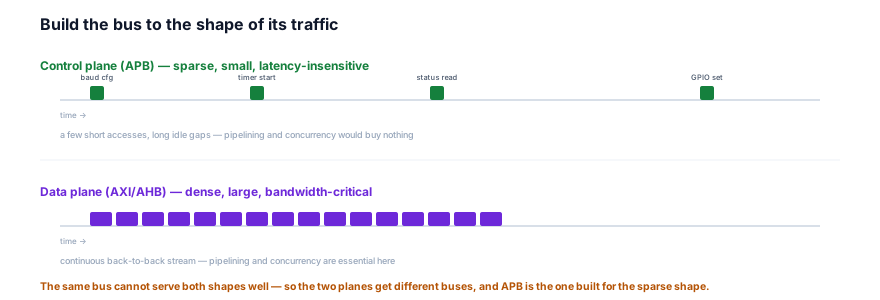
The problem is building a peripheral bus whose cost matches its traffic — and the principle that solves it is build the bus to the shape of its traffic.
Two traffic shapes dominate a chip:
- Sparse control traffic — a processor occasionally configuring or checking a peripheral. A few short accesses scattered across long idle gaps. Latency does not matter; average bandwidth is near zero.
- Dense data traffic — a DMA engine or display streaming a continuous run of accesses with no gaps. Bandwidth is everything; latency must be hidden.
Pipelining, bursts, outstanding transactions, and out-of-order completion all pay off only for the dense shape. Applied to sparse control traffic they buy nothing and cost gates, power, corner cases, and verification. The problem APB solves is serving the sparse shape without paying for the dense shape — and the philosophy is to leave out every feature whose only benefit is to traffic APB will never see.
2. Why existing buses were not the right fit
A feature-rich bus is the wrong fit for peripherals because every feature is paid for on every interface that implements it — used or not — and peripherals are numerous.
Putting peripherals on a feature-rich bus means each peripheral's interface must implement that bus's pipelining, outstanding-transaction tracking, ordering, and response rules. That logic is fixed cost: it sits in silicon, draws leakage and switching power, occupies area, and must be verified — regardless of whether a given peripheral ever sees traffic that exercises it. A timer poked twice a second would carry the same heavyweight interface as a memory controller streaming gigabytes.
Now multiply across a real chip. SoCs have many peripherals — dozens on a midrange part — so the interface cost is paid per peripheral and the waste scales with peripheral count. The more peripherals you have, the more a feature-rich peripheral bus costs you, and the more a deliberately minimal one saves. There is a second, subtler reason a fast bus is the wrong fit: simplicity is a correctness asset. A protocol with two phases and no concurrency has a tiny state space, so an APB subordinate is among the easiest things in a whole SoC to verify exhaustively — and on a chip with dozens of peripherals, every interface you can sign off quickly is engineering risk removed. A feature-rich peripheral bus throws that away on every peripheral.
3. APB mental model
The model to carry: a bus is a suit, and you tailor it to the body of its traffic.
A feature-rich bus like AXI is a heavily tailored suit with many pockets, linings, and reinforcements — every one useful for the demanding job it was cut for. APB is a plain, light garment with nothing extra. Putting the heavy suit on a peripheral is not "giving it the best" — it is dressing a desk clerk in a deep-sea diving suit. The extra capability is dead weight: it costs material (area), it is hot (power), and it has many seams that could fail (corner cases and verification).
The philosophy is the tailoring instinct: measure the traffic, then cut the bus to fit. Two refinements keep the model honest:
- "Cheap" is not "bad." A plain garment perfectly fitted to its wearer is better engineering than an elaborate one that does not fit. APB fitted to control traffic is excellent; AXI forced onto a timer is poor. Quality is fit, not feature count.
- The fit can flex a little. APB has exactly one tailoring allowance —
PREADYwait states — to accommodate a subordinate that is slightly slow. Beyond that small flex, APB does not stretch; if the traffic outgrows the garment, you change garments (use a different bus), you do not let APB out at the seams.
4. Real SoC placement & hardware context
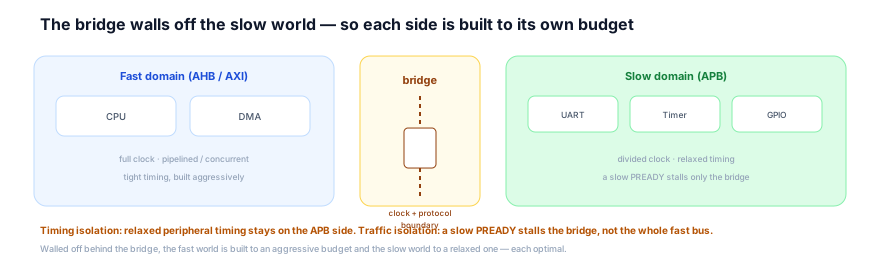
On silicon, the philosophy shows up as the smallest sensible memory-mapped interface and as a clean clock-and-timing boundary realized by the bridge.
A minimal APB subordinate is close to the floor of what a register interface can be: decode the address to know you are selected, write your registers during the ACCESS phase, multiplex the addressed register onto the read data bus, and assert PREADY (often tied high for a fast peripheral). The gate count is dominated by the peripheral's actual registers, not by bus machinery — the right balance. And because the traffic is latency-insensitive, APB can run on a divided-down clock and tolerate the long wires reaching peripherals scattered near the chip's pads — a freedom the philosophy grants it, not a compromise.
At the system level, the philosophy is realized through the bridge, which isolates the slow world so each side can be built to its own budget. Timing isolation: the relaxed clock and long wires of the peripheral world stay on the APB side of the bridge and never impose tight timing on the fast backbone. Traffic isolation: when a slow subordinate stretches PREADY, only the bridge waits — the rest of the fast bus keeps flowing for unrelated traffic, so a slow peripheral cannot stall the whole backbone. Walled off behind the bridge, the fast world is built to an aggressive budget and the slow world to a relaxed one — each optimal.
The philosophy also tells you, for any peripheral, which traffic is control and which is data. Take an SPI flash controller: its configuration — clock divider, mode, chip-select behavior — is sparse register writes and goes on APB; its bulk transfer — streaming a large image out of the flash — is dense and bandwidth-critical and goes through a DMA engine on the fast bus. If a designer instead read the flash word by word with one APB access each, the transfer would crawl at APB's one-at-a-time rhythm, and the chip would look mysteriously slow on a perfectly capable bus. The fix is never to enrich APB; it is to keep APB for the control and move the data to where data belongs.
5. Engineering tradeoffs
The philosophy is one judgment applied per feature: does this feature's benefit reach this traffic? For control traffic the answer is "no" for everything except wait states. The table makes each omission explicit.
| APB omits | What it would give | Why omitting it is correct |
|---|---|---|
| Pipelining | Throughput via overlap | Sparse accesses have idle gaps; overlap fills them with nothing, at the cost of capture logic |
| Bursts | Bulk-transfer efficiency | You rarely write long consecutive register runs |
| Outstanding transactions | Many accesses in flight | No benefit when traffic is one poke at a time |
| Out-of-order completion | Latency hiding via reorder | Register ops are simple and ordered; reordering adds tracking for no gain |
| Arbitration concurrency | Simultaneous masters | A control plane is fine serializing |
(keeps) PREADY wait states | Accommodate a slow subordinate | Slow subordinates genuinely need to stretch the access — the one feature that earns its cost |
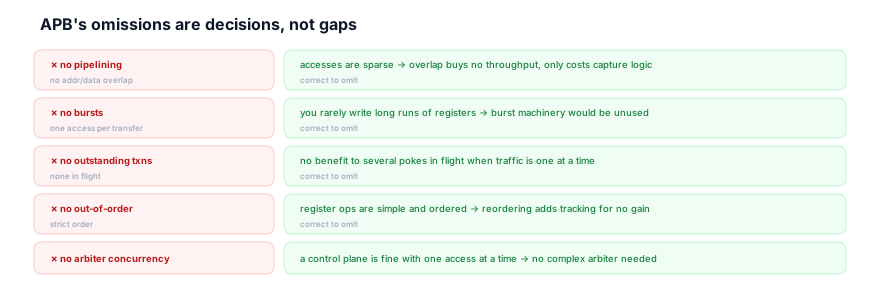
The throughline: APB makes the common case — configure and observe a peripheral — as cheap as load and store, by dropping every feature whose benefit cannot reach sparse traffic, and keeping only the one (wait states) that can.
6. Common RTL / architecture mistakes
7. Interview framing
Interviewers use this topic to test whether you can argue cost, not just describe features. The question often arrives as "why does an SoC have a separate slow bus instead of just one bus?"
The strong answer is the build-to-the-traffic argument: peripheral control traffic is sparse, small, and latency-insensitive, so features like pipelining, bursts, and concurrency buy it nothing while costing area, power, and verification on every peripheral interface; a separate minimal bus (APB) matches cost to that traffic, and a bridge isolates the slow world so the fast world is unaffected. Bonus depth: note that APB keeps exactly one flexibility, PREADY wait states, because that is the one capability slow subordinates genuinely need. What interviewers are really probing is whether you reason about per-interface cost multiplied across many peripherals — a cost-and-scale argument, the systems-economics instinct the question is built to find.
8. Q&A
9. Practice
- Justify an omission. Pick one feature APB omits (bursts, outstanding transactions, or out-of-order) and argue in two sentences why omitting it is correct for control traffic.
- Justify a retention. Explain why APB keeps
PREADYwait states even though it drops everything else. - Cost the scale. A chip has 40 peripherals. Argue qualitatively why a richer peripheral bus would cost roughly 40× the per-interface overhead — and what that buys (nothing for the traffic).
- Place a dual-traffic block. For an SPI flash controller, assign its configuration and its bulk-transfer traffic to buses and justify each.
10. Key takeaways
- Build the bus to the shape of its traffic. Sparse control traffic justifies a deliberately minimal bus; dense data traffic justifies a feature-rich one.
- Every bus feature is paid per interface, used or not. Pipelining, bursts, outstanding transactions, and reordering are pure cost for control traffic, so APB omits all of them.
- The waste scales with peripheral count. Chips have many peripherals, so a minimal peripheral interface is a large, permanent saving in area, power, and verification.
- APB keeps exactly one flexibility —
PREADYwait states — because slow subordinates genuinely need it. Minimalism is removing what does not earn its cost, not removing everything. - The bridge isolates the slow world, containing peripheral timing and stalls behind a clock-and-protocol boundary, so the fast and slow worlds are each built to their own budget.
- Cheap, fitted to its traffic, is high quality. Quality is fit, not feature count; over-building a peripheral bus is the mistake, not the safe choice.