A recurring instinct from engineers who grew up on high-bandwidth interconnects is that a bus without bursts must be crippled — that APB would be a real bus if only someone bolted burst or pipeline support onto it. That instinct inverts the design. APB is deliberately a simple, low-bandwidth, single-transfer control-plane bus — bursts and pipelining are AHB and AXI jobs — and adding them to APB would not improve it, it would destroy the tiny, easily-verified slave that is the entire reason APB exists. The one idea to carry: APB trades throughput for simplicity on purpose, so "no burst" is the feature you bought, not a limitation to be fixed. If you need burst throughput, you are describing a different bus and you already have it.
1. Problem statement
The problem is explaining why APB has no burst or pipeline support and why that absence is correct — not conceding it as a gap, but showing that a burst on a control bus is a category error, so an engineer can defend the design in an interview and, more importantly, place traffic on the right bus in a real SoC.
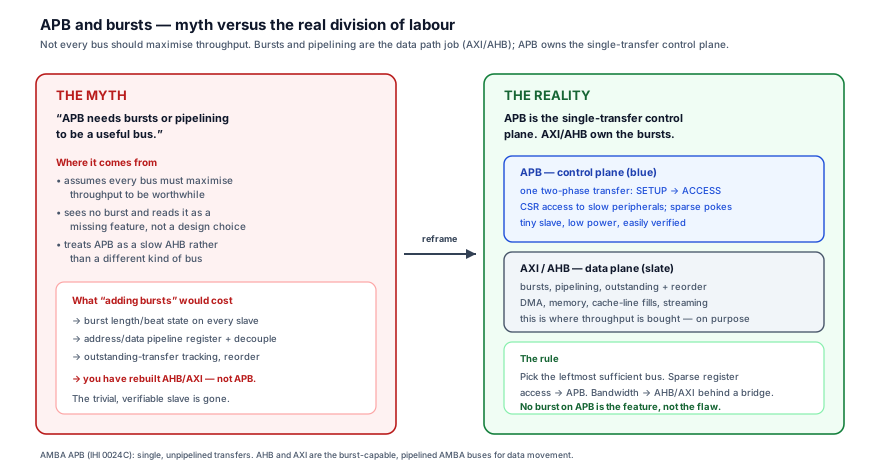
The myth has a specific shape. Someone sees APB carry one address, one data word, one PREADY handshake, and no HBURST-style burst signal, and concludes APB is a stripped-down, throughput-starved bus that "should" have bursts. The reasoning behind the myth is a single hidden assumption: that every bus should maximise throughput, so any bus that does not is deficient. That assumption is false for a control bus. APB's job — per the AMBA APB specification (ARM IHI 0024C) — is sparse, single-word access to peripheral configuration and status registers, and that traffic has nothing to burst.
- APB carries one self-contained transfer at a time. Each access is a two-phase ceremony: SETUP (
PSELhigh,PENABLElow) then ACCESS (PENABLEhigh untilPREADY). There is no burst length, no beat count, no address auto-increment — because a register poke is one word to one address. - The traffic is genuinely sparse. Configuration writes at boot and occasional status reads at runtime are not bandwidth-bound. There is no stream to accelerate, so a burst would optimise a cost that is already negligible.
- The absent machinery is the point. No burst means no per-beat state, no address increment logic, no outstanding-transfer tracking — which is exactly what keeps an APB slave a few dozen lines of RTL.
So the job of this chapter is to show that "APB needs bursts" measures APB against the wrong yardstick. The right question is not "how much bandwidth does this bus deliver" but "what is the cheapest bus that serves this traffic" — and for register access, the answer is the burst-free, pipeline-free APB.
2. Why the belief persists
The belief survives because it rests on a real fact about other buses and then over-generalises it. Bursts genuinely matter — on the data path. The error is assuming the data-path lesson applies to the control plane.
- Bandwidth is the metric people learn first. Interconnect discussions usually start with DDR, DMA, and cache-line fills, where a burst amortises address overhead across many beats and is the whole game. An engineer trained on that traffic reasonably treats "more throughput" as universally good — and then reads APB's lack of bursts as a missing feature rather than a deliberate scope.
- APB looks like a slow AHB. Both are AMBA, both have an address and data phase, both use a ready-style handshake. It is tempting to see APB as AHB with features removed, and to want them added back. But APB is not a subset of AHB to be completed — it is a different bus for different traffic, as the APB vs AHB vs AXI comparison makes explicit: the axis separating them is concurrency, not clock speed.
- The cost of the feature is invisible until you build the slave. Bursts sound free — "just let the manager keep the address asserted for more words." Their real cost is per-slave: beat counting, increment decode, and the loss of the trivial, exhaustively-verifiable slave. Someone who has never written the slave underestimates what the feature would take, so the peripheral access cost never enters the mental model.
- "Unpipelined" gets read as "unfinished." APB is also not pipelined, and the same instinct applies: surely overlapping transfers would help. Why APB is not pipelined shows that serialisation is structural and deliberate — and bursts would require the very same buffering and decoupling that pipelining does. The two myths share a root: mistaking a deliberate omission for an oversight.
The correction is one move: stop asking "why doesn't APB have bursts" and start asking "what traffic is APB for." Once the traffic is sparse register access, the answer is obvious — there is nothing to burst.
3. Mental model
The model: a bus is a tool sized to its traffic, and the right tool for sparse register access is deliberately the smallest one — which means no bursts, by design. Think of two different jobs in a warehouse. Moving pallets of stock all day is the forklift's job (AXI/AHB): you want throughput, so you carry many boxes per trip — a burst. Flipping a single wall switch to turn a light on is the control job (APB): you walk over once, flip it, done. Nobody asks why the light switch cannot carry a pallet — it is not a deficient forklift, it is a switch. Demanding burst support on APB is asking the light switch to move pallets.
Three refinements make it precise:
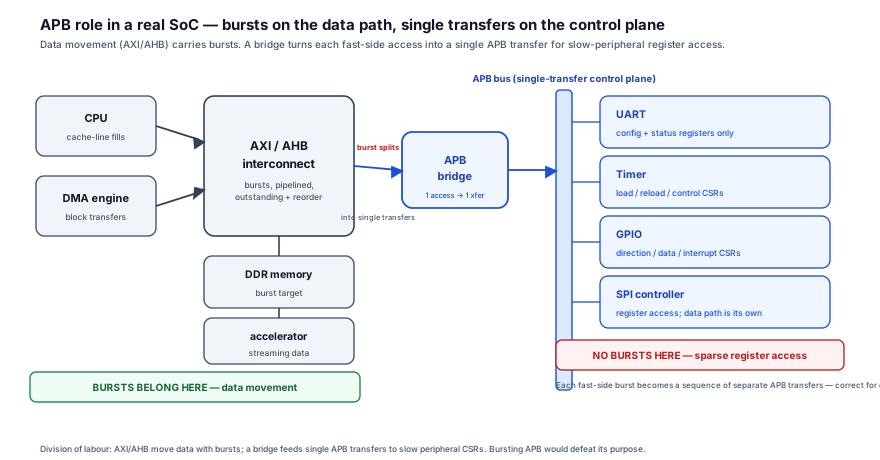
- The control plane and the data plane are separate roles. The data plane moves bulk bytes — memory, DMA, streaming — and lives on AHB or AXI where bursts and pipelining amortise overhead across many beats. The control plane pokes registers to configure those data-plane blocks, one word at a time, and lives on APB. Bursts belong to the first role, not the second.
- APB's cost model has no burst term because its traffic has no burst. A single transfer costs
2 + Ncycles (SETUP + ACCESS + N wait states), and back-to-back transfers do not amortise — see APB throughput. That is fine, because you are not streaming; you are writing a handful of registers whose latency never lands on a critical path. - A bridge is the seam between the two roles. The fast side may issue a burst; the bridge unrolls it into a sequence of separate APB transfers, each paying its own two-phase cost. That is correct for control traffic and exactly why you never route data through the bridge — the burst is absorbed at the boundary, not carried onto APB.
4. Correct division of labour
The concrete way to see the myth dissolve is to place the traffic. Bursts and pipelining are properties of the burst-capable AMBA buses — AHB and AXI — and APB is the deliberately burst-free endpoint behind a bridge. The table contrasts the three on exactly the dimensions the myth conflates.
| Dimension | APB | AHB | AXI |
|---|---|---|---|
| Burst support | none — one word per transfer | yes — HBURST (INCR/WRAP, up to 16 beats) | yes — up to 256 beats per transaction |
| Pipelining | none — self-contained SETUP/ACCESS | address/data phases overlap | five decoupled channels, out-of-order |
| Throughput | low, 1 / (2 + N) per cycle (by design) | moderate — overlap amortises setup | high — many outstanding, reorderable |
| Slave complexity | minimal — decode, respond, PREADY | moderate — capture address, pipeline | high — channels, ordering, outstanding |
| Intended traffic | sparse peripheral register access | embedded backbone / moderate masters | high-bandwidth memory + DMA data path |
| Where bursts live | never on APB (absorbed at the bridge) | native | native |
Read the APB column top to bottom and it is the smallest answer in every row — that is not a scorecard APB loses, it is the specification APB meets. Now the intended pattern in RTL: the data path moves bytes over AXI/AHB, and register access reaches slow peripherals through a bridge that emits single APB transfers.
// Correct division of labour in one SoC datapath.
//
// (A) DATA MOVEMENT — AXI/AHB, where bursts belong.
//     DMA streams a block from DDR to an accelerator using an AXI burst.
//     One address, many beats; this is exactly what bursts are FOR.
axi_dma u_dma (
  .aclk       (aclk),
  .araddr     (src_addr),      // one start address...
  .arlen      (8'd63),         // ...and 64 beats (AxLEN = len-1) = a burst
  .arburst    (2'b01),         // INCR: address auto-increments per beat
  .rdata      (stream_word),   // 64 words returned back-to-back, pipelined
  .rlast      (stream_last)
);

// (B) REGISTER ACCESS — APB, behind a bridge, one transfer at a time.
//     The CPU configures that DMA by poking its control registers.
//     NO burst: each register is a separate two-phase APB transfer.
apb_bridge u_bridge (
  .hclk       (aclk),          // fast side (AHB/AXI) request in...
  .fast_req   (cfg_req),
  .fast_addr  (cfg_addr),
  .fast_wdata (cfg_wdata),
  .fast_ready (cfg_ready),     // ...completes only after the APB access does
  // --- APB side: single-transfer control plane ---
  .pclk       (pclk),
  .presetn    (presetn),
  .psel       (psel),          // SETUP: select the addressed peripheral
  .penable    (penable),       // ACCESS: PENABLE high until PREADY
  .paddr      (paddr),         // one address per transfer, no HBURST
  .pwrite     (pwrite),
  .pwdata     (pwdata),        // one word per transfer, no beat count
  .prdata     (prdata),
  .pready     (pready)         // slow peripheral stretches ACCESS if needed
);

// A "burst" of four config writes on the fast side becomes FOUR separate
// APB transfers here: SETUP/ACCESS x4, each paying its own 2+N cost.
// That is correct for control traffic — and precisely why you never route
// the DMA's STREAM data through this bridge. Data bursts stay on AXI/AHB.
The load-bearing point: the burst lives on the AXI side (arlen, arburst), and it is absorbed at the bridge — the APB side sees only PSEL/PENABLE/PADDR/PWDATA for one word at a time. Adding a burst to the APB side would mean adding PADDR auto-increment, per-beat PWDATA sequencing, and beat-count state to every peripheral slave — rebuilding AHB's machinery on a bus whose traffic never needed it. The division of labour is the design: bursts on the data path, single transfers on the control plane, with the bridge as the one-way valve between them. This is the standard APB SoC architecture and bus topology.
5. Engineering tradeoffs
Adding bursts to APB is not a small feature — it is a re-architecture, and it trades away everything APB was chosen for. The table names what you would spend and what you would get.
| Dimension | APB today (no burst) | "APB with bursts" (the proposal) |
|---|---|---|
| Slave RTL | decode + respond + PREADY, a few dozen lines | beat counter, PADDR increment, per-beat data path — AHB-class |
| Verification | near-exhaustive; small state space | outstanding beats, ordering, mid-burst reset — combinatorial blow-up |
| Area / power | minimal — the explicit goal | grows per slave, multiplied across the whole peripheral fan-out |
| Throughput gained | 1 / (2 + N), sufficient for CSRs | higher — but on traffic that was never bandwidth-bound |
| What it becomes | APB — the control plane | AHB — you have reinvented a bus that already exists |
The throughline: the throughput you would gain applies to traffic that does not need it, and the cost you would pay lands on every slave in the SoC. A peripheral fan-out might be twenty or thirty slaves; burst-enabling APB inflates each one to serve a register-poke workload that runs happily at the serial rate. You would spend real area, power, and verification effort to accelerate the one part of the system that was never slow — and the end state is not a better APB, it is AHB, which the SoC already has for exactly this reason. The correct trade is the one AMBA already made: keep APB burst-free and simple, and route anything that genuinely needs bursts onto the burst-capable buses.
6. Misconceptions to unlearn
7. Debugging scenario
The signature failure here is not an RTL bug — it is an architecture-costing mistake: a subsystem that put bulk data traffic on APB, or budgeted APB as if it bursted, and then missed its throughput target.
- Observed symptom: an accelerator's sample buffer is drained by the CPU reading a peripheral FIFO one word at a time over APB. The throughput budget assumed the reads would "burst" at roughly one word per cycle, but the measured drain rate is far lower and the buffer overflows under load. Every read returns correct data; the aggregate rate is wrong by a large factor.
- Waveform clue: the trace shows a stream of separate APB transfers — each a full SETUP (
PSELhigh,PENABLElow) then ACCESS (PENABLEhigh,PREADYhigh), with the next SETUP only on the cycle after the previousPREADY. There is noHBURST-style continuation, no address auto-increment within a burst — because APB has none. Each word pays its own2 + N. - Root cause: bulk data movement was placed on the control bus. The architect modelled APB as if it could burst the FIFO drain like AHB, but APB serialises single transfers by design. The FIFO's data path belongs on AXI/AHB (or a dedicated DMA), with APB used only to configure and poll the block.
- Correct fix: there is nothing to fix in the APB RTL — it is behaving exactly as specified. The fix is architectural: move the bulk FIFO drain onto a burst-capable data path (a DMA engine over AXI/AHB), and keep APB for the accelerator's control and status registers. Re-cost the control traffic with the serial
2 + Nmodel, which it easily meets, and let the data plane carry the bandwidth. - Verification assertion: you cannot assert your way out of an architecture error, but you can catch it early. Add a performance coverpoint that bulk-drain traffic on the APB segment stays below a sane transfer-rate threshold, and a design rule that data-plane paths never terminate on an APB slave. If a "data mover" appears behind the APB bridge, that is the smell.
- Debug habit: when an APB region "runs too slow" and every transfer is correct, do not hunt for a burst feature to enable — check what traffic is on the bus. APB never bursts, so any budget that assumed it is wrong by construction. Confirm the single-transfer waveform, then decide: accept the serial rate for genuine control traffic, or relocate data traffic to a burst-capable bus.
8. Verification / architecture perspective
From a verification and architecture seat, the reason you would not add bursts to APB is that the burst-free slave is the entire reason APB is cheap to verify — and what you verify instead is precisely that the single-transfer contract holds.
- The absence of bursts is what makes the slave near-exhaustively verifiable. A burst-free APB slave has a tiny state space: idle, SETUP, ACCESS, and the wait-state stretch. There are no in-flight beats, no address-increment corner cases, no mid-burst reset, no outstanding-transfer ordering. You can cover it almost completely. Adding bursts explodes that state space — mid-burst reset, early termination, wrapping boundaries, per-beat error — turning a slave you could sign off in an afternoon into an AHB-class verification effort. You would not add bursts precisely because you would lose that closability.
- What you verify instead is the single-transfer contract. The properties that matter are: exactly one word per transfer (no continuation),
PREADYcompletes each access correctly, the two-phasePSEL/PENABLEsequence is well-formed, and back-to-back transfers each pay their full cost with no illegal overlap. These are the guarantees the whole system's cost model depends on — the bus utilization and throughput budgets assume single, serial transfers, so verification's job is to prove that assumption holds, not to add a feature that would break it. - Architecturally, the check is placement, not protocol. The design-review question is never "should this APB slave burst" — it is "does any data-plane traffic terminate on APB." A reviewer traces bulk-data paths and confirms they land on AXI/AHB, and that APB carries only control and status register access. Getting the placement right is what makes the burst-free protocol sufficient; the moment data traffic leaks onto APB, no burst feature would rescue it — the fix is to move the traffic, per the low-speed-peripheral philosophy.
The point: verification confirms that APB does exactly one simple thing per transfer, and architecture confirms that only traffic suited to one-thing-at-a-time is placed on it. Both jobs get harder, not easier, if you add bursts — which is the strongest possible argument for why the design leaves them out.
9. Interview framing
"Why doesn't APB support bursts — isn't that a limitation?" is a trap question. The weak answer accepts the premise and starts explaining how you would add bursts. The strong answer rejects the premise and explains why bursts do not belong on a control bus.
State the reframe first: APB has no bursts because its traffic is sparse register access, which has nothing to burst — and that omission is deliberate, because it keeps the slave trivial and exhaustively verifiable. Then place the division of labour: bursts and pipelining are the job of the burst-capable AMBA buses, AHB and AXI, which carry bulk data on the data path; APB is the single-transfer control plane reached through a bridge, and a fast-side burst is absorbed at that bridge into a sequence of separate APB transfers. Close with the cost argument: "adding bursts to APB would mean address auto-increment, per-beat data, and beat-count state in every peripheral slave — you would inflate the whole fan-out and end up with AHB, a bus the SoC already has. So if a region truly needs burst throughput, that is a signal to move it off APB, not to modify APB." Framing "no burst" as a deliberate, defensible scope decision — rather than a missing feature — is what tells the interviewer you reason about bus selection, not just signal lists. The senior flourish ties it back to why the bus exists: APB is the cheapest sufficient bus for the control plane, and cheapness is impossible if you add the very machinery bursts require.
10. Practice
- Reframe the myth. In two or three sentences, explain why "APB needs bursts" measures APB against the wrong metric — name the metric and name APB's actual job.
- Name the cost. List the three things every APB slave would need in order to support bursts, and say why that inflates the whole peripheral fan-out.
- Place the traffic. For a DMA moving a video frame, a CPU configuring that DMA's registers, and a status poll of a UART — say which bus each belongs on and why.
- Trace the bridge. A master issues a four-word burst toward a peripheral region behind an APB bridge. Describe what the APB side actually sees, transfer by transfer.
- Answer the trap. Write the one-paragraph interview answer to "isn't the lack of bursts a limitation in APB?" — leading with the reframe, not with how you would add them.
11. Q&A
12. Key takeaways
- APB has no bursts or pipelining by design, not by omission. Its job is sparse, single-word register access to slow peripherals — traffic that has nothing to burst — so the absence of bursts is the feature you bought, per the AMBA APB specification (IHI 0024C).
- The myth is a wrong-yardstick error. "APB needs bursts" measures a control bus by data-path metrics. The right question is not "how much bandwidth" but "what is the cheapest sufficient bus for this traffic" — and for register access that is the burst-free APB.
- Bursts belong on the burst-capable AMBA buses. AHB and AXI carry bulk data on the data path with bursts and pipelining; APB is the single-transfer control plane reached through a bridge, where a fast-side burst is absorbed into a sequence of separate APB transfers.
- Adding bursts would rebuild AHB and delete APB's advantages. Address increment, per-beat data, and beat-count state in every slave inflate the whole peripheral fan-out and destroy the trivial, near-exhaustively-verifiable slave that is APB's reason for existing.
- The fix for "APB is too slow" is placement, not a protocol change. If a region needs burst throughput, its data belongs on AXI or AHB — move it, and keep APB for control and status registers. Verification and architecture both get harder, not easier, if you add bursts.