AMBA AHB · Module 1
AHB vs APB vs AXI
An AHB-centric comparison of the three classic AMBA buses — transfer style, concurrency, bandwidth, and cost — and exactly where AHB's tradeoffs win.
The two previous chapters told you why AHB exists and where it sits in the AMBA family. This chapter sharpens that into a direct, side-by-side comparison: given a block of traffic, how do APB, AHB, and AXI each handle it, and what makes AHB the right answer for some traffic and the wrong answer for the rest? We are still at the conceptual level — no signal encodings, no timing edges — but we go one notch deeper than "each has a job," because the reason each bus behaves differently is the thing interviews and design reviews actually test. We will keep AHB at the centre and compare outward, and where a full mechanism-level treatment already exists in the AXI curriculum we will point to it rather than repeat it.
1. What Is It?
This chapter is a comparison, and the most useful thing it can give you is a fixed set of questions you ask of any bus, so the differences line up cleanly instead of blurring together. There are five:
- Transfer style — how is a single access carried out? In one self-contained step, or as overlapping stages, or as fully independent streams?
- Concurrency — can more than one master make progress at the same time, or do they take turns?
- Bandwidth — how much sustained data can actually move?
- Complexity and cost — how much logic, area, and power does the bus require?
- Typical use — what kind of traffic is it the right tool for?
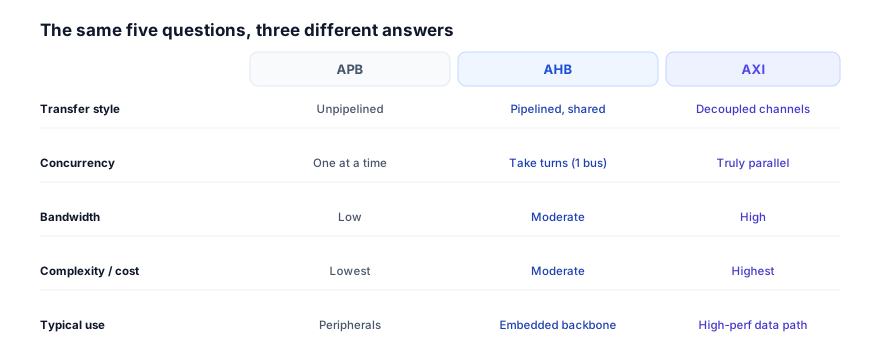
Run those five questions across APB, AHB, and AXI and the family stops being three names to memorize and becomes three positions on a single set of tradeoffs. AHB's identity is precisely its answers: pipelined transfers, shared (so serialized) concurrency, moderate bandwidth, moderate cost, embedded backbone. Hold that row in your head and everything else in this chapter hangs off it.
2. Why Does It Exist?
The three buses exist as distinct designs because the five questions above do not have one best answer — they have a best answer per kind of traffic, and the answers pull against each other.
Push for the cheapest possible bus and you get APB: a single, self-contained access at a time, no pipelining, minimal logic. Perfect for a configuration register, hopeless for a data stream. Push for the highest possible throughput under many simultaneous masters and you get AXI: independent channels, many transactions in flight, out-of-order completion, routed through a switch — at a cost in area and power that only heavy traffic repays. AHB exists in the gap between those extremes, and the comparison exists to make that gap precise.
The reason the gap is real, and not just a marketing tier, is that the jump from APB to AHB and the jump from AHB to AXI are different kinds of jumps:
- APB → AHB is mostly about keeping the bus busy. AHB adds pipelining (overlap the setup of the next access with the current one) and bursts (stream a convoy of related accesses). Both raise throughput on what is still fundamentally one shared bus.
- AHB → AXI is about concurrency, not busyness. AXI's leap is letting many masters genuinely move data at the same time, and keeping many transactions outstanding to hide memory latency. That is not "a busier shared bus" — it is a different topology (a switch instead of a shared wire) and a different transfer model (decoupled channels).
Seeing that the two steps differ in kind is the heart of this comparison, and it is what stops people from collapsing the whole family onto a single "speed" axis.
3. Mental Model
Keep three images side by side, one per bus, and let the difference be visible rather than memorized.
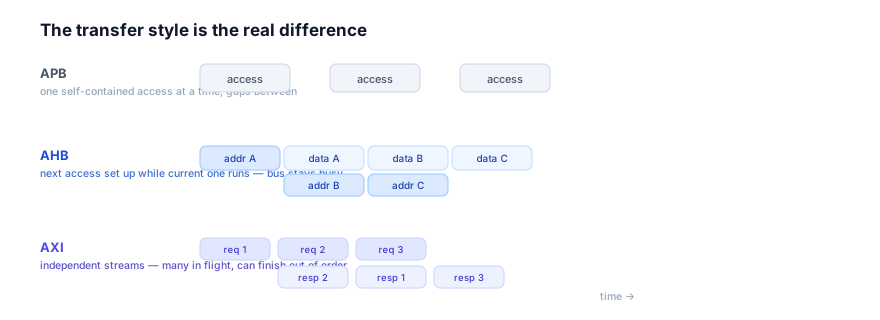
- APB is a single clerk at a counter. A request arrives, the clerk handles it completely, then takes the next. There is dead time between customers, and only one is ever served. Cheap to run, fine when customers are rare.
- AHB is one busy road with a traffic controller. Only one vehicle uses the road at a time (the bus is shared, the arbiter grants it), but the hand-offs are tight: the next vehicle is lined up while the current one is still moving, so the road rarely sits empty. This is the pipelined shared bus, and it is the picture from the previous chapters — now contrasted against its neighbours.
- AXI is a multi-lane interchange. Many vehicles travel at once on separate lanes into a switch, requests and responses flow independently, and a fast trip can finish before a slow one that started earlier. True simultaneity, at the cost of building the interchange.
The single most important contrast to extract: APB and AHB both serve one access path at a time; AXI does not. AHB's pipelining makes that one path efficient, but it does not make two masters move data simultaneously. The step from AHB to AXI is the step from "busy single road" to "interchange," and that is a concurrency step, full stop.
4. Real Hardware Perspective
On silicon, the comparison shows up as three very different amounts of logic and three different placements.
APB's hardware is tiny: a simple state around "present access, wait, complete," often deliberately run in a slower clock domain to save power. AHB's hardware is larger but still modest: an arbiter to grant the shared bus, an address decoder to select the right slave, and slaves that can participate in the pipelined hand-off and stall the bus when they are not ready. AXI's hardware is substantially larger: independent channels each with their own flow control, logic to track many outstanding transactions and their identifiers, and — crucially — a switching fabric that lets disjoint master-slave pairs communicate at once. That fabric is where most of AXI's extra area and power go, and it is exactly what AHB does not have.
This is why "just use AXI everywhere" is a real and costly mistake on the kind of chip where AHB belongs. On a microcontroller-class die, replacing the AHB shared bus with an AXI fabric would multiply the interconnect's area and power to buy concurrency the traffic never uses. Conversely, on a large application processor, forcing the main data path through an AHB shared bus would throttle a chip whose whole point is many masters hammering memory at once. The hardware costs are not abstract — they are gates you pay for and milliwatts you burn, and the comparison is ultimately a comparison of which costs are justified by which traffic.
5. System Architecture Perspective
Because the three buses occupy different points on the cost/performance curve, a real chip uses them together, layered by tier — and the comparison is what tells you which block lands on which tier.
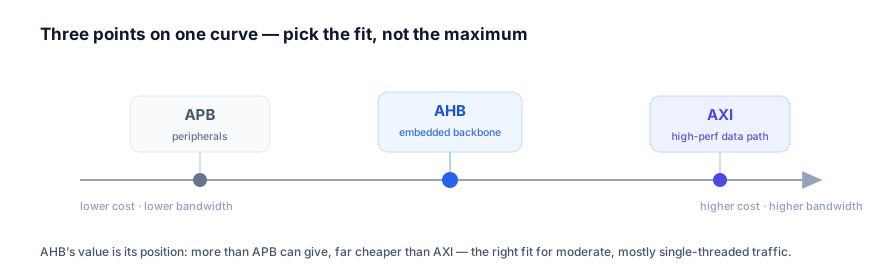
The architectural decision for any block reduces to placing it on this axis:
- A block that is only configured occasionally and moves no real payload sits at the APB end. Putting it any higher wastes expensive bandwidth on traffic that does not need it.
- A block that moves moderate payload, mostly without competing simultaneously with many others, sits at the AHB point. This is the embedded backbone — a processor against on-chip memory, a DMA engine — and on many chips it is the highest tier present.
- A block that moves heavy payload and must make progress concurrently with several other heavy masters sits at the AXI end. Only this traffic justifies the fabric.
The comparison therefore is not academic — it is the daily tool of SoC architecture. Every block placement is implicitly an answer to "APB, AHB, or AXI?", and getting it right is what keeps a chip from being simultaneously over-built and under-performing. The tiers connect through bridges, so a block on one tier can still reach a resource on another when it needs to.
6. Engineering Tradeoffs
Lay the tradeoffs out as direct head-to-heads, because that is how the comparison is used in practice.
- APB vs AHB — simplicity vs throughput. APB wins on gate count, power, and ease of integration; AHB wins decisively on throughput once traffic is anything more than occasional. The deciding question is whether the block moves real payload. If it does, APB's simplicity is a false economy and AHB is correct.
- AHB vs AXI — cost vs concurrency. AHB wins on area, power, and verification effort; AXI wins when many masters must move data simultaneously or when memory latency must be hidden with many outstanding transactions. The deciding question is concurrency, not clock speed — an AHB bus can be clocked fast and still cannot let two masters move data at once. If the traffic is mostly single-threaded, AHB's lower cost is the right call; if it is genuinely concurrent and heavy, AXI's cost is justified.
- The whole-chip tradeoff — uniformity vs fit. Using one bus everywhere is simpler to design and verify but always wrong on cost or performance somewhere. Using the right bus per tier is more integration work (bridges, multiple clock domains) but yields a chip that is correctly sized end to end. Real designs choose fit, and accept the bridges as the price.
The throughline: each comparison turns on a single deciding question — "does it move payload?" for APB-vs-AHB, and "is it genuinely concurrent?" for AHB-vs-AXI. Memorize those two questions and you can place almost any block without memorizing anything else.
7. Industry Example
Trace one chip making all three choices, and the comparison becomes concrete.
Take a mixed-signal SoC: a small application-class subsystem plus a lot of embedded control. The design team places blocks like this:
- The sensor and peripheral registers — a handful of serial ports, timers, GPIO, an I²C controller — go on APB. They are configured occasionally, move no real payload, and APB's near-zero cost is exactly right. Putting them on the data-path fabric would waste bandwidth and drag slow logic into a fast clock domain.
- The embedded backbone — a control processor running firmware from flash, working in on-chip SRAM, with a DMA engine moving buffers — goes on AHB. The traffic is real but mostly single-threaded: the processor and DMA take turns, and AHB's pipelined shared bus keeps that turn-taking efficient at low cost.
- The high-performance data path — application cores, a graphics or vision accelerator, and the external DDR controller — goes on AXI. Here several heavy masters must move data simultaneously and hide memory latency, and only a concurrent fabric can keep them all fed.
The three choices are three different answers to the same five questions, made block by block. Notice that no bus is "best" — each is the correct local answer, and the chip works precisely because the team compared honestly at every tier rather than standardizing on one bus for tidiness. That is the comparison doing its job in a real design.
8. Common Mistakes
9. Interview Insight
The "compare the AMBA buses" question is one of the most common openers in a VLSI interview precisely because a shallow answer and a deep one sound completely different.
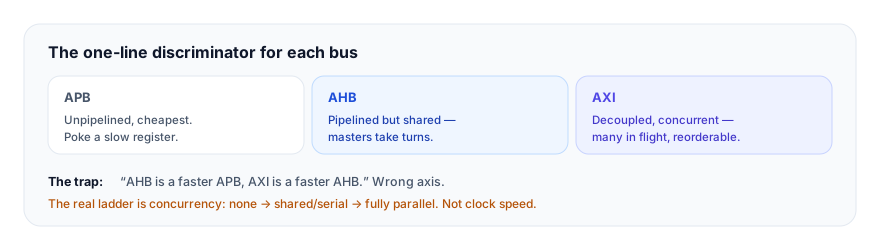
A strong answer has a shape: name the axis that separates each pair, not just the verdict. "APB versus AHB is simplicity versus pipelined throughput — APB does one self-contained access at a time, AHB overlaps accesses and bursts on a shared bus. AHB versus AXI is cost versus concurrency — AHB still serves one access path at a time, AXI lets many masters move data simultaneously and keeps transactions outstanding to hide latency." Delivering the axes shows you understand the mechanisms, which is what the question is built to detect.
10. Practice Challenge
Reason these out from the five axes, not from memory.
- Fill the matrix. From memory, reproduce the five-row comparison (transfer style, concurrency, bandwidth, cost, typical use) for APB, AHB, and AXI. Check yourself against Figure 1.
- Name the axis. For each pair — APB vs AHB, and AHB vs AXI — state the single axis that most separates them and the one deciding question you would ask to choose between them.
- Diagnose a bottleneck. An AHB subsystem with a processor and two DMA engines is missing its throughput target. Describe how you would tell whether the fix is a faster clock or a move to AXI, in terms of contention versus single-master bandwidth.
- Place six blocks. For a UART, a DDR controller, an on-chip SRAM serving one processor, a neural accelerator sharing memory with the cores, a timer, and a flash controller, assign APB / AHB / AXI and justify each in one phrase.
- Catch the bad framing. A colleague's design doc says "we chose AXI because it is the fastest bus." Rewrite that sentence so it justifies the choice on the correct axis.
11. Key Takeaways
- Compare on five axes — transfer style, concurrency, bandwidth, complexity/cost, typical use — not on adjectives. The axes make the differences precise and survive follow-up questions.
- The two steps differ in kind. APB → AHB raises throughput on a shared bus (pipelining, bursts). AHB → AXI adds concurrency (many masters at once, outstanding and out-of-order) via a switch. Not one speed ladder.
- AHB's position is its value: more than APB delivers, far cheaper than AXI — the right fit for moderate, mostly single-threaded embedded traffic.
- Each comparison has one deciding question: "does it move payload?" for APB-vs-AHB, "is it genuinely concurrent?" for AHB-vs-AXI.
- The buses coexist by tier on a real chip, joined by bridges; the comparison is made per block, not per chip.
- For the mechanism-level contrast, especially AXI's channels, defer to the existing AXI vs AHB vs APB chapter rather than re-deriving it here.
12. What Comes Next
You can now place any block on the APB / AHB / AXI spectrum and defend the choice on the right axis. The next chapter zooms back in on AHB alone and shows where it actually lives in real chips:
- 1.4 — Where AHB Is Used in SoCs (coming soon) — AHB's concrete role as the high-performance backbone of microcontroller-class systems, and as a subordinate tier under AXI in larger ones.
To revisit the foundations this comparison rests on, see Why AHB Exists and The AMBA Family Overview. For the deeper, mechanism-level view of the other end of the spectrum, see Why AXI Exists and AXI vs AHB vs APB. For the broader protocol map, see the AMBA family overview.