AMBA APB · Module 3
PPROT — The Protection Attributes
PPROT, the APB4 protection attributes — the privileged, secure, and data-vs-instruction bits that carry access-control context down to peripherals, and what a subordinate does with them.
Module 2 told you that PPROT is the attribute the APB4 version added — the bus that lets an access carry "who is asking." That named the feature; this chapter gives you its exact contract: three bits, what each one means, who sets them, and who checks them. PPROT is a three-bit bus that travels with every access and describes the context of the access — privileged or not, secure or not, instruction or data — so a security-aware subordinate can decide whether to allow it. The single idea to carry: PPROT does not change what is read or written; it describes who is doing it and why, and the subordinate is free to act on that context or ignore it entirely.
1. What problem is being solved?
The problem is carrying access-control context down to the peripheral, so a subordinate can refuse an access it should not serve.
A subordinate sees an address, a direction, and data. That is enough to perform the access — but not enough to police it. In a security-aware SoC, a register might be writable only by privileged software, or readable only by the secure world. The address alone cannot express that: the same address may be legitimate from a trusted master and forbidden from an untrusted one. Something must travel with the access describing the requester's rights.
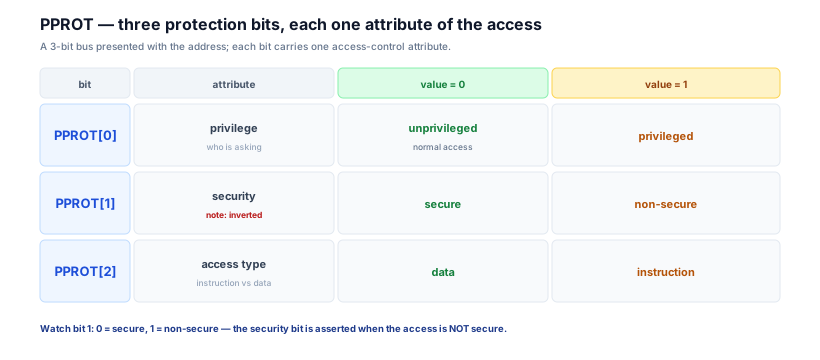
PPROT is that something. It is a three-bit bus, presented alongside PADDR in the address phase, that labels the access:
PPROT[0]— privileged vs unprivileged (normal) access.PPROT[1]— non-secure vs secure access (note the inversion below).PPROT[2]— instruction vs data access.
With these three bits riding along, a subordinate that cares can compare the access context against the protection policy of the targeted register and decide to serve it or reject it. A subordinate that does not care simply ignores PPROT. Either way, the access itself — address, direction, data — is unchanged; PPROT only adds context.
2. Why the lifecycle view is not enough
Module 2 named PPROT as the APB4 attribute add — the version-level fact that APB4 introduced a protection bus on top of APB3. That is true, but "APB4 added a protection bus" is a feature label, not a contract. To wire PPROT into a real bridge, or to check it in a real subordinate, you need three things the lifecycle view leaves unstated:
- The exact meaning of each bit — including the inversion.
PPROT[0]is 1 for privileged,PPROT[2]is 1 for instruction. ButPPROT[1]is inverted: it is 1 for non-secure and 0 for secure. The version view says "carries security info"; the contract says exactly which polarity, and getting it backwards is a real, exploitable bug. - Who sets it, and where it comes from.
PPROTis driven by the manager (the bridge), but its value usually originates further upstream — a CPU's privilege/security state, or theAxPROTattributes of an AXI master on a TrustZone-style fabric — and is propagated down through the bridge ontoPPROT. The subordinate never drives it; it only samples it. - Who checks it, and what rejection looks like. Checking
PPROTis optional and the subordinate's choice. A security-aware subordinate compares it against a per-register policy and, on a violation, rejects the access by assertingPSLVERRat completion. A subordinate that does not care leavesPPROTunconnected.
Knowing the role tells you PPROT "carries protection info." Knowing the contract tells you the polarity of each bit, the chain that sets it, and the mechanism that enforces it — which is what you actually need to build secure RTL.
3. The signal's mental model
The model: PPROT is the credential stamped on the access — and the subordinate is the door that may check it.
Think of someone arriving at a secure facility carrying a badge. The badge does not change where they want to go or what they want to do; it states who they are — their clearance level (secure or not), their rank (privileged or not), and their purpose (fetching an instruction or moving data). At the door, a guard who cares reads the badge and decides whether to let them in; an unguarded door lets everyone through. PPROT is the badge, the access is the visitor, and the subordinate is the door — guarded or not, as the designer chose.
Three refinements make the model precise:
- The badge is stamped upstream, presented at the address phase. The originator's privilege/security/access-type state is captured into
PPROTand presented withPADDRin the address phase, held stable through the access — exactly like the other access-defining signals. PPROT[1]reads "non-secure," not "secure." The security bit is asserted when the access is NOT secure. A 0 onPPROT[1]means a secure access; a 1 means non-secure. Always state it as "non-secure when high" so the polarity never slips.- The door is optional.
PPROTis information, not enforcement. The bus carries the credential, but whether anyone checks it is entirely up to the subordinate. Most peripherals ignore it; the few that guard protected state act on it.
4. Real SoC / hardware context
In a real chip, PPROT is the tail end of a protection chain that starts at the CPU. A processor running secure, privileged code issues a transaction whose attributes reflect that state. On a TrustZone-style fabric those attributes ride as the AxPROT and security signals of AXI; when the access is bridged down to APB, the bridge maps them onto PPROT and presents it with the address. So the bridge drives PPROT, but it rarely invents the value — it propagates context that originated upstream.
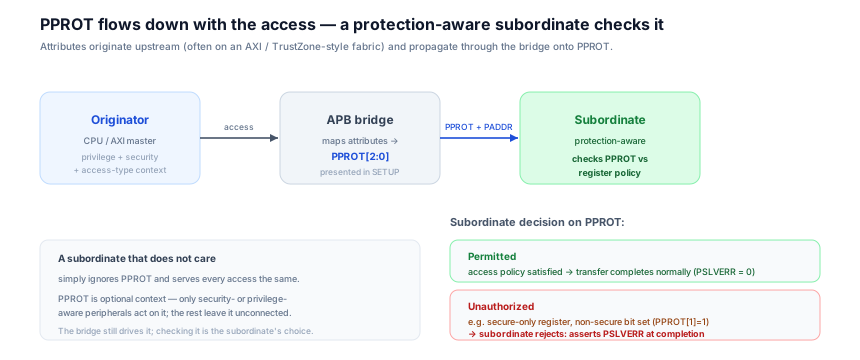
On the subordinate side, the question is binary: does this peripheral guard protected state or not? Most peripherals — a UART, a timer, a GPIO with no privilege model — simply leave PPROT unconnected and serve every access identically. A peripheral that does hold protected state (a secure key store, a privileged control register) reads PPROT and enforces a policy: it compares the access context against what the targeted register requires and rejects a mismatch.
// Security-aware APB subordinate: reject a non-secure access to a
// secure-only register by asserting PSLVERR at completion.
// Teaching sketch — not a full slave.
// PPROT[0] = privileged (1) vs unprivileged (0)
// PPROT[1] = NON-secure (1) vs secure (0)   <-- note the inversion
// PPROT[2] = instruction (1) vs data (0)

logic        sel_secure_reg;   // address decode: target is a secure-only register
logic        non_secure;       // this access is non-secure
logic        access_denied;

assign sel_secure_reg = psel && (paddr == SECURE_KEY_REG);
assign non_secure     = pprot[1];                 // PPROT[1] high => NOT secure
assign access_denied  = sel_secure_reg && non_secure;

// PSLVERR is sampled at completion (PENABLE & PREADY high). A denied access
// completes the handshake but reports an error instead of acting on the data.
assign pready  = 1'b1;                             // always ready in this sketch
assign pslverr = penable && pready && access_denied;

// The register only updates on a permitted write — never when denied.
always_ff @(posedge pclk) begin
  if (psel && penable && pready && pwrite && sel_secure_reg && !access_denied)
    secure_key_reg <= pwdata;
end
Two things to read out of that sketch. First, the violation is expressed through PSLVERR, the same completion-edge status bit APB3 already had — PPROT enforcement reuses the error path rather than inventing a new one. Second, a denied access still completes the handshake normally (the bridge is not left hanging); it simply reports an error and leaves the protected state untouched. Refusing to assert PREADY would be wrong — that stalls the bus, it does not secure the register.
5. Engineering tradeoff table
PPROT is a deliberately thin, optional bus. Each property trades enforcement power for the simplicity APB insists on.
PPROT property | What it gives up | What it buys | Why it is correct for APB |
|---|---|---|---|
| Three bits only | Rich, fine-grained permission models | A tiny, cheap attribute bus | APB peripherals need coarse context, not an MMU |
| Descriptive, not enforcing | Bus-level access blocking | A subordinate that may choose to check | Enforcement belongs to the device that owns the state |
| Optional to check | Guaranteed protection everywhere | Zero cost for peripherals that do not care | Most peripherals hold no protected state |
| Driven by the manager/bridge | Subordinate-set attributes | One driver, context propagated from upstream | Rights originate at the CPU/fabric, not the slave |
Rejection via PSLVERR | A dedicated security-error channel | Reuse of the existing completion-edge error bit | No new mechanism; violations ride the error path |
The throughline: PPROT carries just enough context for a security-aware subordinate to make an allow/deny decision, and nothing more. It enforces nothing on its own, costs nothing for peripherals that ignore it, and reuses PSLVERR for rejection — keeping APB's protection story as cheap and optional as the rest of the bus.
6. Common RTL / waveform mistakes
7. Interview framing
PPROT is a strong discriminator because a precise answer proves you understand both the bit-level contract and the security model around it, while a vague one ("it's the protection signal") proves neither. Interviewers ask "what does PPROT carry?" or "how would a subordinate enforce security on APB?"
The strong answer states the contract, then the model: PPROT is the APB4 three-bit protection bus, presented with the address — PPROT[0] privileged vs unprivileged, PPROT[1] non-secure (high) vs secure (low, note the inversion), PPROT[2] instruction vs data. Then frame the flow: the bridge drives it, but the value propagates down from the CPU or an AXI/TrustZone-style fabric; the subordinate optionally checks it against a per-register policy and rejects a violation by asserting PSLVERR at completion, while still completing the handshake and leaving protected state untouched. The depth point that lands: PPROT describes, it does not enforce — enforcement is the subordinate's choice, and it reuses the existing error path rather than inventing a new one. Calling out the PPROT[1] inversion unprompted signals you have actually written this RTL.
8. Q&A
9. Practice
- Decode the bits. For
PPROT = 3'b010, state whether the access is privileged or not, secure or not, and instruction or data — and watch thePPROT[1]inversion. - State the contract. From memory, write the meaning of each
PPROTbit including which value ofPPROT[1]means non-secure, and explain why the polarity matters in a security check. - Trace the chain. Describe how the security state of a CPU running secure, privileged code reaches a peripheral's
PPROTinput, naming the role of the AXI fabric and the APB bridge. - Write the check. Sketch the condition a subordinate uses to deny a non-secure write to a secure-only register, and explain why it still asserts
PREADYand reports viaPSLVERRrather than stalling. - Find the bug. A subordinate treats
PPROT[1]high as "secure" and permits those accesses. State exactly what attacks this enables and how to fix the polarity.
10. Key takeaways
PPROTis the APB4 three-bit protection bus — presented with the address, carrying the context of the access, not changing the access itself.- The bits are
PPROT[0]privileged,PPROT[1]non-secure,PPROT[2]instruction — andPPROT[1]is inverted: high means non-secure, low means secure. Getting that polarity wrong inverts a security policy. - The manager/bridge drives it; the value propagates from upstream — a CPU's privilege/security state or an AXI master's
AxPROTon a TrustZone-style fabric, mapped down ontoPPROT. PPROTdescribes, it does not enforce. Checking it is the subordinate's optional choice; a peripheral with no protected state simply ignores it and stays fully correct.- A security-aware subordinate rejects a violation via
PSLVERRat completion — completing the handshake while leaving protected state untouched, reusing the existing error path rather than stalling. - It is descriptive metadata only —
PPROTnever alters address, direction, data, or the byte lanes thatPSTRBcontrols; it only adds the ability to refuse.