AMBA AHB · Module 21
AHB Interview Checklist
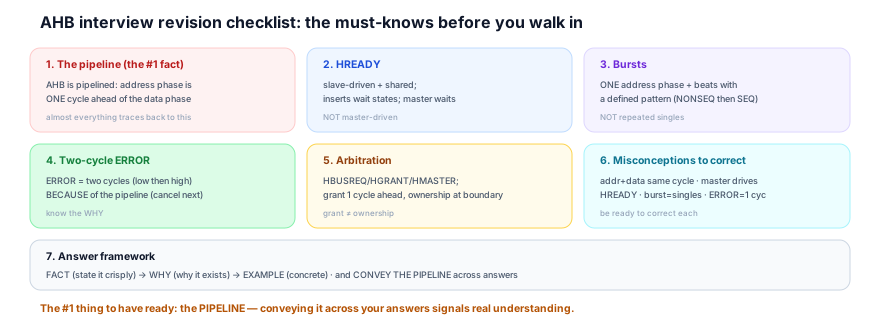
A last-mile revision checklist before an AHB interview — the must-knows to have ready. Seven areas: (1) the pipeline (the #1 fact — the address phase is one cycle ahead of the data phase; almost everything traces back to it); (2) HREADY (slave-driven, shared, inserts wait states, the master waits — not master-driven); (3) bursts (one address phase + beats with a defined pattern — not repeated singles); (4) the two-cycle ERROR (and the why — the pipeline); (5) arbitration (HBUSREQ/HGRANT/HMASTER; grant one cycle ahead, ownership at a boundary — grant is not ownership); (6) the misconceptions to correct; (7) the answer framework (FACT then WHY then EXAMPLE, and convey the pipeline across answers). The single most important thing to have ready is the pipeline — conveying it is the strongest signal of real understanding.
The fifth checklist is the AHB Interview Checklist: the last-mile revision list to review right before an AHB interview — the must-knows to have ready. It distills the entire interview module into a cram sheet. There are seven areas: (1) the pipeline — the #1 fact: the address phase is one cycle ahead of the data phase; almost everything traces back to it; (2) HREADY — slave-driven, shared, inserts wait states, the master waits (not master-driven); (3) bursts — one address phase + beats with a defined pattern (not repeated singles); (4) the two-cycle ERROR — and the why (the pipeline); (5) arbitration — HBUSREQ/HGRANT/HMASTER; grant one cycle ahead, ownership at a boundary (grant ≠ ownership); (6) the misconceptions to correct — address+data same cycle, master drives HREADY, burst = singles, ERROR = one cycle, granted = owns now; (7) the answer framework — FACT → WHY → EXAMPLE, and convey the pipeline across answers. The single most important thing to have ready is the pipeline — conveying it across your answers is the strongest signal of real understanding. This chapter is the cram sheet, with the why each item matters.
1. What Is It?
This checklist is the last-mile cram sheet for an AHB interview — review it right before. The seven must-knows:
- (1) The pipeline (the #1) — the address phase is one cycle ahead of the data phase. Almost everything traces back to it. Convey it.
- (2) HREADY + (3) bursts —
HREADYslave-driven, shared, master waits; a burst is one address phase + a pattern (not singles). - (4) two-cycle ERROR + (5) arbitration —
ERRORis two cycles (and why — the pipeline); arbitration: grant ≠ ownership (grant ahead, ownership at a boundary). - (6) misconceptions + (7) framework — be ready to correct the myths; answer FACT → WHY → EXAMPLE and convey the pipeline.
So the interview checklist is the focused revision — the high-value facts and the framework, condensed for last-minute review. The value is priming the essentials: before an interview, you can't re-read everything — you review the cram sheet to have the must-knows fresh and ready. And it's centered on the pipeline, because that one fact unlocks the most. So this chapter is the pre-interview revision. So review it right before you walk in.
2. Why Does It Exist?
This checklist exists because interviews reward primed recall (the must-knows fresh and ready) — and because the pipeline unlocks the most (one fact → many answers) — and because the framework and the misconceptions are quick wins (a little prep on how to answer and what to correct pays off disproportionately).
The primed recall is the root: in an interview, you recall under pressure — having the must-knows fresh (reviewed right before) means you answer crisply, not fumbling. So a focused cram sheet primes the essentials. So this checklist exists to prime recall. So review right before. So it's the priming.
The the pipeline unlocks the most is the focus: the pipeline is the one fact that most AHB answers build on — conveying it signals understanding, and internalizing it prevents the misconceptions. So the cram sheet centers on it. So this checklist exists to prime the highest-value fact. So it's the focus. So convey the pipeline.
The framework + misconceptions are quick wins is the leverage: knowing how to answer (FACT → WHY → EXAMPLE) and what myths to correct are small bits of prep with large payoff (they shape every answer). So the cram sheet includes them. So this checklist exists to capture the quick wins. So it's the leverage. So this checklist exists because: interviews reward primed recall (must-knows fresh — the root); the pipeline unlocks the most (one fact → many answers — the focus); and the framework and misconceptions are quick wins (small prep, large payoff — the leverage). So the AHB interview checklist is the last-mile cram sheet — priming the must-knows, centered on the pipeline. So this chapter is the pre-interview revision. So review it, and convey the pipeline.
3. Mental Model
Model the interview checklist as an actor's final run-through before going on stage. They don't re-read the whole script in the wings — they review the key cues, the hardest lines, and the one emotional throughline that anchors the whole performance. The throughline is what they hold onto: get that right and the rest flows; lose it and the performance falls apart. The AHB interview checklist is the same final run-through: you don't re-read the whole protocol — you review the must-knows (HREADY, bursts, the two-cycle ERROR, arbitration), the misconceptions to avoid (the hardest lines), and the one throughline that anchors everything: the pipeline. Convey the pipeline and the rest of your answers flow from it; lose it and you fall into the misconceptions. Review the cues, but hold the throughline.
An actor's final run-through before going on stage. They don't re-read the whole script in the wings — they review the key cues, the hardest lines, and the one emotional throughline that anchors the whole performance. The throughline is what they hold onto: get that right and the rest flows; lose it and the performance falls apart. The AHB interview checklist is the same final run-through: you don't re-read the whole protocol — you review the must-knows (HREADY, bursts, the two-cycle ERROR, arbitration), the misconceptions to avoid (the hardest lines), and the one throughline that anchors everything: the pipeline. Convey the pipeline and the rest of your answers flow from it; lose it and you fall into the misconceptions. Review the cues, but hold the throughline.
This captures the checklist: the final run-through, not re-reading the script = the cram sheet, not re-reading the protocol; the key cues and hardest lines = the must-knows and the misconceptions; the one emotional throughline that anchors the performance = the pipeline (the one fact everything traces to); get the throughline right and the rest flows = convey the pipeline and answers follow; lose it and the performance falls apart = miss the pipeline and fall into the misconceptions. Review the cues (must-knows, misconceptions), but hold the throughline (the pipeline) — it anchors everything.
Here is the throughline — the pipeline, the one fact to hold:
The throughline: AHB is pipelined (address one cycle ahead of data) — convey this
4 cyclesThe model's lesson: review the cues (must-knows, misconceptions), but hold the throughline (the pipeline) — it anchors everything. In the figure, the throughline is the one fact — address one cycle ahead of data, transfers overlapping. Hold that, convey it, and the must-knows follow; the misconceptions can't take hold (you can't believe "address and data same cycle" if you've internalized the pipeline).
4. Real Hardware Perspective
The substance behind each must-know is the protocol you've learned — so each checklist item maps to the core chapters, condensed.
The the pipeline, HREADY, bursts: the must-knows — (1) the pipeline (address ahead of data); (2) HREADY (slave-driven, shared); (3) bursts (one address phase + pattern). So the cram sheet condenses the pipeline, HREADY, and burst fundamentals (see Pipelined Operation, What HREADY Means, Single vs Burst Transfer). So they're the fundamentals. So have them ready.
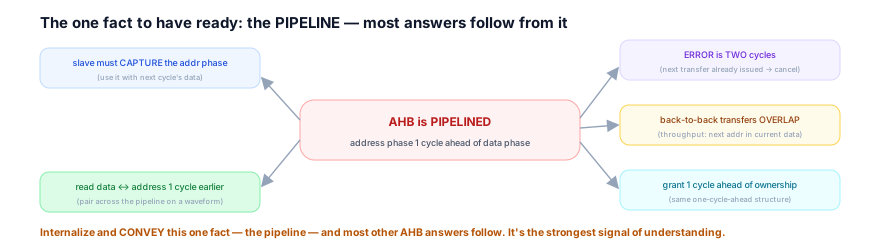
The the two-cycle ERROR, arbitration, misconceptions, framework: the must-knows — (4) the two-cycle ERROR (+ why); (5) arbitration (grant ≠ ownership); (6) the misconceptions; (7) the framework. So the cram sheet condenses the response, arbitration, misconception, and answer-framework material (see Two-Cycle ERROR Response, Bus Ownership Handover, HBUSREQ / HGRANT, Tricky Misconceptions, Beginner Questions). So in practice, the interview checklist is the interview module, condensed — centered on the pipeline. So in practice, review the cram sheet and convey the pipeline. So that's the revision.
5. System Architecture Perspective
At the interview-prep level, the checklist is a focusing tool — it concentrates limited prep time on the highest-value items (the pipeline, the framework), guards against the misconceptions (which cost the most), and gives you a throughline (the pipeline) that organizes your whole performance.
The concentrates limited prep: before an interview, time is limited — you can't review everything. The cram sheet concentrates on the highest-value items (the pipeline, the framework, the misconceptions). So at the prep level, it focuses limited time. So review the high-value. So it's the focus.
The a throughline organizes the performance: the pipeline is a throughline — one fact that anchors and organizes your whole set of answers (convey it everywhere). So the cram sheet gives you that throughline. So at the prep level, the pipeline organizes your performance. So hold the throughline. So it's the anchor. So at the interview-prep level, the checklist is a focusing tool (concentrates limited prep on the highest-value items) and gives you a throughline (the pipeline) that organizes your performance. So the interview checklist is where your prep is focused and anchored — making the pipeline the throughline and FACT → WHY → EXAMPLE the framework for a strong interview. So review the high-value, hold the pipeline. So the checklist focuses your prep.
6. Engineering Tradeoffs
Using the interview checklist embodies the prime-the-essentials, hold-the-throughline, correct-the-myths discipline.
- Cram sheet vs re-read everything. A focused cram sheet primes the must-knows; re-reading everything is unfocused (and impossible last-minute). Review the sheet.
- The pipeline vs scattered facts. Centering on the pipeline (one fact → many answers) is high-leverage; scattered facts don't connect. Hold the throughline.
- FACT → WHY → EXAMPLE vs bare facts. The framework (with the why) signals understanding; bare facts could be memorized. Use the framework.
- Correct the myths vs repeat them. Being ready to correct the misconceptions signals depth; repeating one signals a shaky foundation. Know the myths.
The throughline: the AHB interview checklist is the last-mile cram sheet — seven must-knows: (1) the pipeline (the #1), (2) HREADY (slave-driven, shared), (3) bursts (one address phase + pattern), (4) the two-cycle ERROR (+ why), (5) arbitration (grant ≠ ownership), (6) the misconceptions (to correct), (7) the answer framework (FACT → WHY → EXAMPLE). The #1: convey the pipeline. At the prep level, it focuses limited time and gives you a throughline (the pipeline) that organizes your performance.
7. Industry Example
A concrete walk — reviewing the cram sheet the morning of an interview.
A candidate has an AHB-focused interview and reviews the checklist beforehand.
- (1) The pipeline. They re-anchor on the one fact: the address phase is one cycle ahead of the data phase, transfers overlap. They resolve to convey it across answers — it's their throughline.
- (2) HREADY. They refresh: slave-driven, shared, inserts wait states, the master waits. Not master-driven. Ready.
- (3) Bursts. One address phase +
SEQbeats with a defined pattern (increment/wrap). Not repeated singles. Ready. - (4) Two-cycle ERROR. Two cycles (low then high) — and the why: the pipeline means the next transfer is already issued, so the master needs a cycle to cancel it. Ready (with the why).
- (5) Arbitration.
HBUSREQ/HGRANT/HMASTER; grant one cycle ahead, ownership at a boundary. Grant ≠ ownership. Ready. - (6) Misconceptions. They run through the myths to correct — and resolve to do so graciously. Ready.
- (7) Framework. FACT → WHY → EXAMPLE. They resolve to always give the why. Ready.
- The interview. When asked "what is AHB?", they answer with FACT → WHY → EXAMPLE and convey the pipeline. When the interviewer plants "so address and data go out together?", they catch and correct it. When asked about ERROR, they give two cycles and the why. Throughout, the pipeline is their throughline. The interviewer sees real understanding.
The example shows the checklist in use: a focused pre-interview review that primed the must-knows, anchored on the pipeline, and prepared the framework and corrections — leading to crisp, understanding-signaling answers. This is how you prepare for an AHB interview.
8. Common Mistakes
9. Interview Insight
The interview checklist is the interview insight — it's the condensed must-knows, centered on the pipeline, ready for last-mile review.
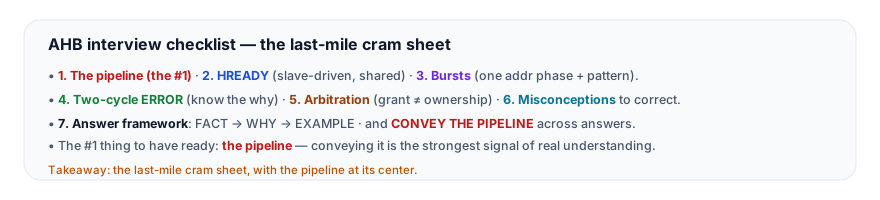
This whole chapter is the interview insight: the condensed must-knows for last-mile review. The meta-advice: don't try to re-learn AHB the night before — review this cram sheet to prime the essentials, and hold the pipeline as your throughline. In the interview, answer FACT → WHY → EXAMPLE (always give the why), correct the misconceptions graciously, and — above all — convey the pipeline (the address phase one cycle ahead of the data phase) across your answers. That one fact, conveyed consistently, is the strongest signal of real understanding you can send — and internalizing it prevents the misconceptions that sink candidates. Review the sheet, hold the pipeline, and you'll signal the depth the whole curriculum built.
10. Practice Challenge
Practice the last-mile revision.
- The seven must-knows. Recite them (pipeline, HREADY, bursts, two-cycle ERROR, arbitration, misconceptions, framework).
- The pipeline. State it crisply and explain why it's the #1 throughline (one fact → many answers).
- The corrections. For each misconception (address+data same cycle, master drives HREADY, burst = singles, ERROR = one cycle, grant = ownership), state the correction.
- The why. For the two-cycle ERROR, give the why (the pipeline — to cancel the next transfer).
- The framework. Answer "what is AHB?" with FACT → WHY → EXAMPLE, conveying the pipeline.
11. Key Takeaways
- The AHB interview checklist is the last-mile cram sheet — the must-knows, centered on the pipeline, for review right before the interview.
- Seven must-knows — (1) the pipeline (the #1), (2) HREADY (slave-driven, shared), (3) bursts (one address phase + pattern), (4) the two-cycle ERROR (+ why), (5) arbitration (grant ≠ ownership), (6) the misconceptions (to correct), (7) the answer framework.
- The pipeline is the throughline — the address phase one cycle ahead of the data phase. Conveying it across answers is the strongest signal of understanding; internalizing it prevents the misconceptions.
- Answer FACT → WHY → EXAMPLE — state it crisply, give the why (the differentiator), ground it with an example.
- Correct the misconceptions graciously — be ready to catch and correct the myths; agreeing signals you share them.
- Review the sheet, hold the pipeline — don't re-read everything; prime the essentials and hold the throughline.
12. What Comes Next
You're now primed for the interview. The final chapter closes the curriculum:
- Common Mistakes Checklist (next) — the recurring AHB mistakes to never make, across design, verification, and reading — the last sign-off.
To review the interview material this checklist condenses, see Beginner Questions, Intermediate Questions, Advanced Questions, Tricky Misconceptions, and Pipelined Operation.