AMBA AHB · Module 12
Why AHB-Lite Exists
Why AHB-Lite exists — the single-master subset of AHB. With only one master there's nothing to arbitrate, so the arbiter, HBUSREQ/HGRANT, HMASTER, locked transfers, and SPLIT/RETRY all drop out; one master drives the bus directly. Most microcontrollers use AHB-Lite for the same pipelined transfers with far less logic.
This opens Module 12 — AHB-Lite, the single-master subset that powers most microcontrollers. The insight is simple but powerful: almost all of full AHB's complexity exists to handle multiple masters competing for the bus — the arbiter, the request/grant handshake (HBUSREQ/HGRANT), the master-number signal (HMASTER), locked transfers (HLOCK), the SPLIT/RETRY responses, and bus-handover logic. But most systems — especially microcontrollers — have only one bus master (the CPU). With one master, there's nothing to arbitrate: the single master always owns the bus. So all that multi-master machinery is unnecessary — and AHB-Lite drops it. What remains is one master driving the bus directly to a decoder and slaves, with a read-data mux returning responses — the same pipelined, high-performance transfers as full AHB, but with far less logic. This chapter explains why AHB-Lite exists (the single-master simplification), what it drops, and why it's the most widely deployed AHB variant.
1. What Is It?
AHB-Lite is the single-master subset of AHB — a version of the protocol that assumes there is exactly one bus master. Because of that single assumption, it removes everything that exists only to coordinate multiple masters:
- No arbiter — there's nothing to arbitrate with one master.
- No HBUSREQ/HGRANT — the master never requests the bus; it always has it.
- No HMASTER — there's only one master to identify.
- No HLOCK / locked transfers — locking exists to prevent another master interrupting; with one master, irrelevant.
- No SPLIT/RETRY — these responses exist to let a slave release the bus to other masters; with one master, unneeded.
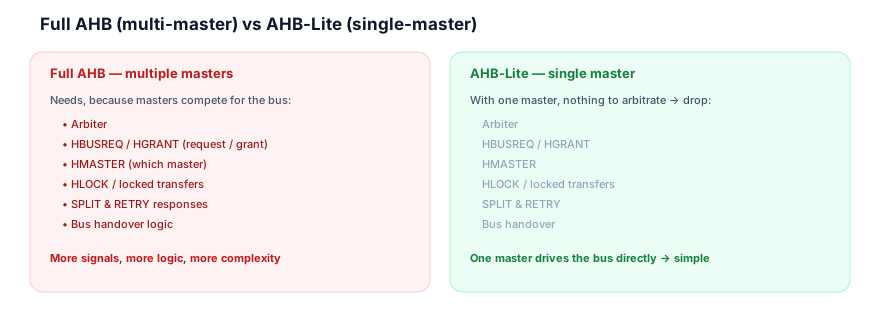
So AHB-Lite is full AHB minus the multi-master machinery. Crucially, it keeps everything about the core data transfer: the two-phase pipeline (address phase + data phase), HADDR/HWRITE/HSIZE/HTRANS/HBURST, wait states (HREADY), the OKAY/ERROR responses, and read/write data buses. So an AHB-Lite transfer looks exactly like a full-AHB transfer — same signals, same pipeline, same timing — it just lacks the arbitration layer around it. So AHB-Lite is the high-performance core of AHB with the multi-master complexity stripped away. So it's the single-master subset: same transfers, no arbitration.
2. Why Does It Exist?
AHB-Lite exists because most of full AHB's complexity serves multi-master coordination, most real systems have only one master, and so a single-master subset gives those systems the full performance of AHB without paying for machinery they don't use.
The complexity-is-for-multi-master observation is the root: look at what full AHB adds beyond a basic pipelined transfer. The arbiter decides which master gets the bus. HBUSREQ/HGRANT is how masters request and are granted the bus. HMASTER identifies which master is active. HLOCK/locked transfers prevent another master interrupting an atomic sequence. SPLIT/RETRY let a slave release the bus so other masters can proceed. Bus handover logic transfers ownership between masters. Every one of these exists solely to coordinate multiple masters. None is needed for the core act of moving data between one master and a slave. So full AHB's complexity is predominantly multi-master coordination. So if you don't have multiple masters, you don't need most of full AHB.
The most-systems-are-single-master fact is the second pillar: a huge fraction of real systems — especially microcontrollers, simple SoCs, and many subsystems — have exactly one bus master: the CPU. There's no DMA contending, no second processor, no other initiator on that bus. (Or, if there are multiple initiators, they're handled by a higher-level interconnect, and each downstream bus segment sees one master.) So for these systems, the multi-master machinery is pure overhead — logic, signals, and verification effort for a scenario that never occurs. So there's a large class of systems that would benefit from not paying for multi-master support. So the demand for a single-master subset is real and large.
The reason the subset is worth defining as a standard (rather than each design ad-hoc-stripping AHB) is interoperability and reuse: AHB-Lite is a defined subset, so IP (masters, slaves, tools) can target it specifically — an AHB-Lite slave is simpler than a full-AHB slave (no SPLIT/RETRY handling), and AHB-Lite masters/slaves interoperate cleanly. Defining it as a standard subset means a whole ecosystem of simpler, single-master IP. So AHB-Lite exists as a standard to give that ecosystem a clean target. So AHB-Lite exists because full AHB's complexity is mostly multi-master coordination, most systems have one master, and a defined single-master subset lets those systems get AHB's full transfer performance with far less logic and a simpler IP ecosystem. It's the recognition that you shouldn't pay for arbitration you'll never use — codified as a standard. (The arbitration machinery AHB-Lite drops is exactly what Module 10 covered; AHB-Lite is what's left when you remove Module 10's concerns.)
3. Mental Model
Model AHB-Lite as a private driveway versus a shared parking garage — a shared garage needs ticket machines, gate arms, an attendant directing cars, and rules for who waits and who goes (the multi-master arbitration); but if you're the only car that ever uses your private driveway, you need none of that — you just drive straight in, every time, because the space is always yours.
A shared parking garage (full AHB, multi-master) serves many cars (masters). To coordinate them, it needs infrastructure: ticket machines and gate arms (the request/grant handshake), an attendant directing who parks where and who waits (the arbiter), reserved-spot logic so one car can hold a spot exclusively (locked transfers), and a "come back later" system when the garage is full so other cars can be served (SPLIT/RETRY). All of this exists because cars compete for limited space. Now consider a private driveway (AHB-Lite): if you're the only car that ever uses it, you need none of that machinery — no ticket, no gate, no attendant, no waiting rules. You just drive straight in, every time, because the space is always yours. The act of parking (the data transfer) is the same — pull in, park — but all the coordination infrastructure is gone, because there's no one to coordinate with. So a private driveway is a parking spot minus the shared-garage machinery — simpler, because it's yours alone.
This captures AHB-Lite: the shared garage = full AHB (multi-master); the private driveway = AHB-Lite (single master); ticket machines / gate arms = HBUSREQ/HGRANT; the attendant = the arbiter; reserved-spot logic = locked transfers; "come back later" = SPLIT/RETRY; driving straight in, always yours = the single master always owning the bus; the act of parking being the same = the identical data transfer (pipeline, HADDR, HREADY, OKAY/ERROR). One car, one driveway — no coordination machinery needed, same parking.
Watch an AHB-Lite transfer — the master just drives, no grant handshake:
AHB-Lite transfer: master drives directly (no grant)
4 cyclesThe model's lesson: one car, one private driveway — drive straight in, no garage machinery. In the waveform, there are no request/grant signals — the master just drives the transfer, identical to full AHB but without the arbitration layer.
4. Real Hardware Perspective
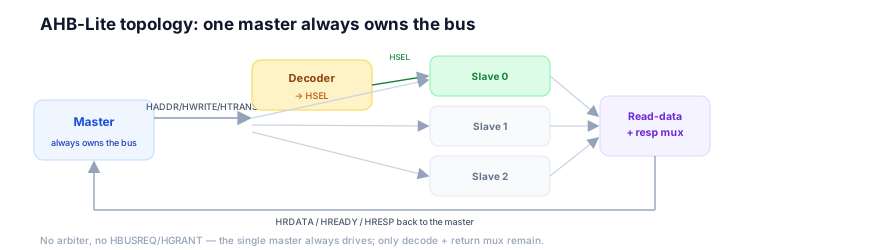
In hardware, AHB-Lite is dramatically simpler than full AHB: there's no arbiter block, no request/grant routing, the interconnect reduces to a decoder plus a read-data mux, and slaves are simpler (no SPLIT/RETRY logic).
The interconnect reduction is the biggest hardware saving: full AHB's interconnect includes an arbiter (with per-master priority/round-robin logic), the request/grant signal network (HBUSREQ/HGRANT per master), the HMASTER generation and routing, the address/control multiplexing between masters, and handover logic. AHB-Lite's interconnect is just: a decoder (HADDR → HSEL, chapter 11.1) and a read-data/response mux (selecting the active slave's HRDATA/HREADY/HRESP back to the master). That's it. There's no master-side muxing (one master drives directly), no arbiter, no grant network. So the AHB-Lite interconnect is a fraction of the gate count of a full-AHB interconnect. So in hardware, AHB-Lite slashes the interconnect logic.
The simpler slaves are the second hardware saving: a full-AHB slave must implement the SPLIT and RETRY responses (the logic to release the bus and later signal readiness, plus the master-tracking SPLIT requires). An AHB-Lite slave doesn't — it only drives OKAY and ERROR (and uses HREADY for wait states). So AHB-Lite slaves are simpler: fewer response types, no SPLIT bookkeeping. Across many slaves, this is significant area/complexity savings. So in hardware, AHB-Lite slaves are leaner. (Chapter 12.6 details AHB-Lite slave design; chapter 12.4 covers the simplified responses.)
The single master's direct drive is the structural change: in full AHB, masters' address/control outputs are muxed (the arbiter selects which master drives the bus). In AHB-Lite, the one master's outputs drive the bus directly — HADDR, HWRITE, HTRANS, etc. go straight to the slaves (and decoder), no muxing. The master also doesn't need request/grant logic (it never asks for the bus). So the master interface is simpler too (no HBUSREQ output, no HGRANT input, no HLOCK). So in hardware, the single master drives directly with a simpler interface. So overall, AHB-Lite's hardware is much leaner than full AHB: no arbiter, no grant network, a decoder-plus-mux interconnect, simpler slaves, and a simpler master — all while preserving the identical high-performance pipelined transfer. So the hardware perspective is: AHB-Lite is the same transfer engine with the multi-master superstructure removed, yielding a far smaller, simpler implementation.
5. System Architecture Perspective
At the system level, AHB-Lite is the right-sized bus for the single-master systems that dominate embedded computing — and its existence reflects a key design principle: match the protocol complexity to the actual system needs.
The dominant-use-case point is why AHB-Lite matters so much: the vast majority of embedded systems are single-master at the bus level. A typical microcontroller has one CPU as the bus master, talking to flash, RAM, and peripherals. Even many larger SoCs are organized so that individual bus segments are single-master (with a higher-level interconnect, like a bus matrix or AXI fabric, handling the multi-master concurrency at the top). So AHB-Lite is the bus most actually-deployed AHB systems use. Full multi-master AHB is comparatively rare (largely superseded by AXI for high-end multi-master needs). So AHB-Lite isn't a "lite" afterthought — it's the mainstream AHB, the one that ships in billions of microcontrollers. So at the system level, AHB-Lite is the dominant, mainstream AHB variant.
The right-sizing principle is the architectural lesson: AHB-Lite embodies matching protocol complexity to system needs. A single-master system shouldn't carry the area, power, timing, and verification cost of multi-master machinery it never exercises. AHB-Lite lets the architect pick the right-sized protocol: full AHB (or AXI) when there's genuine multi-master concurrency, AHB-Lite when there's one master. This is good system design — don't over-provision. The savings are real: smaller interconnect (area/power), simpler timing (no arbiter in the path), and much less verification (no arbitration corner cases, no SPLIT/RETRY scenarios, no master-interaction bugs). So at the system level, AHB-Lite is the right-sizing choice for single-master systems — and the verification saving alone is often decisive (multi-master arbitration is a notorious source of bugs and verification effort).
The composition with larger fabrics view: AHB-Lite also fits into bigger systems as a leaf protocol. A complex SoC might use an AXI or multi-layer interconnect at the top (handling many masters/concurrency), with AHB-Lite subsystems hanging off it — each subsystem being single-master from its own bus's perspective (e.g. behind a bridge, one port drives an AHB-Lite peripheral bus). So AHB-Lite composes cleanly as the simple, single-master edge of a larger hierarchy. This is common: the heavy multi-master concurrency is handled once, at the top, in a capable fabric, and the many leaf subsystems use simple AHB-Lite. So at the system level, AHB-Lite is both the standalone bus for single-master systems and the simple leaf in larger hierarchies — right-sized in both roles. So AHB-Lite exists and dominates because it matches the protocol to the single-master reality of most systems, saving area, power, timing, and especially verification, while composing cleanly into larger fabrics. It's a textbook case of not paying for capability you don't need.
6. Engineering Tradeoffs
AHB-Lite embodies the right-sized, single-master design.
- AHB-Lite (single-master) vs full AHB (multi-master). AHB-Lite is far simpler (no arbiter, grant, HMASTER, lock, SPLIT/RETRY) and cheaper to build and verify, at the cost of supporting only one master. Full AHB supports multiple masters at much higher complexity. Choose by whether you have one master or many.
- Same transfer performance, less logic. AHB-Lite keeps the full pipelined transfer (same throughput/latency as full AHB) while dropping the arbitration layer — so there's no performance penalty for the simplification, only a capability (multi-master) given up.
- Right-sized vs over-provisioned. Using AHB-Lite for a single-master system right-sizes the protocol (no wasted multi-master logic); using full AHB there would over-provision (paying for unused capability). Match complexity to need.
- Standalone vs leaf-in-fabric. AHB-Lite works as a standalone single-master bus and as a simple single-master leaf off a larger multi-master fabric (AXI/bus-matrix) — flexible in both roles.
The throughline: AHB-Lite is the single-master subset of AHB — with one master, nothing to arbitrate, so the arbiter, HBUSREQ/HGRANT, HMASTER, HLOCK, and SPLIT/RETRY all drop out, leaving one master driving the bus directly through a decoder and read-data mux. It keeps the identical pipelined transfer (no performance loss) while shedding the multi-master complexity (big savings in area, power, timing, and verification). It's the right-sized, mainstream AHB for the single-master systems that dominate embedded computing, and composes cleanly as a leaf in larger fabrics.
7. Industry Example
See where AHB-Lite fits in real designs.
- A typical microcontroller. A Cortex-M-class MCU has one CPU core as the sole bus master, connected via AHB-Lite to flash (instruction/data), SRAM, and (through an AHB-to-APB bridge) the peripherals. There's one master, so AHB-Lite is the natural choice: the CPU drives the bus directly, the decoder selects flash/RAM/bridge, and there's no arbiter. Billions of such MCUs ship with AHB-Lite as the main bus.
- The performance is full. The MCU's AHB-Lite bus runs pipelined, burst, wait-stated transfers at full speed — fetching instructions and data from flash/RAM with the same performance a full-AHB bus would give. The simplification costs no throughput; it only removes the (unused) arbitration.
- Adding a DMA (the boundary). If the design adds a DMA engine (a second master), the single-master assumption breaks. Two options: move to full multi-master AHB (add an arbiter, request/grant) for that bus, or use a multi-layer/bus-matrix interconnect (which gives each slave its own arbitration and lets masters run concurrently). Many MCUs use a small bus matrix here — keeping each path effectively simple while allowing CPU and DMA concurrency. So the single-master AHB-Lite assumption is revisited only when a true second master appears.
- AHB-Lite as a leaf in a big SoC. A large application SoC uses an AXI fabric at the top for its many masters (CPUs, GPU, DMA, …). Hanging off it, individual peripheral subsystems use AHB-Lite — each subsystem is single-master from its bus's view (the AXI-to-AHB bridge is its one master). So AHB-Lite is the simple leaf, AXI the multi-master core.
- Verification savings. The MCU team verifying the AHB-Lite bus doesn't need to test arbitration fairness, grant timing, lock behavior, SPLIT/RETRY, or master-interaction races — none exist. Their verification focuses on the transfer protocol and the slaves. This is a major reduction in verification scope versus a multi-master bus.
The examples show AHB-Lite's role: the mainstream bus for single-master MCUs (full transfer performance, no arbitration), revisited only when a real second master appears (then full AHB or a bus matrix), and the simple single-master leaf in larger AXI-based SoCs. AHB-Lite is right-sized for the single-master reality of most designs.
8. Common Mistakes
9. Interview Insight
AHB-Lite is a foundational interview topic — the single-master subset framing, what drops out, and "same transfer, no arbitration" are the signals.
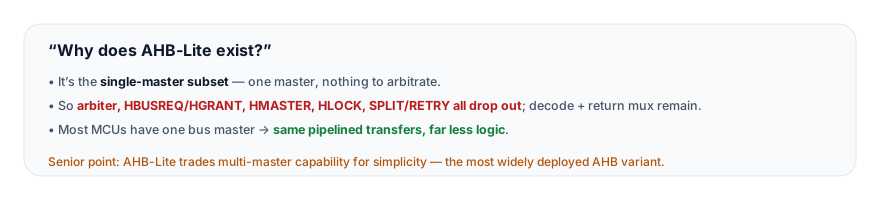
The answer that lands frames it as the single-master subset: "AHB-Lite is the single-master subset of AHB. The key insight is that almost all of full AHB's complexity exists to coordinate multiple masters — the arbiter, the HBUSREQ/HGRANT request-grant handshake, the HMASTER signal, locked transfers, and the SPLIT and RETRY responses (which let a slave release the bus to other masters). If a system has only one bus master — which most do, especially microcontrollers — there's nothing to arbitrate: that one master always owns the bus. So AHB-Lite drops all of that machinery. What's left is one master driving the bus directly to a decoder and slaves, with a read-data mux returning the response. Crucially, AHB-Lite keeps the entire core transfer protocol — the two-phase pipeline, all the burst and transfer types, wait states via HREADY, and the OKAY/ERROR responses — so transfers are identical to full AHB, at full performance. It just removes the arbitration layer. The result is the same pipelined transfers with far less logic, simpler slaves, and much less verification — which is why AHB-Lite is the most widely deployed AHB variant, the main bus in most MCUs. You only need full AHB (or a bus matrix) when there's a genuine second master." The single-master-subset framing, the dropped features, and "same transfer, less logic" are the senior signals.
10. Practice Challenge
Reason from AHB-Lite.
- Define it. Describe what AHB-Lite is and the single assumption it's built on.
- What drops. List the features AHB-Lite removes and, for each, why it's multi-master-only.
- Read the waveform. From Figure 2, point out what's absent compared to a full-AHB transfer and what's identical.
- Same performance. Explain why AHB-Lite has the same transfer performance as full AHB despite being "Lite."
- When to upgrade. Explain when you'd move from AHB-Lite to full AHB or a bus matrix, and why.
11. Key Takeaways
- AHB-Lite is the single-master subset of AHB — built on the assumption of exactly one bus master, so there's nothing to arbitrate.
- It drops all multi-master machinery — no arbiter, no HBUSREQ/HGRANT, no HMASTER, no HLOCK/locked transfers, no SPLIT/RETRY responses (each exists only to coordinate multiple masters).
- It keeps the full transfer protocol — the two-phase pipeline, all transfer/burst types, wait states (HREADY), and OKAY/ERROR — so transfers are identical to full AHB, at full performance. "Lite" = removed arbitration, not reduced transfer capability.
- The hardware is far leaner — the interconnect reduces to a decoder + read-data mux (no arbiter, no grant network), slaves are simpler (no SPLIT/RETRY), and the master drives directly.
- It's the mainstream AHB — most embedded systems (especially MCUs) are single-master, so AHB-Lite is the most widely deployed variant; full multi-master AHB is comparatively rare.
- Right-size the protocol — use AHB-Lite for one master (huge savings in area, power, timing, and especially verification); move to full AHB or a bus matrix only when a genuine second master appears. AHB-Lite also composes as the simple single-master leaf in larger AXI fabrics.
12. What Comes Next
You now understand why AHB-Lite exists — the single-master subset that drops the multi-master machinery while keeping the full transfer. The next chapters detail the simplification:
- Single-Master Simplification (next) — exactly what drops out when only one master exists, signal by signal.
- Removed Arbitration — why AHB-Lite needs no arbiter or request/grant, in detail.
- Simplified Responses and AHB-Lite Slave Design — the OKAY/ERROR-only responses and how to build a correct AHB-Lite slave.
To revisit the multi-master machinery AHB-Lite removes, see HBUSREQ & HGRANT and Master, Slave, Decoder & Arbiter; for why AHB exists at all, see Why AHB Exists.