AMBA APB · Module 4
Single-Cycle Transfers
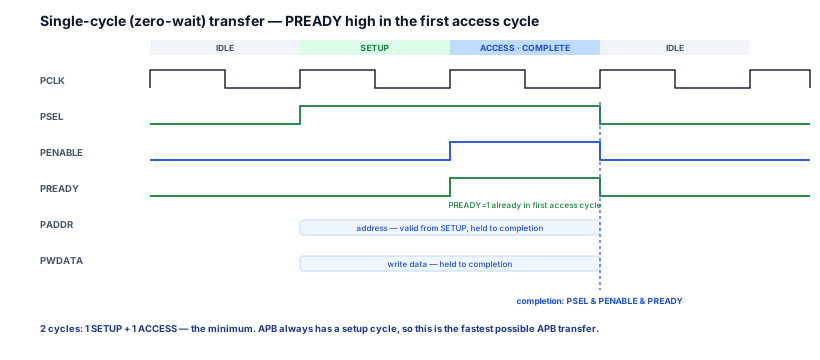
The fastest APB transfer — PREADY high in the first access cycle, so a transfer completes in two cycles (setup + access) with zero wait states.
Across Module 4 you have watched the access phase stretch under wait states and resolve on a single completion edge. This chapter looks at the opposite extreme: the fastest an APB transfer can go. A single-cycle transfer is a zero-wait-state access — the subordinate drives PREADY high in the very first access cycle, so the access completes immediately. But "single-cycle" names a single ACCESS cycle, not a single bus cycle: every APB transfer still costs a minimum of two PCLK cycles, one SETUP and one ACCESS, because APB always has a setup cycle. The single idea to carry: zero wait states is the floor, not pipelining — back-to-back single-cycle transfers are still two cycles each, adjacent and never overlapped.
1. What problem is being solved?
The problem is pinning down the fastest legal APB transfer and naming it precisely — so "single-cycle" never gets misread as "one clock."
Most subordinates on an APB bus are plain configuration registers that can answer the instant they are accessed. For them, inserting a wait state would be pure waste: the data is already there. APB lets such a subordinate finish in the minimum time by tying PREADY high, so the access completes on its first cycle. That gives the bus its best case:
PREADYhigh in the first access cycle — no wait states, the access completes at once.- Still one SETUP cycle first — the address and control are presented in SETUP with
PENABLElow, before the access can begin.
So the floor is two PCLK cycles: one SETUP, one ACCESS. "Single-cycle" is the name engineers use for zero wait states — a single ACCESS cycle — and the value this chapter pins down is exactly that the minimum is two bus cycles, not one.
2. Why the previous model is not enough
You already understand wait states: the multi-cycle transfer where PREADY stays low and the access phase stretches. The natural next thought is "so the fast case must be a single clock cycle." That is the misread this chapter exists to prevent.
The danger is collapsing two distinct ideas into one number:
- A single ACCESS cycle is not a single bus cycle. "Zero wait states" removes the extra access cycles, not the mandatory SETUP cycle. The transfer is still SETUP then ACCESS — two cycles.
PENABLEhigh is not, by itself, completion. In a single-cycle transferPENABLEandPREADYhappen to go high on the same cycle, so completion coincides withPENABLErising — but the rule is stillPSEL & PENABLE & PREADY. It is the conjunction that completes the transfer, notPENABLEalone.- Fast does not mean pipelined. A subordinate finishing in one access cycle does not let APB overlap the next transfer with this one. The next transfer's SETUP comes after this transfer's completion, never beside it.
So the model to add is not "the bus can do a transfer in one cycle." It is the precise floor — two cycles, one of them an unavoidable setup — and the discipline of keeping "single ACCESS cycle" and "single bus cycle" apart.
3. Mental model
The model: a single-cycle transfer is an express checkout — no queue at the counter, but you still walk up to it first.
Picture a shop with one express lane. The walk to the counter is SETUP: you present what you are doing (the address and control land, PSEL high, PENABLE low). The checkout itself is ACCESS. In the express lane the clerk is always ready — the stamp comes down the instant you arrive, because the subordinate ties PREADY high. There is no waiting at the counter. But you cannot skip the walk: APB always presents the access in SETUP before performing it in ACCESS. So the fastest trip is still two beats — walk, then stamp — and "single-cycle" means the stamp took one cycle, not the whole trip.
Three refinements make the model precise:
PREADYhigh in the first access cycle is the whole trick. A fast subordinate tiesPREADYhigh, so the cyclePENABLErises is also the cycle the access completes. There is never a wait cycle to hold the access.- SETUP is not optional. Even the fastest transfer spends one cycle in SETUP with
PENABLElow. That cycle is what makes APB's access phase a clean, single-beat handshake — and it is why the floor is two cycles, not one. - Completion coincides with
PENABLEhere, but the rule is unchanged. In this best casePENABLEandPREADYare high together on one edge, so it looks likePENABLEcompleted the transfer. It did not —PSEL & PENABLE & PREADYdid. The coincidence is exactly what makes a single-cycle waveform a trap for the rule.
4. Real SoC / hardware context
In RTL, a single-cycle transfer is what you get from the simplest possible subordinate: one that is always ready. It does not generate PREADY from a counter or a state bit — it ties the wire high and lets every access complete on its first access cycle.
// Fastest possible APB subordinate: always ready, zero wait states.
assign pready = 1'b1;   // ready in the FIRST access cycle of every transfer,
                        // so each access completes immediately — no wait states.
                        // This is the fastest an APB transfer can go.
                        // It does NOT make the transfer one cycle: every APB
                        // transfer is still SETUP + ACCESS = two PCLK cycles,
                        // because APB always presents the access in SETUP first.
Two facts fall out of this. First, because PREADY is held high, the access never has a wait cycle — the cycle PENABLE rises is the cycle the transfer completes, and this is true for every access to this subordinate. Second, the SETUP cycle is still there: the manager presents the address and control with PENABLE low for one cycle before driving PENABLE high, so even this trivial subordinate sees a two-cycle transfer. Tying PREADY high removes wait states; it cannot remove the setup cycle, which is part of APB's lifecycle, not the subordinate's choice.
5. Engineering tradeoff table
Making the fast case "one ACCESS cycle on top of a mandatory SETUP" is a deliberate design point. Each property trades something APB does not need for the simplicity it does.
| Single-cycle property | What it gives up | What it buys | Why it is correct for APB |
|---|---|---|---|
| Mandatory SETUP cycle | A true one-cycle access | A clean, single-beat access handshake | The address must settle before the access is performed |
PREADY tied high | Backpressure on this subordinate | The minimum-latency transfer, trivially | A register that is always ready needs no wait logic |
| Two-cycle floor (SETUP + ACCESS) | Peak throughput | Predictable, uniform transfer shape | A sparse control plane does not need higher rates |
| No overlap with the next transfer | Pipelined back-to-back accesses | Dead-simple, contention-free timing | APB chooses simplicity over bandwidth by design |
| Same lifecycle as a slow access | A separate fast path | One FSM handles fast and slow identically | Zero-wait is just the wait-count-equals-zero case |
The throughline: the single-cycle transfer is not a special mode — it is the ordinary lifecycle with zero wait states. APB spends one mandatory setup cycle to keep the access phase a clean handshake, and in return the fastest and slowest transfers share one shape, one FSM, and one completion rule.
6. Common RTL / waveform mistakes
7. Interview framing
This is a precision question: an interviewer asks "how many cycles is the fastest APB transfer?" and the answer separates someone who has internalised the lifecycle from someone who pattern-matches "single-cycle" to "one clock."
Lead with the floor: the fastest APB transfer is two PCLK cycles — one SETUP, one ACCESS — because APB always presents the access in SETUP before performing it. Then explain the name: "single-cycle" means a single ACCESS cycle, i.e. zero wait states, achieved when a fast subordinate ties PREADY high so the access completes on its first cycle. Add the depth point that completion still follows the full rule — PSEL & PENABLE & PREADY — and that in this case it merely coincides with PENABLE rising. Close with the trap most candidates miss: this is not pipelining — back-to-back zero-wait transfers are two cycles each, adjacent and never overlapped. Volunteering the SETUP-is-mandatory reason for the two-cycle floor is exactly what signals you understand the protocol, not just the buzzword.
8. Q&A
9. Practice
- Count the floor. From memory, state how many
PCLKcycles the fastest APB transfer takes and name each cycle. Explain why it cannot be fewer. - Write the fast subordinate. Write the one line of RTL an always-ready subordinate uses for
PREADY, and say how many cycles each access then takes. - Name the coincidence. On a single-cycle transfer, mark the completion edge and explain why it is wrong to say "
PENABLEhigh completed it" even thoughPENABLEis high there. - Spot the non-pipeline. Draw two back-to-back single-cycle transfers with no idle gap, label every cycle, and state the total cycle count — then explain why this is adjacent, not pipelined.
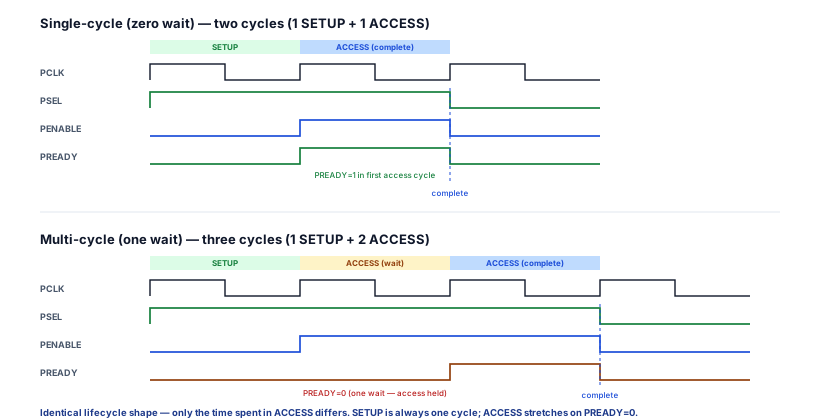
- Compare the shapes. Draw a zero-wait transfer and a one-wait transfer one above the other and show that the only difference is the number of access cycles, not the lifecycle shape.
10. Key takeaways
- A single-cycle transfer is a zero-wait-state access: the subordinate drives
PREADYhigh in the first access cycle, so the access completes immediately. - "Single-cycle" means one ACCESS cycle, not one bus cycle. Every APB transfer is still a minimum of two
PCLKcycles — one SETUP, one ACCESS — because APB always has a setup cycle. - A fast subordinate ties
PREADYhigh —assign pready = 1'b1;— which removes wait states but never removes the mandatory SETUP cycle. - Completion still follows the full rule.
PSEL & PENABLE & PREADYcompletes the transfer; here it merely coincides withPENABLErising, soPENABLEhigh alone is not the completion condition. - This is not pipelining. Back-to-back zero-wait transfers are still two cycles each, adjacent and never overlapped — APB trades throughput for simplicity by design.
- Single-cycle is just the zero-wait case of the ordinary lifecycle — same IDLE → SETUP → ACCESS shape, same FSM, same completion edge as a multi-cycle transfer; only the time spent in ACCESS differs.