AMBA AHB · Module 1
Where AHB Is Used in SoCs
AHB's concrete role in real chips — the backbone of microcontroller-class SoCs and a mid-level subsystem under AXI in larger ones — and the traffic profile that fits it.
We have established what AHB is, why it exists, and how it compares to its siblings. This chapter answers the practical question a designer actually faces: on a real chip, where does AHB go? The abstract tradeoffs of the previous chapters become concrete here — you will see AHB as the beating heart of a microcontroller, and as a quieter mid-level subsystem inside a large application processor. The aim is that when you open a real SoC block diagram, you can point to the AHB and say not just "there it is" but "and here is exactly why it is there and not somewhere else." Still no signals — this is about placement and role.
1. What Is It?
"Where AHB is used" has a precise answer: AHB is the high-performance interconnect for moderate-bandwidth, mostly single-threaded on-chip traffic — most often the central backbone of a microcontroller-class chip, and sometimes a subordinate subsystem beneath a larger fabric. It is the bus that the processor, the on-chip memories, and the DMA engine talk over when that conversation is the most demanding one on the chip but is not heavy enough to justify a full concurrent fabric.
There are two canonical placements, and almost every real appearance of AHB is one of them:
- As the top-level backbone of a microcontroller or small SoC. Here AHB is the high-performance bus — there is nothing above it. The processor fetches code, works in memory, and shares the bus with DMA, all on AHB, with peripherals hanging below on APB.
- As a mid-level subsystem inside a large SoC that also has AXI. Here AHB is hung off the AXI fabric through a bridge, carrying a self-contained chunk of moderate traffic — a control subsystem, a cluster of mid-speed peripherals — without burdening the main data path.
Recognizing which of these two you are looking at, on any block diagram, is most of the skill this chapter builds.
2. Why Does It Exist?
AHB ends up in these specific places because of a matching exercise: every block of on-chip traffic has a profile, every bus has an operating envelope, and AHB's envelope matches one extremely common profile.
That profile is: a small number of masters, moving real but moderate payload, mostly one at a time, under tight area and power budgets. This is the profile of the overwhelming majority of embedded systems — the sensor hubs, motor controllers, wearables, and appliance chips that ship by the billion. They have a processor that needs to fetch instructions and data quickly, often a DMA engine to move buffers without burdening the processor, and not much else competing for the bus at the same instant. They cannot afford the area and power of a concurrent fabric, and they would be crippled by the slowness of a peripheral bus.
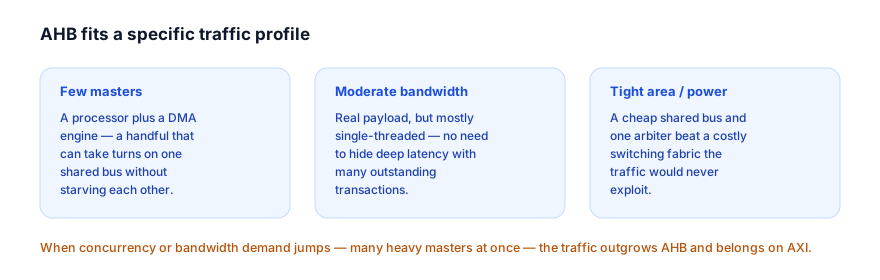
AHB exists in these places, then, not by habit or legacy but because the match is genuinely good. A shared, pipelined, arbitrated bus is exactly enough for a processor and a DMA engine taking turns, at a fraction of the cost of anything more concurrent. Put differently: AHB is where it is because moving the traffic somewhere cheaper would throttle the chip, and moving it somewhere more capable would waste silicon. It sits at the point of best fit, and that point happens to be the centre of an enormous category of chips.
3. Mental Model
The clearest mental model for AHB's placement is a building's service spine.
Picture a mid-size building. There is a central service corridor — wide enough for the real daily traffic of people and carts moving between the important rooms (the offices and storerooms that matter). That corridor is AHB: the spine along which the building's actual work flows. Off that corridor, through a narrow doorway, is a side passage to the utility closets — the slow, rarely visited rooms. That doorway is the bridge, and the side passage is APB: cheap, narrow, and perfectly adequate for occasional visits.
Now scale the building up to a large complex. The daily traffic between major wings becomes far too heavy for a single corridor, so the complex builds a multi-lane concourse — AXI — connecting the big wings. But each wing still has its own internal service spine for its local traffic, and those spines are still AHB, now connected to the concourse through a controlled entrance (the AXI-to-AHB bridge). The service spine did not disappear when the concourse was built; it became a local feature of each wing.
That is the whole placement story in one image: AHB is the service spine. On a small building it is the main corridor; on a large complex it is a per-wing spine off the concourse. Its job — carrying the real but moderate local traffic — never changes; only its position in the hierarchy does.
4. Real Hardware Perspective
On real silicon, AHB's placement is visible as a cluster of blocks in the same fast clock domain, wired to a common bus, with the slow stuff fenced off behind a bridge.
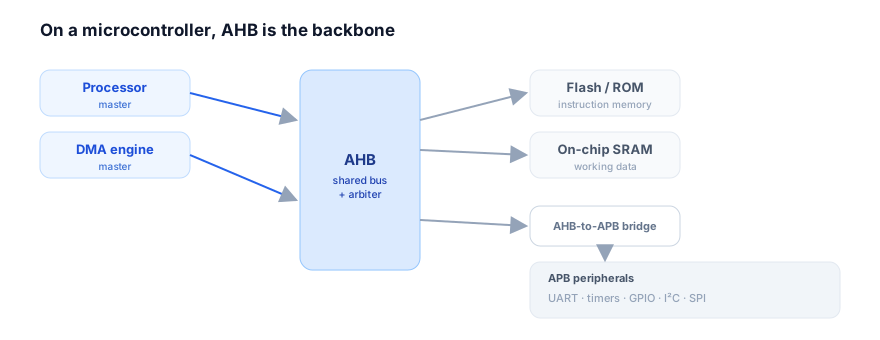
The physical reasoning behind that picture is concrete:
- The performance-critical slaves — on-chip flash holding instructions, SRAM holding working data — are placed directly on the AHB bus, in the fast clock domain, because every access to them is on the chip's critical path. A processor stalls when it waits for instructions; you do not put instruction memory behind a slow bridge.
- The slow peripherals are deliberately fenced off behind the AHB-to-APB bridge, frequently in a slower clock domain. This keeps their cheap, low-power logic from being dragged up to backbone speed, and keeps their occasional traffic out of the way of the performance-critical accesses.
- The arbiter and decoder sit on the AHB bus itself: the arbiter to grant the shared bus when the processor and DMA both want it, the decoder to route each access to the right slave. These are small, and their smallness is much of why AHB is cheap.
Seeing this on a die or a block diagram, you can read the design intent directly: anything on the AHB is performance-critical and worth the fast domain; anything behind the bridge is not. The placement of a block relative to the bridge tells you how the designer judged its importance — a genuinely useful thing to be able to read.
5. System Architecture Perspective
Zoom out to the whole chip and AHB's placement resolves into one of two architectural roles, depending on chip scale.
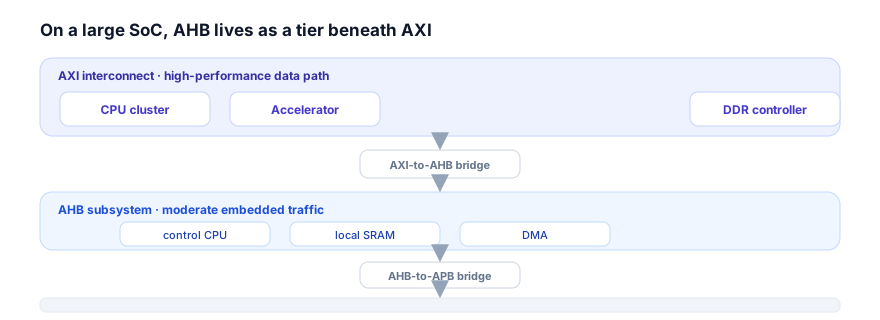
The two roles:
- Top-tier backbone (small chips). On a microcontroller there is no AXI; AHB is the highest-performance interconnect on the die. The entire system is organized around it: masters on the bus, fast memory on the bus, peripherals bridged below. This is AHB at its most prominent, and it is the most common AHB deployment by sheer chip count.
- Subordinate subsystem (large chips). On an application-class SoC, the main data path runs on AXI, and AHB appears as one or more self-contained subsystems hung off that fabric through bridges. A typical use is a control or "always-on" subsystem — a small management processor with its own local memory and peripherals — that does moderate work and does not belong on the expensive main fabric. AHB is the right bus for that island precisely because the island's traffic fits AHB's envelope, even though the chip as a whole needed AXI.
The architectural lesson generalizes the previous chapters' rule: match each region of the chip to the bus its traffic needs. A large chip is not "an AXI chip"; it is a chip with an AXI data path and AHB subsystems and APB peripherals, each placed where its traffic profile fits. AHB's home is the moderate-traffic region, wherever that region happens to sit in the hierarchy.
6. Engineering Tradeoffs
The placement decisions around AHB are themselves tradeoffs, and they recur in every embedded design.
- Put a slave on AHB, or bridge it to APB? Directly on AHB means fast access in the high-speed domain, at the cost of occupying the backbone and requiring AHB-capable logic. Behind an APB bridge means cheap, low-power, slow access, out of the backbone's way. The deciding question is whether the slave is on a performance-critical path. Instruction memory: on AHB. A status LED's control register: behind the bridge.
- Keep a subsystem on AHB, or promote it to AXI? On a growing chip, a subsystem that started as a comfortable AHB backbone can outgrow it as masters and bandwidth demands multiply. Staying on AHB keeps cost low but risks contention; promoting to AXI buys concurrency at real area and power cost. The deciding question is, again, concurrency: are masters now contending simultaneously, or is the traffic still essentially taking turns?
- One big AHB, or split buses? A single shared AHB is simplest, but if two groups of masters and slaves rarely talk to each other, splitting them onto separate buses (or a layered bus structure) reduces contention. This trades simplicity and area for reduced serialization — an early step on the road that, taken to its conclusion, becomes the multi-path concurrency of AXI.
The throughline across all three: placement is sizing. Every decision about where AHB goes, and what goes on AHB, is a judgment about whether the traffic fits AHB's moderate, mostly-single-threaded envelope. Get the sizing right and the chip is lean and fast where it matters; get it wrong and you either throttle the backbone or pay for capability nothing uses.
7. Industry Example
Make both placements concrete with two real chip shapes.
A motor-control microcontroller. This chip's job is to run a control loop and drive a motor. It has a single processor executing the control firmware from flash, an SRAM for working data, a DMA engine feeding a set of analog-to-digital converters, and peripherals — timers generating the drive waveforms, a serial port for telemetry, some GPIO. AHB is the backbone: processor and DMA are the masters, flash and SRAM are on the bus, and the timers, serial port, and GPIO sit on APB behind a bridge. There is no AXI anywhere — the traffic never demands concurrency, and adding a fabric would inflate the chip's cost for nothing. This is AHB as top-tier backbone, and it is the shape of an enormous fraction of all microcontrollers.
An application processor for a smart display. This chip has multiple CPU cores, a GPU, a video decoder, and an external DDR controller — heavy, simultaneous, latency-sensitive traffic that runs on an AXI fabric. But the same chip also has an always-on control subsystem: a small management processor that handles power sequencing, boot, and low-speed housekeeping while the big cores sleep. That subsystem has its own local SRAM and a few peripherals, and it runs on AHB, hung off the AXI fabric through a bridge, with its peripherals on APB below. Here AHB is a subordinate subsystem — small, cheap, perfectly sized for housekeeping traffic that would be absurd to run on the main fabric.
The two chips use AHB in structurally different positions, but for the same reason: in each, AHB is the right-sized bus for a region of moderate, mostly single-threaded traffic. That consistency of reasoning, across wildly different chips, is exactly what makes "where is AHB used?" answerable from first principles rather than from memorized examples.
8. Common Mistakes
9. Interview Insight
"Where would you actually use AHB?" is a favourite because it separates people who learned AHB as a spec from people who have seen it in chips.
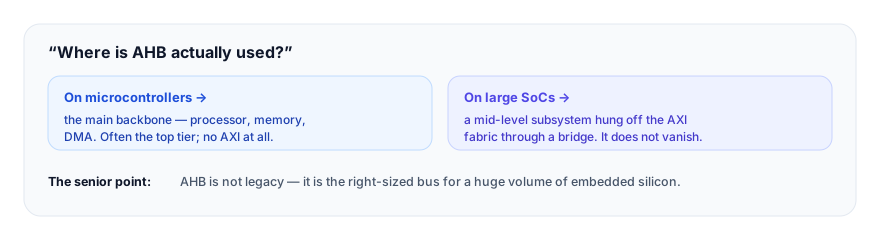
The answer that lands names both placements and the single reason behind them: "On a microcontroller, AHB is the backbone — processor, memory, and DMA on the bus, peripherals on APB below — and it is often the top tier with no AXI at all. On a large SoC, AHB shows up as a mid-level subsystem, like an always-on control island, hung off the AXI fabric through a bridge. In both cases it is there because the traffic is real but moderate and mostly single-threaded, which is exactly AHB's envelope." That structure — two placements, one reason — shows system-level fluency.
10. Practice Challenge
Work from the traffic-profile reasoning, not from memorized diagrams.
- Read a block diagram. Given a microcontroller diagram, identify every master on the AHB, every slave directly on it, and everything behind the APB bridge — and state, for two of the bridged peripherals, why they are not on AHB.
- Place the islands. For a large SoC with application cores, a GPU, a DDR controller, and an always-on management processor with local memory, say which blocks are on AXI and which form an AHB subsystem, and where the bridges go.
- Justify a placement. A reviewer asks why you put instruction flash directly on AHB but the telemetry UART behind an APB bridge. Answer in terms of performance-critical paths and clock domains.
- Spot the outgrown bus. Describe the symptoms of a shared AHB that has quietly accumulated too many masters, and explain why a faster clock would not fix it.
- One reason, two placements. In two sentences, state the single traffic-profile reason that puts AHB at the top of a microcontroller and in the middle of a large SoC.
11. Key Takeaways
- AHB has two canonical placements: the top-level backbone of a microcontroller-class chip, and a mid-level subsystem hung off the AXI fabric in a large SoC. Most real AHB is one of these two.
- One reason underlies both: AHB fits traffic that is real but moderate and mostly single-threaded, under tight area/power budgets — a cheap shared bus is the best match.
- Performance-critical blocks go on AHB; slow peripherals are bridged to APB, often in a slower clock domain. A block's position relative to the bridge encodes its judged importance.
- AHB is not legacy. The majority of chips by volume — microcontrollers — use it as their backbone today, and AXI-based chips embed AHB subsystems.
- Placement is sizing. Every decision about where AHB goes is a judgment about whether the traffic fits its envelope; mis-sizing either throttles the backbone or wastes silicon.
- Re-check the profile when adding masters. A shared AHB can be quietly outgrown; the fix for contention is structural, not a faster clock.
12. What Comes Next
You can now place AHB correctly in any chip and justify it from the traffic profile. The next chapter goes inward — from where AHB sits to how it actually behaves — building the two-phase pipelined shared-bus mental model that the rest of the curriculum's mechanics rest on:
- 1.5 — The AHB Mental Model (coming soon) — the shared-bus, arbitrated, two-phase pipelined model of AHB, still ahead of the signal detail.
To revisit the reasoning this placement rests on, see Why AHB Exists, The AMBA Family Overview, and AHB vs APB vs AXI. For how the high-performance tier above AHB works, see Why AXI Exists. For the broader protocol map, see the AMBA family overview.