AMBA APB · Module 11
Slave RTL Templates
Production-grade APB slave RTL templates that assemble the whole module — bank, decoder, read mux, write logic, PREADY and PSLVERR generation, and reset — into reusable, parameterised, lint-clean blocks, and the trade-offs between a minimal always-ready, a wait-capable registered, and a fully-registered variant.
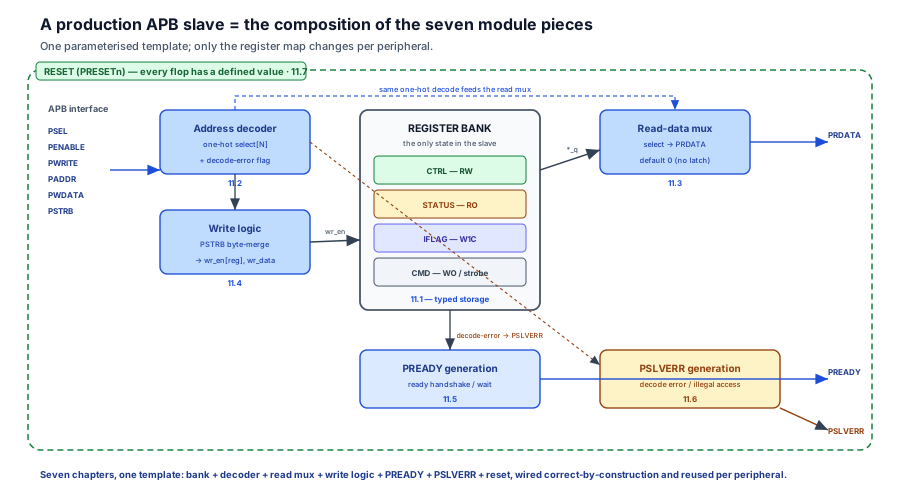
You did not build seven things in this module — you built one thing, seven times over. The register bank, the decoder, the read mux, the write logic, PREADY, PSLVERR, and reset are not independent peripherals; they are the seven sections of a single circuit: an APB slave. This closing chapter does the assembly. It takes those pieces and welds them into reusable, production-grade slave templates — RTL you can instantiate today, change one register map, and ship as a real peripheral. The single idea to carry: a correct APB slave is the composition of this module's seven pieces, and a good template makes that composition correct-by-construction and reusable across every peripheral in the SoC. The danger this chapter retires is the worst habit in RTL design — hand-copying a slave per peripheral and mis-wiring one of the seven pieces during the copy. A template replaces copy-paste with parameterisation: the structure is fixed and proven once; only the map changes.
1. Problem statement
The problem is turning seven verified sub-modules into one reusable peripheral skeleton — a template that integrates the bank, decoder, read mux, write logic, PREADY, PSLVERR, and reset so cleanly that instantiating a new peripheral is a matter of editing a register map, not re-deriving a slave.
Every SoC has dozens of APB peripherals — a UART, a timer, a GPIO block, a watchdog, a PWM, a mailbox — and every one of them is an APB slave with the same seven-part structure. The naive approach builds each from scratch (or copies the last one and edits it), which means the seven pieces get re-wired by hand dozens of times, and each copy is a fresh opportunity to mis-align PREADY with PRDATA, forget a reset value, or break the one-hot decode. The template's job is to make that impossible by construction. That forces three decisions:
- What is fixed, and what is parameterised. The structure — how the seven pieces wire together, the handshake timing, the no-latch read default, the reset discipline — must be fixed and proven once. The map — how many registers, at what offsets, of what kind, with what reset values — must be a parameter, because that is the only thing that legitimately differs between a UART and a timer.
- How many template variants you need. One template cannot serve every timing context. A slow, low-fanout APB segment is happy with a minimal always-ready slave; a fast bus near timing closure needs fully-registered outputs; a slave fronting a slow data source needs a wait-capable variant. The chapter must define a small set of variants and the rule for choosing among them.
- What makes a template production-grade rather than a sketch. Lint-clean (no latches, no inferred logic), defined defaults on every path, one-hot decode, a defined reset on every flop, registered or combinationally-defined outputs by policy, and a clear separation between the register bank and the bus glue — so the template survives synthesis, CDC sign-off, and reuse without surprises.
So the job is not "write one more slave" — it is to capture the invariant structure of an APB slave as a parameterised, lint-clean template, define the handful of variants that cover real timing contexts, and make every per-peripheral change a map edit.
2. Why previous knowledge is insufficient
You have built all seven pieces, and each is correct on its own. But a pile of correct sub-modules is not a slave — the value, and the remaining risk, is entirely in the composition:
- 11.1 Register-bank design gave you the typed storage — RW, RO, W1C, WO — and the discipline of separating storage from bus glue. But a bank is not a slave; it has no bus interface, no handshake, no error response.
- 11.2 Address decoder gave you the one-hot per-register select and the decode-error flag. But a decoder produces selects, not a working transfer.
- 11.3 Read-data mux gave you the combinational select onto
PRDATAwith a defined default. But a mux without a phase-alignedPREADYis exactly the stale-read trap this chapter's debug beat exposes. - 11.4 Write logic gave you
PSTRBbyte-merge and the access-phase commit. But write-enable timing only works relative to the handshake — it cannot be reasoned about in isolation fromPREADY. - 11.5 PREADY generation gave you the ready handshake and wait-state insertion. But ready timing is meaningful only when it is aligned with when the read mux and write commit actually happen.
- 11.6 PSLVERR generation gave you the error response for decode misses and illegal accesses. But the error flag must be wired to the decoder's miss output and qualified by the same handshake — composition again.
- 11.7 Slave reset behaviour gave you the defined power-on state. But reset is a property of every flop in the whole slave, which only exists once the pieces are assembled.
Notice the pattern: every piece's correctness depends on its phase relationship to the others. The decode feeds both the read mux and the write logic and PSLVERR. PREADY must agree with when PRDATA is valid and when the write commits. Reset must cover every flop across all seven pieces. None of that can be reasoned about one chapter at a time — it is an integration property. So the knowledge to add is not a new piece; it is the assembly rule that makes the seven pieces a single correct circuit, captured as a template so the assembly is done right once and reused everywhere.
3. Mental model
The model: an APB slave template is a printed circuit board with seven fixed footprints and one swappable component. The board layout — where the bank sits, how the decode traces run to the mux and the write logic and the error generator, how PREADY lines up with the data, how reset reaches every flop — is fixed, proven, and never re-drawn. The one swappable component is the register map: a parameter that says "this peripheral has these registers at these offsets, of these kinds, with these reset values." Building a new peripheral is populating the swappable slot, not re-laying the board. And because the board is proven, you cannot accidentally mis-route a trace during the swap — the very class of bug that hand-copying invites.
Three refinements make it precise:
- The structure is the invariant; the map is the variable. Everything that is the same across every APB slave — the seven-piece wiring, the handshake phase relationship, the no-latch read default, the reset-every-flop rule, the one-hot decode — lives in fixed template code. Everything that differs between peripherals — register count, offsets, kinds, reset constants, which bits are hardware-owned — lives in a parameter or a localised map block. If a per-peripheral change forces you to edit the structure, the template is leaking, and that is a smell to fix, not work around.
- Variants are about timing context, not about features. There is a small, fixed set of variants — a minimal always-ready slave (combinational
PREADY/PRDATA, lowest latency, for slow segments), a wait-capable slave (a tiny FSM and registered ready for a slow source), and a fully-registered slave (all outputs flopped, for timing closure on a fast bus). They differ only in where the flops sit and how ready is generated — the seven pieces and the map are identical. You pick a variant by the bus's timing situation, then drop in the same map. - Correct-by-construction beats correct-by-inspection. A template's whole point is that the dangerous integration choices —
PREADY/PRDATAphase alignment, the no-latch default on the read mux, the decode feeding both the mux and the error path, reset on every flop — are baked into the fixed structure, so a new instance is correct because it reused the proven assembly, not because a reviewer re-checked all seven phase relationships by eye. That is the difference between a template and a copy.
4. Real SoC implementation
Here is a complete, production-grade, parameterised APB slave template — the minimal always-ready variant — assembling all seven pieces. It is lint-conscious: no latches, defined defaults on every path, one-hot decode, registered storage with a defined reset, and a combinational but fully-defined PRDATA/PREADY/PSLVERR. Each section is commented with the chapter it comes from. To re-use it for another peripheral you change only the address map and the register declarations — nothing structural.
// =====================================================================
//  apb_slave_template  —  minimal always-ready variant (APB4)
//  Assembles the seven pieces of Module 11 into one reusable slave.
//  Per-peripheral, you change ONLY the address map + register block.
// =====================================================================
module apb_slave_template #(
  parameter int ADDR_W = 12,        // PADDR bits this slave decodes
  parameter int DATA_W = 32         // APB data width (APB is 32-bit)
)(
  input  logic                 pclk,
  input  logic                 presetn,
  // ---------------- APB4 subordinate interface ----------------
  input  logic                 psel,
  input  logic                 penable,
  input  logic                 pwrite,
  input  logic [ADDR_W-1:0]    paddr,
  input  logic [DATA_W-1:0]    pwdata,
  input  logic [DATA_W/8-1:0]  pstrb,
  output logic [DATA_W-1:0]    prdata,
  output logic                 pready,
  output logic                 pslverr,
  // ---------------- hardware-side ports (peripheral logic) ----
  input  logic [DATA_W-1:0]    hw_status, // RO value owned by hardware
  input  logic                 hw_event,  // sets the W1C interrupt flag
  output logic [DATA_W-1:0]    ctrl_o,    // RW control, consumed by hw
  output logic                 cmd_start  // WO strobe pulse to hardware
);
  // ------------------------------------------------------------------
  //  Address map  —  THE ONLY THING THAT CHANGES PER PERIPHERAL
  //  (word-aligned offsets; one-hot decode below, 11.2)
  // ------------------------------------------------------------------
  localparam logic [ADDR_W-1:0] OFF_CTRL   = 'h00; // RW   control
  localparam logic [ADDR_W-1:0] OFF_STATUS = 'h04; // RO   status (hw)
  localparam logic [ADDR_W-1:0] OFF_IFLAG  = 'h08; // W1C  interrupt flags
  localparam logic [ADDR_W-1:0] OFF_CMD    = 'h0C; // WO   command strobe

  // ------------------------------------------------------------------
  //  Access-phase qualifiers (11.5 PREADY / 11.4 write logic)
  //  Always-ready: the access phase is psel & penable. A committing
  //  read or write happens in exactly that cycle.
  // ------------------------------------------------------------------
  // These MUST be nets (or assign statements). Writing them as
  //     logic access = psel & penable;
  // is a variable declaration with an initialisation value: SystemVerilog
  // evaluates it ONCE at time zero and never again, so the qualifier freezes
  // at X and the slave silently does nothing. See the Debug Lab in beat 7.
  wire access   = psel &  penable;          // APB access phase
  wire do_write = access &  pwrite;         // committing write
  wire do_read  = access & ~pwrite;         // committing read (read mux below)

  // ------------------------------------------------------------------
  //  Address decoder (11.2)  —  one-hot register select + decode error.
  //  Word offset is paddr with the byte-lane bits masked off.
  // ------------------------------------------------------------------
  logic sel_ctrl, sel_status, sel_iflag, sel_cmd, decode_err;
  always_comb begin
    sel_ctrl   = 1'b0; sel_status = 1'b0;
    sel_iflag  = 1'b0; sel_cmd    = 1'b0;
    decode_err = 1'b0;
    if (psel) begin                          // only decode when selected
      unique case (paddr & ~('h3))           // word-align (drop [1:0])
        OFF_CTRL  : sel_ctrl   = 1'b1;
        OFF_STATUS: sel_status = 1'b1;
        OFF_IFLAG : sel_iflag  = 1'b1;
        OFF_CMD   : sel_cmd    = 1'b1;
        default   : decode_err = 1'b1;        // unmapped → PSLVERR (11.6)
      endcase
    end
  end

  // ------------------------------------------------------------------
  //  Write logic (11.4)  —  PSTRB byte-merge into a 32-bit write word.
  //  Only lanes whose strobe is set are updated; the rest hold.
  // ------------------------------------------------------------------
  function automatic logic [DATA_W-1:0] byte_merge
      (logic [DATA_W-1:0] old_v, logic [DATA_W-1:0] new_v,
       logic [DATA_W/8-1:0] strb);
    byte_merge = old_v;
    for (int b = 0; b < DATA_W/8; b++)
      if (strb[b]) byte_merge[b*8 +: 8] = new_v[b*8 +: 8];
  endfunction

  // ------------------------------------------------------------------
  //  Register bank (11.1)  —  the only state; reset on every flop (11.7)
  // ------------------------------------------------------------------
  logic [DATA_W-1:0] ctrl_q, status_q, iflag_q;

  // CTRL : RW, software-owned. byte-merged write commits in access phase.
  always_ff @(posedge pclk or negedge presetn)
    if (!presetn)                     ctrl_q <= '0;            // reset (11.7)
    else if (do_write && sel_ctrl)    ctrl_q <= byte_merge(ctrl_q, pwdata, pstrb);

  // STATUS : RO, hardware-owned. Software writes can never reach it.
  always_ff @(posedge pclk or negedge presetn)
    if (!presetn) status_q <= '0;
    else          status_q <= hw_status;                       // hw only

  // IFLAG : W1C, joint ownership — hardware-set beats software-clear.
  always_ff @(posedge pclk or negedge presetn)
    if (!presetn) iflag_q <= '0;
    else begin
      if (do_write && sel_iflag)
        iflag_q <= iflag_q & ~byte_merge('0, pwdata, pstrb);   // write-1-clear
      if (hw_event) iflag_q[0] <= 1'b1;                        // hw set wins
    end

  // CMD : WO strobe — a one-cycle pulse to hardware on a write; reads 0.
  always_ff @(posedge pclk or negedge presetn)
    if (!presetn) cmd_start <= 1'b0;
    else          cmd_start <= (do_write && sel_cmd);          // 1-cycle pulse

  assign ctrl_o = ctrl_q;

  // ------------------------------------------------------------------
  //  Read-data mux (11.3)  —  combinational, DEFINED DEFAULT (no latch).
  //  WO register reads back 0; everything else returns its stored value.
  // ------------------------------------------------------------------
  always_comb begin
    prdata = '0;                              // default 0 → no inferred latch
    if (do_read) begin
      unique case (1'b1)
        sel_ctrl  : prdata = ctrl_q;
        sel_status: prdata = status_q;
        sel_iflag : prdata = iflag_q;
        sel_cmd   : prdata = '0;              // WO reads as 0
        default   : prdata = '0;              // unmapped read → 0
      endcase
    end
  end

  // ------------------------------------------------------------------
  //  PREADY generation (11.5)  —  always-ready: complete every access in
  //  one cycle. Tied to the access phase so the master never stalls.
  // ------------------------------------------------------------------
  assign pready = 1'b1;                        // single-cycle slave

  // ------------------------------------------------------------------
  //  PSLVERR generation (11.6)  —  flagged ONLY in the access phase and
  //  only for an unmapped offset (decode miss). Defined low otherwise.
  // ------------------------------------------------------------------
  assign pslverr = access & decode_err;       // qualified by the handshake
endmodule
Three facts make this a template and not just a slave. First, the only per-peripheral edit is the map — the four localparam offsets and the four register declarations. The decode, the byte-merge, the handshake, the read default, and the reset discipline are structural and never touched, which is the whole point: a UART instance and a timer instance differ by their map and nothing else. Second, PREADY and PRDATA are phase-aligned by construction — PREADY is tied high because PRDATA is combinational from the selected register in the same access phase; there is no flop between them to fall out of sync (the exact bug the copy-paste workflow invites, dissected in beat 7). Third, every output is defined on every path — prdata defaults to '0, pslverr is qualified by access, the read mux uses unique case with a default, and every flop has a reset value, so the design is lint-clean with no latches and no Xs. The wait-capable and fully-registered variants change only PREADY/PRDATA timing (a small FSM and a registered ready, or a flopped prdata/pready stage) — the seven pieces and the map are unchanged.
5. Engineering tradeoffs
The template is not one design — it is a small family, and you pick the variant by the bus's timing context. All three integrate the same seven pieces and the same map; they differ only in where the flops sit and how PREADY is generated.
| Variant | Read latency | Timing closure | Area | Complexity | When to use |
|---|---|---|---|---|---|
Minimal always-ready (combinational PREADY/PRDATA, PREADY=1) | Lowest — 0 wait states; access completes in the access phase | Hardest — PRDATA and PSLVERR are combinational from the bank through the read mux; long path on a fast bus | Smallest — no extra flops | Lowest — one mux, no FSM | Slow/low-fanout APB segment, small register count, relaxed timing — the default for most peripherals |
Wait-capable registered (small FSM, registered PREADY, inserts wait states) | Higher — one or more wait cycles for a slow source | Moderate — registered ready breaks the combinational ready path; data may still be combinational | Moderate — a few FSM flops + ready register | Moderate — a 2–3 state FSM and its assertions | Slave fronting a slow data source (a shared RAM, an external bridge, a clock-crossing FIFO) that genuinely cannot answer in one cycle |
Fully-registered (all outputs flopped: PRDATA, PREADY, PSLVERR) | Higher — read returns one cycle later; PREADY registered to match | Easiest — every output leaves a flop, so the slave-to-master path is a register-to-register hop | Largest — output register stage on every signal | Highest — must keep registered PREADY and registered PRDATA phase-aligned, the very thing that breaks if mis-wired | Fast APB bus or a slave far from the master where the combinational output path fails timing; timing-closure-driven |
The throughline: you do not choose a variant on preference — you choose it on the bus's timing situation, and you keep the map identical across the choice. Start with the minimal always-ready variant (lowest latency, smallest, simplest) and escalate only when forced: to wait-capable when a source is genuinely slow, to fully-registered when synthesis fails the combinational output path. The cost of escalating is always latency (and, for fully-registered, the discipline of keeping a registered PREADY aligned with a registered PRDATA) — which is exactly why "more registered" is not "more correct," only "easier to close." The template family makes the escalation a swap of the ready/data stage, not a rewrite of the slave.
6. Common RTL mistakes
7. Debugging scenario
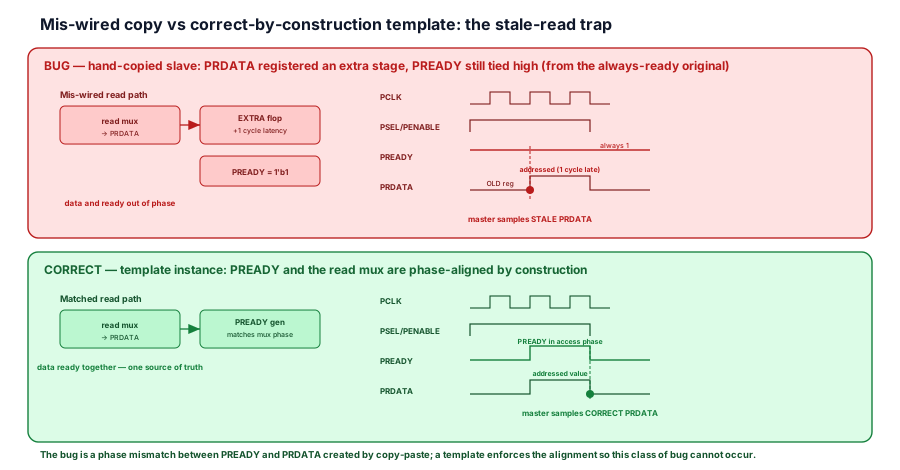
The signature template bug is a slave that returns stale read data, caused not by any one of the seven pieces being wrong but by two of them being mis-aligned during a hand-copy — PRDATA was registered an extra stage when the design was copied from a pipelined peripheral, but PREADY was left tied high as in the always-ready original, so ready asserts a cycle before the data is valid. It is precisely the class of bug a correct-by-construction template prevents.
- A second signature bug, one keyword wide: declaring the access qualifiers with
logic x = expr;instead ofwire x = expr;makes them one-time initialisations rather than continuous assignments, so they freeze at X and the slave accepts every transfer while doing nothing at all (beat 7b). - Observed symptom: software reads a register immediately after writing it and gets the old value; or a status register read returns the value of the previous read's address. The slave passes a single isolated read in directed simulation but fails back-to-back reads and fails on hardware intermittently — the data is always exactly one cycle late.
- Waveform clue: on the APB,
PREADYasserts in the access phase (PSEL & PENABLE) as it should, butPRDATAat that sampling edge still holds the previous register's value; the correctly-addressed value appears onPRDATAone cycle after the master has already latched the read.PREADYandPRDATAare one cycle out of phase. - Root cause: during a copy-paste from a pipelined slave, an extra output flop was left on the
PRDATApath (adding a cycle of latency) whilePREADYwas kept tied high from the always-ready source. The two pieces — read-data path (11.3) and ready generation (11.5) — disagree on which cycle the read completes. Neither piece is individually wrong; their composition is. This is the integration property that no single-chapter review catches, and the exact failure a fixed template structure makes impossible. - Correct RTL: make
PREADYandPRDATAagree on the completion cycle. In the always-ready variant, keepPRDATAcombinational so it is valid the same cyclePREADYis high:assign pready = 1'b1; always_comb prdata = sel_ctrl ? ctrl_q : '0; /* etc */. In the fully-registered variant, registerPREADYto match the registeredPRDATAso both advance together — never one flopped and the other not. The template enforces this by tying the two generations to the same phase by construction, so an instance cannot split them. - Verification assertion: assert that whenever the slave completes a read,
PRDATAequals the addressed register —assert property (@(posedge pclk) disable iff(!presetn) (psel && penable && pready && !pwrite && sel_ctrl) |-> (prdata == ctrl_q));(and one per mapped register). A stale-read bug fails this on the completing edge becauseprdatastill holds the previous value. A protocol-monitor variant assertsPRDATAis stable whilePREADYis low and valid the cyclePREADYrises. - Debug habit: when reads are exactly one cycle stale, do not hunt inside the read mux — check the phase relationship between
PREADYandPRDATAfirst. Count the flops on thePRDATApath and confirmPREADYwas registered the same number of times. The moment you find a registered data path with an unregistered (or differently-registered) ready, you have it — and the fix is to re-align the two, which is exactly what instantiating the template instead of copying would have guaranteed.
7b. The bug this page used to contain
The template above previously declared its access qualifiers like this:
logic access   = psel &  penable;      // ✗
logic do_write = access &  pwrite;     // ✗
logic do_read  = access & ~pwrite;     // ✗
That is not a continuous assignment. It is a variable declaration with an
initialisation value, which SystemVerilog evaluates exactly once, before time
zero, and never again. access is not a function of psel and penable; it is
a variable that was set once and then left alone for the rest of the simulation.
The slave elaborated, simulated, and did nothing at all
DECL-INIT-NOT-CONTINUOUS-ASSIGNA freshly integrated APB peripheral was completely inert. Every register read
back its reset value, writes had no effect, the command strobe never pulsed, and
the interrupt flag never set. PREADY was high and PSLVERR was low, so from
the bus's point of view every access completed successfully — the transfers were
being accepted and acknowledged, they simply had no effect on anything.
There were no compile errors, no elaboration warnings, and no lint violations.
module apb_slave_template #(...) (...);
  logic access   = psel &  penable;
  logic do_write = access &  pwrite;
  logic do_read  = access & ~pwrite;

  always_ff @(posedge pclk or negedge presetn)
    if (!presetn)                  ctrl_q <= '0;
    else if (do_write && sel_ctrl) ctrl_q <= byte_merge(ctrl_q, pwdata, pstrb);
  ...
endmoduleProbing the internal qualifiers rather than the bus settled it in one look:
  pclk    ___|‾‾‾|___|‾‾‾|___|‾‾‾|___
  psel    ______|‾‾‾‾‾‾‾‾‾‾‾‾‾|______
  penable ____________|‾‾‾‾‾‾‾|______
  access  xxxxxxxxxxxxxxxxxxxxxxxxxxx     <-- never changes, never resolves
  do_write xxxxxxxxxxxxxxxxxxxxxxxxxx
access was X for the entire run and never transitioned, including during the
access phase where psel and penable were plainly both high. A signal that
ignores its inputs completely is not a logic bug — it means nothing is driving
it. Searching for a driver found only the declaration.
The X is the second half of the explanation. The initialiser is evaluated before
time zero, when psel and penable are still uninitialised, so access
initialises to X. Every downstream qualifier is then X, and if (do_write && ...)
is never taken because X is not true — hence a slave that accepts transfers and
does nothing, rather than one that misbehaves visibly.
logic declares a variable. A variable declaration with an assignment is a
one-time initialisation, equivalent in effect to writing the value in an
initial block. wire declares a net, and a net declaration with an
assignment is a continuous assignment, re-evaluated whenever any operand
changes.
The two forms are one keyword apart and look identical at a glance, which is what makes this survive review. It is also why the failure mode is silence rather than noise: the code is legal, so no tool is obliged to say anything. Some linters flag a variable that is initialised and never subsequently assigned, but the rule is not on by default in every ruleset, and this design would have shipped without it.
Note that the design is not merely wrong in simulation — it is inconsistent. Synthesis has no notion of a time-zero initialiser for a signal with no other driver, so tools variously infer a constant, tie the signal off, or reject the design. A netlist that disagrees with the RTL simulation is the worst outcome available, and this construct invites it.
// A net declaration with an assignment IS a continuous assignment.
wire access   = psel &  penable;
wire do_write = access &  pwrite;
wire do_read  = access & ~pwrite;

// Equivalent, if you prefer to keep the variable type:
logic access;
assign access = psel & penable;
Verifying the fix does not need a clever test — it needs any test at all that
checks an effect rather than a handshake. The reason this reached integration is
that the peripheral's own bring-up test drove APB transfers and checked that
PREADY came back, which it did. The self-checking testbench in the next section
writes a value and reads it back, and that single check fails immediately against
the broken RTL.
The durable guard is a lint rule rather than a test: forbid a logic declaration
whose only assignment is its initialiser. It is a cheap rule, it has essentially
no false positives in synthesisable RTL, and it catches the entire class rather
than this instance.
7c. The testbench that catches it
module apb_slave_tb;
  localparam int AW = 12, DW = 32;

  logic pclk = 0, presetn = 0;
  logic psel = 0, penable = 0, pwrite = 0;
  logic [AW-1:0]   paddr  = '0;
  logic [DW-1:0]   pwdata = '0;
  logic [DW/8-1:0] pstrb  = '1;
  logic [DW-1:0]   prdata;
  logic            pready, pslverr;
  logic [DW-1:0]   hw_status = 32'hCAFE_0000;
  logic            hw_event  = 0;
  logic [DW-1:0]   ctrl_o;
  logic            cmd_start;

  apb_slave_template #(.ADDR_W(AW), .DATA_W(DW)) dut (.*);

  always #5 pclk = ~pclk;

  // A complete APB transfer: IDLE -> SETUP -> ACCESS, held until PREADY.
  task automatic apb_xfer (input bit               write,
                           input logic [AW-1:0]    addr,
                           input logic [DW-1:0]    wdata,
                           output logic [DW-1:0]   rdata,
                           output logic            err);
    @(negedge pclk);
    psel = 1; penable = 0; pwrite = write; paddr = addr; pwdata = wdata;  // SETUP
    @(negedge pclk);
    penable = 1;                                                          // ACCESS
    // The transfer completes on the cycle where PSEL && PENABLE && PREADY.
    // PRDATA and PSLVERR are only meaningful on that cycle.
    do @(posedge pclk); while (!pready);
    rdata = prdata; err = pslverr;
    @(negedge pclk);
    psel = 0; penable = 0;                                                // back to IDLE
  endtask

  logic [DW-1:0] rd; logic er; int fails = 0;

  task automatic expect_eq (input string what,
                            input logic [DW:0] got, exp);
    if (got !== exp) begin
      $error("%s: got %h, expected %h", what, got, exp);
      fails++;
    end else $display("PASS %s = %h", what, got);
  endtask

  initial begin
    repeat (2) @(negedge pclk); presetn = 1;

    // 1. CTRL is read-write. This single check fails against the broken RTL,
    //    because the write never commits and CTRL reads back its reset value.
    apb_xfer(1, 'h00, 32'hA5A5_1234, rd, er);
    apb_xfer(0, 'h00, '0,            rd, er);
    expect_eq("CTRL write/read-back", rd, 32'hA5A5_1234);

    // 2. STATUS is hardware-owned; a software write must not change it.
    apb_xfer(1, 'h04, 32'hFFFF_FFFF, rd, er);
    apb_xfer(0, 'h04, '0,            rd, er);
    expect_eq("STATUS is read-only", rd, hw_status);

    // 3. W1C: a hardware event sets the flag, writing a one clears it.
    @(negedge pclk) hw_event = 1; @(negedge pclk) hw_event = 0;
    apb_xfer(0, 'h08, '0, rd, er);
    expect_eq("IFLAG set by hardware", rd[0], 1'b1);
    apb_xfer(1, 'h08, 32'h0000_0001, rd, er);
    apb_xfer(0, 'h08, '0,            rd, er);
    expect_eq("IFLAG cleared by write-one", rd[0], 1'b0);

    // 4. Byte strobes: only the enabled lanes are updated.
    apb_xfer(1, 'h00, 32'h0000_0000, rd, er);
    pstrb = 4'b0010;
    apb_xfer(1, 'h00, 32'hFFFF_FFFF, rd, er);
    pstrb = 4'b1111;
    apb_xfer(0, 'h00, '0, rd, er);
    expect_eq("PSTRB updates only lane 1", rd, 32'h0000_FF00);

    // 5. An unmapped offset raises PSLVERR on the completing cycle.
    apb_xfer(0, 'h40, '0, rd, er);
    expect_eq("unmapped read asserts PSLVERR", er, 1'b1);

    // 6. The command strobe is exactly one cycle wide.
    fork
      begin : watch
        int high = 0;
        repeat (6) begin @(posedge pclk); if (cmd_start) high++; end
        expect_eq("CMD strobe is one cycle", high[0+:1] & (high == 1), 1'b1);
      end
      apb_xfer(1, 'h0C, 32'h1, rd, er);
    join

    if (fails == 0) $display("All APB slave checks passed.");
    else            $fatal(1, "%0d check(s) failed", fails);
    $finish;
  end
endmodule
Check 1 is the whole argument for having a testbench at all. A write followed by
a read-back is the most obvious thing anyone would test, it takes four lines, and
it fails instantly against RTL whose access qualifiers never resolve. The
peripheral reached integration because its bring-up test checked that PREADY
came back rather than checking that anything happened.
7d. Protocol assertions
module apb_slave_sva #(parameter int AW = 12, DW = 32) (
  input logic pclk, presetn,
  input logic psel, penable, pwrite, pready, pslverr,
  input logic [AW-1:0]   paddr,
  input logic [DW-1:0]   pwdata, prdata
);
  // SETUP is exactly one cycle: PSEL without PENABLE always advances to ACCESS.
  a_setup_one_cycle: assert property (@(posedge pclk) disable iff (!presetn)
    (psel && !penable) |=> (psel && penable));

  // ACCESS persists until PREADY - the manager cannot abort mid-transfer.
  a_access_holds: assert property (@(posedge pclk) disable iff (!presetn)
    (psel && penable && !pready) |=> (psel && penable));

  // PENABLE drops after every completed access, so back-to-back transfers get
  // their own SETUP cycle rather than running ACCESS into ACCESS.
  a_penable_drops: assert property (@(posedge pclk) disable iff (!presetn)
    (psel && penable && pready) |=> !penable);

  // Address, direction and write data are stable for the whole transfer.
  a_stable: assert property (@(posedge pclk) disable iff (!presetn)
    (psel && !(penable && pready)) |=>
      $stable(paddr) && $stable(pwrite) && $stable(pwdata));

  // PSLVERR is only meaningful on the completing cycle; it must be low
  // whenever the slave is not completing a transfer.
  a_pslverr_qualified: assert property (@(posedge pclk) disable iff (!presetn)
    !(psel && penable && pready) |-> !pslverr);

  // Coverage - a pass means nothing if these are zero.
  c_write:   cover property (@(posedge pclk) psel && penable && pready &&  pwrite);
  c_read:    cover property (@(posedge pclk) psel && penable && pready && !pwrite);
  c_err:     cover property (@(posedge pclk) psel && penable && pready && pslverr);
  c_b2b:     cover property (@(posedge pclk)
               (psel && penable && pready) ##1 (psel && !penable));
endmodule
8. Verification perspective
A template's verification is itself reusable — you verify the structure once against the seven-piece contract, then verify each instance against its map. The leverage of a template is that the testbench, the protocol monitor, and the assertion set are written once and ride along with every peripheral.
- Build one reusable slave testbench, parameterise it by the map. The same environment — APB driver, protocol monitor, RAL model, scoreboard — serves every instance; only the RAL register model (offsets, kinds, reset values, access policy) changes per peripheral, mirroring the RTL's "only the map changes." A UVM RAL
built-insequence (reset-value, bit-bash, access) then exercises every register's kind contract automatically, so per-instance verification is configuration, not new code. - A protocol monitor enforces the integration properties the template guarantees. Bind an APB protocol checker that asserts
PREADY/PRDATAphase alignment,PRDATAstability whilePREADYis low,PSLVERRonly in the access phase, noXonPRDATAwhen selected, andPENABLE/PSELlegality. These are exactly the cross-piece properties a hand-copy breaks — so the monitor is the automated guardian of correct-by-construction, run on every instance. - Coverage is per-variant, not one-size-fits-all. The always-ready variant covers single-cycle read/write of every register, the decode-error access, and reset values. The wait-capable variant additionally covers every wait-state count and the FSM's states/transitions. The fully-registered variant covers the back-to-back read pipeline where the registered
PREADY/PRDATAalignment is stressed. Reuse the base coverage and add only the variant-specific bins. - Lint and CDC sign-off are part of "done," and reusable. Lint the template once for no latches, no inferred logic, full-case/parallel-case on the decode and read mux, and defined resets — properties that hold for every instance because the structure is shared. If the slave bridges clock domains (a fast core to a slow APB, or a wait-capable slave fronting a CDC FIFO), the reset and the data-path synchronisers get a CDC review; a registered-output variant on a crossing simplifies that sign-off.
The point: verify the template's structure once and reuse the whole environment per instance. The reusable testbench, protocol monitor, RAL model, per-variant coverage, and lint/CDC sign-off are the verification analogue of the template itself — the assembly is proven once, and every peripheral inherits it by changing only its map.
9. Interview discussion
"Walk me through how you would structure a reusable APB slave you could drop into any peripheral" is a strong senior-level question because a weak answer describes one slave while a strong one shows you think in invariant structure plus a parameterised map, with variants for timing context.
Lead with the architecture: an APB slave is the composition of seven pieces — register bank, address decoder, read mux, write logic, PREADY, PSLVERR, and reset — and a template fixes that composition once so the only per-peripheral change is the register map. Then show the integration insight that separates senior answers: the pieces' correctness is a phase relationship, not a per-piece property — the decode feeds the mux, the write logic, and the error path; PREADY must agree with when PRDATA is valid and when the write commits; reset must cover every flop. That is why you template the structure rather than copy a slave — copying re-wires those relationships by hand and invites the stale-read bug where a registered PRDATA and a tied-high PREADY fall out of phase. Deliver the variant judgment: a minimal always-ready slave for slow segments (lowest latency, hardest to close), a wait-capable variant for a genuinely slow source, and a fully-registered variant for timing closure on a fast bus — same seven pieces, same map, different ready/data staging — and you escalate only when forced, because more registering costs latency, not correctness. Close with production discipline — lint-clean, no latches, one-hot decode, defined defaults, reset on every flop, and a reusable testbench/RAL/monitor that verifies the structure once and every instance by its map. Mentioning that "the bug a template prevents is the one where two correct pieces are mis-aligned during a copy" signals you have actually shipped peripherals this way.
10. Practice
- Spot the variable. Given the template in beat 4, list every line you would edit to retarget it from this generic peripheral to a 4-register GPIO block — and confirm none of them are structural.
- Choose the variant. For (a) a watchdog on a slow APB segment, (b) a slave fronting a shared dual-port RAM, and (c) a high-fanout slave on a fast APB bus failing the
PRDATAoutput path, pick the template variant and justify it on latency vs timing closure. - Add a wait state. Convert the always-ready variant into the wait-capable variant: write the 2–3 state FSM and the registered
PREADYthat inserts exactly one wait cycle, keepingPRDATAvalid the cyclePREADYrises. - Register the outputs. Convert the always-ready variant into the fully-registered variant — flop
PRDATA,PREADY, andPSLVERR— and state the new read latency and the one alignment invariant you must preserve. - Break it on purpose. Introduce the beat-7 bug (extra
PRDATAflop,PREADYstill tied high), predict the exact waveform on a back-to-back read, and write the assertion that catches it.
11. Q&A
11b. Where This Is Specified
- Arm AMBA APB Protocol Specification (ARM IHI 0024). The IDLE → SETUP → ACCESS transfer model;
PSELasserted in SETUP withPENABLElow for exactly one cycle;PENABLEasserted throughout ACCESS; the transfer completing only whenPSEL && PENABLE && PREADY; andPRDATAandPSLVERRbeing valid only on that completing cycle. APB4 addsPSTRBwrite strobes andPPROT. - IEEE 1800-2023 §6.7 — Net declarations. A net declaration assignment is a continuous assignment, re-evaluated whenever an operand changes.
- IEEE 1800-2023 §6.8 — Variable declarations. A variable declaration assignment sets the variable once, before time zero — the distinction the Debug Lab above turns on.
- IEEE 1800-2023 §12.5.3 and §11.4.14 —
unique caseviolation reporting, and theinside/case-equality semantics used by the address decoder.
12. Key takeaways
- A production APB slave is the composition of this module's seven pieces — register bank, address decoder, read mux, write logic,
PREADY,PSLVERR, and reset — and a template captures that composition once so it is correct-by-construction and reusable across every peripheral. - Fix the structure; parameterise the map. The seven-piece wiring, handshake phase alignment, no-latch read default, one-hot decode, and reset-every-flop rule are invariant; register count, offsets, kinds, and reset values are the only legitimate per-peripheral change. If an instance forces a structural edit, the template is leaking.
- The danger a template retires is hand-copying. Copying re-wires the pieces and invites the stale-read bug where two individually-correct pieces — a registered
PRDATAand a tied-highPREADY— fall out of phase. A template makes that mis-alignment impossible in the swap. - There is a small variant family chosen by timing context, not preference — minimal always-ready (lowest latency), wait-capable (slow source), fully-registered (timing closure) — same seven pieces and same map, different ready/data staging. Escalate only when forced, because more registering costs latency, not correctness.
- A template does not skip verification — it makes verification reusable. Verify the structure once with a parameterised testbench, protocol monitor, RAL model, per-variant coverage, and lint/CDC sign-off; verify each instance against its map (offsets, kinds, reset values, propagated widths), which the structural proof never saw.
- Every output defined on every path —
PRDATAzero default,PSLVERRqualified by the access phase,unique casewith a default, reset on every flop — is what makes the template lint-clean, latch-free, and safe to drop into any peripheral.