AMBA APB · Module 6
PRDATA Timing
When PRDATA must be valid and who drives it — the subordinate's read-mux drive responsibility, the completion-edge valid window, and why PRDATA is don't-care before completion, including during wait cycles.
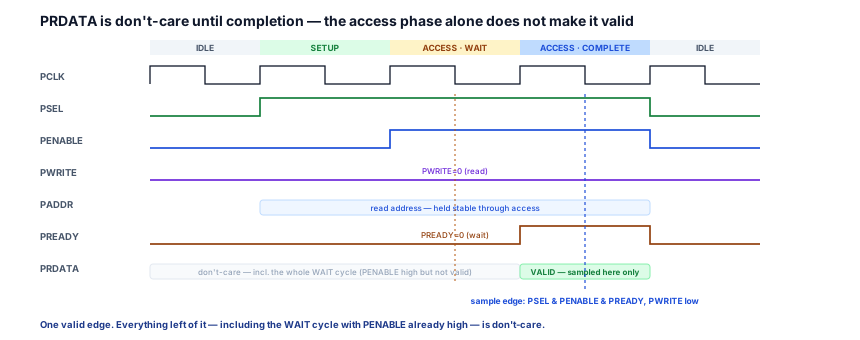
A read returns a value, but the value is only real for one edge — and the whole skill of building or debugging a read is knowing exactly which edge, what the bus carries before it, and who is on the hook to drive it. This chapter pins the timing of PRDATA down to the cycle: it is don't-care through IDLE, SETUP, and every wait cycle, and is required valid only on the completion edge where PSEL, PENABLE, and PREADY are all high with PWRITE low. The single idea to carry: PRDATA validity is gated by the handshake, not by the access phase — PENABLE going high does not make it valid — and the subordinate carries the timing obligation to have its read mux settled by that one edge.
1. What problem is being solved?
The problem is placing the read value on the bus on exactly the cycle the manager will sample it, and not requiring it a cycle sooner or trusting it a cycle later — so that a combinational read path, a wait state, and an undriven idle bus all coexist without ever handing the manager a wrong or undefined value.
A read value is a moving target in time. The address has to decode, the read mux has to settle, and — if the source is slow — the data may genuinely not exist yet for a cycle or two. APB resolves all of that with a single timing law:
PRDATAis required valid on exactly one edge: the completion edge, whereread_commit = PSEL & PENABLE & PREADY & ~PWRITEis high.- Everywhere before that edge — IDLE, SETUP, and every wait cycle —
PRDATAis don't-care, and the manager must not sample it.
That single-edge law is what lets the subordinate drive PRDATA from a plain combinational mux and still be correct: it only has to be settled by the completion edge, not before. The manager's job is the mirror image — sample on that edge and ignore the bus otherwise.
2. Why the previous model is not enough
Module 3 — the PRDATA signal introduced PRDATA as the subordinate-driven read bus and gave you its valid-when-PREADY rule: read data is valid on the completion cycle and don't-care otherwise. That is the correct rule of thumb. But a rule of thumb is not a timing contract, and to drive PRDATA in real RTL or to place a sampling assertion you need three things that the signal page deliberately left at the level of "valid at completion":
- The exact valid edge, expressed as a commit term, not a phase. Validity is not "during access" — it is the single edge where
PSEL & PENABLE & PREADY & ~PWRITEholds. This chapter pins it to that boolean so you can wire it. - The don't-care window made explicit through the wait cycles. The trap the role-level view hides is the wait state:
PENABLEis already high there, yetPRDATAis still don't-care becausePREADYis low. Module 3 stated this; here it is the centre of gravity. - The subordinate's timing obligation, not just its ownership. Module 3 told you the subordinate drives
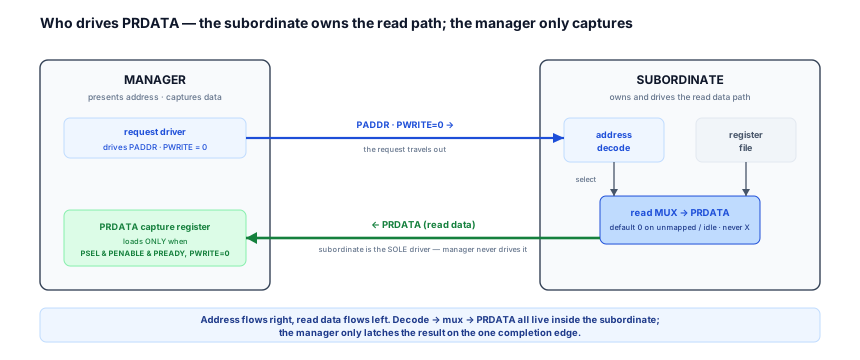
PRDATA. This chapter states the harder half: the subordinate must have its read mux settled by the completion edge off the heldPADDR, and must drive a clean default so the bus is neverXon any other cycle.
So the model this chapter adds is not "PRDATA is the read bus" — you have that. It is the edge-precise drive-and-sample contract: the exact valid edge, the don't-care window that swallows the wait cycles, and the subordinate's obligation to be settled by that edge.
3. Mental model
The model: PRDATA is a stage cue, not a standing line. The actor (the subordinate) must be in position and speaking the right line at exactly the moment the spotlight (the completion edge) hits — but before that cue, whatever is on stage is rehearsal, and the audience (the manager) is told plainly to look away until the light comes up.
The light comes up on exactly one edge: PSEL, PENABLE, and PREADY all high, PWRITE low. Walk the timeline against PCLK:
- Through IDLE and SETUP, the spotlight is off.
PRDATAis don't-care; the manager does not look. - Through every wait cycle (
PENABLEhigh butPREADYlow), the spotlight is still off. This is the cycle people misread: access has started, but the cue has not landed, soPRDATAremains don't-care. The subordinate is allowed to be mid-fetch. - On the completion edge (
PREADYfinally high), the light comes up.PRDATAis required valid; the manager samples it here and only here.
Two refinements make the timing precise:
- The cue is gated by the handshake, not the phase.
PENABLEhigh marks the access phase;PREADYhigh marks the completion edge.PRDATAfollows the edge. TrustingPENABLEalone samples a cycle early on any wait read. - The actor must be in position by the cue, not before. Because
PADDRis held stable from SETUP through completion, the subordinate's combinational read mux settles during access and is guaranteed correct by the completion edge — that is its timing obligation, and a settled mux is all it takes.
4. Real SoC / hardware context
In silicon, PRDATA timing is the meeting of two clocks of responsibility. The subordinate runs a combinational read path — decode the held PADDR, select the register, drive the bus — that must be settled by the completion edge. The manager runs a single registered load that fires on exactly the completion edge and is otherwise blind to the bus. The contract lives in the gap between them, and the don't-care window is what makes that gap cheap: because nothing requires PRDATA before completion, the subordinate may take wait cycles, and the bus may sit at its default, with no violation.
// Subordinate read path: PRDATA must be SETTLED by the completion edge.
// PADDR is held stable from setup through completion, so this combinational
// mux settles during the access phase and is correct by the time PREADY rises.
always_comb begin
  prdata = '0;                       // clean default: idle/unmapped never X
  case (paddr)
    ADDR_STATUS: prdata = status_q;
    ADDR_COUNT:  prdata = count_q;
    ADDR_ID:     prdata = ID_CONST;
    default:     prdata = '0;        // unmapped read returns 0, deterministic
  endcase
end

// The read VALID edge, as a single commit term (manager samples here only):
wire read_commit = psel & penable & pready & ~pwrite;

// PRDATA is REQUIRED valid only when read_commit is high. Before it — IDLE,
// SETUP, and every wait cycle (penable high but pready low) — PRDATA is
// don't-care. Optional check that the subordinate is settled at the edge:
// assert property (@(posedge pclk) read_commit |-> !$isunknown(prdata));
Two facts make the timing robust. First, the don't-care window is load-bearing, not slack: it is precisely what lets a slow source hold PREADY low and finish the read late — the subordinate presents valid PRDATA only when its source is ready, and the cycles before are legitimately don't-care, not a violation. Second, the manager's capture must be gated on read_commit, not on PENABLE: gate it on the phase and the very first wait read samples a cycle early and latches the don't-care value. (How the wait cycles are sequenced is the PREADY interaction on reads; this chapter is only about where on the timeline PRDATA is real.)
5. Engineering tradeoff table
Pinning PRDATA validity to one edge with a wide don't-care window is a deliberate timing choice. Each property trades a capability APB does not need for the simplicity it does.
| PRDATA timing property | What it gives up | What it buys | Why it is correct for APB |
|---|---|---|---|
| Valid only on the completion edge | A continuously-trusted read value | One unambiguous sample edge | The mux settles over access; the manager loads once |
| Don't-care through every wait cycle | A value the instant PENABLE rises | Reads from any-speed source on one bus | Slow sources hold PREADY low and finish late, legally |
| Subordinate settled by the edge (not before) | An early-presented / pre-staged value | A trivial combinational read mux | PADDR held stable → mux is correct by completion |
| Gated by handshake, not by phase | Sampling on PENABLE alone | Wait reads are correct without manager rework | PREADY distinguishes the edge from the phase |
| Clean default (0) on idle/unmapped | A "no data" encoding on the bus | PRDATA is never X off the valid edge | Undefined reads become deterministic and debuggable |
The throughline: PRDATA is valid for one edge and don't-care everywhere else, and that single-edge contract is exactly what lets the subordinate stay a settled combinational mux and the manager stay a single gated load — while the don't-care window absorbs any read latency the source needs.
6. Common RTL / waveform mistakes
7. Interview framing
"On which exact edge is PRDATA valid, and what is it during a wait cycle?" separates an engineer who can place a read sample from one who only knows the role. A weak answer says "valid at completion"; a strong one pins the edge and nails the wait cycle.
Lead with the edge as a term, not a phase: PRDATA is required valid only on the completion edge — PSEL & PENABLE & PREADY & ~PWRITE — and is don't-care everywhere before it. Then deliver the discriminating point, the wait cycle: during a wait, PENABLE is high but PREADY is low, so PRDATA is still don't-care — which is exactly why the manager must gate its capture on PREADY, not on PENABLE. Close with the subordinate's obligation: the subordinate must have its read mux settled by that edge off the held PADDR, and drive a clean default so the bus is never X otherwise. Volunteering "the don't-care window during the wait is what lets a slow source finish the read late and still be legal" signals you understand the timing as a contract, not a waveform you memorised.
8. Q&A
9. Practice
- Pin the edge. On a one-wait read waveform, mark the single cycle
PRDATAis required valid and write the boolean term that identifies it. State what the bus is on every earlier cycle. - Trap the wait. Point to the wait cycle on the same waveform, state both
PENABLEandPREADYthere, and explain in one line whyPRDATAis don't-care despitePENABLEbeing high. - Find the bug. A manager loads its read register whenever
PENABLEis high. On a two-wait read, identify which cycle it wrongly samples, what it captures, and the one-word fix to its load enable. - Defend the default. A subordinate omits the
defaultin its readcase. Describe what appears onPRDATAfor an unmapped read, why it survives in simulation but bites in silicon, and the fix. - Reconcile slow data. A read source needs three cycles. Describe what
PRDATAcarries during the two wait cycles, what the combinational mux drives at the completion edge, and why no pipeline is required.
10. Key takeaways
PRDATAis required valid on exactly one edge — the completion edge wherePSEL & PENABLE & PREADY & ~PWRITEis high — and is don't-care everywhere before it: IDLE, SETUP, and every wait cycle.- The wait cycle is the trap.
PENABLEis high there butPREADYis low, soPRDATAis still don't-care. Validity follows the handshake edge, not the access phase. - The manager must gate its capture on
PREADY, not onPENABLE. Gating on the phase samples a cycle early on any wait read and latches the don't-care value. - The subordinate's obligation is to be settled by the completion edge, not before it. Because
PADDRis held stable across access, a plain combinational read mux meets this with no pipeline. - Never leave
PRDATAXoff the valid edge — drive a clean default (typically 0) on idle and unmapped reads so a mis-timed capture or an unmapped address is deterministic, not garbage. - The don't-care window is load-bearing. It is exactly what lets a slow source hold
PREADYlow and finish the read late, legally — the same single-edge law that keeps the read path a simple settled mux.