AMBA APB · Module 9
Error-Response Timing
The exact cycle PSLVERR must be asserted — coincident with PREADY on the actual completion edge — and the sample-window discipline it inherits. Why getting the error value right is useless if it lands in the wrong cycle, and how the verdict tracks the completion edge across zero- and N-wait accesses.
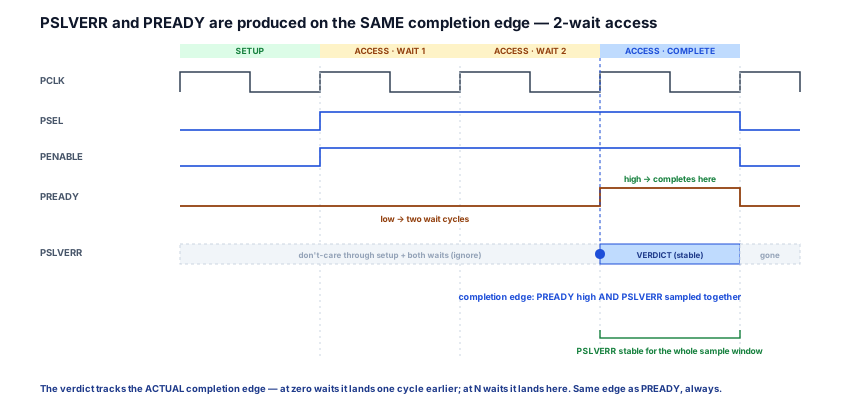
You already know what PSLVERR means — a pass/fail verdict, not an abort. This chapter is the rigorous when: the verdict is only correct if it is driven in exactly the right cycle. The single idea to carry: PSLVERR must be asserted coincident with PREADY high on the completion edge, produced on the same registered edge, stable across the entire sample window — don't-care before completion and gone after. A correct error value in the wrong cycle is a wrong error. Error-response correctness is a timing property pinned to the completion edge.
1. Problem statement
The problem is placing a one-bit verdict on exactly one clock edge — the edge where the transfer completes — with no margin for it to be early, late, or smeared.
Chapter 9.1 settled the semantics: PSLVERR is sampled at completion, the transfer happens regardless, recovery lives above the bus. That left the hard part untouched — the temporal contract. APB samples PSLVERR at precisely one instant per access: the PCLK rising edge where PSEL && PENABLE && PREADY are all high. There is no second look, no hold, no "was it high recently." So the slave's obligation is brutally specific:
- The verdict and the completion are the same event.
PSLVERRandPREADYmust rise on the same registered edge. If the verdict resolves one cycle beforePREADY(during a wait) it is sampled as0and the error is lost; if it resolves one cycle after, it is attributed to whatever access completes next. - The bit must be stable across the sample window. At the completion edge,
PSLVERRmust meet setup and hold aroundPCLKlike any sampled signal — no glitch, noX, no mid-window transition. A combinational error path that is still settling when the edge arrives can be sampled as a metastable or wrong value. - It tracks the actual completion edge, not a fixed cycle. Whether the access completes at zero waits or after N waits, the verdict lands wherever
PREADYlands. The slave cannot hard-code "assertPSLVERRin the access cycle" — it must assert it in the cycle it actually completes.
So the job is not "compute the error" — Chapter 9.1 did that. The job is "deliver that computed verdict on one specific edge, clean and stable, wherever that edge happens to be."
2. Why previous knowledge is insufficient
Chapter 9.1 — PSLVERR behaviour taught you the meaning of the bit: verdict not abort, sampled at completion, recovery above the bus. That is the semantic contract. Module 8 — PREADY timing taught the temporal discipline of the completion signal: register it, keep it glitch-free, respect the sample window. And Module 3 — the PREADY handshake gave you the completion edge itself. This chapter sits at the intersection — and the gaps are exactly where those three stop:
- 9.1 told you the bit is sampled at completion; it did not tell you how to produce it there. "Valid at the completion edge" is a consumer-side statement. The producer-side question — how does the slave guarantee the bit is correct on that exact edge across any wait count — is this chapter. Knowing where to read is not knowing how to drive.
PSLVERRinherits Module 8'sPREADYtiming discipline, but on a second signal that must match the first. Module 8 madePREADYa clean registered edge.PSLVERRmust be a clean registered edge and the same edge asPREADY. The new failure mode is not "glitchyPSLVERR" alone — it is misalignment between two signals that the protocol assumes were generated together. That cross-signal alignment requirement does not exist anywhere in Module 8.- The completion edge moves, and the verdict must move with it. Module 3 fixed the structure of the handshake; it did not stress that the completion edge floats by wait count. A verdict pinned to a fixed cycle silently desynchronises from completion the moment wait states change — a class of bug the handshake chapter never had to consider because it only tracked one signal.
So the model to add is the alignment model: PSLVERR is not just "a clean bit valid at completion" — it is "the bit that must be born on the same registered edge as PREADY, and ride that edge wherever it lands." (Tracing a reported error back to which access actually caused it is the 9.6 discipline that depends entirely on this alignment being correct.)
3. Mental model
The model: PSLVERR and PREADY are two halves of one stamp pressed at the same instant. PREADY is the half that says "delivered now"; PSLVERR is the half that says "pass or fail." The protocol presses both halves with a single press — the completion edge. If the two halves are not aligned under that press, you get a smudged stamp: the "fail" half lands on the wrong package, or in the gap between packages where no one reads it.
Three refinements make it precise:
- One press, one edge. The slave registers
PSLVERRandPREADYoff the sameposedge PCLK. They are computed from the same condition (access completing this cycle) and latched together. There is no legitimate implementation wherePREADYis registered andPSLVERRis combinational off a still-settling decode — that is two presses at two times, and the protocol only reads one. - The press lands wherever completion lands. On a zero-wait access the stamp presses one cycle into the access phase; on a two-wait access it presses three cycles in. The verdict follows
PREADY. The slave must never assertPSLVERR"in the access phase" generically — only in the specific cycle it drivesPREADYhigh. - Stable for the whole window, blank outside it. Across the sample window around the completion edge,
PSLVERRmust hold its value with proper setup and hold — no glitch, noX, no mid-window edge. Before completion it is don't-care (drive0); after completion it is gone (back to0). The only legible reading is the value coincident withPREADYhigh, held still.
4. Real SoC implementation
In silicon the alignment is enforced structurally: PSLVERR and PREADY are written in the same always_ff branch, from the same completion condition, so by construction they cannot drift apart. The error term itself may be computed combinationally upstream, but it is captured on the completion edge alongside PREADY — never sampled directly by the manager while still settling. Here is the registered pair across an N-wait access, with the verdict tracking the actual completion edge:
// APB subordinate: PREADY and PSLVERR produced on the SAME registered edge.
// The access takes a variable number of wait states (wcnt counts them down).
// err_cond is the slave's "I cannot honour THIS access" term (unmapped addr,
// PPROT mismatch, internal fault). It is computed combinationally but must be
// CAPTURED on the completion edge alongside PREADY — never sampled mid-flight.

logic [1:0] wcnt;          // remaining wait states for the current access
wire access_phase = psel && penable;
wire completing   = access_phase && (wcnt == 2'd0);   // THIS is the completion edge

always_ff @(posedge pclk or negedge presetn) begin
  if (!presetn) begin
    wcnt    <= 2'd0;
    pready  <= 1'b0;
    pslverr <= 1'b0;
  end else if (psel && !penable) begin
    // SETUP phase: load this access's wait count, hold outputs deasserted
    wcnt    <= wait_states_for(paddr);   // 0 for fast regs, N for slow ones
    pready  <= 1'b0;
    pslverr <= 1'b0;                      // don't-care to the manager, but drive 0
  end else if (completing) begin
    // COMPLETION EDGE: assert PREADY and stamp the verdict TOGETHER.
    // Because both are written here, from the same `completing`, they are
    // aligned by construction — the verdict rides the ACTUAL completion edge,
    // whether wcnt started at 0 (zero-wait) or counted down from N (N-wait).
    pready  <= 1'b1;
    pslverr <= err_cond;                 // SAME edge as PREADY — never one off
  end else if (access_phase) begin
    // ACCESS · WAIT: still counting down. PREADY low, verdict not yet valid.
    wcnt    <= wcnt - 2'd1;
    pready  <= 1'b0;
    pslverr <= 1'b0;                     // don't leak a stale/early verdict
  end else begin
    // IDLE / UNSELECTED. Two things matter here and both are easy to miss.
    //
    // 1. Do NOT decrement wcnt - there is no access in flight, and a 2-bit
    //    counter decremented from 0 wraps to 3.
    // 2. Drive PREADY HIGH, not low. An unselected subordinate holding PREADY
    //    low hangs any bridge that ANDs its subordinates' PREADY outputs -
    //    a legal and common bridge implementation. AMBA leaves the combining
    //    to the bridge, so driving high when unselected is the portable habit.
    wcnt    <= wcnt;
    pready  <= 1'b1;
    pslverr <= 1'b0;
  end
end
// Contract: pslverr is meaningful ONLY in the cycle pready is high, and it is
// born on that same edge. There is no path where the verdict resolves a cycle
// early (lost in a wait) or a cycle late (blamed on the next access).
//
// LATENCY NOTE: because both outputs are registered, `completing` asserting in
// one cycle makes PREADY high in the NEXT. So wait_states_for() returning 0
// still costs one ACCESS wait cycle - the minimum latency of any registered
// PREADY, discussed under the tradeoffs below. Name the function for what it
// controls (additional waits) rather than for the total, or the datasheet
// number and the silicon will disagree by one.
Two facts drive the real design. First, the two signals share one register stage and one condition, so they cannot be one cycle apart — the most expensive error-timing bug (misattribution to the next access) is eliminated by structure, not by review. Second, the wait count makes the completion edge a runtime value, so the verdict must be gated on completing (the actual edge) rather than a fixed access-phase cycle; a slave that asserted PSLVERR whenever err_cond is true and access_phase is high would assert it through the waits — exactly the early-pulse bug Chapter 9.1's debug case showed. The combinational err_cond is fine as an input because it is captured by a flop on the completion edge; the manager never sees it un-registered.
4b. The error timing on one waveform
Errored access with wait states, then a clean access
8 cycles4c. Checking it
module apb_error_sva #(parameter int MAX_WAIT_POLICY = 32) (
  input logic pclk, presetn,
  input logic psel, penable, pwrite, pready, pslverr,
  input logic [31:0] paddr, pwdata, prdata
);
  wire completing = psel && penable && pready;

  // --- PSLVERR validity -------------------------------------------------
  // The verdict exists only on the completing cycle. Asserting it during a
  // wait is the "early pulse" bug; asserting it in SETUP is worse, because
  // the manager may sample a level that belongs to no transfer at all.
  a_pslverr_only_on_completion: assert property (@(posedge pclk) disable iff (!presetn)
    pslverr |-> completing)
    else $error("PSLVERR asserted outside the completing ACCESS cycle");

  // It must be a known value when it IS sampled - an X here propagates
  // straight into the manager's fault decision.
  a_pslverr_known: assert property (@(posedge pclk) disable iff (!presetn)
    completing |-> !$isunknown(pslverr));

  // --- The alignment guarantee ------------------------------------------
  // PSLVERR must not rise before PREADY and then fall again before the
  // transfer completes - the verdict would be lost in the wait.
  a_no_early_verdict: assert property (@(posedge pclk) disable iff (!presetn)
    (psel && penable && !pready) |-> !pslverr)
    else $error("PSLVERR asserted while the access was still waiting");

  // --- Request stability across the stall, including for errored access --
  a_request_stable: assert property (@(posedge pclk) disable iff (!presetn)
    (psel && !completing) |=>
      $stable(paddr) && $stable(pwrite) && $stable(pwdata));

  // --- An errored read returns no meaningful data. This asserts the house
  //     rule that it is driven to a defined value rather than left stale,
  //     which keeps a failure reproducible. AMBA does not require a
  //     particular value, so treat this as project policy.
  a_errored_read_data_defined: assert property (@(posedge pclk) disable iff (!presetn)
    (completing && pslverr && !pwrite) |-> !$isunknown(prdata));

  // --- Recovery: the transfer after an error must be able to complete.
  a_recovers: assert property (@(posedge pclk) disable iff (!presetn)
    (completing && pslverr) |=> !penable);

  // --- ENGINEERING POLICY, not protocol. AMBA sets no maximum wait count.
  a_completes_within_policy: assert property (@(posedge pclk) disable iff (!presetn)
    (psel && penable && !pready) |-> ##[1:MAX_WAIT_POLICY] pready);

  // --- Coverage. Every property above is vacuous on a run with no errors.
  c_err_zero_wait: cover property (@(posedge pclk)
                     (psel && !penable) ##1 (penable && pready && pslverr));
  c_err_waited:    cover property (@(posedge pclk)
                     (psel && penable && !pready) ##[1:$] (pready && pslverr));
  c_err_then_ok:   cover property (@(posedge pclk)
                     (completing && pslverr) ##[1:$] (completing && !pslverr));
endmodule
c_err_waited is the cover that matters most. A suite that only errors on
zero-wait accesses never exercises the alignment the whole page is about, and
every alignment property above passes vacuously.
A bus fault was reported for the wrong peripheral
PSLVERR-EARLY-PULSEA driver reported bus faults on a timer peripheral that had no fault condition and, on inspection, was working correctly. The faults were intermittent — perhaps one access in thirty — and correlated with system load rather than with anything the timer was doing.
The faulting accesses were always timer reads that immediately followed an access to a different peripheral: the ADC, which is behind a slow analog block and inserts several wait states. Accesses to the timer in isolation never faulted.
// PSLVERR driven from the error condition whenever the access phase is active.
assign pslverr = access_phase && err_cond;    // ✗ true throughout the WAITS
assign pready = access_phase && (wcnt == 0);A waveform across the peripheral boundary made it visible:
  cycle          1      2      3      4      5      6
  target       ADC    ADC    ADC    ADC    --    TIMER
  PSEL_adc       1      1      1      1      0      0
  PENABLE        0      1      1      1      0      1
  PSLVERR        0      1      1      1      0      0     <- high during WAITS
  PREADY         0      0      0      1      1      1
                                     ^completing
The ADC asserted PSLVERR from the first ACCESS cycle and held it through its
wait states. On the ADC's own completing cycle the verdict was correct, so the
ADC's accesses behaved properly — and the manager, in this SoC, sampled PSLVERR
on every ACCESS cycle rather than only on the completing one.
That is a manager bug in itself, but the subordinate handed it the opportunity. The stray high on cycles 2 and 3 was attributed by the manager's fault logic to whatever transfer it was tracking, and under back-to-back traffic that was sometimes the following timer access.
PSLVERR is defined as valid only on the cycle where PSEL, PENABLE and
PREADY are all high. The subordinate drove it from access_phase && err_cond,
which is true from the first ACCESS cycle onwards — so the verdict was published
before the transfer had completed and held through every wait state.
Two properties make this expensive rather than merely untidy. The error is attributed to the wrong peripheral, because the stray assertion overlaps the window in which a manager may be tracking a different transfer — so the debugging starts at an innocent device. And it is load-dependent, appearing only when a slow access is followed closely by another, which makes it look like a concurrency or arbitration problem rather than a signal-validity one.
The subordinate is not compliant here even though a strict manager would be
immune. AMBA specifies when PSLVERR is valid, and the widely-followed
practice is to drive it low outside that window precisely so that a manager
sampling more eagerly cannot be misled.
Register the verdict onto the completion edge, so it cannot exist before the transfer does:
wire completing = access_phase && (wcnt == 2'd0);

always_ff @(posedge pclk or negedge presetn)
  if (!presetn) begin
    pready <= 1'b0; pslverr <= 1'b0;
  end else if (completing) begin
    pready  <= 1'b1;
    pslverr <= err_cond;        // born on the SAME edge as PREADY
  end else begin
    pready  <= 1'b0;
    pslverr <= 1'b0;            // no verdict outside the completing cycle
  end
Writing both from one condition in one register stage makes the alignment structural: there is no path in which the verdict resolves a cycle early or a cycle late, so the failure is unreachable rather than merely absent.
The test that fails on the old RTL and passes on the new one is a waited
errored access with the assertion pslverr |-> psel && penable && pready. The
original suite had none, because every error it injected was zero-wait — and on a
zero-wait access the buggy and correct forms are indistinguishable.
Two habits generalise.
Any signal that is "valid only on cycle X" should be driven only on cycle X. Relying on the consumer to sample at the right moment is relying on someone else's correctness for your own compliance, and it converts your bug into their bug report.
Cover the waited case separately from the zero-wait case. Alignment properties are vacuous when there is nothing to be misaligned with, so a suite that only errors on fast accesses proves nothing about the mechanism it was written to check.
See PREADY timing for the sampling-window rules this rests on and PREADY common design bugs for the related wait-count failures.
5. Engineering tradeoffs
Error-response timing is a choice about where the alignment guarantee comes from — and each choice trades structural safety against timing slack.
| Error-path implementation | Alignment guarantee | Timing risk | When to choose it |
|---|---|---|---|
PSLVERR registered with PREADY (same branch, same condition) | Guaranteed by construction — both born on one edge | None beyond the shared flop | Almost always — the safe default for any failable slave |
PSLVERR combinational off err_cond, PREADY registered | None — verdict can settle in a wait or after completion | High: early-pulse loss, off-by-one misattribution, glitch in window | Never on APB; the two signals desynchronise |
PSLVERR registered, but off a different condition than PREADY | Fragile — relies on two conditions staying identical forever | Medium: drifts the day wait-state logic changes | Avoid; collapse to one shared completing term |
err_cond combinational, captured by the completion flop | Guaranteed — only the captured value reaches the bus | Low: err_cond must settle before setup, but never sampled raw | Good — keeps decode flexible while pinning the sampled bit |
Glitchy decode driving PSLVERR directly (no capture flop) | None — a glitch can land in the sample window | High on fast clocks: spurious or metastable verdict | Never — the verdict bit must be a clean flop output |
The throughline: on APB the error-response timing problem is not "compute the right verdict" — it is "guarantee the right verdict reaches exactly the completion edge, stable." The only robust way to guarantee that is to make PSLVERR and PREADY two outputs of one registered decision. Every other row buys nothing and reintroduces the off-by-one and glitch hazards.
6. Common RTL mistakes
7. Debugging scenario
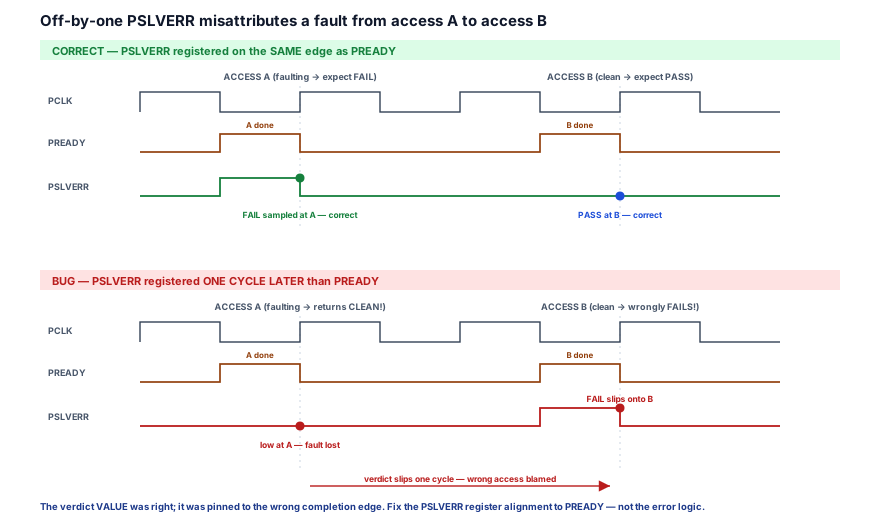
A faulting peripheral does report an error — but the bus-fault names the wrong access. Bring-up software hits a known-bad register (access A), and the fault handler fires while pointing at the next, perfectly valid access (B). The fault is real; the attribution is off by one.
-
Observed symptom: every time the firmware touches the faulting register A and then immediately touches a good register B, the bus-fault / error-status logs blame B, not A. Access A itself returns clean. Re-ordering so a clean access follows A makes the new follower take the blame — the error always slides to whatever completes next.
-
Waveform clue: at access A's completion edge (
PSEL && PENABLE && PREADYhigh),PSLVERRis low. OnePCLKlater — at access B's completion edge —PSLVERRis high, even though B is a valid access.PREADYis correctly aligned to each access; onlyPSLVERRis shifted one cycle to the right ofPREADY. -
Root cause:
PSLVERRwas registered through an extra flop (or off acompletingterm that was itself a cycle delayed), so the verdict for A is latched one edge after A'sPREADY. The slave computed the right verdict for the right access — but pinned it to the wrong completion edge, so it lands on B. The error value is correct; the error timing is off by one. -
Correct RTL: register
PSLVERRin the same branch and off the samecompletingcondition asPREADY, with no extra pipeline stage:else if (completing) begin pready <= 1'b1; pslverr <= err_cond; end. Now the verdict is born on A's completion edge by construction and can never slide onto B. -
Verification assertion: assert that whenever
PSLVERRis high it is on a completion edge (so it cannot float into the next access), and that the verdict is stable and known at that edge:Azvya Education Pvt. Ltd.VLSI MentorSnippet// PSLVERR may be high ONLY on a completion edge — never a cycle off. ap_pslverr_on_completion: assert property (@(posedge pclk) disable iff (!presetn) pslverr |-> (psel && penable && pready)); // At every completion edge the verdict must be a known, stable value. ap_pslverr_known_at_done: assert property (@(posedge pclk) disable iff (!presetn) (psel && penable && pready) |-> !$isunknown(pslverr)); -
Debug habit: when an error is reported on the wrong access, do not audit the error-decode logic — its value is right. Overlay
PSLVERRonPREADYand check they rise on the same edge. IfPSLVERRis even one cycle offPREADY, it is an alignment bug (an extra flop, a delayedcompleting), and the fix is in the register stage, never in the decode.
8. Verification perspective
PSLVERR timing is a cross-signal alignment property, so verification must pin both signals together and across every wait count — a checker that only watches PSLVERR in isolation, or only on zero-wait accesses, misses the entire bug class.
- Assert alignment to the actual completion edge. The core property is
pslverr |-> (psel && penable && pready)—PSLVERRmay be high only on a completion edge. This single assertion catches the off-by-one (verdict on the next access), the early pulse (verdict in a wait), and the stuck-high (verdict bleeding past completion). Pair it with(psel && penable && pready) |-> !$isunknown(pslverr)so the verdict is neverXat the sampled edge. These two are the non-negotiable error-timing checks. - Cover the verdict across zero-wait and N-wait completions. Because the completion edge floats, functional coverage must cross
PSLVERR=1with wait-count buckets: error on a zero-wait access, error on a 1-wait, error on an N-wait. A suite that only ever errors at zero waits never exercises the moving completion edge — exactly where the "verdict pinned to a fixed cycle" bug hides. Also cover error-then-clean back-to-back (the misattribution corner) so a shifted verdict is caught landing on the follower. - Take it to gate level for glitches. RTL hides combinational glitches; a
PSLVERRdriven off a settling decode can glitch in the sample window only on a real clock. Run the alignment and never-Xassertions at gate level / with SDF so a glitch or a setup/hold violation on the verdict bit around the completion edge is caught. On fast clocks this is where a "passing in RTL" error path fails in silicon.
The point: error-response correctness is verified as a timing property, not a value property. Assert PSLVERR is high only on a real completion edge and never X there, cover the verdict across zero/N waits and the error-then-clean corner, and confirm at gate level that the verdict bit is glitch-free in the sample window. (Methodology for tracing a reported error to its true source builds directly on these alignment guarantees holding.)
9. Interview discussion
"When exactly must PSLVERR be asserted, and what breaks if it's a cycle off?" separates someone who memorised "sampled at completion" from someone who has debugged it. The weak answer stops at "at the completion edge." The strong answer makes it a cross-signal alignment statement and names the failure modes.
Frame it as one edge, two signals, born together: PSLVERR must be asserted coincident with PREADY high on the completion edge (PSEL && PENABLE && PREADY), produced on the same registered edge from the same completion condition, and stable across the sample window — don't-care/0 before completion, gone after. Then deliver the depth: the completion edge floats with wait count, so the verdict tracks the actual edge — at zero waits one cycle in, at N waits N+1 cycles in — and a slave that pins PSLVERR to a fixed access cycle desynchronises the moment waits change; the signature bug is an off-by-one, where PSLVERR is a flop late relative to PREADY, so a fault on access A slips onto the clean access B that completes next — the value is right, the cycle is wrong, and you find it by overlaying PSLVERR on PREADY and checking they rise on the same edge; and the glitch hazard — a combinational PSLVERR off a settling decode can be sampled mid-glitch on a fast clock, so the verdict must be a clean flop output, not raw combinational logic. Closing with "this is the PREADY-timing discipline of Module 8 applied to the verdict bit, except now two signals must match at the edge, not just one be clean" shows you see the structure: error correctness is a timing property pinned to the completion edge, and getting the value right is worthless if it lands in the wrong cycle.
10. Practice
- Pin the edge across waits. For a zero-wait and a two-wait access of the same faulting slave, mark the exact cycle
PSLVERRmust go high in each, and state why it is a different cycle but the same relationship toPREADY. - Spot the off-by-one. Given a waveform where
PSLVERRrises onePCLKafterPREADYacross two back-to-back accesses, identify which access the error is attributed to versus which one caused it, and the one-line RTL fix. - Write the aligned pair. From memory, write the
always_ffbranch that assertsPREADYandPSLVERRtogether on the completion edge of an N-wait access, and explain why putting them in the same branch makes misalignment structurally impossible. - Combinational vs captured. Explain why a combinational
err_condfeeding a capture flop is safe, but a combinationalPSLVERRdriven straight to the bus is not — in terms of the sample window on a fast clock. - Assert the window. Write the two SVA properties that catch (a)
PSLVERRhigh off a completion edge and (b)PSLVERRunknown at the completion edge, and say which bug each one catches.
11. Q&A
11b. Where This Is Specified
- Arm AMBA APB Protocol Specification (ARM IHI 0024). The IDLE → SETUP → ACCESS model;
PSELasserted withPENABLElow for exactly one SETUP cycle; the transfer completing only whenPSEL && PENABLE && PREADY;PSLVERRbeing valid only on that completing cycle; the requirement that address, direction and write data are stable for the whole transfer; and the absence of any maximum wait-state count. - Arm AMBA APB —
PSLVERR. Defined as an optional signal; where a subordinate does not implement it the manager sees it tied low. AMBA does not specify whatPRDATAcarries on an errored read, nor mandate drivingPSLVERRlow outside its valid window — both are widely-followed practice rather than requirements. - IEEE 1800-2023 §16 — Assertions. Concurrent properties,
$stable,$isunknown,cover property, and the##[m:n]bounded range that makes the policy completion bound falsifiable in simulation.
12. Key takeaways
- The verdict and the completion are one event.
PSLVERRmust be asserted coincident withPREADYhigh on the completion edge — produced on the same registered edge, from the same completion condition. Two outputs of one decision, not two racing paths. - A right value in the wrong cycle is a wrong error. If
PSLVERRresolves a cycle early it is lost in a wait; a cycle late it is misattributed to the next access. The cycle is part of the verdict. - The completion edge floats — the verdict tracks it. At zero waits it lands one cycle in; at N waits, N+1 cycles in. Gate
PSLVERRon the actualcompletingcondition, never a fixed access cycle, or it desynchronises when wait states change. - The signature bug is an off-by-one —
PSLVERRa flop late relative toPREADY, so a fault on access A lands on the clean access B. Find it by overlayingPSLVERRonPREADY; the fix is in the register stage, not the decode. - Drive a clean, stable flop output across the sample window —
err_condmay be combinational as an input if captured by the completion flop, but the bus must never see raw combinationalPSLVERR, or a decode glitch can be sampled in the window on a fast clock. Don't-care/0before completion, gone after. - Verify it as a timing property: assert
PSLVERRhigh only on a real completion edge and neverXthere, cover the verdict across zero/N waits and the error-then-clean corner, and confirm at gate level that the verdict bit is glitch-free in the sample window.
Standards & specifications
- Governing standard
- Arm AMBA APB Protocol Specification (IHI 0024)(opens Arm in a new tab)
Defines the APB setup/access phases and the PREADY and PSLVERR signalling. Peripheral register layout and verification approach are outside its scope.
This page also covers RTL structure, verification approach and debugging technique. Those are engineering practice built on the standard, not requirements the standard itself imposes.
Where this fits
Part of the AMBA APB curriculum.