AMBA APB · Module 2
The Access Phase
The ACCESS phase — PENABLE high, the subordinate completing with PREADY high or stretching with PREADY low, and the rule that read data is valid and a write is accepted only at completion.
The SETUP phase presented the access; the ACCESS phase is where the access is actually performed and finished. It is the phase that carries the one moment every APB transfer is built around — the cycle on which a write is accepted and read data becomes valid. The trap to avoid: ACCESS is not a single cycle you can count on. It is elastic — it lasts as long as the subordinate needs, and exactly one of its cycles is the completion. The single idea to carry: a transfer is complete only when the lifecycle says so, and in ACCESS that "say-so" is PREADY going high — never a cycle sooner.
1. What problem is being solved?
The problem is performing the access and agreeing, unambiguously, on the one cycle it finishes — even when the subordinate cannot answer immediately.
SETUP did the preparation: the target is selected, the address and control are presented, and the subordinate has had a cycle to decode. But preparation is not the access. Something still has to commit — capture the write data into a register, or drive the requested read data back — and both the manager and the subordinate must agree on exactly when that happens. The complication is that subordinates differ in speed: a fast register answers at once, while a slow register or a clock-crossing bridge needs a few cycles. ACCESS solves both problems at once. It is the phase where the access is performed, marked by PENABLE high, and it is held — by PREADY — until the subordinate is ready, so that completion lands on one well-defined cycle whether the access takes one cycle or ten.
2. Why the previous mental model is not enough
The transfer overview treated ACCESS as a single step — present, then access, done. That is a useful first sketch, but it hides the property that causes most APB bugs: ACCESS is elastic, and exactly one of its cycles commits the data.
If you carry "ACCESS is the second cycle and that is where it finishes," you will read waveforms wrong the moment a subordinate inserts a wait. ACCESS is not "the cycle after SETUP"; it is a phase the transfer sits in — PENABLE high the whole time — that lasts until PREADY is high. Two things the single-step picture cannot express, but ACCESS must:
- ACCESS can last many cycles. While the subordinate holds
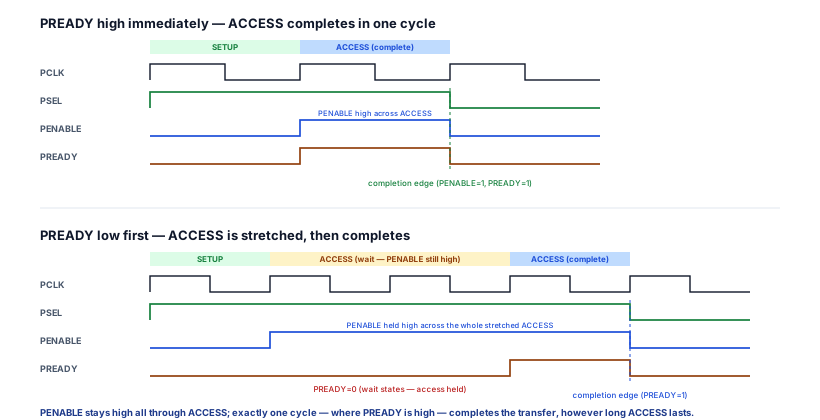
PREADYlow, the access is held — a wait state.PENABLEstays high, the address and data stay stable, and nothing commits. The phase stretches; the lifecycle's shape does not. - Exactly one cycle is completion. Of all the cycles ACCESS spans, only the one where
PREADYis high commits the data. Mis-reading which cycle commits — sampling read data a cycle early, or assuming the write landed beforePREADY— is the classic APB bug. The whole point of this phase is to make that cycle unmistakable.
3. APB transfer mental model
The model: ACCESS is the handshake at the counter — you have handed over the form, and the transaction only counts when the clerk stamps it.
You have already filled in the form and slid it across (that was SETUP). Now you are standing at the counter with PENABLE high, waiting for the stamp. The clerk (the subordinate) controls the stamp: if they are ready, they stamp immediately and you are done in one cycle; if they are busy, they make you wait — you keep the form on the counter, nothing changes hands, and you wait until the stamp comes down. That stamp is PREADY high, and it is the only moment the transaction is real.
Three refinements make the model precise — and notice none of them is a deep dive into a signal; each is a lifecycle role:
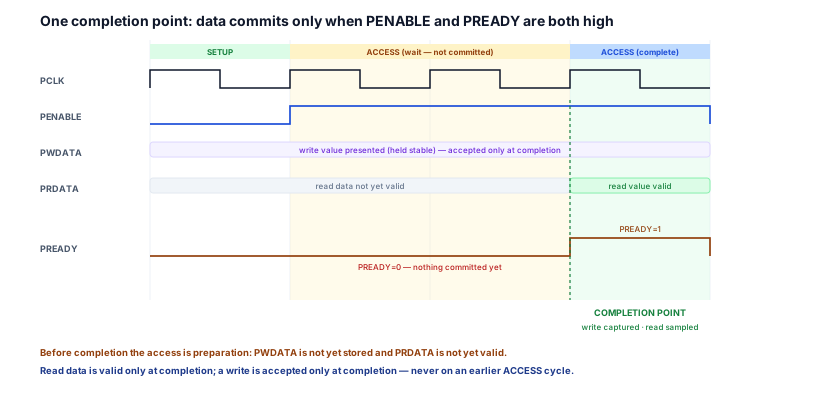
PENABLEmarks the phase, not the finish.PENABLEhigh means "we are in ACCESS, performing the access" — it is true for every cycle of the phase, including the wait cycles. It does not mean "done."PREADYis the completion-and-backpressure control. The subordinate drivesPREADY: high to complete, low to hold. It is the subordinate's one lever over timing — its way of saying "not yet" (backpressure) or "now" (completion).- The data commits on the stamp, and only then. A write is captured and read data is valid on the single cycle where
PENABLEandPREADYare both high. Before that, the form is on the counter but the transaction has not happened.
4. Real SoC / hardware context
In hardware, ACCESS is the phase where the subordinate finally does something. On the manager side it is one state of the lifecycle FSM — PENABLE asserted, the manager sampling PREADY each cycle. On the subordinate side it is where the real work happens: a write enable is generated, a register is clocked, or a read mux drives PRDATA back. The subordinate decides how long it takes by holding or releasing PREADY.
Why does APB need this elasticity at all? Because a single APB bus hosts subordinates of wildly different speeds. A plain configuration register answers in its first ACCESS cycle. A register that lives in a slower clock domain, or behind a bridge to another bus, may need several cycles before its value is settled and safe to commit — so it holds PREADY low until it is, inserting wait states. The control plane does not care about the extra cycles (the traffic is rare and latency-insensitive, per why APB exists), so trading a few cycles for the freedom to host any-speed subordinate is exactly the right deal.
The whole of ACCESS reduces, in RTL terms, to one completion condition that everything keys off:
// APB ACCESS-phase completion condition (teaching sketch — not a full slave).
// True on exactly ONE cycle per transfer: the access is being performed
// (psel & penable, i.e. we are in ACCESS) AND the subordinate is ready.
wire access_done = psel & penable & pready;

// Commit ONLY when access_done is high:
//   - a write is captured here (sample PWDATA into the register)
//   - read data is sampled here (PRDATA is valid this cycle)
// While pready is low, access_done is low: the access is HELD (a wait state),
// PENABLE stays high, address/control/PWDATA are held stable, and NOTHING
// commits. The transfer is not done until access_done pulses high.
That one wire is the lifecycle marker made concrete. It is low for every SETUP cycle (PENABLE low) and for every wait cycle (PREADY low), and high for the single completion cycle. Anchor every commit in the design — the register write, the read sample, the manager's move to the next transfer — to that pulse, and the elasticity of ACCESS takes care of itself.
5. Engineering tradeoff table
ACCESS being a held, ready-gated phase is a deliberate choice. It costs predictability and buys universality — exactly the trade the control plane wants.
| ACCESS design choice | What it gives up | What it buys | Why it is correct for APB |
|---|---|---|---|
Held until PREADY (elastic length) | Fixed, known timing | Subordinates of any speed on one bus | Slow registers and clock-crossing bridges must be able to stall |
PENABLE marks the phase, PREADY the finish | A single "done" signal | A clear split: phase vs completion | Lets the manager know it is in ACCESS yet still wait for the answer |
| Single completion cycle | Nothing real | One unambiguous commit edge | Removes all sample-timing guesswork in RTL and verification |
| Hold everything stable while waiting | Freedom to change mid-access | A safe, repeatable access for slow subordinates | Changing address or data mid-ACCESS would corrupt the transfer |
Subordinate owns the timing (via PREADY) | Manager-side control of duration | Trivial, uniform manager logic | The subordinate is the only block that knows when it is ready |
The throughline: ACCESS spends certainty about duration to buy certainty about completion. You do not know how many cycles ACCESS will take, but you know — exactly — the one cycle on which it finishes. For a control plane, that second certainty is the one that matters.
6. Common RTL / architecture / waveform mistakes
7. Interview framing
ACCESS is where an interviewer checks whether you actually know when an APB transfer commits. The give-away weak answer is "the access happens in the second cycle." The strong answer treats ACCESS as an elastic phase with one completion point.
Say it in three moves: ACCESS is marked by PENABLE high and is held until PREADY is high; the subordinate uses PREADY to complete (high) or insert wait states (low) — that is backpressure; and the data commits on exactly one cycle — PENABLE and PREADY both high — where a write is captured and read data is valid. Then volunteer the depth point that separates levels: while PREADY is low the manager holds everything stable and simply waits, so ACCESS changes length but never shape. What the interviewer is really probing is whether you locate the completion cycle correctly and understand that PENABLE marks the phase while PREADY marks the finish — the exact distinction that lets you debug a stretched APB waveform.
8. Q&A
9. Practice
- Mark the completion. Given a waveform where ACCESS spans three cycles, identify which cycle is the completion and explain how you found it (
PENABLEandPREADYboth high). - Write the condition. From memory, write the one-line completion condition for ACCESS and state what must be gated on it (write capture, read sample).
- Trace a wait state. For a read whose subordinate inserts two wait states, describe what is true on each ACCESS cycle — the value of
PENABLE, ofPREADY, and whetherPRDATAis valid yet. - Spot the bug. A subordinate captures
PWDATAon the first cyclePENABLEis high, regardless ofPREADY. Explain, using the completion point, what goes wrong when that subordinate also inserts a wait state. - Defend the elasticity. In two sentences, justify why ACCESS being held by
PREADYis the right design for a bus that hosts both a fast register and a clock-crossing bridge on the same wires.
10. Key takeaways
- ACCESS is the phase where the access is performed and completed, marked by
PENABLEhigh — true on every cycle of the phase, including wait states. PREADYis the completion-and-backpressure control: the subordinate drives it high to complete or holds it low to insert wait states, stretching ACCESS without changing the lifecycle's shape.- ACCESS is elastic — one or more cycles — but exactly one of them is the completion: the cycle where
PENABLEandPREADYare both high. - Data commits only at completion. A write is accepted, and read data (
PRDATA) is valid, only on that single cycle — never on an earlier ACCESS cycle. - A transfer is complete only when the lifecycle says so, never when the address merely appears or when
PENABLEfirst goes high. Gate every commit onpsel & penable & pready. - The trade is duration for certainty: you cannot predict how long ACCESS lasts, but you know exactly the one cycle it finishes — and that certainty is what the control plane is built on.